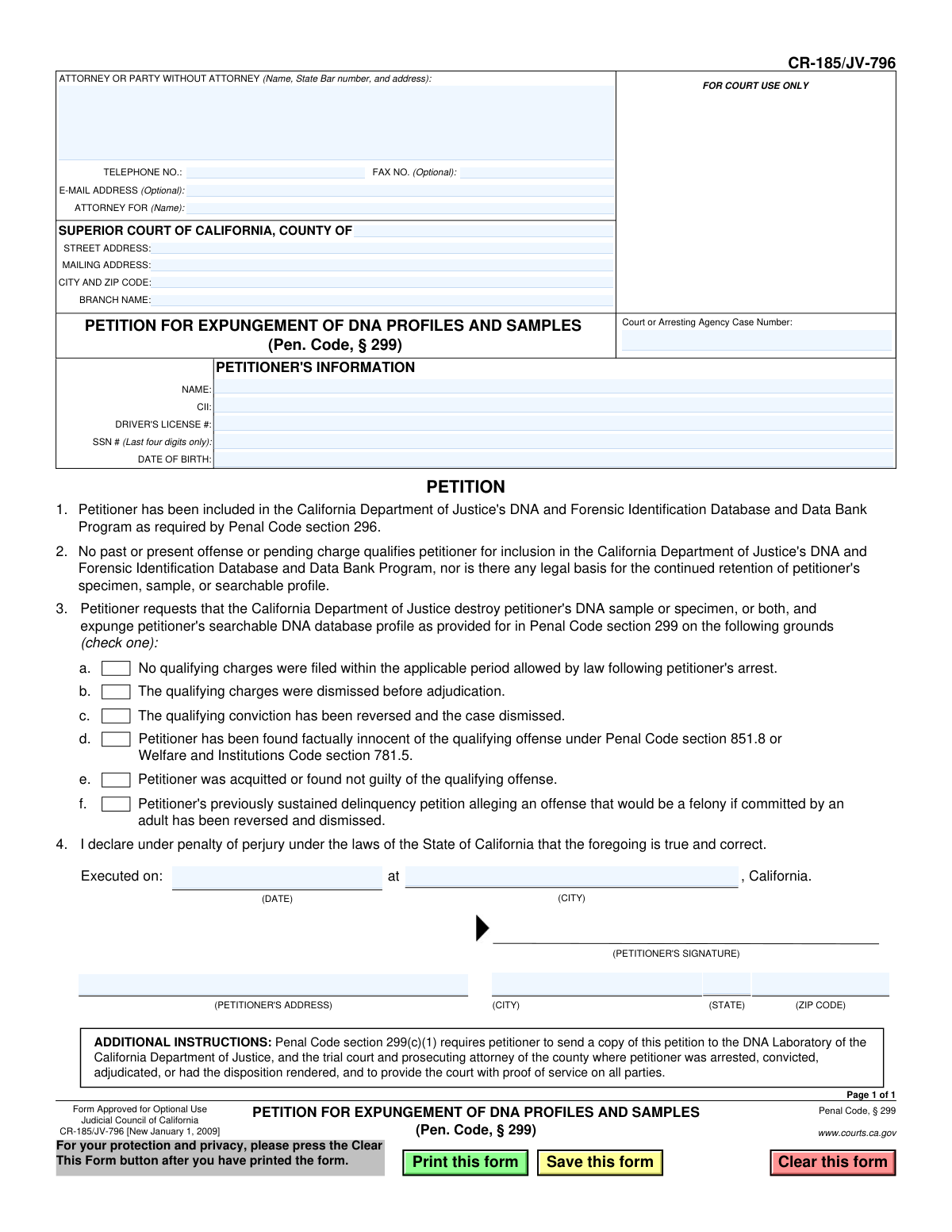
Yes! You can use AI to fill out Form CR-185/JV-796, Petition for Expungement of DNA Profiles and Samples (Pen. Code, § 299)

Form CR-185/JV-796 is a legal document for individuals in California seeking to have their DNA records removed from the Department of Justice's DNA Data Bank Program under Penal Code section 299. This is typically done when a case is dismissed, a conviction is reversed, or the person is found factually innocent. Today, this form can be filled out quickly and accurately using AI-powered services like Instafill.ai, which can also convert non-fillable PDF versions into interactive fillable forms.
CR-185/JV-796 is part of the California court forms category on Instafill.
Our AI automatically handles information lookup, data retrieval, formatting, and form filling.
It takes less than a minute to fill out CR-185/JV-796 using our AI form filling.
Securely upload your data. Information is encrypted in transit and deleted immediately after the form is filled out.

Form specifications

Form name: Form CR-185/JV-796, Petition for Expungement of DNA Profiles and Samples (Pen. Code, § 299)
Number of fields: 32
Number of pages: 1
Language: English
main-image

Instafill Demo: How to fill out PDF forms in seconds with AI

How to Fill Out CR-185/JV-796 Online for Free in 2026

Are you looking to fill out a CR-185/JV-796 form online quickly and accurately? Instafill.ai offers the #1 AI-powered PDF filling software of 2026, allowing you to complete your CR-185/JV-796 form in just 37 seconds or less.
Follow these steps to fill out your CR-185/JV-796 form online using Instafill.ai:
  1. 1 Navigate to Instafill.ai and upload the CR-185/JV-796 form or select it from the template library.
  2. 2 Provide your personal information, including your name, date of birth, contact details, and any identifying numbers like CII or Driver's License.
  3. 3 Enter the Superior Court information for the correct county, along with the specific case number related to your request.
  4. 4 Review the list of grounds for expungement and check the box that applies to your situation, such as acquittal or case dismissal.
  5. 5 Carefully review all the information populated by the AI to ensure accuracy and completeness.
  6. 6 Electronically sign and date the petition in the designated fields to declare the information is true and correct under penalty of perjury.
  7. 7 Download the completed form and follow the instructions to serve copies to the required parties, such as the California Department of Justice and the prosecuting attorney.

Our AI-powered system ensures each field is filled out correctly, reducing errors and saving you time.

Why Choose Instafill.ai for Your Fillable CR-185/JV-796 Form?

Speed

Complete your CR-185/JV-796 in as little as 37 seconds.

Up-to-Date

Always use the latest 2026 CR-185/JV-796 form version.

Cost-effective

No need to hire expensive lawyers.

Accuracy

Our AI performs 10 compliance checks to ensure your form is error-free.

Security

Your personal information is protected with bank-level encryption.

Frequently Asked Questions About Form CR-185/JV-796

This form is used to formally request a California court to order the destruction of your DNA sample and the removal of your DNA profile from the state's forensic database.

You are eligible to file if your DNA was collected for an offense, but you were ultimately found not guilty, the charges were dismissed, your conviction was reversed, or you were found factually innocent.

You will need your personal details like your name and date of birth, the case number from the court or arresting agency, and information about the outcome of your case.

Review your case's final disposition and check the box that accurately describes why you qualify for expungement, such as an acquittal, dismissal of charges, or a reversed conviction. You should only check one box.

This number is typically found on official court documents, arrest records, or any legal paperwork related to your case. If you can't find it, contact the clerk of the court where your case was heard.

You must file the original, signed petition with the Superior Court in the county where your arrest or conviction occurred.

You must send a copy of the filed petition to the DNA Laboratory of the California Department of Justice and to the prosecuting attorney's office in the county of your case.

Proof of service is a separate legal form you must file with the court to confirm that you have legally delivered copies of your petition to the Department of Justice and the prosecuting attorney.

Processing times vary, but once the court approves your petition and issues an order, the California Department of Justice will proceed with destroying the sample and expunging the profile from the database.

The CII (Criminal Identification and Information) number is your unique identifier within the California justice system. Including it helps ensure your record is correctly identified, but you can still file the petition if you don't know it.

Yes, services like Instafill.ai use AI to help you accurately auto-fill form fields with your information, which can save time and reduce the chance of errors.

You can use a service like Instafill.ai to upload the CR-185/JV-796 PDF. Their platform allows you to type your information directly into the fields and download the completed form for filing.

If you have a non-fillable or 'flat' PDF, you can upload it to a platform like Instafill.ai. It can convert the document into an interactive, fillable form that you can easily complete on your computer.

Compliance CR-185/JV-796
Validation Checks by Instafill.ai

1
Exclusive Grounds for Petition Selection
This validation ensures that the petitioner has selected exactly one checkbox from the list of grounds in section 3 (options a-f). The form explicitly states 'check one', making this a mandatory single choice. If zero or more than one option is selected, the petition is ambiguous and cannot be processed, leading to rejection and requiring the petitioner to resubmit with a clear basis for their request.
2
SSN Last Four Digits Format
This check verifies that the 'SSN #' field contains exactly four numeric digits. This is crucial for correctly identifying the petitioner's records while adhering to privacy standards that limit SSN exposure. An invalid entry (e.g., containing letters, fewer or more than four digits) would prevent proper record matching and cause the form to be rejected for correction.
3
Date of Birth Validity
This validation confirms that the 'DATE OF BIRTH' is a real, valid calendar date and that it occurs in the past. It prevents impossible dates like '02/30/2000' or future dates. This is essential for verifying the petitioner's identity and age, and an invalid date would halt the verification process and require correction.
4
Case Number Presence
This check ensures that the 'Court or Arresting Agency Case Number' field is not empty. This number is the primary identifier for the legal case associated with the DNA sample and is absolutely critical for the court and Department of Justice to locate the correct records. A missing case number makes the petition impossible to process, resulting in an immediate rejection.
5
Petitioner Name Completeness
This validation ensures that the petitioner's full name is provided in the 'NAME' field under 'PETITIONER'S INFORMATION'. The name is a fundamental piece of identifying information required to locate the individual in the DNA database and court systems. A missing name would render the petition anonymous and unprocessable.
6
County Court Specification
This check verifies that the 'COUNTY OF' field is filled out, specifying the Superior Court county where the petition is being filed. This information is essential for routing the document to the correct court jurisdiction for review and processing. Failure to specify the county will result in the petition being rejected as it cannot be assigned to a court.
7
Execution Date Validity
This validation ensures the 'Executed on' date is a complete and valid calendar date that is not in the future. This date legally marks when the petitioner signed the declaration under penalty of perjury. An invalid or future date would invalidate the declaration, making the entire petition legally unsound and subject to rejection.
8
Signature Date Consistency
This check compares the 'Executed on' date with the 'DATE' field located next to the petitioner's signature. The two dates must be identical to ensure consistency and affirm that the declaration was signed on the date stated. A mismatch between these dates can create legal ambiguity about when the document was attested to, potentially leading to processing delays or rejection.
9
Petitioner's Address Completeness
This validation ensures that the petitioner's full address, including street, city, and ZIP code, is provided in the designated fields. This address is the primary means for the court and other agencies to send official correspondence, notices, and the final decision regarding the petition. An incomplete or missing address will prevent communication and may cause the petition to be dismissed.
10
Attorney or Party Information Presence
This check ensures that the field 'ATTORNEY OR PARTY WITHOUT ATTORNEY' is not left blank. This section identifies who is filing the petition—the petitioner themselves (in pro per) or their legal counsel—and provides their contact information. This is mandatory for the court to know who to contact regarding the case, and its absence would lead to rejection.
11
Telephone Number Format
This validation checks that the 'TELEPHONE NO.' field, if filled, contains a valid phone number format, typically 10 digits with optional formatting. A valid phone number is a key piece of contact information for the court to quickly communicate with the filer. An improperly formatted number could hinder communication, causing delays if urgent contact is needed.
12
Email Address Format Validation
This check verifies that if an 'E-MAIL ADDRESS' is provided, it conforms to a standard email format (e.g., '[email protected]'). Although optional, providing a valid email allows for efficient electronic communication and document delivery. An invalid format would cause communication failures and defeat the purpose of providing the address.
13
Declaration Location Presence
This validation ensures that the city where the petition was 'Executed on' is provided. Stating the location of the signing is a required component of a declaration made under penalty of perjury in California. Omitting the city name makes the declaration incomplete and legally deficient, which could be grounds for the court to reject the petition.

Common Mistakes in Completing CR-185/JV-796

Filing in the Wrong Court Jurisdiction

Petitioners often mistakenly list the court in the county where they currently reside instead of the county where the arrest or conviction originally occurred. This leads to the petition being rejected for improper venue, causing significant delays and requiring the petitioner to start the process over. To avoid this, carefully review your original case records to identify the correct Superior Court and branch name before filling out the form.

Omitting or Mismatching the Case Number

The 'Court or Arresting Agency Case Number' is a primary identifier for your legal records. People often forget this number, enter it with typos, or confuse it with a different case. An incorrect or missing case number will prevent the court from locating the relevant file, leading to an automatic rejection or dismissal of the petition. Always reference original court documents to confirm the exact number.

Incorrectly Filling the 'Attorney or Party Without Attorney' Section

Individuals representing themselves (pro se) often get confused by the attorney information block, leaving it blank or only partially complete. If you do not have a lawyer, you must enter your own full name, address, and phone number in the top section and write your name again or 'Self-Represented' on the 'ATTORNEY FOR (Name):' line. Incomplete information can cause processing delays or rejection.

Failing to Provide the CII Number

The CII (Criminal Identification and Information) number is a unique identifier used by the California Department of Justice. Many petitioners do not know this number and leave the field blank, which can delay the processing of their request as the DOJ must manually search for their record. This number can often be found on past court documents or by requesting your own criminal record from the DOJ.

Entering the Full SSN Instead of the Last Four Digits

The form explicitly asks for only the last four digits of the Social Security Number to verify identity while protecting privacy. A common error is entering the full nine-digit SSN, which creates a security risk and may cause the court clerk to reject or redact the form. Always double-check instructions for sensitive data fields to ensure compliance.

Selecting the Incorrect Legal Grounds for Expungement

Section 3 requires the petitioner to select the specific legal reason for the expungement, such as acquittal, dismissal, or a finding of factual innocence. Petitioners often misunderstand the legal nuances of their case's disposition and check the wrong box. This is a fatal error, as selecting a basis that doesn't match the court record will result in the petition being denied.

Checking Multiple Boxes for the Grounds of Petition

The instructions in Section 3 state to 'check one' box that represents the grounds for the petition. Some individuals, out of uncertainty or a desire to be thorough, check multiple boxes. This creates ambiguity and will likely lead to the court rejecting the form and requiring the petitioner to refile with a single, clear basis for their request.

Forgetting to Sign and Date the Declaration

The declaration under penalty of perjury is legally binding and requires a signature, date, and city of execution to be valid. Forgetting to sign the form is one of the most common and critical errors, rendering the entire petition invalid and leading to immediate rejection by the court clerk. Always perform a final review to ensure all signature fields are completed.

Neglecting to Serve Copies to All Required Parties

The 'ADDITIONAL INSTRUCTIONS' section is a critical procedural step that is often overlooked. The petitioner is required to send a copy of the petition to the DOJ DNA Laboratory and the prosecuting attorney, and then file a 'Proof of Service' with the court. Failure to serve these parties and provide proof will stall the petition indefinitely, as the court cannot proceed without it.

Submitting an Illegible, Handwritten Form

This form is often available as a non-fillable PDF, leading people to fill it out by hand. This frequently results in illegible entries for critical data like names, addresses, and case numbers, which can cause data entry errors by court clerks and potential rejection. AI-powered tools like Instafill.ai can convert flat PDFs into fillable versions, ensuring all entries are typed, clear, and professional, thus avoiding legibility issues.
Saved over 80 hours a year

“I was never sure if my IRS forms like W-9 were filled correctly. Now, I can complete the forms accurately without any external help.”

Kevin Martin Green

Your data stays secure with advanced protection from Instafill and our subprocessors

Robust compliance program

Transparent business model

You’re not the product. You always know where your data is and what it is processed for.

ISO 27001, HIPAA, and GDPR

Our subprocesses adhere to multiple compliance standards, including but not limited to ISO 27001, HIPAA, and GDPR.

Security & privacy by design

We consider security and privacy from the initial design phase of any new service or functionality. It’s not an afterthought, it’s built-in, including support for two-factor authentication (2FA) to further protect your account.

Fill out CR-185/JV-796 with Instafill.ai

Worried about filling PDFs wrong? Instafill securely fills form-cr-185jv-796-petition-for-expungement-of-dna-profiles-and-samples-pen-code-299 forms, ensuring each field is accurate.