Yes! You can use AI to fill out Form CR-191, Declaration of Counsel for Appointment in Capital Case

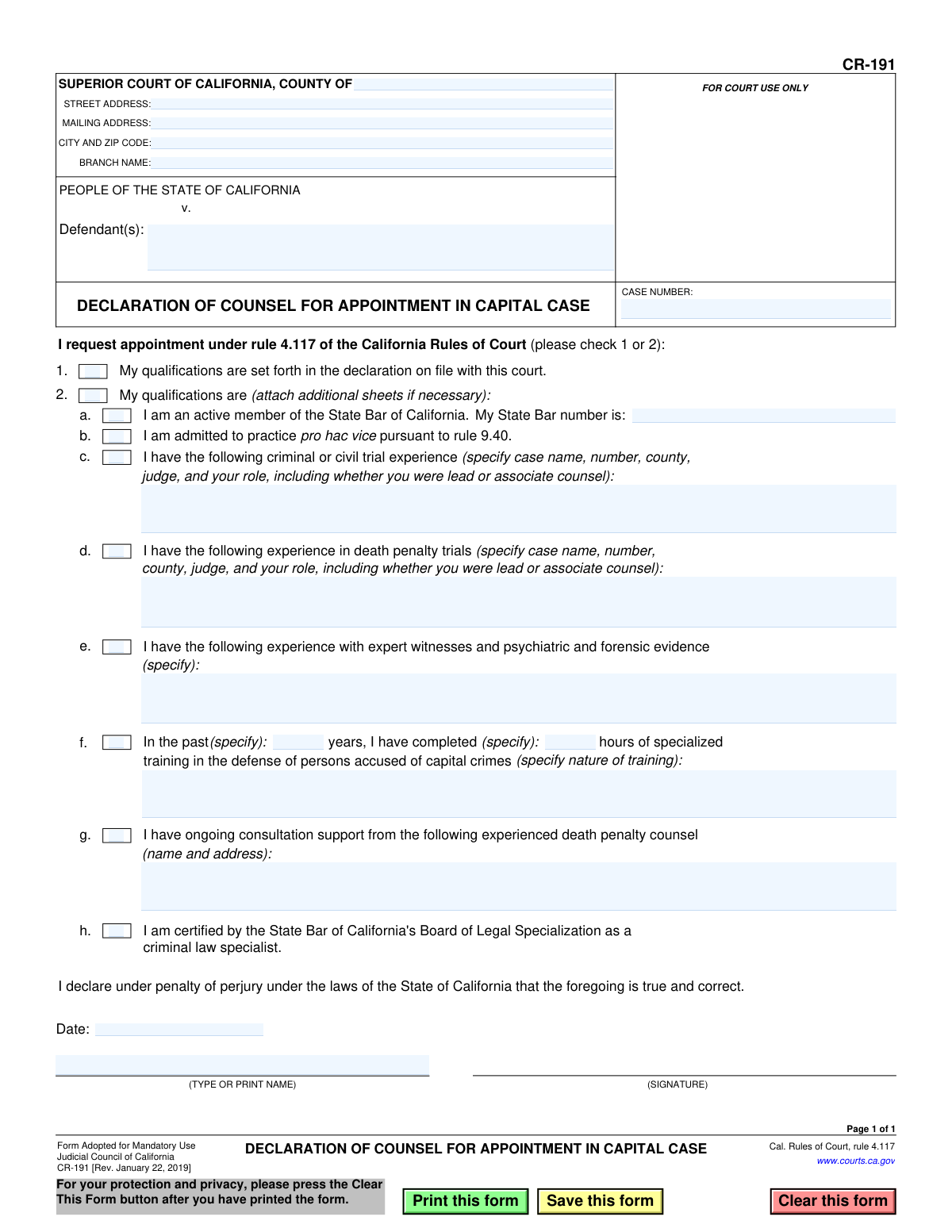
The Declaration of Counsel for Appointment in Capital Case, Form CR-191, is a judicial document used in the Superior Court of California. Attorneys must complete this form to demonstrate they meet the specific qualifications required by the California Rules of Court to represent a defendant in a death penalty case. This declaration details an attorney's trial experience, specialized training, and other credentials relevant to capital defense. Today, this form can be filled out quickly and accurately using AI-powered services like Instafill.ai, which can also convert non-fillable PDF versions into interactive fillable forms.
CR-191 is part of the California court forms category on Instafill.
Our AI automatically handles information lookup, data retrieval, formatting, and form filling.
It takes less than a minute to fill out CR-191 using our AI form filling.
Securely upload your data. Information is encrypted in transit and deleted immediately after the form is filled out.

Form specifications

Form name: Form CR-191, Declaration of Counsel for Appointment in Capital Case
Number of fields: 32
Number of pages: 1
Language: English
main-image

Instafill Demo: How to fill out PDF forms in seconds with AI

How to Fill Out CR-191 Online for Free in 2026

Are you looking to fill out a CR-191 form online quickly and accurately? Instafill.ai offers the #1 AI-powered PDF filling software of 2026, allowing you to complete your CR-191 form in just 37 seconds or less.
Follow these steps to fill out your CR-191 form online using Instafill.ai:
  1. 1 Navigate to Instafill.ai and upload or select the Form CR-191.
  2. 2 Provide the court and case information, including the county, court address, and case number.
  3. 3 Indicate your qualifications by checking the appropriate boxes and providing your State Bar number.
  4. 4 Detail your criminal trial experience, specific experience in death penalty cases, and work with expert witnesses as prompted by the AI assistant.
  5. 5 Specify the hours and nature of specialized training you have completed for capital crime defense and list any consultation support.
  6. 6 Review all the auto-filled information for accuracy, including your name, experience details, and certifications.
  7. 7 Electronically sign and date the declaration under penalty of perjury before downloading, printing, or submitting the completed form.

Our AI-powered system ensures each field is filled out correctly, reducing errors and saving you time.

Why Choose Instafill.ai for Your Fillable CR-191 Form?

Speed

Complete your CR-191 in as little as 37 seconds.

Up-to-Date

Always use the latest 2026 CR-191 form version.

Cost-effective

No need to hire expensive lawyers.

Accuracy

Our AI performs 10 compliance checks to ensure your form is error-free.

Security

Your personal information is protected with bank-level encryption.

Frequently Asked Questions About Form CR-191

This form is used by attorneys in California to declare their qualifications to the court when seeking appointment to represent a defendant in a capital case, where the death penalty is a possible punishment.

Any attorney who wishes to be appointed by the court to represent a defendant in a capital case must complete this form to demonstrate they meet the required qualifications under California Rules of Court, rule 4.117.

Check box 1 if you have already filed a comprehensive declaration of your qualifications with that specific court. Check box 2 if you need to list your qualifications for the first time or if the court does not have your information on file.

You must provide the case name, case number, county, the presiding judge's name, and your specific role in the case, including whether you were lead or associate counsel.

Yes, the form states you can 'attach additional sheets if necessary.' This is common if you need more space to detail your extensive trial experience or other qualifications.

This refers to continuing legal education, seminars, or workshops specifically focused on the defense of individuals accused of capital crimes. You must specify the nature of the training, the number of hours, and when it was completed.

You must file the completed form with the Superior Court of the county where the capital case is being heard. The specific court address and branch name should be filled in at the top of the form.

You should fill out the form as completely and accurately as possible with the qualifications you do have. The court will evaluate your overall experience to determine if you meet the necessary standards for appointment in a capital case.

Yes, if you have been admitted to practice 'pro hac vice' (for this specific case) under California Rules of Court, rule 9.40, you can indicate this by checking box 2b.

While not always strictly mandatory, listing ongoing consultation support from experienced death penalty counsel strengthens your declaration. It demonstrates to the court that you have access to additional expertise for the complexities of a capital case.

Yes, services like Instafill.ai use AI to accurately auto-fill form fields with your information, which can save you significant time and help avoid repetitive data entry.

You can use a service like Instafill.ai to upload the form, fill it out interactively on your computer, and securely store your information for future use on other legal forms.

If you have a non-fillable or 'flat' PDF, you can upload it to a platform like Instafill.ai. Their technology can convert the document into an interactive, fillable form that you can complete and save digitally.

Yes, you must sign the form under penalty of perjury, declaring that all the information you have provided about your qualifications is true and correct.

Compliance CR-191
Validation Checks by Instafill.ai

1
Exclusive Qualification Path Selection
This validation ensures that the user selects either checkbox 1 ('My qualifications are set forth in the declaration on file') or checkbox 2 ('My qualifications are...'), but not both. These options are mutually exclusive and one must be chosen to define the basis of the declaration. If neither or both are selected, the form submission should be blocked with an error message prompting the user to choose a single path.
2
Case Number Format and Presence
This check verifies that the 'CASE NUMBER' field is not empty and conforms to the standard format used by California Superior Courts. The case number is a critical identifier for linking the declaration to the correct legal proceeding. A missing or malformed case number would cause the document to be rejected or misfiled, delaying the appointment of counsel.
3
Conditional Requirement for State Bar Number
This validation ensures that if the user checks box 2.a ('I am an active member of the State Bar of California'), the 'State Bar number' field is filled out. The bar number is essential for the court to verify the attorney's standing and eligibility to practice. If the box is checked but the number is missing, an error should prevent submission until the number is provided.
4
State Bar Number Format Validation
This check validates that the provided State Bar number is a numeric value, typically 5 to 6 digits long, consistent with the format issued by the State Bar of California. This prevents data entry errors like including letters or special characters. An invalid format would trigger an error, ensuring the data is clean and usable for verification purposes.
5
Completeness of Specialized Training Information
This validation applies to section 2.f and ensures that if any of the training fields ('years', 'hours', 'nature of training') are filled, all three must be completed. Providing partial information, such as hours without the timeframe, is ambiguous and incomplete for judicial review. The system should prompt the user to complete all three related fields to provide a full picture of their training.
6
Numeric Input for Training Years and Hours
This check ensures that the values entered into the 'years' and 'hours' fields within section 2.f are strictly numeric. Textual or special characters in these fields would make the data unusable for quantitative assessment of the counsel's experience. If non-numeric data is entered, the user should be alerted to correct the input.
7
Declaration Date Presence and Format
This validation confirms that the 'Date' field in the signature block is not empty and contains a valid date format (e.g., MM/DD/YYYY). A dated signature is a legal requirement for a declaration made under penalty of perjury. The form cannot be considered valid without a properly formatted date, and submission should be blocked if it is missing.
8
Declaration Date Logical Check
This check ensures the date entered in the 'Date' field is not a future date. A declaration cannot be signed and dated for a time that has not yet occurred. This validation prevents logical impossibilities and potential questions about the document's authenticity, ensuring the declaration is valid as of the time of signing.
9
Declarant's Printed Name Requirement
This validation ensures that the '(TYPE OR PRINT NAME)' field is filled out before submission. A printed name is crucial for identifying the declarant, especially if the signature is difficult to read. Without a clear name, the identity of the person making the declaration is ambiguous, and the form's legal standing could be challenged.
10
Defendant Name Presence
This check verifies that the 'Defendant(s)' field is not left blank. The declaration is specific to a particular case, which is defined by the parties involved. A declaration without a named defendant is incomplete and cannot be correctly associated with the intended legal matter, leading to filing errors.
11
Conditional Requirement for Experience Details
This validation ensures that if a user checks a box indicating a type of experience (e.g., 2.c 'criminal or civil trial experience' or 2.d 'death penalty trials'), the corresponding text area for specifying details is not left empty. Checking the box creates an expectation of detail that is necessary for the court's evaluation. The system should warn the user that providing specifics is required to substantiate their claim.
12
Conditional Requirement for Consultation Support Details
This check verifies that if the user checks box 2.g ('I have ongoing consultation support'), the corresponding field for the consultant's name and address is filled in. This information is vital for the court to understand the support structure available to the counsel. If the box is checked but the details are missing, the form should be considered incomplete and an error message should be displayed.
13
Valid California County
This validation checks that the 'COUNTY OF' field contains the name of one of the 58 official counties in California. This ensures the form is directed to the correct jurisdiction and prevents filing errors due to misspellings or non-existent county names. An invalid entry should trigger a suggestion list or an error message to correct the county name.

Common Mistakes in Completing CR-191

Incorrect or Incomplete Case Number

Attorneys often mistype or omit parts of the case number, which is the primary identifier for the court filing. This can happen due to transcription errors or haste. An incorrect case number will cause the declaration to be rejected or misfiled, delaying the crucial process of appointing counsel and potentially impacting case deadlines.

Incomplete Court Information

Applicants frequently leave the court's street address, mailing address, or branch name fields blank, assuming the county name is sufficient. This ambiguity can lead to the document being sent to the wrong courthouse or branch, causing significant processing delays. Always verify and enter the full, specific address for the court handling the case.

Ambiguous Qualification Selection

A common error is checking both box 1 and box 2, or failing to check either one, when indicating qualifications. The form requires a clear choice between referencing a declaration already on file (box 1) or providing the details in the form itself (box 2). This mistake signals carelessness and requires the court clerk to return the form for correction, delaying the appointment.

Invalid State Bar Number

Entering an incorrect State Bar number is a frequent data entry error. Since the court uses this number to verify the attorney's active status and eligibility, a single wrong digit can halt the entire appointment process. The court cannot proceed until it can confirm the attorney is in good standing with the State Bar.

Vague Trial Experience Descriptions

In sections 2c and 2d, attorneys often provide a generic list of cases without the required specifics. The form explicitly asks for the case name, number, county, judge, and the attorney's role (lead or associate counsel). Omitting these details prevents the court from properly assessing the depth and relevance of the applicant's experience, potentially leading to a request for more information or denial.

Failing to Attach Necessary Supplemental Pages

The spaces provided for detailing trial experience (2c, 2d) and expert witness experience (2e) are very limited. Attorneys may try to cram illegible text into the small boxes instead of attaching additional sheets as instructed. This results in an incomplete and unprofessional submission that the court may not be able to properly evaluate.

Omitting Specialized Training Details

In section 2f, applicants must specify the number of years, hours, and the nature of their specialized capital defense training. It is common for attorneys to forget to fill in one of these data points, such as the number of hours. This omission makes it impossible for the court to verify compliance with the mandatory training requirements under the California Rules of Court.

Insufficient Detail on Expert Witness Experience

When describing experience with expert witnesses in section 2e, many applicants use vague phrases like 'worked with many experts.' This is insufficient for the court to gauge the attorney's competency with complex psychiatric and forensic evidence. It is essential to specify the types of experts (e.g., DNA analysts, forensic pathologists, psychologists) and the context of that experience.

Missing Signature or Date

Forgetting to sign and date the declaration is a simple but critical mistake that instantly invalidates the document. The statement 'I declare under penalty of perjury' is legally binding only with a signature and date. An unsigned form will be immediately rejected by the court clerk, stopping the appointment process entirely.

Submitting an Illegible, Hand-Filled Form

This form is often available as a non-fillable PDF, leading attorneys to print it and fill it out by hand. This can result in illegible handwriting, which causes data entry errors by court staff and may lead to the form's rejection. To avoid this, use a tool like Instafill.ai, which can convert flat PDFs into fillable forms, ensuring all entries are clear, legible, and properly formatted.
Saved over 80 hours a year

“I was never sure if my IRS forms like W-9 were filled correctly. Now, I can complete the forms accurately without any external help.”

Kevin Martin Green

Your data stays secure with advanced protection from Instafill and our subprocessors

Robust compliance program

Transparent business model

You’re not the product. You always know where your data is and what it is processed for.

ISO 27001, HIPAA, and GDPR

Our subprocesses adhere to multiple compliance standards, including but not limited to ISO 27001, HIPAA, and GDPR.

Security & privacy by design

We consider security and privacy from the initial design phase of any new service or functionality. It’s not an afterthought, it’s built-in, including support for two-factor authentication (2FA) to further protect your account.

Fill out CR-191 with Instafill.ai

Worried about filling PDFs wrong? Instafill securely fills form-cr-191-declaration-of-counsel-for-appointment-in-capital-case forms, ensuring each field is accurate.