Yes! You can use AI to fill out Form CR-221, Order to Install Ignition Interlock Device

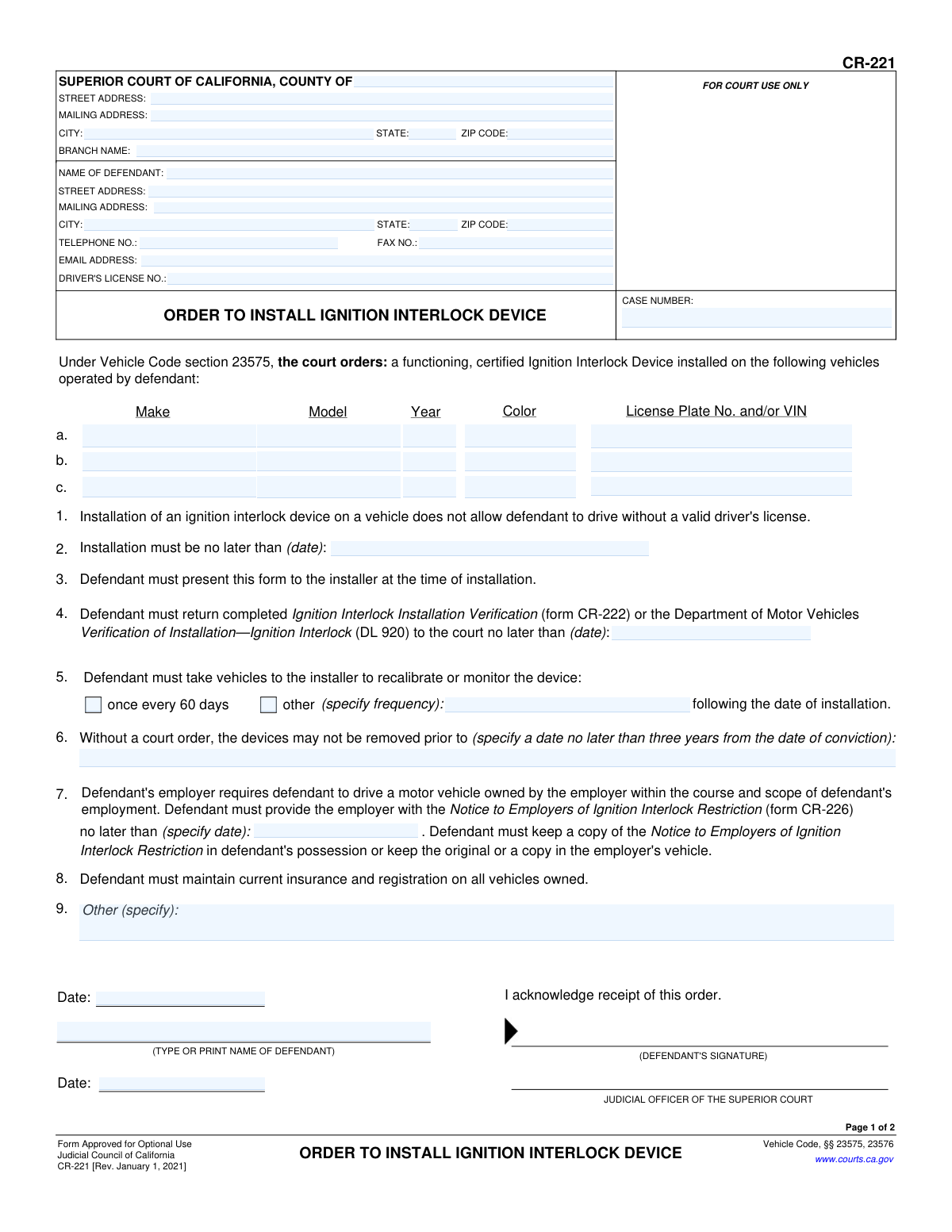
This form, officially known as CR-221, is a legal order issued by the Superior Court of California. It compels a defendant, typically following a DUI conviction, to install a certified Ignition Interlock Device on specified vehicles and outlines the terms of compliance, including installation deadlines and monitoring requirements. Today, this form can be filled out quickly and accurately using AI-powered services like Instafill.ai, which can also convert non-fillable PDF versions into interactive fillable forms.
CR-221 is part of the California court forms category on Instafill.
Our AI automatically handles information lookup, data retrieval, formatting, and form filling.
It takes less than a minute to fill out CR-221 using our AI form filling.
Securely upload your data. Information is encrypted in transit and deleted immediately after the form is filled out.

Form specifications

Form name: Form CR-221, Order to Install Ignition Interlock Device
Number of fields: 50
Number of pages: 1
Language: English
main-image

Instafill Demo: How to fill out PDF forms in seconds with AI

How to Fill Out CR-221 Online for Free in 2026

Are you looking to fill out a CR-221 form online quickly and accurately? Instafill.ai offers the #1 AI-powered PDF filling software of 2026, allowing you to complete your CR-221 form in just 37 seconds or less.
Follow these steps to fill out your CR-221 form online using Instafill.ai:
  1. 1 Navigate to Instafill.ai and upload or select the CR-221 form.
  2. 2 Enter the court and case information, including the county, court address, and case number, in the header section.
  3. 3 Provide the defendant's full name, address, contact information, and driver's license number.
  4. 4 List the details of each vehicle requiring an ignition interlock device, including make, model, year, color, and license plate or VIN.
  5. 5 Fill in the court-mandated dates for installation, proof of installation, and the earliest date the device can be removed.
  6. 6 Indicate the required frequency for device calibration and specify any orders related to employer-owned vehicles.
  7. 7 Review all entered information for accuracy before the defendant and judicial officer sign and date the form to make it a legally binding order.

Our AI-powered system ensures each field is filled out correctly, reducing errors and saving you time.

Why Choose Instafill.ai for Your Fillable CR-221 Form?

Speed

Complete your CR-221 in as little as 37 seconds.

Up-to-Date

Always use the latest 2026 CR-221 form version.

Cost-effective

No need to hire expensive lawyers.

Accuracy

Our AI performs 10 compliance checks to ensure your form is error-free.

Security

Your personal information is protected with bank-level encryption.

Frequently Asked Questions About Form CR-221

This is a legal document from a California court that orders a defendant to install a certified Ignition Interlock Device (IID) on any vehicle they operate. It specifies all the rules, deadlines, and penalties associated with the IID requirement.

The court and a judicial officer fill out the details of the order, such as the deadlines and vehicle information. You, the defendant, must read the order, acknowledge you understand it, and sign it.

You must contact a state-certified IID installer to schedule the installation on your vehicle(s) before the deadline listed in item #2. You will need to bring this order with you to the installation appointment.

After installation, you must submit proof to the court using either Form CR-222 (Ignition Interlock Installation Verification) or Form DL 920 (DMV Verification of Installation). This must be done by the date specified in item #4 of your order.

You must provide your employer with Form CR-226, 'Notice to Employers of Ignition Interlock Restriction,' and keep a copy of that notice in the company vehicle. This exemption only applies to vehicles owned by your employer, not a business you own or control.

Violating this order can result in the court notifying the DMV and lead to misdemeanor charges, which are punishable by jail time and/or fines. Violations include failing to install the device, tampering with it, or driving a vehicle without an IID.

No, the order applies to any vehicle you operate. Driving any vehicle that is not equipped with a functioning IID (other than a qualifying employer's vehicle) is a violation of the court order.

You are required to take your vehicle to the installer for regular monitoring and calibration of the device. The frequency is specified in item #5 of the order, but it is typically every 60 days.

The device cannot be legally removed before the date specified by the court in item #6 of your order. Early or unauthorized removal is a violation of the law.

This order applies to any vehicle you 'operate,' not just own, so you cannot drive any car, even if borrowed, unless it has an IID installed. You should consult with your attorney to understand how to comply with the order in your specific situation.

Yes, while the court issues this order, you can use AI-powered services like Instafill.ai for related documents. It can help you accurately fill out forms like the CR-222 (Proof of Installation) or CR-226 (Notice to Employer), saving time and reducing errors.

Simply upload the PDF of a related form, like the CR-222 or CR-226, to the Instafill.ai platform. The AI will make the document fillable online, allowing you to easily type in your information and ensure everything is correct before printing.

If you have a flat, non-fillable PDF, you can use a service like Instafill.ai to make it interactive. Just upload the document, and the tool will convert it into a fillable form you can complete on your computer.

Compliance CR-221
Validation Checks by Instafill.ai

1
Case Number Consistency Across Pages
This check verifies that the 'CASE NUMBER' entered on page 1 is identical to the 'CASE NUMBER' on page 2. This is crucial for ensuring that all pages of the document are correctly associated with the same legal case. A mismatch could lead to filing errors or the document being rejected, invalidating the order.
2
California Driver's License Format
Validates that the 'DRIVER'S LICENSE NO.' field follows the standard California format, which is typically a letter followed by seven digits. Proper formatting is essential for correct identification of the defendant within the Department of Motor Vehicles (DMV) system. An invalid format would prevent the DMV from correctly applying the restriction to the defendant's driving record.
3
Installation Deadline Chronology
Ensures the installation deadline date in section 2 is a future date that occurs after the Judicial Officer's signature date. An order cannot mandate an action to be completed before the order itself is officially signed and dated. This validation prevents logically impossible or back-dated requirements.
4
Verification Submission Deadline Logic
This check confirms that the date for returning the 'Ignition Interlock Installation Verification' form (section 4) is on or after the installation deadline date (section 2). The defendant needs time to complete the installation before they can submit proof of it. This validation ensures the deadlines are logical and achievable for the defendant.
5
Conditional Recalibration Specification
If the 'other' checkbox is selected for device recalibration frequency in section 5, this validation ensures the corresponding text field specifying the frequency is not empty. This prevents an ambiguous order where a non-standard frequency is chosen but not defined. Failure to specify the frequency would make the order unenforceable.
6
Device Removal Prohibition Date Validity
Validates that the date specified in section 6, before which the device cannot be removed, is a valid future date. The form notes this should be no later than three years from the conviction date, so this check ensures the entered date is plausible and complies with the order's long-term nature. An invalid or past date would nullify this critical part of the order.
7
Minimum Vehicle Requirement
Verifies that at least one vehicle is listed in section 1 of the order. An order to install an ignition interlock device is meaningless without at least one vehicle to which it applies. This check ensures the order is actionable and not fundamentally incomplete.
8
Vehicle Identification Number (VIN) Format
If a VIN is entered in the 'License Plate No. and/or VIN' field, this check validates that it conforms to the standard 17-character alphanumeric format (excluding letters I, O, and Q). A valid VIN is a unique identifier for a vehicle and is critical for installers and law enforcement to correctly identify the vehicle subject to the order. An incorrect VIN could lead to the device being installed on the wrong vehicle or the order being unenforceable.
9
Vehicle Model Year Sanity Check
This validation ensures the 'Year' for each listed vehicle is a 4-digit number within a reasonable range (e.g., not in the future and not before 1900). This prevents simple data entry errors, such as typos or entering the current date. It improves the overall data quality and accuracy of the vehicle's description.
10
Judicial Officer Signature Date Presence
Confirms that the date field next to the 'JUDICIAL OFFICER OF THE SUPERIOR COURT' signature line is filled. This date is the official effective date of the court order. Without this date, the order is not legally valid, and all other deadlines within the document are rendered meaningless.
11
Defendant Name Consistency
This check verifies that the defendant's name listed in the header of the form matches the typed or printed name on the signature line. This ensures the individual identified in the order is the same person acknowledging its receipt. A discrepancy could raise legal challenges about whether the correct party was served and acknowledged the order.
12
Mutually Exclusive Recalibration Selection
Ensures that only one option for recalibration frequency in section 5 is selected, either 'once every 60 days' or 'other'. The form presents these as mutually exclusive choices. Allowing both to be selected would create an ambiguous and contradictory instruction for the defendant and the installer.
13
Defendant Email Address Format
Validates that the defendant's 'EMAIL ADDRESS' field contains a string in a valid email format (e.g., [email protected]). While optional, if an email is provided, it should be correctly formatted to be useful for communication. This check prevents the entry of malformed data that cannot be used.
14
Zip Code Format Validation
Checks that the 'ZIP CODE' fields for both the court and the defendant's address contain a valid 5-digit or 9-digit (ZIP+4) format. Correct zip codes are essential for mail delivery and accurate location records. This validation helps ensure any correspondence related to the order is sent to the correct address.

Common Mistakes in Completing CR-221

Entering an Incorrect or Incomplete Case Number

The case number is the primary identifier linking this order to your court file. People often make typos, transpose digits, or leave this field blank, which can cause the document to be rejected or misfiled. A misfiled form can lead to the court thinking you are non-compliant, resulting in further legal penalties. Always double-check the case number against other official court documents from your case to ensure it is 100% accurate.

Providing Inaccurate Vehicle Information (VIN/License Plate)

Defendants frequently enter incorrect information for their vehicle's Make, Model, Year, License Plate, or VIN. This often happens from memory rather than checking official documents, leading to transposed numbers or incomplete details. An incorrect VIN means the order is not properly tied to the vehicle, which can cause major issues with the DMV and law enforcement, and could be considered a violation. Always use your vehicle's registration card to meticulously copy this information.

Misunderstanding or Missing Critical Deadlines

This form contains multiple crucial deadlines, including the final date for device installation (Item 2) and the date to submit proof of installation to the court (Item 4). It is a common and serious error to misread, forget, or ignore these dates. Missing a deadline constitutes a direct violation of the court order, which will be reported to the DMV and can lead to license suspension or other penalties. Immediately record these dates in a calendar with reminders to avoid this.

Failing to List All Operated Vehicles

The order requires an Ignition Interlock Device (IID) on all vehicles the defendant operates, but the form only provides three lines. A common mistake is failing to list a secondary family car or work vehicle, assuming the order only applies to a primary car. Driving any unlisted vehicle without an IID is a violation of the order and can lead to a misdemeanor charge. If you operate more vehicles than there are lines for, you must attach an addendum with the additional vehicle information.

Misinterpreting the Employer Vehicle Exemption

Defendants often misunderstand the strict rules for the employer vehicle exemption (Item 7). A frequent error is assuming a vehicle from their own business qualifies, which it does not if the defendant owns or controls the business. Another mistake is failing to provide the employer with the required notice (form CR-226) by the court-ordered date. These mistakes can void the exemption and result in penalties for driving a non-compliant vehicle.

Submitting an Unsigned or Undated Form

In the rush to complete paperwork, defendants sometimes forget to physically sign and date the form in the designated 'DEFENDANT'S SIGNATURE' section. An unsigned or undated form is legally invalid and will be rejected by the court. This simple oversight can be treated as a failure to comply with the order's requirements, leading to unnecessary complications. Always perform a final check to ensure your signature and the correct date are present before submission.

Using Nicknames or Incomplete Personal Details

Legal documents require your full, legal name and current address as they appear on official records like your driver's license. Using a nickname, an old address, or an abbreviated name can cause the form to be rejected or lead to important notices from the court or DMV being sent to the wrong location. This can result in missed deadlines and unintended legal consequences. AI-powered tools like Instafill.ai can help prevent this by populating fields with your verified, official information.

Illegible Handwriting on a Printed Form

This form is often provided as a non-fillable PDF, forcing individuals to print it and complete it by hand. Rushed or poor handwriting can make critical data like a VIN, driver's license number, or case number unreadable to the court clerk. An illegible form is likely to be rejected, delaying the process and risking non-compliance. To prevent this, it is best to use a tool like Instafill.ai that can convert the document into a digitally fillable version, ensuring all entries are clear and legible.

Failing to Return Proof of Installation to the Court

After successfully installing the IID, some individuals forget the second crucial step: returning the completed 'Ignition Interlock Installation Verification' (form CR-222) or DMV form DL 920 to the court by the deadline in Item 4. The court does not automatically know the installation is complete; you must provide this specific proof. Failure to do so is a violation of the order and will be reported to the DMV, even if the device was installed on time.
Saved over 80 hours a year

“I was never sure if my IRS forms like W-9 were filled correctly. Now, I can complete the forms accurately without any external help.”

Kevin Martin Green

Your data stays secure with advanced protection from Instafill and our subprocessors

Robust compliance program

Transparent business model

You’re not the product. You always know where your data is and what it is processed for.

ISO 27001, HIPAA, and GDPR

Our subprocesses adhere to multiple compliance standards, including but not limited to ISO 27001, HIPAA, and GDPR.

Security & privacy by design

We consider security and privacy from the initial design phase of any new service or functionality. It’s not an afterthought, it’s built-in, including support for two-factor authentication (2FA) to further protect your account.

Fill out CR-221 with Instafill.ai

Worried about filling PDFs wrong? Instafill securely fills form-cr-221-order-to-install-ignition-interlock-device forms, ensuring each field is accurate.