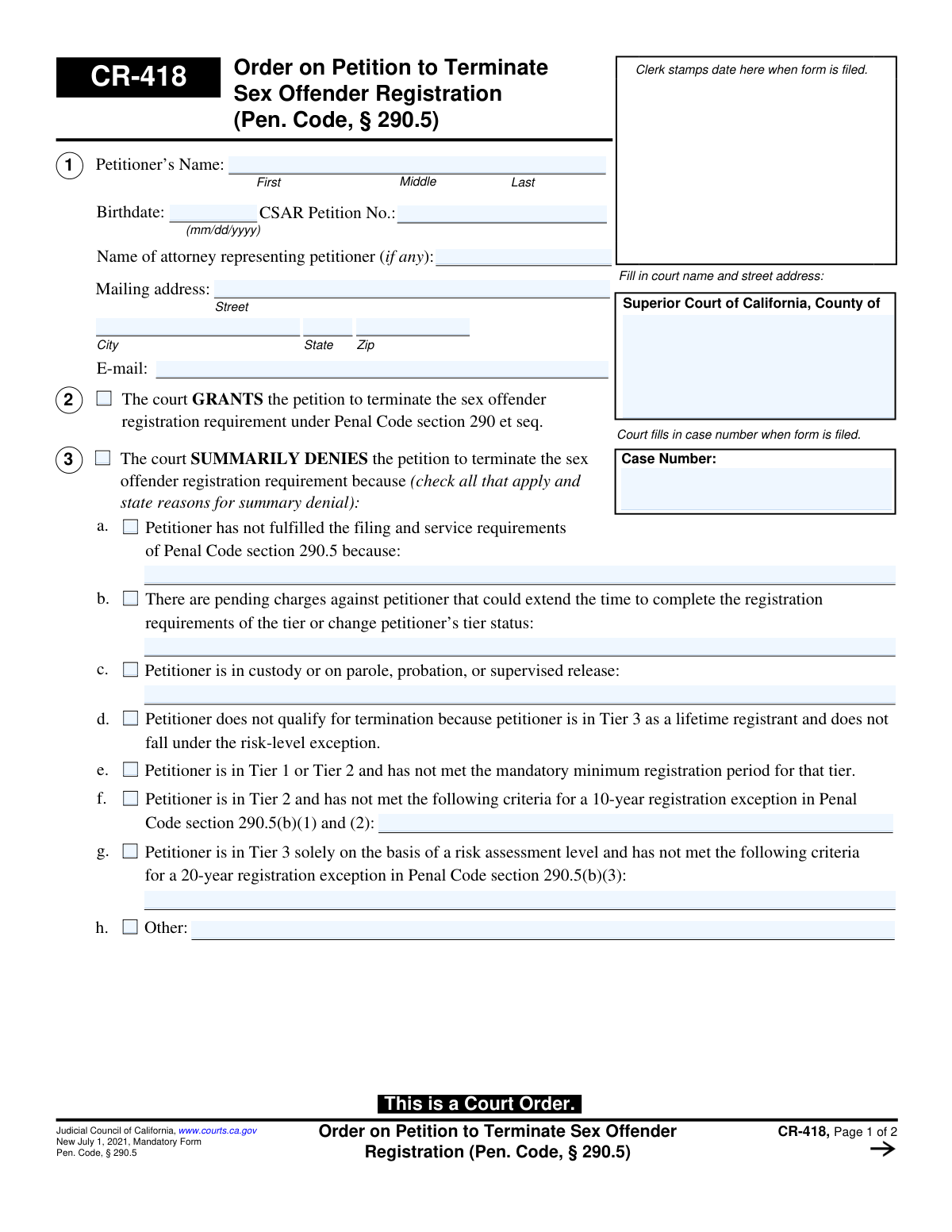
Yes! You can use AI to fill out Form CR-418, Order on Petition to Terminate Sex Offender Registration (Pen. Code, § 290.5)

Form CR-418, issued by the Judicial Council of California, is the official court order that documents a judge's decision on a petition to end the requirement for sex offender registration under Penal Code § 290.5. The form details whether the petition is granted, summarily denied, or denied after a hearing, and provides the legal reasoning for the court's decision. Today, this form can be filled out quickly and accurately using AI-powered services like Instafill.ai, which can also convert non-fillable PDF versions into interactive fillable forms.
CR-418 is part of the California court forms category on Instafill.
Our AI automatically handles information lookup, data retrieval, formatting, and form filling.
It takes less than a minute to fill out CR-418 using our AI form filling.
Securely upload your data. Information is encrypted in transit and deleted immediately after the form is filled out.

Form specifications

Form name: Form CR-418, Order on Petition to Terminate Sex Offender Registration (Pen. Code, § 290.5)
Number of fields: 47
Number of pages: 1
Language: English
main-image

Instafill Demo: How to fill out PDF forms in seconds with AI

How to Fill Out CR-418 Online for Free in 2026

Are you looking to fill out a CR-418 form online quickly and accurately? Instafill.ai offers the #1 AI-powered PDF filling software of 2026, allowing you to complete your CR-418 form in just 37 seconds or less.
Follow these steps to fill out your CR-418 form online using Instafill.ai:
  1. 1 Navigate to Instafill.ai and upload the CR-418 form or select it from the template library.
  2. 2 Enter the court information, case number, and the petitioner's personal details, including name, birthdate, and attorney information.
  3. 3 The judicial officer will select the primary action: granting the petition (Section 2), summarily denying it (Section 3), or denying it after a hearing (Section 4).
  4. 4 If the petition is denied, the officer will check the specific reasons, such as failure to meet requirements, pending charges, or tier status.
  5. 5 For denials, the judicial officer will specify any required waiting period before a new petition can be filed.
  6. 6 The judicial officer will date and sign the form to validate the court order.
  7. 7 Review the entire completed form for accuracy before it is officially filed by the court clerk and sent to the Department of Justice.

Our AI-powered system ensures each field is filled out correctly, reducing errors and saving you time.

Why Choose Instafill.ai for Your Fillable CR-418 Form?

Speed

Complete your CR-418 in as little as 37 seconds.

Up-to-Date

Always use the latest 2026 CR-418 form version.

Cost-effective

No need to hire expensive lawyers.

Accuracy

Our AI performs 10 compliance checks to ensure your form is error-free.

Security

Your personal information is protected with bank-level encryption.

Frequently Asked Questions About Form CR-418

Form CR-418, 'Order on Petition to Terminate Sex Offender Registration,' is the official court document a judge uses to grant or deny a person's request to be removed from the sex offender registry in California.

No, this form is an 'Order' that is filled out and signed by a judicial officer. You would have previously filed a 'Petition' (a different form) to request termination, and this form is the court's official response to your petition.

If the box in Section 2 is checked, it means your petition was successful. The court has ordered an end to your requirement to register as a sex offender under Penal Code section 290.

A summary denial happens without a full court hearing, typically because you don't meet basic eligibility requirements. A denial after a hearing occurs when the judge considers your case but decides against termination, often based on community safety concerns.

A petition may be summarily denied if you haven't completed the mandatory minimum registration period for your tier, have pending criminal charges, or failed to follow the correct filing and service procedures.

Yes, but the court will specify a mandatory waiting period before you can file another petition. This period can range from one to five years, depending on the reason for the denial and your tier.

The court is required to notify the California Department of Justice and the California Sex Offender Registry of the decision. If your petition was granted, the registry will be updated to reflect that you are no longer required to register.

While the judge fills out this order, the information on it, such as your name, birthdate, and case number, comes from the petition you originally filed with the court. It is crucial that your initial petition is accurate and complete.

This is a legal finding by the judge that, based on the evidence presented, the public's safety is better served by you remaining on the sex offender registry. The judge must state the reasons for this finding on the record or on the form.

Yes, even if you are in Tier 1 and have met the minimum registration period, a judge can deny your petition after a hearing if they find that community safety would be significantly enhanced by your continued registration.

Yes, AI-powered services like Instafill.ai can help you accurately complete the necessary petition forms that initiate this process. These tools can auto-fill your information, saving you time and helping to prevent errors.

You would upload the petition form (not this order form) to a service like Instafill.ai. The AI can then help you accurately populate fields with your personal information, case details, and other required data before you print and file it with the court.

If you have a flat, non-fillable PDF, you can use a service like Instafill.ai to make it interactive. The platform converts the document into a fillable form, so you can easily type your information directly into the fields.

The form explicitly instructs the court to notify the Department of Justice and the California Sex Offender Registry of the outcome. This ensures the central registry is updated with the court's final order.

Compliance CR-418
Validation Checks by Instafill.ai

1
Petitioner Name Completeness
This check ensures that the Petitioner's First and Last Name fields are not empty. These fields are essential for correctly identifying the individual subject to the court order. If this validation fails, the form cannot be processed as the primary subject is not clearly identified.
2
Birthdate Format and Plausibility
Validates that the petitioner's birthdate is entered in the 'mm/dd/yyyy' format and represents a plausible date in the past. This is crucial for identity verification and cross-referencing with other legal documents. An invalid format or a future date would render the record inaccurate and could lead to rejection.
3
Case Number Consistency
This validation verifies that the 'Case Number' entered on Page 1 is identical to the 'Case Number' entered on Page 2. Maintaining consistency is critical for ensuring the document is correctly filed and that all pages are associated with the same legal case. A mismatch could cause the document to be misfiled or considered invalid.
4
Mutually Exclusive Order Outcome
Ensures that only one of the primary order outcomes (Section 2: GRANTS, Section 3: SUMMARILY DENIES, or Section 4: DENIES after hearing) is selected. A petition can only have one final disposition. Selecting multiple outcomes creates a logical contradiction, making the order legally unenforceable and requiring correction by the user.
5
Mandatory Order Outcome Selection
This check confirms that at least one of the three main order outcomes (GRANTS, SUMMARILY DENIES, or DENIES after hearing) has been selected. The entire purpose of the form is to document the court's decision. Failure to select an outcome makes the form incomplete and without legal effect, prompting the user to make a selection.
6
Summary Denial Reason Requirement
If the court 'SUMMARILY DENIES' the petition (Section 3), this check ensures that at least one of the specific reasons (checkboxes a-h) is also selected. The legal code requires the court to state the basis for a summary denial. If this validation fails, the order is incomplete and lacks the necessary legal justification.
7
Conditional Explanation for Summary Denial 'a'
Validates that if checkbox 3a ('Petitioner has not fulfilled the filing and service requirements') is checked, the corresponding text field explaining the reason is filled. The form explicitly requires this detail. An empty field would make the denial reason vague and legally insufficient, requiring the user to provide the specific details.
8
Conditional Explanation for 'Other' Summary Denial
This check ensures that if checkbox 3h ('Other') is selected under the summary denial section, the associated text field is populated with an explanation. Selecting 'Other' without providing details makes the reason for denial unknown and legally invalid. The system should prompt the user to specify the reason.
9
Denial After Hearing Reason Requirement
If the court 'DENIES' the petition after a hearing (Section 4), this check verifies that at least one of the reasons (checkbox 4a or 4b) is selected. The order must specify the grounds for the denial to be legally sound. Failure to select a reason would result in an incomplete order.
10
Conditional Findings Selection for Denial 'b'
When denial reason 4b ('Community safety would be significantly enhanced...') is checked, this validation ensures that one of the two sub-options ('stated orally on the record' or 'set forth below') is also selected. This clarifies how the court's findings are documented. An error should be raised if neither is selected, as the record would be ambiguous.
11
Conditional Text for 'Set Forth Below' Findings
If the 'set forth below' option is checked in Section 4b, this validation confirms that the corresponding text area is not empty. The form requires the court's findings to be explicitly written if this option is chosen. An empty text area would contradict the selection and make the order incomplete.
12
Tier 1/2 Denial Re-file Period Validation
This check validates that if the box for a Tier 1 or Tier 2 denial (Section 4(1)) is checked, the 'years' field contains a numeric value between 1 and 5, inclusive. The form specifies this legal constraint on the re-filing period. An entry outside this range would be legally non-compliant and must be corrected.
13
Tier 2 Exception Denial Re-file Period Validation
For a Tier 2 denial under the 10-year exception (Section 4(2)), this check ensures the 'year(s)' field contains a numeric value that is greater than or equal to 1. This rule is explicitly stated on the form. The validation prevents the entry of an invalid waiting period, such as zero or a negative number.
14
Tier 3 Denial Re-file Period Validation
If the box for a Tier 3 denial (Section 4(3)) is checked, this validation ensures the 'years' field contains a numeric value that is greater than or equal to 3. This is a mandatory minimum period set by the form's instructions. This check enforces compliance with the legal requirement for this specific type of denial.
15
Order Date Presence
Verifies that the 'Date' field near the judicial officer's signature line is filled with a valid date. The date of the order is a critical piece of information that establishes when the order becomes effective. An undated order is invalid and cannot be processed.
16
Attorney Email Format
If an email address is provided for the petitioner's attorney, this check validates that it follows a standard email format (e.g., '[email protected]'). This ensures that electronic communications and notifications can be successfully delivered. An invalid format would prevent successful delivery and should be flagged for correction.

Common Mistakes in Completing CR-418

Miscalculating the Minimum Registration Period

This is one of the most frequent errors leading to summary denial. Petitioners often file prematurely because they fail to account for periods that pause the clock on their registration requirement, such as time spent incarcerated, on parole, or periods of non-compliance. Filing even one day too early will result in the petition being denied, forcing the petitioner to start the process over after waiting for the correct date.

Filing While Ineligible Due to Supervision or Pending Charges

A petition will be summarily denied if the petitioner is currently in custody, on parole, probation, supervised release, or has pending criminal charges that could affect their tier status. Many petitioners are eager to terminate their requirement and file prematurely, not realizing these are absolute bars to eligibility that the court will immediately check.

Failure to Properly Serve All Required Parties

Simply filing the petition with the court clerk is not enough; the law requires the petitioner to formally serve a copy to the district attorney and the law enforcement agency of registration. Many petitioners overlook this step or do it incorrectly, leading to a denial for failing to meet service requirements. Proper service ensures all parties are notified and have a chance to respond.

Using an Incorrect or Incomplete Case Number

Petitioners often forget, transpose, or mis-enter the original criminal case number that mandated their registration. Without the correct case number, the court cannot locate the necessary records, causing significant delays or summary denial of the petition. This is especially common when multiple cases or jurisdictions are involved.

Filing for Termination from an Ineligible Tier

Petitioners designated as Tier 3 (lifetime) registrants are generally not eligible for termination and often file petitions that are immediately denied. They may misunderstand their tier status or be unaware that only very specific, rare exceptions allow a Tier 3 registrant to petition. This results in wasted time and filing fees.

Providing Incomplete or Mismatched Personal Information

Using a nickname, omitting a middle name that appears on court records, or entering a birthdate in the wrong format (e.g., DD/MM/YYYY instead of MM/DD/YYYY) can cause processing delays. The court uses this data to verify identity, and any mismatch with official records will flag the petition for review and can lead to rejection. AI-powered form filling tools like Instafill.ai can help prevent these errors by automatically validating and formatting data correctly.

Filing in the Wrong Court Jurisdiction

Petitioners often mistakenly file in the county where they currently reside, not the county of the conviction that requires registration. This leads to immediate rejection and wasted time and filing fees. The petition must be filed in the superior court of the county where the petitioner was convicted of the registrable offense.

Using an Outdated or Incorrect Form Version

Judicial Council forms are updated periodically to reflect changes in the law. Using an old version of the petition form can result in an automatic rejection by the court clerk because it may lack required fields or contain outdated legal language. Always download the latest version of the required form directly from the official court website. If the form is a non-fillable PDF, a tool like Instafill.ai can convert it into an interactive, fillable version.

Providing an Inaccurate Mailing Address

A typo in a street name or zip code can lead to missed court notices, including hearing dates and the final order. Missing a crucial notice can result in the case being dismissed without the petitioner's knowledge. It is critical to triple-check the mailing address and ensure it is reliable for the duration of the case. AI form fillers like Instafill.ai can use address validation to help catch typos and formatting errors.

Failing to Attach Necessary Supporting Documents

A petition is more than just the form; it's a legal argument that must be supported by evidence. Petitioners often fail to attach crucial documents like proof of rehabilitation, letters of support, or psychological evaluations. This weakens the case and may lead to a denial because the court finds that continued registration is needed for community safety.
Saved over 80 hours a year

“I was never sure if my IRS forms like W-9 were filled correctly. Now, I can complete the forms accurately without any external help.”

Kevin Martin Green

Your data stays secure with advanced protection from Instafill and our subprocessors

Robust compliance program

Transparent business model

You’re not the product. You always know where your data is and what it is processed for.

ISO 27001, HIPAA, and GDPR

Our subprocesses adhere to multiple compliance standards, including but not limited to ISO 27001, HIPAA, and GDPR.

Security & privacy by design

We consider security and privacy from the initial design phase of any new service or functionality. It’s not an afterthought, it’s built-in, including support for two-factor authentication (2FA) to further protect your account.

Fill out CR-418 with Instafill.ai

Worried about filling PDFs wrong? Instafill securely fills form-cr-418-order-on-petition-to-terminate-sex-offender-registration-pen-code-2905 forms, ensuring each field is accurate.