Yes! You can use AI to fill out Form CR-850, Permission to Have Firearm or Ammunition for Work (Criminal Protective Order)
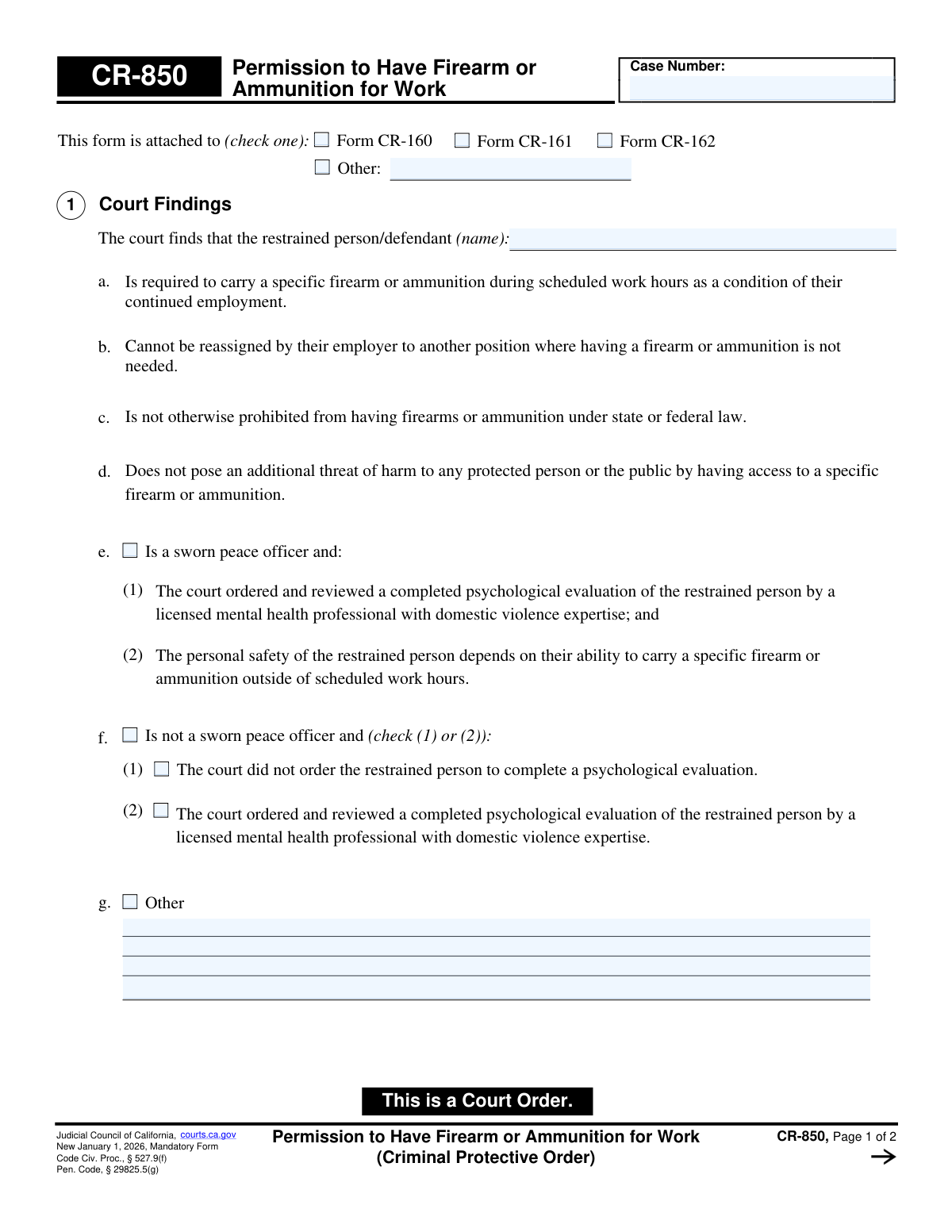
Form CR-850, Permission to Have Firearm or Ammunition for Work, is a California Judicial Council form used by a court to grant an exception to a criminal protective order. It allows a restrained person to possess a specific firearm or ammunition required for their employment, based on specific court findings. Today, this form can be filled out quickly and accurately using AI-powered services like Instafill.ai, which can also convert non-fillable PDF versions into interactive fillable forms.
CR-850 is part of the
California court forms category on Instafill.
Our AI automatically handles information lookup, data retrieval, formatting, and form filling.
It takes less than a minute to fill out CR-850 using our AI form filling.
Securely upload your data. Information is encrypted in transit and deleted immediately after the form is filled out.
Form specifications
| Form name: | Form CR-850, Permission to Have Firearm or Ammunition for Work (Criminal Protective Order) |
| Number of fields: | 27 |
| Number of pages: | 1 |
| Language: | English |
Instafill Demo: How to fill out PDF forms in seconds with AI
How to Fill Out CR-850 Online for Free in 2026
Are you looking to fill out a CR-850 form online quickly and accurately? Instafill.ai offers the #1 AI-powered PDF filling software of 2026, allowing you to complete your CR-850 form in just 37 seconds or less.
Follow these steps to fill out your CR-850 form online using Instafill.ai:
- 1 Navigate to Instafill.ai and upload or select Form CR-850.
- 2 Enter the case number and the name of the restrained person/defendant as directed by the court.
- 3 In Section 1, check the boxes corresponding to the court's findings regarding the employment requirement, threat assessment, and psychological evaluation status.
- 4 In Section 2, specify whether the person is a sworn peace officer and the conditions under which they may possess the firearm (e.g., only during work hours, on duty).
- 5 List the specific details of the permitted firearm (make, model, serial number) and any authorized ammunition as ordered by the court.
- 6 Carefully review all entered information to ensure it accurately reflects the court's order before finalizing.
- 7 Securely download, print, or share the completed court order as required for official records and distribution.
Our AI-powered system ensures each field is filled out correctly, reducing errors and saving you time.
Why Choose Instafill.ai for Your Fillable CR-850 Form?
Speed
Complete your CR-850 in as little as 37 seconds.
Up-to-Date
Always use the latest 2026 CR-850 form version.
Cost-effective
No need to hire expensive lawyers.
Accuracy
Our AI performs 10 compliance checks to ensure your form is error-free.
Security
Your personal information is protected with bank-level encryption.
Frequently Asked Questions About Form CR-850
Form CR-850 is a court order that grants a person under a criminal protective order permission to possess a specific firearm or ammunition, but only for work-related purposes. This form documents a legal exception to the general rule that prohibits individuals with protective orders from having firearms.
Form CR-850 is a court order, which means it is completed and signed by a judicial officer, such as a judge. While the restrained person requests the exemption, the court makes the final findings and issues the order on this form.
This form is used when a person subject to a criminal protective order (like Form CR-160 or CR-161) needs to carry a firearm for their job. The court uses this form to document its approval and the specific conditions of that approval.
The court must find that you are required to carry a firearm for work, cannot be reassigned to another role, are not otherwise prohibited from owning firearms, and do not pose an additional threat. Depending on your job, a psychological evaluation may also be required.
Yes, the rules are different for sworn peace officers. The court must review a completed psychological evaluation and may grant permission for a peace officer to carry their firearm both on and off duty for personal safety.
The court order must list the specific firearm you are permitted to possess for work. You will need to provide the make, model, and serial number of the firearm, as well as a description of any permitted ammunition.
If you are not a sworn peace officer, you may only possess the firearm during your scheduled work hours. Sworn peace officers may be granted permission to carry their firearm on or off duty, as specified by the court in the order.
This permission only applies to the specific criminal protective order it is attached to. If you are prohibited from having firearms by any other court order or law, this form does not override that prohibition, and possessing a firearm would still be illegal.
A psychological evaluation is required for sworn peace officers seeking this exemption. For individuals who are not peace officers, the court has the discretion to order one or waive the requirement based on the case's circumstances.
This means that starting January 1, 2026, all California courts must use this specific form (CR-850) for this purpose. Courts cannot use older or different local forms to grant a work-related firearm exemption to a criminal protective order after that date.
The case number is the same as the one on the underlying criminal protective order case (e.g., Form CR-160). It should be prominently displayed on all documents related to your court case.
Yes, services like Instafill.ai use AI to help you accurately fill out forms and organize your information. While the court issues this order, you can use AI to prepare related documents for your hearing, saving time and ensuring all details are correct.
To fill out forms with Instafill.ai, you can upload the PDF to the platform. The AI will make the form fillable and help you populate the fields with your information accurately and efficiently before you print it for submission.
Services like Instafill.ai can convert non-fillable or 'flat' PDFs into interactive, fillable forms. Simply upload the document, and the AI will identify the fields for you to complete online.
Compliance CR-850
Validation Checks by Instafill.ai
1
Case Number Consistency Across Pages
This validation ensures that the 'Case Number' entered on Page 1 is identical to the 'Case Number' entered on Page 2. It is critical for maintaining document integrity, as both pages constitute a single court order. A mismatch could lead to the pages being separated or misfiled, rendering the order invalid or unenforceable.
2
Case Number Format
Checks if the 'Case Number' field follows the standard format for California court cases. While the exact format can vary by county, it typically follows a predictable pattern of letters and numbers. This validation helps prevent typographical errors and ensures the case can be correctly identified and indexed in the court's system.
3
Single Selection for Attached Form
Verifies that exactly one checkbox is selected in the 'This form is attached to' section (CR-160, CR-161, CR-162, or Other). This section provides crucial context for the order by linking it to a primary protective order form. Failure to select one, or selecting multiple, creates ambiguity about the order's legal basis.
4
Specification for 'Other' Attached Form
If the 'Other' checkbox is selected in the 'This form is attached to' section, this rule ensures the adjacent text field is not empty. The text field must specify the form number or name to which this order is attached. An empty field would make the reference incomplete and the order's context unclear.
5
Restrained Person's Name Presence
Ensures that the name of the restrained person/defendant in Section 1 is filled out. This is the most fundamental piece of identifying information on the order. An order without a named individual is legally void and completely unenforceable.
6
Logical Consistency of Peace Officer Status
This check cross-references the court's findings in Section 1 with the court's order in Section 2. If finding '1.e' (Is a sworn peace officer) is indicated, then order '2.a.(2)' (A sworn peace officer) must be selected. This ensures the court's reasoning (the finding) is consistent with its final directive (the order), preventing contradictory legal documents.
7
Mandatory Choice for 'Not a Peace Officer' Evaluation
If the court finds the person is 'not a sworn peace officer' (implied by selecting options under 1.f), this rule validates that exactly one of the two sub-options regarding a psychological evaluation is checked. This information is a required part of the court's finding under the law. Leaving this choice blank creates an incomplete and potentially invalid finding.
8
Mandatory Selection of Restrained Person's Status
Validates that in Section 2.a, one of the two primary options ('(1) Not a sworn peace officer' or '(2) A sworn peace officer') is selected. This is a critical part of the order that defines the conditions under which the person may possess a firearm. Failure to make this selection leaves the core of the order undefined.
9
Mandatory Selection of Peace Officer Duty Status
If the restrained person is identified as 'A sworn peace officer' in Section 2.a.(2), this check ensures that one of the sub-options ('(A) May have the items... while on duty' or '(B) ...while on or off duty') is selected. This selection is crucial as it defines the scope and time frame of the permission. An incomplete selection would make the order ambiguous and difficult to enforce.
10
Justification for Peace Officer Off-Duty Carry
This is a logical check ensuring that if the order permits a peace officer to carry a firearm off-duty (Section 2.a.(2)(B)), then the corresponding court finding in Section 1.e.(2) must also be checked. This finding states that the officer's personal safety depends on off-duty carry. This validation ensures the legal justification for the expanded permission is explicitly documented on the form.
11
Firearm or Ammunition Details Required
Verifies that if the form is being used to grant permission, details for at least one firearm (make, model, serial no.) or ammunition are provided in Section 2.b. An order that grants permission but lists no specific items is meaningless. This check ensures the order has a practical and enforceable subject.
12
Firearm Serial Number Completeness
If a firearm's 'make' or 'model' is entered in Section 2.b, this validation requires that the 'serial no.' field also be completed. The serial number is the only truly unique identifier for a specific firearm. Without it, the order is ambiguous and could be misinterpreted to apply to any firearm of that make and model, undermining the specificity required by law.
Common Mistakes in Completing CR-850
Users often forget to enter the case number on the second page after filling it in on the first, or they make a transcription error. The case number is the primary identifier linking this permission to the correct court case, and an error can cause the document to be misfiled or rejected entirely. To avoid this, carefully enter the case number on both pages and double-check that they match perfectly before submission.
In Section 2b, individuals frequently provide incomplete firearm information, such as omitting the serial number or mistyping the model. The court's permission is specific to the exact firearm listed, so any inaccuracy or omission makes the order invalid for that weapon, potentially leading to a violation of the protective order and severe legal consequences. It is critical to transcribe the make, model, and serial number exactly as they appear on the firearm.
At the top of the form, the user must check a box to indicate which underlying protective order (e.g., CR-160, CR-161) this permission form is attached to. People often overlook this section or are unsure which box to check, leaving it blank. An unlinked permission form is invalid and will be rejected by the court, as it must be legally connected to a specific restraining order.
The form makes a critical distinction between a 'sworn peace officer' and other individuals. A person might mistakenly check the 'sworn peace officer' box in Section 2a when they are a private security guard or hold a different role, leading to different legal standards being applied incorrectly. This mistake can invalidate the order or even lead to charges of perjury, so it is crucial to understand the precise legal definition of one's employment status.
The form contains several sets of mutually exclusive checkboxes, such as the options in Section 2a for 'Not a sworn peace officer' versus 'A sworn peace officer'. In a rush, users may accidentally check conflicting boxes, creating a logical impossibility that makes the form invalid. This requires a corrected resubmission, causing delays. AI-powered form-filling tools like Instafill.ai can help prevent this by flagging contradictory entries.
Section 2a(2) requires a user who identifies as a sworn peace officer to make a second choice: whether the permission is for on-duty use or on/off-duty use. A common error is checking the 'sworn peace officer' box but failing to select one of the required sub-options. This leaves the scope of the permission undefined and makes the form incomplete, necessitating clarification and delaying the order.
When listing ammunition in Section 2b, users may enter a generic description like 'bullets' or '9mm ammo'. The form requires a specific description to ensure the permission is not overly broad. A vague entry can be challenged by the court or opposing counsel, potentially leading to that part of the request being denied.
This form is explicitly marked as mandatory starting January 1, 2026. Individuals may find and use an older or draft version of the form from an unofficial source. Courts strictly enforce mandatory form dates, and submitting an obsolete version will result in automatic rejection by the clerk's office, forcing the filer to start over.
If the form is printed and filled out by hand, illegible handwriting can render critical data like the firearm serial number or case number unreadable. This can lead to the form being rejected or, worse, an unenforceable order due to ambiguity. To ensure clarity, it is best to use a fillable PDF or a service like Instafill.ai, which can convert the form and populate it with typed, legible text.
Users sometimes focus on the first page and neglect to complete the second, assuming the form is finished. However, Page 2 contains the most critical parts of the order, including the specific firearm details and the scope of the permission. Submitting only the first page results in a fundamentally incomplete filing that is completely unenforceable.
Saved over 80 hours a year
“I was never sure if my IRS forms like W-9 were filled correctly. Now, I can complete the forms accurately without any external help.”
Kevin Martin Green
Your data stays secure with advanced protection from Instafill and our subprocessors
Robust compliance program
Transparent business model
You’re not the product. You always know where your data is and what it is processed for.
ISO 27001, HIPAA, and GDPR
Our subprocesses adhere to multiple compliance standards, including but not limited to ISO 27001, HIPAA, and GDPR.
Security & privacy by design
We consider security and privacy from the initial design phase of any new service or functionality. It’s not an afterthought, it’s built-in, including support for two-factor authentication (2FA) to further protect your account.
Fill out CR-850 with Instafill.ai
Worried about filling PDFs wrong? Instafill securely fills form-cr-850-permission-to-have-firearm-or-ammunition-for-work-criminal-protective-order forms, ensuring each field is accurate.