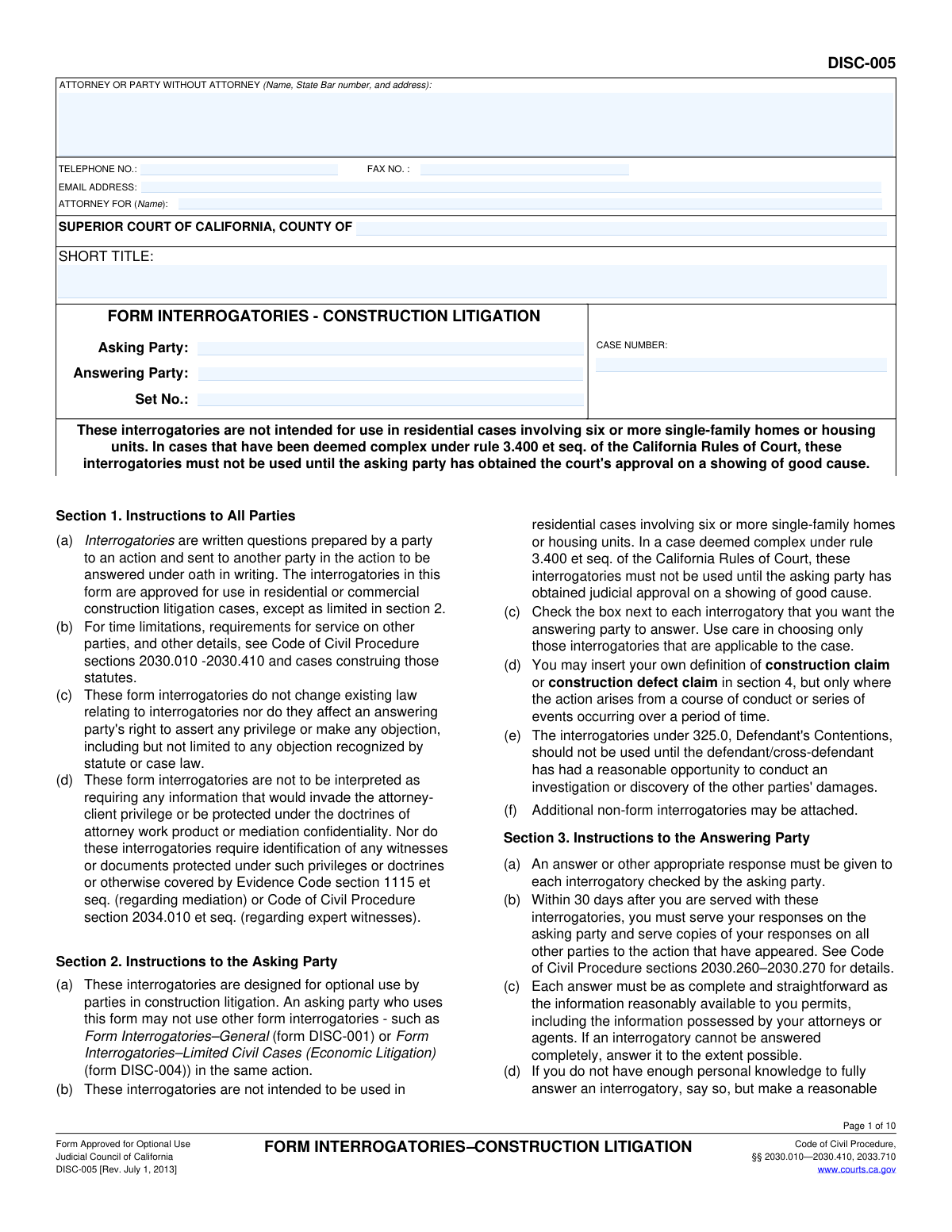
Yes! You can use AI to fill out Form DISC-005, Form Interrogatories—Construction Litigation
Form DISC-005, Form Interrogatories—Construction Litigation, is a standardized set of written questions used in the discovery phase of construction-related legal disputes in California. Approved by the Judicial Council, it helps parties gather essential facts about claims, damages, contracts, and other relevant issues from the opposing party. Today, this form can be filled out quickly and accurately using AI-powered services like Instafill.ai, which can also convert non-fillable PDF versions into interactive fillable forms.
DISC-005 is part of the
California court forms category on Instafill.
Our AI automatically handles information lookup, data retrieval, formatting, and form filling.
It takes less than a minute to fill out DISC-005 using our AI form filling.
Securely upload your data. Information is encrypted in transit and deleted immediately after the form is filled out.
Form specifications
| Form name: | Form DISC-005, Form Interrogatories—Construction Litigation |
| Number of fields: | 107 |
| Number of pages: | 1 |
| Language: | English |
Instafill Demo: How to fill out PDF forms in seconds with AI
How to Fill Out DISC-005 Online for Free in 2026
Are you looking to fill out a DISC-005 form online quickly and accurately? Instafill.ai offers the #1 AI-powered PDF filling software of 2026, allowing you to complete your DISC-005 form in just 37 seconds or less.
Follow these steps to fill out your DISC-005 form online using Instafill.ai:
- 1 Navigate to Instafill.ai and upload or select the Form DISC-005, Form Interrogatories—Construction Litigation.
- 2 Provide the initial case information, including the court, county, case number, and the names of the asking and answering parties.
- 3 If you are the Asking Party, use the platform's tools to check the boxes next to each interrogatory you want the Answering Party to answer.
- 4 If you are the Answering Party, use the AI assistant to draft comprehensive responses to the checked interrogatories, providing details on background, insurance, damages, and contracts as requested.
- 5 Review all the information entered, ensuring the answers are complete, accurate, and directly address the specific questions posed.
- 6 Electronically sign and date the declaration under penalty of perjury to verify the truthfulness of your answers.
- 7 Download the completed form and serve it on the asking party and all other parties in the action as required by the Code of Civil Procedure.
Our AI-powered system ensures each field is filled out correctly, reducing errors and saving you time.
Why Choose Instafill.ai for Your Fillable DISC-005 Form?
Speed
Complete your DISC-005 in as little as 37 seconds.
Up-to-Date
Always use the latest 2026 DISC-005 form version.
Cost-effective
No need to hire expensive lawyers.
Accuracy
Our AI performs 10 compliance checks to ensure your form is error-free.
Security
Your personal information is protected with bank-level encryption.
Frequently Asked Questions About Form DISC-005
This form is a set of standard written questions used during the discovery phase of a construction-related lawsuit in California. It helps one party (the Asking Party) gather information from another party (the Answering Party) about the case.
The 'Answering Party' in a lawsuit, or their attorney, must complete this form after receiving it from the 'Asking Party'. You only need to answer the specific questions that have been checked by the Asking Party.
Yes, this form is not intended for residential cases involving six or more single-family homes or housing units. It also requires court approval before being used in cases that have been officially deemed 'complex'.
You must serve your written, sworn answers on the asking party and all other parties in the lawsuit within 30 days of being served with the form.
You must answer as completely as possible with the information reasonably available to you. This includes making a good faith effort to get the information from your agents, attorneys, or others, unless that information is equally available to the asking party.
You must respond to each checked question, but you can object to a question if you believe the information is protected by attorney-client privilege, attorney work product, or another legal objection. Any objection must be clearly stated in your written response.
For many of the insurance details, you have the option to attach a complete and accurate copy of the insurance policy instead. However, you must still provide written answers to questions about any coverage disputes or reservations of rights from the insurer.
Verifying your answers means you must sign a statement at the end, under penalty of perjury, declaring that your answers are true and correct. This makes your responses official evidence in the legal proceeding.
No, the instructions state that an asking party who uses this specialized construction litigation form (DISC-005) may not also use other form interrogatories like DISC-001 in the same action.
You may need to reference contracts, change orders, insurance policies, project plans, inspection reports, and any correspondence related to the construction project and the claims being made.
Yes, services like Instafill.ai use AI to help you fill out legal forms accurately and efficiently. The AI can auto-fill information, saving you time and helping to avoid common mistakes.
You can upload the Form DISC-005 PDF to the Instafill.ai platform. The service will make the document interactive, allowing you to easily type in your answers, check the necessary boxes, and prepare the form for signature and submission.
You can use a service like Instafill.ai to solve this problem. It can convert flat, non-fillable PDFs into interactive forms that you can complete on your computer, saving you the hassle of printing and filling it out by hand.
Compliance DISC-005
Validation Checks by Instafill.ai
1
Case Information Completeness
This check ensures that the primary case identification fields in the header are all populated. It verifies that 'ATTORNEY OR PARTY WITHOUT ATTORNEY', 'ATTORNEY FOR', 'Asking Party', 'Answering Party', and 'CASE NUMBER' are not empty. This is critical for ensuring the document is correctly filed and associated with the proper legal case and parties. A failure would render the document invalid for court processing.
2
Case Number Format Validation
Validates that the 'CASE NUMBER' field follows the standard format for California Superior Court case numbers. This format is crucial for the court's electronic and manual filing systems to correctly identify and route the document. An incorrect format could lead to filing rejection, delays in the legal process, or the document being misfiled.
3
Attorney State Bar Number Presence
This check parses the 'ATTORNEY OR PARTY WITHOUT ATTORNEY' field to confirm the presence of a numeric California State Bar number if an attorney is listed. The State Bar number is a unique identifier required for legal practice and court filings. Missing or invalid numbers can call into question the authority of the filing attorney and lead to rejection by the court clerk.
4
Contact Information Formatting
Verifies that the 'TELEPHONE NO.', 'FAX NO.', and 'EMAIL ADDRESS' fields adhere to standard formats. Phone and fax numbers should follow a recognizable pattern (e.g., (XXX) XXX-XXXX), and the email address must contain an '@' symbol and a domain. This ensures that opposing counsel and the court can reliably contact the filing party, which is essential for communication throughout the litigation process.
5
Uniform Date Formatting
Ensures that all date entries throughout the form (e.g., date of birth in 302.2, date of conviction in 302.6, dates of employment in 302.4) follow a consistent and valid format, such as MM/DD/YYYY. Inconsistent or invalid date formats can cause confusion, lead to data entry errors in case management systems, and may be grounds for an objection to the sufficiency of the answer. This check prevents such ambiguity.
6
Chronological Consistency of Historical Dates
For questions requiring a history over a period of time, such as residence addresses for the past 15 years (302.3) or employment history (302.4), this check validates that the provided date ranges are sequential and logical. It ensures there are no backward time-travel paradoxes, significant unexplained gaps, or overlapping date ranges. This is important for establishing a clear and credible timeline of events.
7
Conditional Response for Felony Conviction
This validation rule is triggered by the response to interrogatory 302.6 ('Have you ever been convicted of a felony?'). If the answer is affirmative, the system checks that the required follow-up details in sub-parts (a) through (d), such as the date, offense, and case number, are all filled out. This ensures a complete response to a potentially critical question regarding witness credibility, preventing evasive or incomplete answers.
8
Business Entity Type Exclusivity
This check ensures that when a business entity is responding, it only fills out the section corresponding to its legal structure. For example, if the entity indicates it is a 'corporation' (303.1), the sections for 'partnership' (303.2), 'LLC' (303.3), and 'joint venture' (303.4) must be left blank. This prevents contradictory or confusing information about the legal status of the answering party.
9
Contractor License Status and Dates Logic
In section 303.7, this check verifies that any dates provided for a contractor's license lapse, suspension, or inactivity are valid date ranges. It also performs a logical check to ensure these dates do not conflict with the overall period of work claimed to have been performed on the project. This is crucial for determining if work was performed legally and without a valid license.
10
Insurance Policy Completeness Check
For each insurance policy listed in response to interrogatory 304.1, this check verifies that the mandatory fields are completed. It ensures that either a full copy of the policy is attached or, at a minimum, that the policy number, effective dates, and custodian information (items j-l) are provided as instructed. Incomplete insurance information can severely hamper the progress of litigation, which often revolves around insurance coverage.
11
Damage Claim Calculation Explanation
This validation targets interrogatory 305.1(d), which asks for the amount of damage being claimed. The check ensures that if a monetary value is entered, the accompanying explanation of how that amount was calculated is not left empty. This prevents parties from asserting unsubstantiated damage figures and forces them to provide a basis for their claims, which is fundamental to the discovery process.
12
Signature and Date of Verification
This check confirms that the signature block on the final page contains a typed name and a valid date. Answers to interrogatories must be signed under penalty of perjury to be legally valid. The absence of a signature or date renders the entire set of responses legally insufficient and subject to being stricken.
13
Cross-Validation of Work Dates and License Status
This is a sophisticated logical check that compares the work dates provided in section 321.4 with the contractor's license status dates from section 303.7. It flags any instances where work was allegedly performed during a period when the license was reported as lapsed, suspended, or inactive. This is vital for establishing potential legal violations or defenses in construction litigation.
14
Consistency of Answering Party Name
This validation ensures the name of the 'Answering Party' listed in the header (field party2) is consistent with the name provided in the detailed background information sections. For an individual, it should match the name in 302.1; for a business, it should match the name in 303.1, 303.2, etc. This prevents ambiguity about who is formally providing the sworn answers.
Common Mistakes in Completing DISC-005
Parties often forget to sign and date the declaration under penalty of perjury at the end of their responses. This is a critical error because unverified responses are legally equivalent to providing no response at all. This can lead to the court deeming all facts admitted or imposing monetary sanctions, severely damaging the answering party's case. Always double-check that the party themselves, not just the attorney, has signed and dated the final verification page.
In section 304.1, respondents frequently fail to list all potentially applicable insurance policies, such as excess or umbrella policies, or they omit crucial details like coverage disputes or reservation of rights letters. This happens due to poor record-keeping or a misunderstanding of what's required. Incomplete disclosure can lead to motions to compel, sanctions, and potential claims of bad faith or waiver of coverage defenses. To avoid this, conduct a thorough search of all policies and be transparent about any communications with insurers.
When responding to interrogatory 324.1, which asks for the facts supporting each affirmative defense, parties often provide boilerplate or conclusory statements without factual support. This is improper and invites a motion to compel from the asking party, wasting time and money. Before asserting a defense in your initial pleading, you should have a good-faith basis for it, and you must state those supporting facts when asked in discovery. Each defense listed must be backed by specific names, dates, events, and documents.
The form defines terms like 'You,' 'Document,' and 'Contract' very broadly in Section 4, but people often answer based on a narrow, everyday understanding. For example, a response to 'You' must include information known by your agents, employees, and attorneys, not just your personal knowledge. This mistake leads to evasive and incomplete answers, requiring supplemental responses and potentially weakening your credibility. Carefully review all definitions before answering any questions to ensure your response is fully compliant.
In the contracts section (314.1), parties tend to focus only on the primary written agreement, forgetting to disclose subsequent oral modifications, change orders, or informal understandings. Construction projects are dynamic, and these modifications are legally significant parts of the contract. Failing to disclose them provides an incomplete picture and can be used to attack your credibility or claims. Diligently document all written and oral agreements related to the project to ensure a complete response.
Instruction 3(e) allows referring to a document for an answer, but parties often make a vague reference like 'See documents produced' without specifying the exact page, section, or Bates stamp number. This is an improper, evasive response that forces the asking party to search through potentially thousands of pages. To avoid this, always provide a precise citation so the answer can be easily located, or consider using an AI-powered tool like Instafill.ai to manage and reference document productions efficiently.
When answering questions about property damages (305.0), homeowners or property owners often neglect to mention maintenance, repairs, or improvements they performed themselves (305.8, 305.9). The opposing party will argue these actions were an intervening cause of the damage or that they altered the original condition. Omitting this information can damage your credibility and your case when it is inevitably discovered through other means, such as a site inspection.
Mistakes in the header section, such as an incorrect case number, misspelled party names, or the wrong court county, are surprisingly common. These errors can cause the document to be rejected by the court clerk, leading to missed deadlines and the need to re-serve all parties. Using an AI form-filling tool like Instafill.ai can help prevent these data entry errors by saving and auto-populating correct case information across all related legal documents.
Interrogatory 301.1 requires identifying every person who assisted in preparing the answers, but parties often only list the attorney or the signatory. They forget to include paralegals, spouses, or colleagues who helped gather information or formulate the responses. This omission can lead to challenges regarding the completeness of the investigation undertaken to answer the interrogatories. To avoid this, keep a log of everyone who contributes to the response preparation process.
Respondents often answer 'I don't know' to a question without making the required 'reasonable and good faith effort to get the information' (Instruction 3(d)). The law requires you to investigate information reasonably available to you, including from your agents, employees, or records. Simply claiming lack of personal knowledge is insufficient and can result in a motion to compel further responses. Document your efforts to find the information to demonstrate you have met your legal duty.
Saved over 80 hours a year
“I was never sure if my IRS forms like W-9 were filled correctly. Now, I can complete the forms accurately without any external help.”
Kevin Martin Green
Your data stays secure with advanced protection from Instafill and our subprocessors

Robust compliance program
Transparent business model
You’re not the product. You always know where your data is and what it is processed for.
ISO 27001, HIPAA, and GDPR
Our subprocesses adhere to multiple compliance standards, including but not limited to ISO 27001, HIPAA, and GDPR.
Security & privacy by design
We consider security and privacy from the initial design phase of any new service or functionality. It’s not an afterthought, it’s built-in, including support for two-factor authentication (2FA) to further protect your account.
Fill out DISC-005 with Instafill.ai
Worried about filling PDFs wrong? Instafill securely fills form-disc-005-form-interrogatoriesconstruction-litigation forms, ensuring each field is accurate.