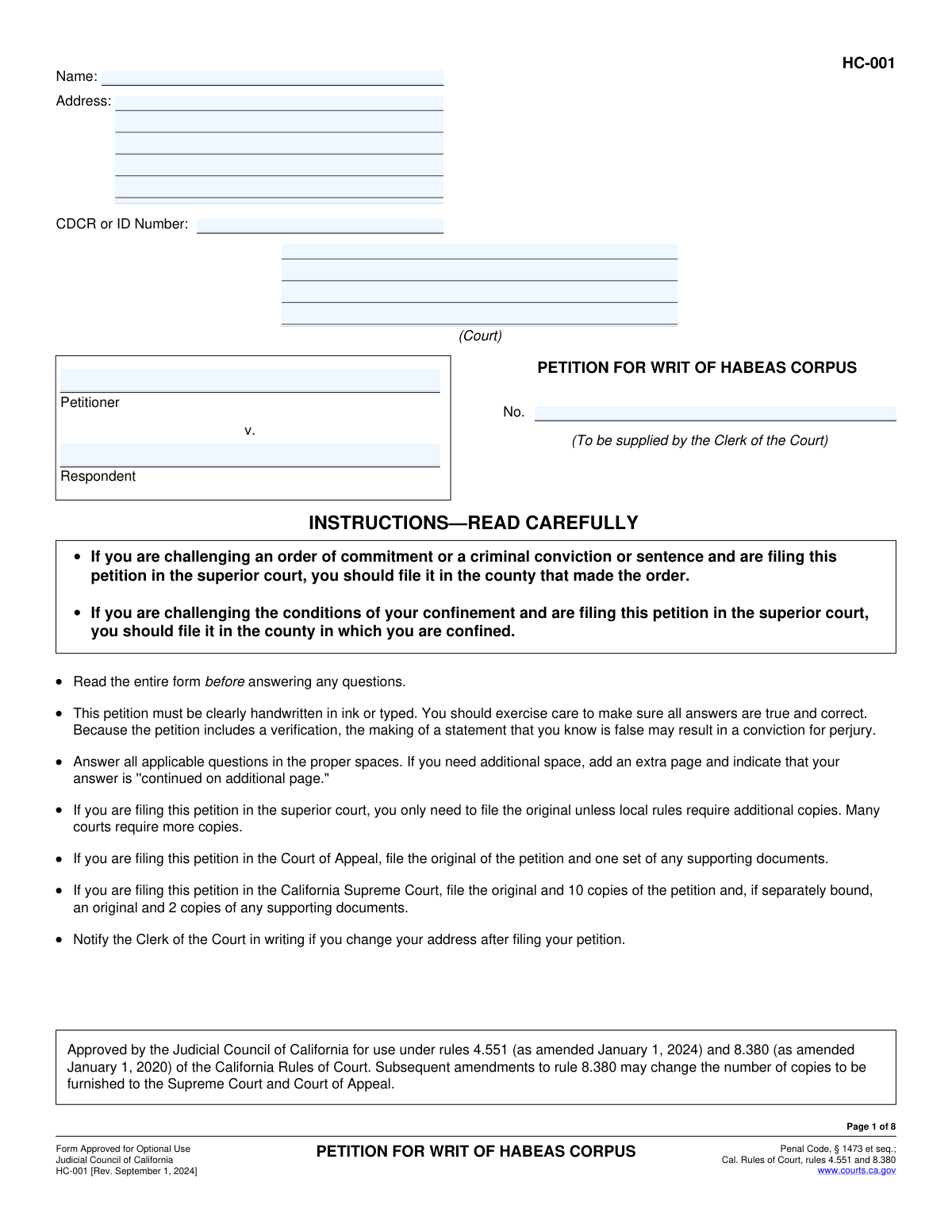
Yes! You can use AI to fill out Form HC-001, Petition for Writ of Habeas Corpus
California Form HC-001, Petition for Writ of Habeas Corpus, is a crucial legal document filed to challenge the lawfulness of a person's imprisonment or the conditions of their confinement. Petitioners use this form to argue that their constitutional rights have been violated, seeking relief from the court, which can range from release to a change in sentence or prison conditions. This extensive petition requires detailed information about the case history, claims for relief, and prior appeals; today, this form can be filled out quickly and accurately using AI-powered services like Instafill.ai, which can also convert non-fillable PDF versions into interactive fillable forms.
HC-001 is part of the
California court forms category on Instafill.
Our AI automatically handles information lookup, data retrieval, formatting, and form filling.
It takes less than a minute to fill out HC-001 using our AI form filling.
Securely upload your data. Information is encrypted in transit and deleted immediately after the form is filled out.
Form specifications
| Form name: | Form HC-001, Petition for Writ of Habeas Corpus |
| Number of fields: | 142 |
| Number of pages: | 1 |
| Language: | English |
Instafill Demo: How to fill out PDF forms in seconds with AI
How to Fill Out HC-001 Online for Free in 2026
Are you looking to fill out a HC-001 form online quickly and accurately? Instafill.ai offers the #1 AI-powered PDF filling software of 2026, allowing you to complete your HC-001 form in just 37 seconds or less.
Follow these steps to fill out your HC-001 form online using Instafill.ai:
- 1 Navigate to Instafill.ai and upload or select the California Form HC-001, Petition for Writ of Habeas Corpus.
- 2 Allow the AI to scan and process the form, identifying all the required fields for personal information, case details, and legal claims.
- 3 Enter your personal details, including your name, address, and CDCR or ID number, and specify the reason for your custody or supervised release.
- 4 Carefully detail your claims for relief in Section 6, providing supporting facts and referencing any attached documents for each claim.
- 5 Complete the sections on your case history, including information about appeals (Section 7), reviews by the California Supreme Court (Section 8), and any other petitions filed (Section 11).
- 6 If applicable, complete Section 18 regarding claims under the Racial Justice Act, checking all relevant boxes and providing necessary explanations.
- 7 Thoroughly review all entered information for accuracy, then sign and date the declaration under penalty of perjury on the final page.
Our AI-powered system ensures each field is filled out correctly, reducing errors and saving you time.
Why Choose Instafill.ai for Your Fillable HC-001 Form?
Speed
Complete your HC-001 in as little as 37 seconds.
Up-to-Date
Always use the latest 2026 HC-001 form version.
Cost-effective
No need to hire expensive lawyers.
Accuracy
Our AI performs 10 compliance checks to ensure your form is error-free.
Security
Your personal information is protected with bank-level encryption.
Frequently Asked Questions About Form HC-001
This form is used to file a legal petition with a California court to challenge the legality of your imprisonment, the conditions of your confinement, or other restrictions on your liberty, such as parole conditions.
You should fill out this form if you are incarcerated or on supervised release (like probation or parole) and believe you are being held unlawfully or that your rights are being violated.
If you are challenging a conviction or sentence, file it in the superior court of the county that made the order. If you are challenging your conditions of confinement, file it in the superior court of the county where you are confined.
For a superior court, file the original (check local rules for more). For the Court of Appeal, file the original and one set of supporting documents. For the California Supreme Court, file the original and 10 copies of the petition.
You must state specific facts about what happened, who did what to violate your rights, and when and where it occurred. Simply stating conclusions, like 'my counsel was incompetent,' is not enough and may result in denial.
Supporting documents are records, transcripts, declarations, or other papers that help prove your claim. It is very important to attach these, as the court relies on them to evaluate the facts you present.
This means you must complete any available internal appeal or grievance process (like a prison's internal review) before filing this petition with the court. Failure to do so can cause your petition to be denied.
In question 9, you must explain why the claim was not made on appeal. For example, you might explain that new facts were discovered that were not known at the time of your appeal.
This is a specific claim you can make if you believe that bias or animus based on your race, ethnicity, or national origin was a factor in your conviction or sentence.
This petition is signed under penalty of perjury. Knowingly making a false statement is a crime and could result in a conviction for perjury.
Yes, services like Instafill.ai use AI to accurately auto-fill form fields with your information, which can save you time and help prevent errors.
You can use a service like Instafill.ai to upload the PDF, fill it out interactively on your computer or mobile device, and then download or print the completed form for filing.
If you have a non-fillable PDF, you can use a tool like Instafill.ai. It can convert flat PDFs into interactive, fillable forms that you can easily complete online.
Compliance HC-001
Validation Checks by Instafill.ai
1
Ensures Petitioner Name Consistency
This check verifies that the petitioner's name entered in the top caption of Page 1 is identical to the name entered in question 1. Consistency is crucial for accurate case identification and record-keeping. A mismatch could lead to processing delays or incorrect filing.
2
Requires Specification for 'Other' Petition Concern
Validates that if the 'Other' checkbox is selected under 'This petition concerns:', the corresponding text field is filled out. This ensures the court understands the specific, non-standard nature of the petition from the outset. Failure to specify will result in an incomplete and ambiguous filing.
3
Conditional Supervised Release Details
This check ensures that if the petitioner answers 'Yes' to being on supervised release in question 2b, they must specify the type of release (e.g., probation, parole). This information is vital for the court to understand the petitioner's current custody status and jurisdiction. An empty specification field would make the 'Yes' answer meaningless.
4
Logical Date Sequence for Conviction and Sentencing
Verifies that the 'Date sentenced' (question 3f) is on or after the 'Date convicted' (question 3e). A sentencing date cannot precede a conviction date. This check prevents logical impossibilities in the case timeline, ensuring the data's integrity for judicial review.
5
Conditional Requirement for Trial Counsel Information
If the petitioner indicates 'Yes' to being represented by counsel in the trial court (question 3i), this validation ensures the attorney's name and address field is not left blank. This information is necessary for the court to contact the attorney or review their performance if it is a subject of the petition. Failure to provide the name makes the 'Yes' response incomplete.
6
Mandatory 'Supporting Facts' for Claim 1
This check confirms that the 'Supporting facts' text area for the first claim (question 6a) is not empty. This section is the core of the petition, containing the factual basis for the relief sought. An empty facts section means there is no claim to evaluate, leading to immediate denial of the petition.
7
Conditional Requirement for Appeal Details
Ensures that if a petitioner answers 'Yes' to having appealed their conviction (question 7), they must provide the essential details of that appeal, such as the court name, result, and date. This information is critical for establishing the procedural history of the case and determining if issues were previously raised. Missing details can halt the review process.
8
Conditional Disclosure of Prior Petitions
This validation checks that if the petitioner answers 'Yes' to question 11, confirming they have filed other petitions, they must provide the details of at least one prior proceeding in question 12. This is crucial for the court to assess potential procedural bars, such as successive or abusive petitions. Failure to disclose prior filings can result in sanctions or dismissal.
9
Racial Justice Act Section Trigger
Verifies that if the petition concerns a 'violation of the Racial Justice Act' (checkbox on page 2), then at least one sub-question within section 18 must be answered. Conversely, if the RJA box is not checked, section 18 should be empty. This ensures that the detailed RJA section is only filled out when relevant, preventing confusion and unnecessary data.
10
Conditional Judge Name for RJA Claim
In the Racial Justice Act section (question 18c), if the petitioner answers 'Yes' that the claim is based on a statement or conduct by a judge, this check ensures the judge's name is provided. Identifying the specific judicial officer is essential for investigating the claim. An omission would render the allegation too vague to be actionable.
11
Conditional RJA Appointed Counsel Logic
This check validates that if a petitioner requests appointed counsel for a Racial Justice Act claim (question 18d), they must also answer the follow-up question about whether they can afford to hire counsel. This two-part question is necessary to determine eligibility for court-appointed counsel based on indigency. An incomplete response prevents the court from ruling on the counsel request.
12
Conditional RJA Amendment Request Details
If a petitioner answers 'Yes' to question 18e, requesting to amend a pending petition with a Racial Justice Act claim, this validation ensures the court name and case number of the pending petition are provided. This information is mandatory for the clerk to locate the correct case file to which the amendment applies. Without it, the request cannot be processed.
13
Mandatory Signature Date
This validation ensures that the signature date field on the final page is filled out with a valid, non-future date. The signature and date certify under penalty of perjury that the information is true and correct as of that day. A missing or invalid date can render the entire legal document invalid.
14
Mandatory Custody Basis Selection
This check requires the petitioner to select either 'Criminal conviction' or 'Civil commitment' in question 3. This selection is fundamental as it establishes the legal grounds for their confinement or supervision and dictates which subsequent legal standards apply. The form cannot be properly evaluated without this basic information.
15
Administrative Exhaustion for Confinement Claims
If the petition concerns 'Jail or prison conditions', this check verifies that question 10a, explaining the administrative remedies sought, is filled out. Courts require prisoners to exhaust all available administrative remedies before filing a habeas petition on confinement conditions. Failure to provide this explanation will likely lead to the petition's dismissal for procedural reasons.
Common Mistakes in Completing HC-001
In the 'Claims for Relief' section, petitioners often write conclusions like 'my counsel was ineffective' or 'my rights were violated.' This happens because they focus on the legal outcome they want rather than the events that occurred. The court will deny a petition that lacks specific, supporting facts, as it has no factual basis to evaluate the claim. To avoid this, describe exactly who did what, when, and where, detailing how the action or inaction specifically harmed your case, as instructed in Item 6a.
For claims regarding prison conditions or discipline, petitioners frequently file in court before completing the required internal grievance process (e.g., CDCR Form 602). This mistake, often due to impatience or misunderstanding procedure, results in an automatic denial of the petition for failing to exhaust available remedies. Before filing, you must complete every level of administrative review and attach documentation proving it, as noted in Item 10. This ensures the court only hears issues that the correctional facility has had a chance to resolve first.
Petitioners sometimes overlook the final signature and date line on page 8. An unsigned petition is legally invalid and will be rejected by the court clerk, causing significant delays and requiring a complete refiling. This simple oversight can happen in the rush to complete the lengthy form. Always double-check the last page to ensure you have signed and dated the verification under penalty of perjury before mailing.
A petition may state valid claims, but if it lacks attached evidence like court records, transcripts, or declarations, it will likely be denied. Petitioners may lack access to these documents or not realize their importance, but the court cannot verify the claims without them, as referenced in Items 6b and 10b. You must make every effort to obtain and attach all relevant documents that support the facts alleged in your petition.
Courts require habeas petitions to be filed promptly after the grounds for the claim are discovered. Many petitioners leave Item 14 blank or provide a weak reason for a long delay between the conviction and the filing. This can cause the petition to be dismissed as untimely without the court ever considering its merits. To avoid this, you must provide a detailed, credible explanation for any significant delay, such as the recent discovery of new evidence.
In the caption on the first page, petitioners often mistakenly name the judge, the prosecutor, or the 'State of California' as the respondent. The correct respondent is the person who has legal custody of the petitioner, such as the warden of the prison where they are incarcerated. This error can cause procedural confusion and delays in serving the correct party. Always identify your current custodian as the respondent.
Petitioners may fail to disclose previous appeals or other habeas petitions in Items 7, 8, and 11, either from poor record-keeping or a misguided belief that it will help their case. Courts disfavor successive petitions and will check records, so any omission can lead to a summary denial and damage the petitioner's credibility. It is critical to truthfully and completely list all prior court proceedings related to the case.
The instructions on page 1 specify where to file, but the distinction is often missed: challenges to a conviction belong in the county of the sentencing court, while challenges to confinement conditions belong in the county of incarceration. Filing in the wrong venue will not get the petition dismissed outright but will cause a lengthy delay as the case is transferred to the correct court. Carefully read the instructions to ensure you file in the proper jurisdiction from the start.
The form must be 'clearly handwritten in ink or typed,' but many handwritten petitions are difficult to read. Furthermore, petitioners may cram multiple distinct legal claims into the space for 'Claim 1' instead of using separate pages as instructed. A messy or disorganized petition frustrates the court and may prevent a clear understanding of the claims, increasing the chance of denial. Using a typewriter or an AI tool like Instafill.ai, which can convert a flat PDF into a fillable version, ensures the final document is neat, legible, and properly organized.
In Item 3, petitioners often provide incorrect case numbers, sentencing dates, or vague descriptions of their offense. This occurs due to faded memory or lack of access to official records. Missing or wrong information forces the court clerk to spend extra time locating the case file, delaying the review process. Using an AI-powered tool like Instafill.ai can help prevent these data entry errors by validating formats and ensuring all critical fields are completed accurately.
Saved over 80 hours a year
“I was never sure if my IRS forms like W-9 were filled correctly. Now, I can complete the forms accurately without any external help.”
Kevin Martin Green
Your data stays secure with advanced protection from Instafill and our subprocessors

Robust compliance program
Transparent business model
You’re not the product. You always know where your data is and what it is processed for.
ISO 27001, HIPAA, and GDPR
Our subprocesses adhere to multiple compliance standards, including but not limited to ISO 27001, HIPAA, and GDPR.
Security & privacy by design
We consider security and privacy from the initial design phase of any new service or functionality. It’s not an afterthought, it’s built-in, including support for two-factor authentication (2FA) to further protect your account.
Fill out HC-001 with Instafill.ai
Worried about filling PDFs wrong? Instafill securely fills form-hc-001-petition-for-writ-of-habeas-corpus forms, ensuring each field is accurate.