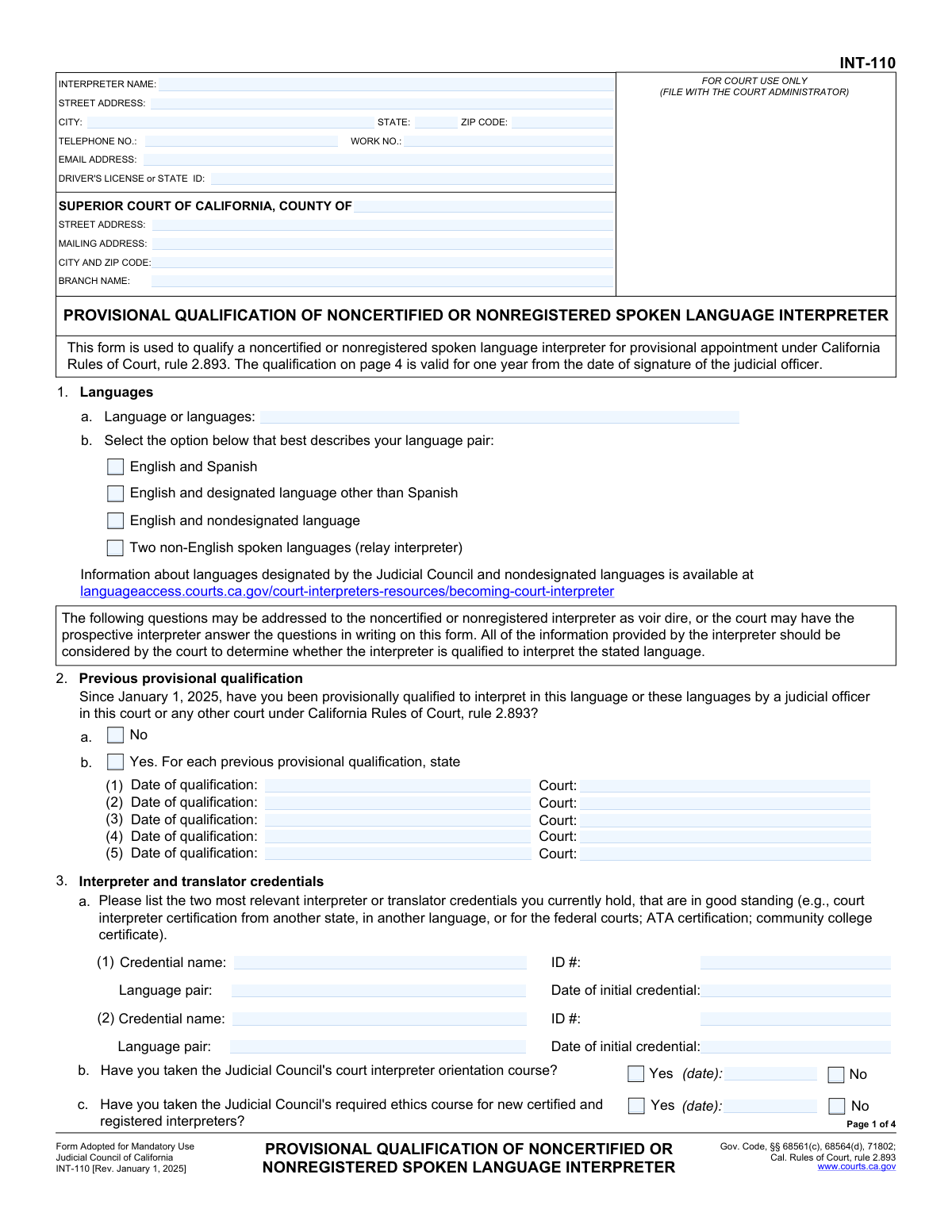
Yes! You can use AI to fill out Form INT-110, Provisional Qualification of Noncertified or Nonregistered Spoken Language Interpreter
This is Form INT-110, a mandatory document from the Judicial Council of California for the provisional qualification of noncertified or nonregistered spoken language interpreters. It is used by the court to evaluate an interpreter's language skills, training, experience, and understanding of ethics to determine if they are qualified for a provisional appointment in court proceedings. Today, this form can be filled out quickly and accurately using AI-powered services like Instafill.ai, which can also convert non-fillable PDF versions into interactive fillable forms.
INT-110 is part of the
California court forms category on Instafill.
Our AI automatically handles information lookup, data retrieval, formatting, and form filling.
It takes less than a minute to fill out INT-110 using our AI form filling.
Securely upload your data. Information is encrypted in transit and deleted immediately after the form is filled out.
Form specifications
| Form name: | Form INT-110, Provisional Qualification of Noncertified or Nonregistered Spoken Language Interpreter |
| Number of fields: | 212 |
| Number of pages: | 1 |
| Language: | English |
Instafill Demo: How to fill out PDF forms in seconds with AI
How to Fill Out INT-110 Online for Free in 2026
Are you looking to fill out a INT-110 form online quickly and accurately? Instafill.ai offers the #1 AI-powered PDF filling software of 2026, allowing you to complete your INT-110 form in just 37 seconds or less.
Follow these steps to fill out your INT-110 form online using Instafill.ai:
- 1 Navigate to Instafill.ai and upload or select Form INT-110.
- 2 Use the AI assistant to automatically fill in your personal information, including your name, address, contact details, and driver's license number.
- 3 Provide details about your language pairs, any existing credentials, and history of interpreter examinations you have taken.
- 4 Document your interpreting and translation training, including institutions attended, observation hours, and legal interpreting training.
- 5 Detail your interpreting experience in both court and non-court settings, professional memberships, and affirm your understanding of the code of professional conduct.
- 6 Answer questions regarding your education, language acquisition, and disclose any past disqualifications or criminal offenses.
- 7 Review all the information for accuracy, then electronically sign and date the declaration under penalty of perjury before submitting it to the court.
Our AI-powered system ensures each field is filled out correctly, reducing errors and saving you time.
Why Choose Instafill.ai for Your Fillable INT-110 Form?
Speed
Complete your INT-110 in as little as 37 seconds.
Up-to-Date
Always use the latest 2026 INT-110 form version.
Cost-effective
No need to hire expensive lawyers.
Accuracy
Our AI performs 10 compliance checks to ensure your form is error-free.
Security
Your personal information is protected with bank-level encryption.
Frequently Asked Questions About Form INT-110
This form is used to provisionally qualify a spoken language interpreter who is not yet certified or registered, allowing them to be appointed for work in California courts for a temporary period of one year.
You should fill out this form if you are a spoken language interpreter seeking to work in California courts but are not currently certified or registered by the Judicial Council of California.
A provisional qualification is valid for one year from the date it is signed by a judicial officer.
The form is filed with the Court Administrator and reviewed by a judicial officer. If approved, the officer will sign the order on page 4, qualifying you to be considered for appointments in that court for one year.
Yes, for a third or subsequent qualification after January 1, 2025, you must demonstrate that you've made at least two attempts to pass a qualifying exam in the last two years and have completed the Judicial Council's ethics training.
You must provide detailed information about your language skills, education, credentials, examination history, interpreting experience, and any past criminal offenses or professional disqualifications.
The Judicial Council designates certain languages for which it offers certification exams. All other languages are considered nondesignated; you can find an official list on the California Courts language access website.
No, the form explicitly states that you do not need to include traffic infractions when disclosing any past convictions.
That's okay, as this form is for noncertified interpreters. The court will consider all the information you provide about your training, experience, and education to determine your qualifications.
Yes, services like Instafill.ai use AI to accurately auto-fill form fields with your personal information, which can save you time and help reduce errors.
You can upload the form to the Instafill.ai platform. Its AI will identify the fields, allowing you to fill them out online or have them auto-filled with your saved information before you download the completed document.
You can use a service like Instafill.ai, which is designed to convert flat, non-fillable PDFs into interactive forms that you can easily complete on your computer.
It is not mandatory for a first-time applicant, but it is required for interpreters seeking a third or subsequent provisional qualification after January 1, 2025. Completing the course is highly recommended for all applicants.
Compliance INT-110
Validation Checks by Instafill.ai
1
Contact Information Format Validation
This check verifies that the 'TELEPHONE NO.' and 'EMAIL ADDRESS' fields are in the correct format. The phone number should match a standard US phone number pattern (e.g., (xxx) xxx-xxxx), and the email address must conform to the standard '[email protected]' structure. This is crucial for ensuring the court can reliably contact the interpreter. An invalid format will prevent submission and prompt the user to correct the entry.
2
Language Pair Single Selection
Validates that in Section 1b, the user has selected exactly one option to describe their language pair. The form presents four mutually exclusive choices. This check ensures the submission is not ambiguous and clearly states the interpreter's working languages. If zero or more than one option is selected, an error message will be displayed, requiring the user to make a single choice.
3
Conditional Requirement for Previous Qualification Details
This validation checks Section 2. If the user answers 'Yes' to having been previously provisionally qualified, then at least one of the five sub-entries for 'Date of qualification' and 'Court' must be filled. This ensures that affirmative answers are substantiated with required details. A failure to provide details after selecting 'Yes' will result in a validation error, blocking submission until the information is provided.
4
Conditional Requirement for Course Dates
In Sections 3b, 3c, and 9a, if the user checks 'Yes' to indicate they have taken a course, the corresponding date field becomes mandatory. This check ensures that claims of completing required training are backed by a specific date. If 'Yes' is selected but the date is left blank, the form will prompt the user to enter the completion date.
5
Chronological Validity of Dates
This check scans all date fields on the form (e.g., qualification dates, credential dates, course dates) and verifies that they are not in the future. All provided dates must be on or before the submission date. This prevents logical impossibilities and ensures the historical accuracy of the information provided. A future date will trigger an error message.
6
Mandatory Ethics Agreement
This validation ensures that the user has checked 'Yes' for question 9c, 'Have you read, do you understand, and will you abide by the Professional Standards and Ethics for California Court Interpreters?'. This is a critical prerequisite for qualification. If 'No' is selected, the form submission should be blocked, and a message should inform the user that agreement is mandatory to proceed.
7
Conditional Explanation for Disqualifications
This check applies to Section 13. If the user answers 'Yes' to having been disqualified (13a) or convicted of an offense (13b), the corresponding 'If yes, please explain' text area becomes a required field. This ensures that potentially disqualifying information is fully disclosed and explained as required. The form cannot be submitted until an explanation is provided for a 'Yes' answer.
8
Interpreter Name Consistency Across Pages
This validation ensures that the 'INTERPRETER (name)' field at the top of pages 2, 3, and 4 is consistent with the 'INTERPRETER NAME' entered on page 1. This is important for document integrity and clarity, ensuring all pages clearly belong to the same applicant. In a digital form, this should be an auto-populated, read-only field after page 1 to prevent discrepancies.
9
Completeness of Credential Entry
In Section 3a, if a user enters a 'Credential name', this check ensures that the associated 'ID #', 'Language pair', and 'Date of initial credential' fields are also filled out. This prevents partial or incomplete entries for professional credentials. The system should flag the incomplete entry and require all fields for that credential to be completed before submission.
10
Conditional Requirement for Experience Details
This validation applies to Section 8. If 'Yes' is checked for court interpreting experience (8a) or non-court experience (8b), the subsequent fields detailing that experience become mandatory. For example, in 8a, at least one proceeding type must have a number, and in 8b, the 'type' and 'number of events' must be filled. This ensures that claims of experience are properly quantified and described.
11
Signature and Date Requirement
This check verifies that the 'Date' and 'SIGNATURE OF PROSPECTIVE INTERPRETER' fields on page 4 are completed before submission. The signature and date are essential to attest that the information provided is true and correct under penalty of perjury. An empty signature or date field will prevent the form from being finalized.
12
Third Qualification Period Logic for Exams
This is a complex logical check based on the note in Section 4. It first counts the number of previous qualifications listed in Section 2. If the count is two or more, it then verifies that the user has documented at least two attempts to pass a qualifying exam in Section 4. This ensures compliance with the rule for interpreters seeking a third or subsequent qualification. If the condition is not met, a warning or error is displayed.
Common Mistakes in Completing INT-110
In Section 13, applicants sometimes omit past criminal convictions or professional disqualifications, fearing it will negatively impact their application. This is a critical error, as the form is signed under penalty of perjury and omissions can be discovered during background checks. Failing to disclose this information will lead to automatic disqualification and potential legal penalties, which is far more severe than the potential impact of a disclosed issue.
Applicants often forget or inaccurately list the dates and courts for previous provisional qualifications in Section 2. This history is crucial, as the court uses it to determine eligibility, especially for those seeking a third or subsequent qualification which has stricter requirements. Missing or incorrect information can significantly delay the process or lead to an outright rejection for failing to meet statutory criteria.
In Section 1, an applicant might enter a general language like 'Chinese' instead of the specific dialect like 'Mandarin' or 'Cantonese.' This ambiguity forces the court to seek clarification, delaying the qualification process. Always specify the exact language or dialect you interpret and carefully review the Judicial Council's definitions to select the correct language pair category (e.g., 'designated' vs. 'nondesignated').
Answering 'No' to Section 9c, which asks if you have read, understand, and will abide by the Professional Standards and Ethics, is an automatic disqualifier. Some applicants may answer honestly without realizing this is a non-negotiable prerequisite for qualification. Before filling out the form, you must obtain, read, and be prepared to adhere to the state's code of ethics for court interpreters.
A surprisingly common and simple mistake is failing to sign or date the declaration on Page 4. An unsigned or undated application is legally invalid and cannot be processed by the court administrator. This results in an immediate rejection and requires the applicant to resubmit the entire form, causing unnecessary delays. Always perform a final review to ensure the signature and date fields are complete.
Throughout the form (e.g., Sections 5, 8, 10), applicants will check 'Yes' to having experience or training but then fail to provide the required supporting details like hours, dates, or specific descriptions. A simple 'Yes' is insufficient for the court to assess competency and will be treated as an incomplete answer. To avoid this, gather all relevant records beforehand and be prepared to provide specific, detailed information for every claim made.
Section 4 requires precise details about examination attempts, which is especially critical for interpreters seeking a third or subsequent qualification period. Applicants often fail to list the required two attempts, misremember dates, or provide vague results. This can lead to an application being denied for not demonstrating a good faith effort to achieve certification. Maintaining meticulous records of all exam registrations and results is essential for accuracy.
In Section 3a, which asks for formal credentials, applicants may mistakenly list certificates of attendance from workshops or short training sessions. This misrepresents their qualifications, as a credential typically involves passing a rigorous exam from a recognized body like a state or federal court system. List only formal, in-good-standing credentials in this section and report other training in the appropriate section (Section 5) to provide a clear and accurate profile.
Applicants often see the 'FOR COURT USE ONLY' heading on Page 1 and leave the entire court address block empty. However, these fields are for the applicant to specify which Superior Court they are seeking qualification from. Submitting the form without this information makes it unclear where it should be filed, leading to processing delays or the form being returned. AI-powered tools like Instafill.ai can help prevent this by flagging required fields that have been left empty.
Data entry errors like inconsistent date formats (MM/DD/YY vs. MM/DD/YYYY), typos in court names, or incorrectly formatted phone numbers are common. These small mistakes can make the form look unprofessional and may cause data processing issues. If the form is a non-fillable PDF, these errors are even more likely when filling it out by hand. Using a tool like Instafill.ai can solve both problems by converting the form to a fillable version and auto-filling information with consistent, validated formatting.
Saved over 80 hours a year
“I was never sure if my IRS forms like W-9 were filled correctly. Now, I can complete the forms accurately without any external help.”
Kevin Martin Green
Your data stays secure with advanced protection from Instafill and our subprocessors

Robust compliance program
Transparent business model
You’re not the product. You always know where your data is and what it is processed for.
ISO 27001, HIPAA, and GDPR
Our subprocesses adhere to multiple compliance standards, including but not limited to ISO 27001, HIPAA, and GDPR.
Security & privacy by design
We consider security and privacy from the initial design phase of any new service or functionality. It’s not an afterthought, it’s built-in, including support for two-factor authentication (2FA) to further protect your account.
Fill out INT-110 with Instafill.ai
Worried about filling PDFs wrong? Instafill securely fills form-int-110-provisional-qualification-of-noncertified-or-nonregistered-spoken-language-interpreter forms, ensuring each field is accurate.