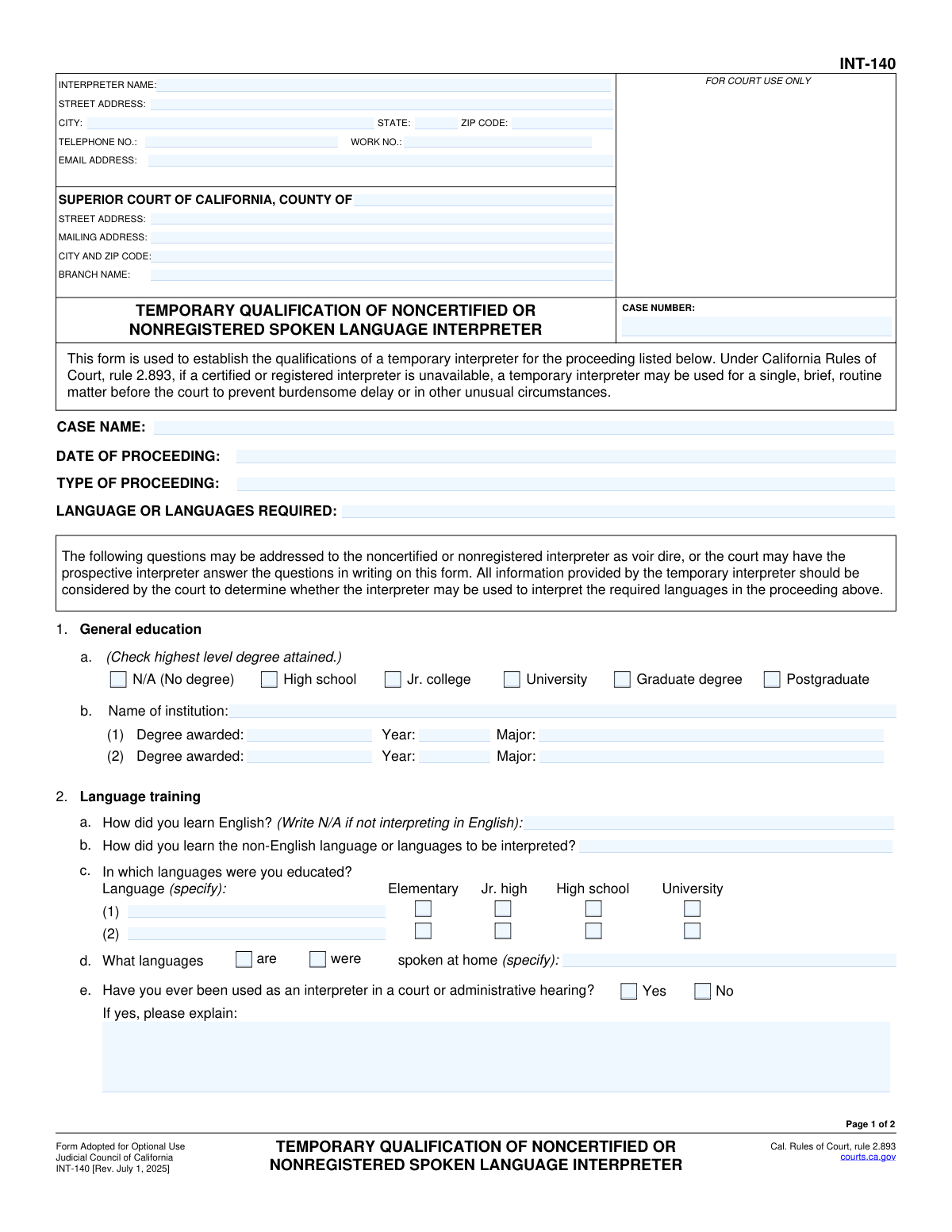
Yes! You can use AI to fill out Form INT-140, Temporary Qualification of Noncertified or Nonregistered Spoken Language Interpreter
Form INT-140, Temporary Qualification of Noncertified or Nonregistered Spoken Language Interpreter, is a legal document used in the Superior Court of California. Its purpose is to vet and qualify a temporary interpreter for a single, brief matter to prevent delays when a certified interpreter cannot be found, as outlined in California Rules of Court, rule 2.893. The form collects information on the interpreter's background, education, language skills, and any potential disqualifications to ensure they are competent for the proceeding. Today, this form can be filled out quickly and accurately using AI-powered services like Instafill.ai, which can also convert non-fillable PDF versions into interactive fillable forms.
INT-140 is part of the
California court forms category on Instafill.
Our AI automatically handles information lookup, data retrieval, formatting, and form filling.
It takes less than a minute to fill out INT-140 using our AI form filling.
Securely upload your data. Information is encrypted in transit and deleted immediately after the form is filled out.
Form specifications
| Form name: | Form INT-140, Temporary Qualification of Noncertified or Nonregistered Spoken Language Interpreter |
| Number of fields: | 70 |
| Number of pages: | 1 |
| Language: | English |
Instafill Demo: How to fill out PDF forms in seconds with AI
How to Fill Out INT-140 Online for Free in 2026
Are you looking to fill out a INT-140 form online quickly and accurately? Instafill.ai offers the #1 AI-powered PDF filling software of 2026, allowing you to complete your INT-140 form in just 37 seconds or less.
Follow these steps to fill out your INT-140 form online using Instafill.ai:
- 1 Navigate to Instafill.ai and upload or select the Form INT-140.
- 2 Provide the prospective interpreter's full name, address, and contact information in the designated fields.
- 3 Enter the specific court information, case name, case number, and details of the proceeding for which the interpreter is needed.
- 4 Complete the questionnaire regarding the interpreter's general education, language training, and specific language proficiencies.
- 5 Answer the questions about any prior disqualifications, relationship to the parties involved, and criminal history.
- 6 Review all the information auto-filled by the AI for accuracy, then have the prospective interpreter e-sign and date the declaration under penalty of perjury.
- 7 Securely download, print, or share the completed Form INT-140 for submission to the court.
Our AI-powered system ensures each field is filled out correctly, reducing errors and saving you time.
Why Choose Instafill.ai for Your Fillable INT-140 Form?
Speed
Complete your INT-140 in as little as 37 seconds.
Up-to-Date
Always use the latest 2026 INT-140 form version.
Cost-effective
No need to hire expensive lawyers.
Accuracy
Our AI performs 10 compliance checks to ensure your form is error-free.
Security
Your personal information is protected with bank-level encryption.
Frequently Asked Questions About Form INT-140
This form is used by California courts to establish the qualifications of a noncertified or nonregistered spoken language interpreter for a temporary appointment. It is used when a certified interpreter is unavailable to prevent delays in a brief, routine court matter.
A person who is being considered to act as a temporary spoken language interpreter in a court proceeding must complete and sign this form. The court then uses the information to decide if the person is qualified for the temporary appointment.
A temporary interpreter may be appointed under California Rule of Court 2.893 when a certified or registered interpreter is unavailable. This is typically for a single, brief, routine matter where waiting for a certified interpreter would cause a burdensome delay.
You must provide your personal contact details, information about your general education and language training, and any prior court interpreting experience. You also need to disclose any past disqualifications, your relationship to the parties in the case, and any criminal convictions.
If you are a native speaker of the non-English language, you can simply state that and mention that you learned it as your first language while growing up. This directly answers the question of how you learned the language.
No, the form specifically instructs you not to include traffic infractions when disclosing any prior convictions. You only need to report other violations of federal, state, county, or municipal laws.
Being 'acquainted' means you know the person but do not have a close personal or professional relationship. You must explain the nature of your acquaintance so the court can assess any potential for bias.
This section is for court use only and is completed by the judicial officer (the judge) presiding over the case. They will sign it if they approve your appointment as a temporary interpreter for that specific proceeding.
After you complete and sign the form, the court will review your qualifications. The judge may ask you additional questions before deciding whether to appoint you as the temporary interpreter for that hearing only.
Yes, services like Instafill.ai use AI to help you accurately auto-fill form fields with your personal information, which saves time and reduces errors. However, you are ultimately responsible for verifying that all information is true and correct before signing.
You can upload the INT-140 PDF to the Instafill.ai platform. The service will make the form interactive, allowing you to type directly into the fields and use AI-powered tools to quickly populate your information before you save or print it.
If you have a non-fillable or 'flat' PDF, you can use a service like Instafill.ai. It can convert the document into an interactive, fillable form that you can easily complete on your computer.
Not necessarily. You must disclose the conviction, and the court will evaluate its nature and when it occurred to determine if it impacts your ability to be impartial. Failure to disclose a conviction is a serious issue that will likely lead to disqualification.
Compliance INT-140
Validation Checks by Instafill.ai
1
Interpreter Contact Information Completeness
This check verifies that the interpreter's full name, street address, city, state, ZIP code, and at least one phone number are provided. This information is critical for court records and for contacting the interpreter if necessary. An incomplete submission would be rejected, requiring the user to provide the missing contact details.
2
Validates the Interpreter's Email Address Format
This validation ensures that the value entered in the email address field conforms to the standard [email protected] format. A valid email is essential for official communication from the court. If the format is incorrect, the system will display an error message prompting the user to enter a valid email address before proceeding.
3
Verifies All Core Case and Proceeding Details are Entered
This check confirms that the Case Number, Case Name, Date of Proceeding, and Language(s) Required fields are all populated. These details are fundamental for associating the interpreter's qualification with the correct legal matter. Failure to provide this information would make the form invalid for court filing, as it cannot be linked to a specific proceeding.
4
Ensures Date of Proceeding is a Valid and Future or Present Date
This validation checks that the 'DATE OF PROCEEDING' is a real calendar date and is not a date in the past. This prevents typographical errors and ensures the qualification is for an upcoming or current court session. An invalid or past date would trigger an error, as an interpreter cannot be qualified for a proceeding that has already occurred.
5
Requires a Single Selection for Highest Education Level
This validation ensures that for question 1a, the user has selected only one checkbox indicating their highest level of education. Selecting multiple options would create ambiguity regarding the interpreter's educational background. The form should enforce a single choice, preventing submission until the ambiguity is resolved.
6
Requires Education Details if a Degree is Indicated
This check enforces a conditional rule: if the user selects 'Jr. college,' 'University,' 'Graduate degree,' or 'Postgraduate' in question 1a, then the 'Name of institution' and 'Year' fields must be filled out. This provides necessary context for the claimed educational attainment. The form would be considered incomplete if a degree is checked but the supporting details are missing.
7
Validates the Format and Logic of the Degree Year
This validation ensures that the 'Year' field for a degree in section 1b is a four-digit number (e.g., 2005). It also checks that the year is not in the future, as a degree cannot be awarded for a future date. This maintains data integrity and prevents logical impossibilities in the submitted information.
8
Requires Explanation for Prior Court Interpretation Experience
This validation rule is triggered by the answer to question 2e, 'Have you ever been used as an interpreter in a court or administrative hearing?'. If the user selects 'Yes', the corresponding explanation text field must be filled in. This detail is crucial for the court to assess the nature and extent of the interpreter's prior experience.
9
Requires Details if Disqualification or Lapsed Certification is Reported
This check ensures that if a user answers 'Yes' to question 3a regarding lapsed certifications or disqualifications, they must provide a detailed explanation. This information is critical for the judge to determine the interpreter's current suitability and trustworthiness. The form submission will be blocked if 'Yes' is checked but the mandatory explanation is left blank.
10
Requires Explanation if Interpreter Knows a Party
This validation checks the response to question 3b, 'What is your relationship to the party?'. If the user selects 'Acquainted' or 'Related', the explanation field must be completed to describe the nature of the relationship. This is vital for assessing potential conflicts of interest that could compromise impartiality.
11
Requires Explanation for Any Reported Criminal Convictions
This rule ensures that if a user answers 'Yes' to question 3c regarding past criminal convictions (excluding traffic infractions), they must provide an explanation. This disclosure is a key part of the background check and is essential for the court's assessment of the interpreter's character. A 'Yes' response without the required details would render the declaration incomplete.
12
Ensures Declaration Date and Printed Name are Completed
This validation verifies that the 'Date' and 'TYPE OR PRINT NAME' fields within the 'TEMPORARY INTERPRETER DECLARATION' section are both filled out. These elements are legally required to execute the declaration under penalty of perjury. An undated or unnamed declaration is legally void, so the form cannot be accepted without this information.
13
Verifies Interpreter Name is Consistent Across Form
This check compares the interpreter's name entered in the contact section on page 1, the header of page 2, and the printed name in the declaration section. All three instances must match to ensure the identity of the person making the declaration is unambiguous. A mismatch would require correction before submission.
14
Ensures Case Number is Consistent on Page 1 and Page 2
This validation confirms that the case number entered in the header of page 1 matches the case number in the header of page 2. This is a critical data integrity check to ensure all pages of the document pertain to the same legal case. Any discrepancy would cause confusion and potential filing errors.
Common Mistakes in Completing INT-140
A frequent oversight is failing to fill in the interpreter's name and the case number at the top of the second page. Since pages can be separated during processing, an unlabelled second page can be lost or misfiled, rendering the entire submission invalid. This forces a refiling and can cause significant delays in the court proceeding. Always verify that the header information is complete on all pages of the form before submission.
In Section 2, questions about how English and the non-English language were learned require specific, descriptive answers. Vague responses like 'at home' or 'in school' are insufficient for the court to assess proficiency. This lack of detail can lead to further questioning or a finding that qualifications have not been adequately established. To avoid this, provide context such as 'Grew up in a bilingual household speaking Spanish daily' or 'Completed four years of advanced Japanese language studies at XYZ University.'
Questions 2e, 3a, and 3c require a detailed explanation if 'Yes' is selected. Many applicants check 'Yes' but then provide a minimal or non-existent explanation, which is treated as an incomplete answer. For example, if you have a prior conviction, you must explain the offense, date, and outcome. An incomplete response will halt the qualification process until the court receives the necessary details, delaying the appointment.
The declaration on page 2 is a sworn statement under penalty of perjury and is legally invalid without a signature and date. Forgetting to sign or date the form is one of the most common and critical errors, leading to automatic rejection. This simple mistake can derail the appointment and delay the legal matter. Always perform a final check to ensure the signature and date fields are properly completed.
Question 3c requires the disclosure of all convictions, excluding only traffic infractions. Applicants often mistakenly omit misdemeanors, old convictions, or offenses they deem minor, not realizing they must be reported. Since this form is signed under penalty of perjury, any intentional omission or false statement can lead to serious legal consequences, including criminal charges, far beyond just being disqualified from interpreting.
In question 3b, any potential conflict of interest must be clearly disclosed. Checking 'Acquainted' without explaining the nature of the relationship (e.g., 'neighbor for 5 years,' 'former coworker') is a common mistake. The court needs this information to determine impartiality. Hiding or downplaying a relationship can lead to immediate disqualification and may even compromise the entire legal proceeding.
In Section 1, the highest level of education checked in part 'a' must match the degree information provided in part 'b'. Applicants sometimes check 'Graduate degree' but only list a Bachelor's degree, or vice versa. This inconsistency creates confusion and can cast doubt on the applicant's attention to detail and the overall accuracy of the form. Ensure the checkbox and the detailed information align perfectly.
This judicial form is often available as a non-fillable PDF, prompting users to print and complete it by hand. Poor or rushed handwriting can make names, addresses, and crucial explanations impossible for court staff to read accurately, leading to data entry errors or rejection. If filling by hand, use clear block letters. To prevent this, AI-powered tools like Instafill.ai can convert non-fillable PDFs into an easy-to-use fillable format, ensuring all entries are legible and professional.
The court information section has separate fields for 'STREET ADDRESS' and 'MAILING ADDRESS.' People often enter the same information in both fields or are unsure of the correct address for each. This can cause important legal notices to be misdirected. The street address is the physical courthouse location, while the mailing address is used for correspondence and may be a P.O. Box. Verifying these on the specific court's website is essential.
Certain fields, like question 2a, explicitly instruct the user to write 'N/A' (Not Applicable) under specific conditions. Many people leave these fields blank instead, creating ambiguity for the reviewer. A blank field could mean the question was missed or the answer is 'none,' whereas 'N/A' is a clear, intentional response. Using 'N/A' demonstrates thoroughness and prevents the court from having to guess the applicant's intent.
Saved over 80 hours a year
“I was never sure if my IRS forms like W-9 were filled correctly. Now, I can complete the forms accurately without any external help.”
Kevin Martin Green
Your data stays secure with advanced protection from Instafill and our subprocessors

Robust compliance program
Transparent business model
You’re not the product. You always know where your data is and what it is processed for.
ISO 27001, HIPAA, and GDPR
Our subprocesses adhere to multiple compliance standards, including but not limited to ISO 27001, HIPAA, and GDPR.
Security & privacy by design
We consider security and privacy from the initial design phase of any new service or functionality. It’s not an afterthought, it’s built-in, including support for two-factor authentication (2FA) to further protect your account.
Fill out INT-140 with Instafill.ai
Worried about filling PDFs wrong? Instafill securely fills form-int-140-temporary-qualification-of-noncertified-or-nonregistered-spoken-language-interpreter forms, ensuring each field is accurate.