Yes! You can use AI to fill out Form PLD-C-001(1), Cause of Action—Breach of Contract
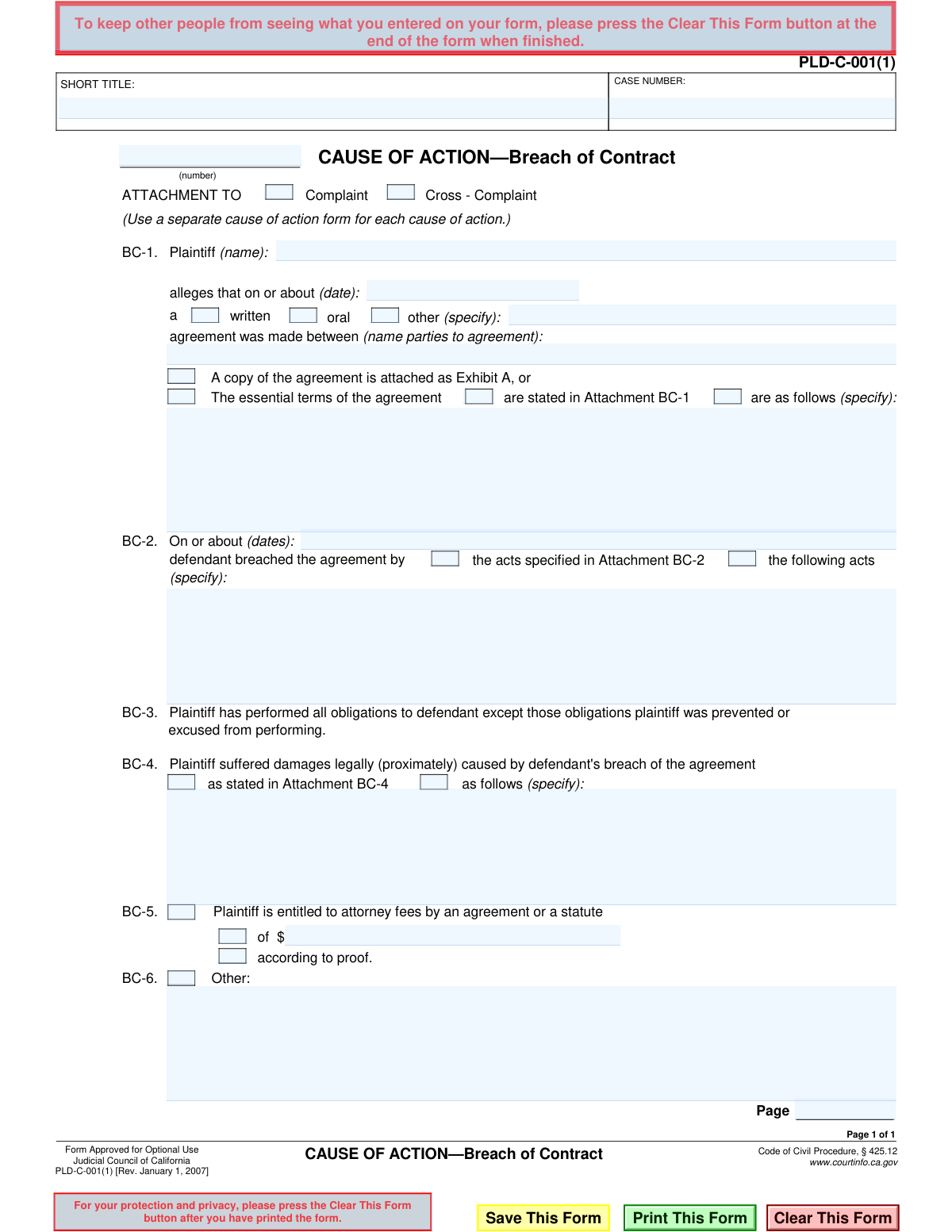
This form, officially titled Cause of Action—Breach of Contract, is a legal pleading used in California Superior Courts. It serves as an attachment to a complaint or cross-complaint to formally allege the details of a broken agreement, including the terms, the defendant's breach, and the resulting damages. Properly completing this form is a critical step in initiating a lawsuit for breach of contract. Today, this form can be filled out quickly and accurately using AI-powered services like Instafill.ai, which can also convert non-fillable PDF versions into interactive fillable forms.
PLD-C-001(1) is part of the
California court forms category on Instafill.
Our AI automatically handles information lookup, data retrieval, formatting, and form filling.
It takes less than a minute to fill out PLD-C-001(1) using our AI form filling.
Securely upload your data. Information is encrypted in transit and deleted immediately after the form is filled out.
Form specifications
| Form name: | Form PLD-C-001(1), Cause of Action—Breach of Contract |
| Number of fields: | 37 |
| Number of pages: | 1 |
| Language: | English |
Instafill Demo: How to fill out PDF forms in seconds with AI
How to Fill Out PLD-C-001(1) Online for Free in 2026
Are you looking to fill out a PLD-C-001(1) form online quickly and accurately? Instafill.ai offers the #1 AI-powered PDF filling software of 2026, allowing you to complete your PLD-C-001(1) form in just 37 seconds or less.
Follow these steps to fill out your PLD-C-001(1) form online using Instafill.ai:
- 1 Navigate to Instafill.ai and upload or select Form PLD-C-001(1), Cause of Action—Breach of Contract.
- 2 Provide the case information, including the short title and case number, in the designated fields.
- 3 Identify the plaintiff and specify the date the agreement was made, indicating whether it was written, oral, or other.
- 4 Name the parties to the agreement and either describe its essential terms or indicate that a copy is attached as an exhibit.
- 5 Clearly describe the specific acts committed by the defendant that constitute a breach of the agreement and the dates on which they occurred.
- 6 Detail the damages the plaintiff suffered as a direct result of the defendant's breach of contract.
- 7 Review the AI-populated form for complete accuracy, make any final adjustments, and then download the completed PLD-C-001(1) for filing with the court.
Our AI-powered system ensures each field is filled out correctly, reducing errors and saving you time.
Why Choose Instafill.ai for Your Fillable PLD-C-001(1) Form?
Speed
Complete your PLD-C-001(1) in as little as 37 seconds.
Up-to-Date
Always use the latest 2026 PLD-C-001(1) form version.
Cost-effective
No need to hire expensive lawyers.
Accuracy
Our AI performs 10 compliance checks to ensure your form is error-free.
Security
Your personal information is protected with bank-level encryption.
Frequently Asked Questions About Form PLD-C-001(1)
This form is a legal document used to formally state the details of a breach of contract claim in a lawsuit. It is not a standalone document but an attachment to a primary Complaint or Cross-Complaint.
The plaintiff (the person or entity initiating the lawsuit) or a cross-complainant (a defendant suing the plaintiff back) fills out this form. It is used to outline their specific legal claim that a contract was broken.
In section BC-1, you must specify the date the agreement was made, whether it was written or oral, the names of all parties, and the essential terms. If the contract was written, you should attach a copy as Exhibit A.
If the agreement was oral, you should check the 'oral' box in section BC-1. You will then need to describe the essential terms of that verbal agreement in the space provided or on a separate attachment.
In section BC-2, you need to clearly state how the other party failed to fulfill their obligations under the contract. Include the dates of the breach and the specific actions or failures to act that occurred.
This is a required legal statement confirming that you have fulfilled your side of the agreement, or that you were excused from performing your duties, often because of the other party's actions. It is a necessary element for a breach of contract claim.
In this section, you should specify the financial losses or other harm you suffered as a direct result of the breach. You can list a specific amount or state that damages are 'according to proof' if the exact amount will be determined later in the case.
You can only request attorney fees if the original contract specifically contains a clause allowing them for the prevailing party in a lawsuit, or if a specific law (statute) entitles you to them.
If your lawsuit involves multiple distinct legal claims (e.g., a breach of contract and a separate claim for fraud), you must complete a different 'Cause of Action' form for each one.
Yes, services like Instafill.ai use AI to help you accurately auto-fill form fields by extracting information from your case files. This can save significant time and help reduce errors.
You can use a service like Instafill.ai to upload the form and fill it out digitally on your computer. Their platform allows you to easily type into fields, add checkmarks, and then save or print the completed document.
If you have a non-fillable or 'flat' PDF, you can upload it to a platform like Instafill.ai. Their technology can convert the document into an interactive, fillable form that you can complete online.
This form must be attached to your main Complaint or Cross-Complaint and filed with the appropriate court where you are initiating or responding to the lawsuit. It is not filed as a separate, standalone document.
Compliance PLD-C-001(1)
Validation Checks by Instafill.ai
1
Ensures Plaintiff Name is Provided
This check verifies that the plaintiff's name field (BC-1) is not empty. This is a fundamental requirement for a legal filing, as it identifies the party initiating the cause of action. A missing plaintiff name would render the document legally insufficient and likely lead to rejection by the court.
2
Validates Agreement Date Format
Verifies that the date provided in section BC-1, indicating when the agreement was made, is a valid calendar date (e.g., MM/DD/YYYY). This ensures accuracy and legal clarity regarding the contract's timeline. An invalid date format could cause confusion or be grounds for challenging the filing's validity.
3
Requires Selection of Agreement Type
Ensures that one of the checkboxes for agreement type ('written', 'oral', or 'other') in section BC-1 is selected. This is crucial for defining the nature of the contract being disputed. If 'other' is selected, the corresponding specification field must also be filled.
4
Conditional Requirement for 'Other' Agreement Type
This check validates that if the 'other' checkbox is selected in section BC-1, the accompanying text field specifying the type of agreement is not empty. This provides necessary context that is missing from the standard options. Failure to specify makes the 'other' selection meaningless and the filing incomplete.
5
Ensures Parties to the Agreement are Named
Verifies that the field for naming the parties to the agreement in section BC-1 is completed. Identifying all parties is essential for establishing who is bound by the contract and who is being sued. Omitting this information would make it impossible to proceed with the breach of contract claim.
6
Validates Provision of Agreement Terms
This check ensures the plaintiff has provided the agreement terms in one of the three specified ways in section BC-1: attaching Exhibit A, referencing Attachment BC-1, or specifying the terms directly. The terms of the contract are the foundation of the claim, and their absence makes the cause of action impossible to evaluate.
7
Logical Check for Breach Date vs. Agreement Date
This validation compares the agreement date from BC-1 with the breach date(s) from BC-2. It ensures the breach date is not before the agreement was made, as a contract cannot be breached before it exists. This logical check prevents a fundamental error in the claim's timeline that would undermine its credibility.
8
Ensures Breach Description is Provided
This check confirms that the plaintiff has described the defendant's breach in section BC-2, either by referencing Attachment BC-2 or by specifying the acts in the provided text box. A clear description of the breach is a core component of the cause of action. Without it, the defendant cannot know what they are accused of, and the court cannot evaluate the claim.
9
Ensures Damages Description is Provided
Validates that the plaintiff has specified the damages suffered as a result of the breach in section BC-4. This can be done by referencing Attachment BC-4 or by detailing the damages in the text box. A breach of contract claim requires demonstrating harm, so failing to specify damages makes the claim incomplete.
10
Conditional Validation for Attorney Fees
This check is triggered if the plaintiff claims entitlement to attorney fees in section BC-5. It ensures that either a specific dollar amount is entered or the 'according to proof' checkbox is selected. This clarifies the plaintiff's demand regarding legal costs and prevents an ambiguous or incomplete claim for fees.
11
Validates Case Number Format
Checks that the 'CASE NUMBER' field in the header conforms to the expected format for the jurisdiction. This is crucial for correct filing and retrieval of the document within the court's system. An incorrect format can lead to misfiling or rejection of the document.
12
Ensures Short Title is Provided
Verifies that the 'SHORT TITLE' field in the header is filled out. The short title is used for quick identification of the case on all subsequent documents. Its absence would complicate case management for the court and all parties involved.
13
Requires Selection of Attachment Type
Ensures that the user has selected whether this form is an attachment to a 'Complaint' or a 'Cross-Complaint'. This selection is fundamental as it defines the procedural context of the cause of action. Failure to select one would create ambiguity and could lead to incorrect processing by the court clerk.
14
Validates Numeric Input for Attorney Fees
This check ensures that if a specific amount for attorney fees is entered in section BC-5, the value is a valid positive number. This prevents data entry errors like text or negative numbers in a currency field. Proper numeric formatting is essential for clear financial claims and subsequent processing.
Common Mistakes in Completing PLD-C-001(1)
Filers often forget to enter the 'SHORT TITLE' and 'CASE NUMBER' at the top of the form, or they enter information that doesn't perfectly match the main complaint document. This mistake can cause the attachment to be misfiled by the court clerk, delaying the case or even causing the document to be rejected entirely. To avoid this, meticulously cross-reference the case number and short title on every single page being filed with the court.
In section BC-1, when not attaching the contract, people often summarize the 'essential terms' in a way that is too brief or legally insufficient. For example, they might omit key details like the exact price, scope of work, or specific deadlines that are central to the dispute. This weakens the claim from the outset, as the court cannot determine the specific obligations the defendant allegedly breached. Always list the specific terms that were violated with enough detail for a third party to understand the agreement.
A critical error in section BC-1 is misspelling the legal names of the parties, using informal names (e.g., 'Bob's Shop' instead of 'Robert Smith d/b/a Bob's Auto Repair, LLC'), or omitting parties to the contract. A breach of contract claim is only valid between the actual legal entities or individuals who signed the agreement. This error can be a fatal flaw, potentially leading to a dismissal that cannot be fixed, as you may have sued the wrong person or entity.
Filers frequently check the box in BC-1 indicating 'A copy of the agreement is attached as Exhibit A' but then forget to include the actual exhibit with their filing. This immediately creates a deficiency in the complaint, as the primary evidence is missing, leaving the court and the defendant unable to see the contract. This almost always invites a legal challenge from the opposing side, causing unnecessary delays and legal costs.
In section BC-2, many filers use conclusory and vague language, such as 'defendant didn't do the work' or 'they broke the contract.' This is legally insufficient. You must state the specific facts of the breach, including what the defendant was supposed to do, what they did or did not do, and the date(s) the breach occurred. An unspecific allegation can lead to the entire cause of action being dismissed by the court for failure to state a claim.
When filling out section BC-4 for damages, people often write vague statements like 'plaintiff suffered financial losses' without specifying an amount or how it was calculated. To properly state a claim, the damages must be clearly explained and logically connected to the defendant's breach. Failure to plead damages with specificity can result in the court striking the claim or, in some cases, dismissing the lawsuit.
A common mistake is checking the box in BC-5 to claim attorney's fees when there is no legal basis to do so. Attorney's fees are generally only recoverable if the contract itself contains a specific clause allowing them or if a specific statute provides for them. Improperly requesting fees is unprofessional and will be immediately challenged by the defense, potentially harming the filer's credibility with the court.
The form explicitly states to use a separate form for each cause of action, but filers often try to cram multiple, distinct legal issues onto a single sheet. For example, they might describe a breach of the initial contract and a separate breach of a later modification on the same form. This makes the complaint confusing and procedurally improper, which can lead to a motion to strike from the defendant, forcing the plaintiff to amend their complaint and causing delays.
Since this form is often provided as a non-fillable PDF, users are forced to print it and fill it out by hand, which can lead to illegible entries. Unreadable names, dates, or factual descriptions can cause the court clerk to reject the filing or create fatal ambiguities in the legal allegations. To avoid this, it is best to use a service that can convert the document into a fillable version. For example, AI-powered tools like Instafill.ai can make a flat PDF like this one digitally fillable, ensuring every entry is perfectly clear and legible.
Saved over 80 hours a year
“I was never sure if my IRS forms like W-9 were filled correctly. Now, I can complete the forms accurately without any external help.”
Kevin Martin Green
Your data stays secure with advanced protection from Instafill and our subprocessors

Robust compliance program
Transparent business model
You’re not the product. You always know where your data is and what it is processed for.
ISO 27001, HIPAA, and GDPR
Our subprocesses adhere to multiple compliance standards, including but not limited to ISO 27001, HIPAA, and GDPR.
Security & privacy by design
We consider security and privacy from the initial design phase of any new service or functionality. It’s not an afterthought, it’s built-in, including support for two-factor authentication (2FA) to further protect your account.
Fill out PLD-C-001(1) with Instafill.ai
Worried about filling PDFs wrong? Instafill securely fills form-pld-c-0011-cause-of-actionbreach-of-contract forms, ensuring each field is accurate.