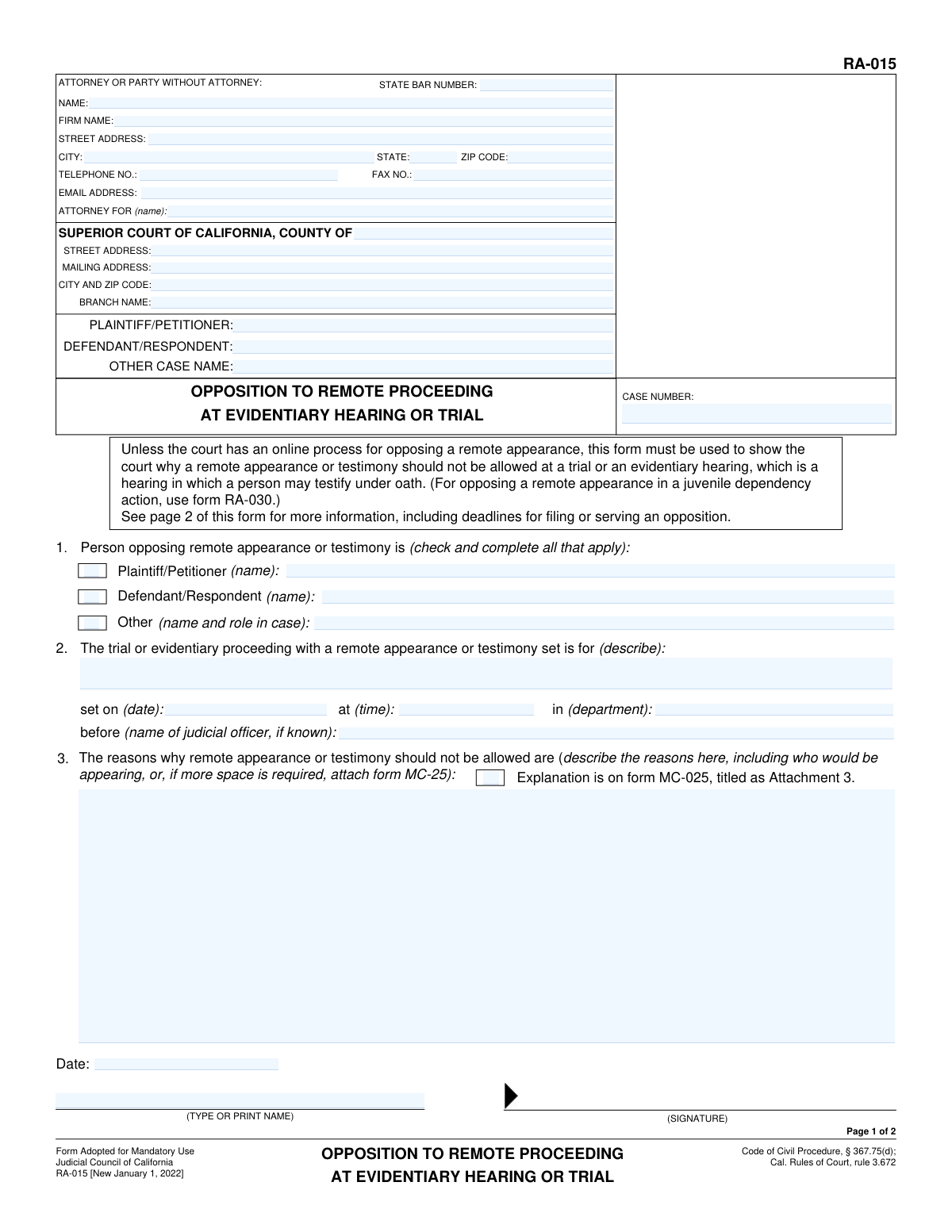
Yes! You can use AI to fill out Form RA-015, Opposition to Remote Proceeding at Evidentiary Hearing or Trial
Form RA-015, Opposition to Remote Proceeding at Evidentiary Hearing or Trial, is a mandatory form in California used by a party in a civil case to object to a remote (e.g., video or phone) appearance or testimony. It provides a formal way to explain to the court why an in-person appearance is necessary for a fair proceeding, as outlined in the Code of Civil Procedure, § 367.75. Today, this form can be filled out quickly and accurately using AI-powered services like Instafill.ai, which can also convert non-fillable PDF versions into interactive fillable forms.
RA-015 is part of the
California court forms category on Instafill.
Our AI automatically handles information lookup, data retrieval, formatting, and form filling.
It takes less than a minute to fill out RA-015 using our AI form filling.
Securely upload your data. Information is encrypted in transit and deleted immediately after the form is filled out.
Form specifications
| Form name: | Form RA-015, Opposition to Remote Proceeding at Evidentiary Hearing or Trial |
| Number of fields: | 42 |
| Number of pages: | 1 |
| Language: | English |
Instafill Demo: How to fill out PDF forms in seconds with AI
How to Fill Out RA-015 Online for Free in 2026
Are you looking to fill out a RA-015 form online quickly and accurately? Instafill.ai offers the #1 AI-powered PDF filling software of 2026, allowing you to complete your RA-015 form in just 37 seconds or less.
Follow these steps to fill out your RA-015 form online using Instafill.ai:
- 1 Navigate to Instafill.ai and upload or select Form RA-015.
- 2 Enter the case information, including the case number, court details, and party names (Plaintiff/Petitioner and Defendant/Respondent).
- 3 Provide your information as the attorney or party without an attorney, including name, address, and contact details.
- 4 Indicate who is opposing the remote proceeding and specify the date, time, and department of the scheduled trial or hearing.
- 5 In section 3, clearly articulate the reasons why the remote appearance or testimony should not be allowed, attaching form MC-025 if more space is needed.
- 6 Review all the information you have entered for completeness and accuracy, then date and sign the form.
- 7 Download the completed form to file with the court and serve on all other parties as required by the California Rules of Court.
Our AI-powered system ensures each field is filled out correctly, reducing errors and saving you time.
Why Choose Instafill.ai for Your Fillable RA-015 Form?
Speed
Complete your RA-015 in as little as 37 seconds.
Up-to-Date
Always use the latest 2026 RA-015 form version.
Cost-effective
No need to hire expensive lawyers.
Accuracy
Our AI performs 10 compliance checks to ensure your form is error-free.
Security
Your personal information is protected with bank-level encryption.
Frequently Asked Questions About Form RA-015
This form is used to formally object to a remote appearance or testimony at a trial or evidentiary hearing. It allows you to explain to the court why you believe a party or witness should be required to appear in person.
Any party in a case (such as a plaintiff, petitioner, defendant, or respondent) who opposes a remote proceeding and wants to request an in-person appearance should fill out this form.
An evidentiary hearing is a court proceeding where a person may provide testimony under oath. This form is specifically for opposing remote appearances at these types of hearings or at a trial.
No, this form cannot be used for juvenile dependency cases. You must use Form RA-030, 'Opposition to Remote Proceeding in a Juvenile Dependency Action,' for those specific cases.
In Section 3, you must clearly describe your reasons for opposing the remote appearance or testimony. You should include the name of the person you believe should appear in person and explain why their remote participation is not appropriate.
If you run out of space in Section 3, you can check the box indicating an attachment and provide your detailed explanation on a separate form, MC-025 (Attachment).
If you received at least 15 court days' notice of the hearing, you must file this form at least 5 court days before the hearing. If you received less than 15 court days' notice, you must file it by noon on the court day before the hearing.
No, you must file the opposition with the court and also serve a copy on all other parties and individuals entitled to receive notice in your case.
This information can be found on any previous documents filed in your case, such as the initial complaint, petition, or summons. It is essential to copy this information exactly as it appears on other court papers.
After you file and serve the form, the court will review your reasons for opposition. The judge will then make a ruling on whether the party or witness must appear in person or if the remote proceeding can go forward.
Yes, services like Instafill.ai use AI to accurately auto-fill form fields with your personal and case information, which can save you significant time and help prevent errors.
You can use a service like Instafill.ai to fill out the form online. Simply upload the PDF, and the platform will allow you to type your information directly into the fields before downloading the completed document.
If you have a non-fillable or 'flat' PDF, you can upload it to a service like Instafill.ai. The platform can convert it into an interactive, fillable form that you can complete easily on your computer.
Compliance RA-015
Validation Checks by Instafill.ai
1
Ensures Case Number Consistency Across Pages
This check verifies that the 'CASE NUMBER' entered in the header of Page 1 is identical to the 'CASE NUMBER' entered in the header of Page 2. Maintaining consistency is critical for ensuring the document is correctly filed and associated with the proper case record. A mismatch could lead to filing errors or rejection of the document by the court clerk.
2
Validates Identification of Opposing Person
This validation ensures that in Section 1, at least one of the checkboxes ('Plaintiff/Petitioner', 'Defendant/Respondent', or 'Other') is selected. Furthermore, it confirms that the corresponding name field next to the selected checkbox is filled out. This is required to clearly identify which party is filing the opposition.
3
Verifies Reason for Opposition is Provided
This check confirms that a reason for the opposition is supplied in Section 3. It validates that either the main text area for reasons is filled with an explanation, or the checkbox indicating that the 'Explanation is on form MC-025' is selected. The form is invalid if no reason is provided in either format, as this is the primary purpose of the document.
4
Validates Hearing Date Format and Logic
This check ensures the 'date' field in Section 2 is a valid calendar date (e.g., MM/DD/YYYY) and is not a date in the past. The hearing must be scheduled for a future date for an opposition to be relevant. An invalid or past date would make the filing nonsensical and likely cause it to be rejected.
5
Confirms Party Name Consistency
This validation cross-references the name entered in Section 1 with the party names listed in the case caption at the top of the form. For example, if the 'Plaintiff/Petitioner' checkbox is selected in Section 1, the name provided should match the 'PLAINTIFF/PETITIONER' name in the caption. This ensures internal consistency and avoids ambiguity about who is filing the opposition.
6
Validates State Bar Number Format
This check verifies that the 'STATE BAR NUMBER' field, if filled, contains only numeric characters and conforms to the expected format for a California State Bar number (typically 6 digits). This is important for correctly identifying the attorney of record. An incorrectly formatted number could prevent proper association with the attorney's record.
7
Ensures Email Address Format is Valid
This validation checks that the value entered in the 'EMAIL ADDRESS' field follows the standard '[email protected]' format. A valid email address is crucial for electronic communication and service of documents from the court and other parties. An invalid format would prevent successful delivery of important case notifications.
8
Requires Signature Date and Printed Name
This check ensures that both the 'Date' and the printed name ('TYPE OR PRINT NAME') fields in the signature block are completed. The date authenticates when the document was signed, and the printed name clarifies the identity of the signatory. Missing either of these fields can render the document legally insufficient.
9
Verifies Completeness of Hearing Details
This validation ensures that all essential fields in Section 2 describing the hearing are filled out, including the description of the proceeding, date, time, and department. This information is critical for the court to identify the specific hearing to which this opposition applies. Incomplete information would make the filing ambiguous and potentially void.
10
Validates ZIP Code Format
This check verifies that the 'ZIP CODE' field in the attorney/party address block contains a valid 5-digit or 9-digit (ZIP+4) US postal code. Correct formatting is essential for mail delivery of court notices and other legal documents. An invalid ZIP code could lead to returned mail and missed deadlines.
11
Conditional Requirement for Attorney Information
This validation rule checks that if a 'STATE BAR NUMBER' is entered, then the 'ATTORNEY FOR (name)' field must also be filled out. The presence of a bar number indicates the filer is an attorney, and it is legally necessary to specify which party they represent in the case. Failure to do so creates ambiguity regarding legal representation.
12
Validates Court County Name
This check ensures that the 'COUNTY OF' field contains a valid California county name. This is a data integrity check to ensure the form is being filed in a legitimate jurisdiction within the state. An incorrect or misspelled county name could lead to the document being misrouted or rejected.
Common Mistakes in Completing RA-015
Users frequently enter the Case Number with typos or fail to provide the specific Branch Name of the court. This happens because they are copying from memory or an unclear document. An incorrect case number can lead to the document being rejected by the clerk or filed in the wrong case, causing significant delays and potentially making the opposition void.
Parties representing themselves (pro se) often get confused by the 'ATTORNEY FOR' and 'STATE BAR NUMBER' fields. They might leave them blank or write 'N/A', when they should enter their own name and contact information in the main block and write 'Self-Represented' or 'In Pro Per' in the 'ATTORNEY FOR' field. This confusion can cause processing delays while the court clerk clarifies the filer's identity and role.
It is a common mistake to incorrectly list the names in the 'PLAINTIFF/PETITIONER' and 'DEFENDANT/RESPONDENT' fields. This usually occurs from a simple oversight or not referring to official case documents. The names must be listed exactly as they appear on the official court summons and complaint to ensure the filing is correctly associated with the case docket.
In Section 1, filers often check the box for 'Plaintiff/Petitioner' or 'Defendant/Respondent' but forget to type their name in the corresponding text field. This omission makes it unclear exactly who is filing the opposition, especially in cases with multiple plaintiffs or defendants. To avoid this, double-check that every selected checkbox is accompanied by the required name or information.
Section 2 requires the specific date, time, and department of the proceeding being opposed, but users often provide incomplete or vague information. For example, they might omit the time or department number, making it impossible for the court to know which hearing the opposition applies to. This can result in the opposition being ignored and the remote proceeding going forward as planned.
The most critical error is in Section 3, where filers provide generic or conclusory reasons like 'It is unfair' or 'I prefer an in-person hearing.' The court requires specific, factual reasons why a remote proceeding is prejudicial, such as the inability to assess witness credibility, technological disadvantages, or issues with presenting evidence. A weak justification will almost certainly result in the opposition being denied.
When more space is needed for Section 3, the form directs the user to attach Form MC-025. A common mistake is to either check the box indicating an attachment is used but forget to include it, or to attach a separate document that is not properly labeled as 'Attachment 3'. This can lead the judge to disregard the extended explanation, weakening the opposition.
The instructions on page 2 specify strict deadlines based on 'court days,' which exclude weekends and holidays. Filers frequently miscalculate these deadlines, submitting their opposition too late. An untimely filing will be disregarded by the court, and the right to oppose the remote proceeding will be lost.
A filer may correctly file the opposition with the court but forget to 'serve' (formally deliver) a copy to all other parties in the case as required. Failure to properly serve the opposition means the other parties were not given legal notice, which is a procedural defect that can render the filing invalid. Always complete and attach a Proof of Service form to the filing.
An unsigned or undated form is typically invalid. People often rush and forget to sign, date, or legibly print their name in the final section. This simple oversight can lead to the court rejecting the entire filing, forcing the user to refile and potentially miss the strict deadline. AI-powered tools like Instafill.ai can help prevent this by flagging empty required fields before submission and ensuring data is correctly formatted.
Saved over 80 hours a year
“I was never sure if my IRS forms like W-9 were filled correctly. Now, I can complete the forms accurately without any external help.”
Kevin Martin Green
Your data stays secure with advanced protection from Instafill and our subprocessors

Robust compliance program
Transparent business model
You’re not the product. You always know where your data is and what it is processed for.
ISO 27001, HIPAA, and GDPR
Our subprocesses adhere to multiple compliance standards, including but not limited to ISO 27001, HIPAA, and GDPR.
Security & privacy by design
We consider security and privacy from the initial design phase of any new service or functionality. It’s not an afterthought, it’s built-in, including support for two-factor authentication (2FA) to further protect your account.
Fill out RA-015 with Instafill.ai
Worried about filling PDFs wrong? Instafill securely fills form-ra-015-opposition-to-remote-proceeding-at-evidentiary-hearing-or-trial forms, ensuring each field is accurate.