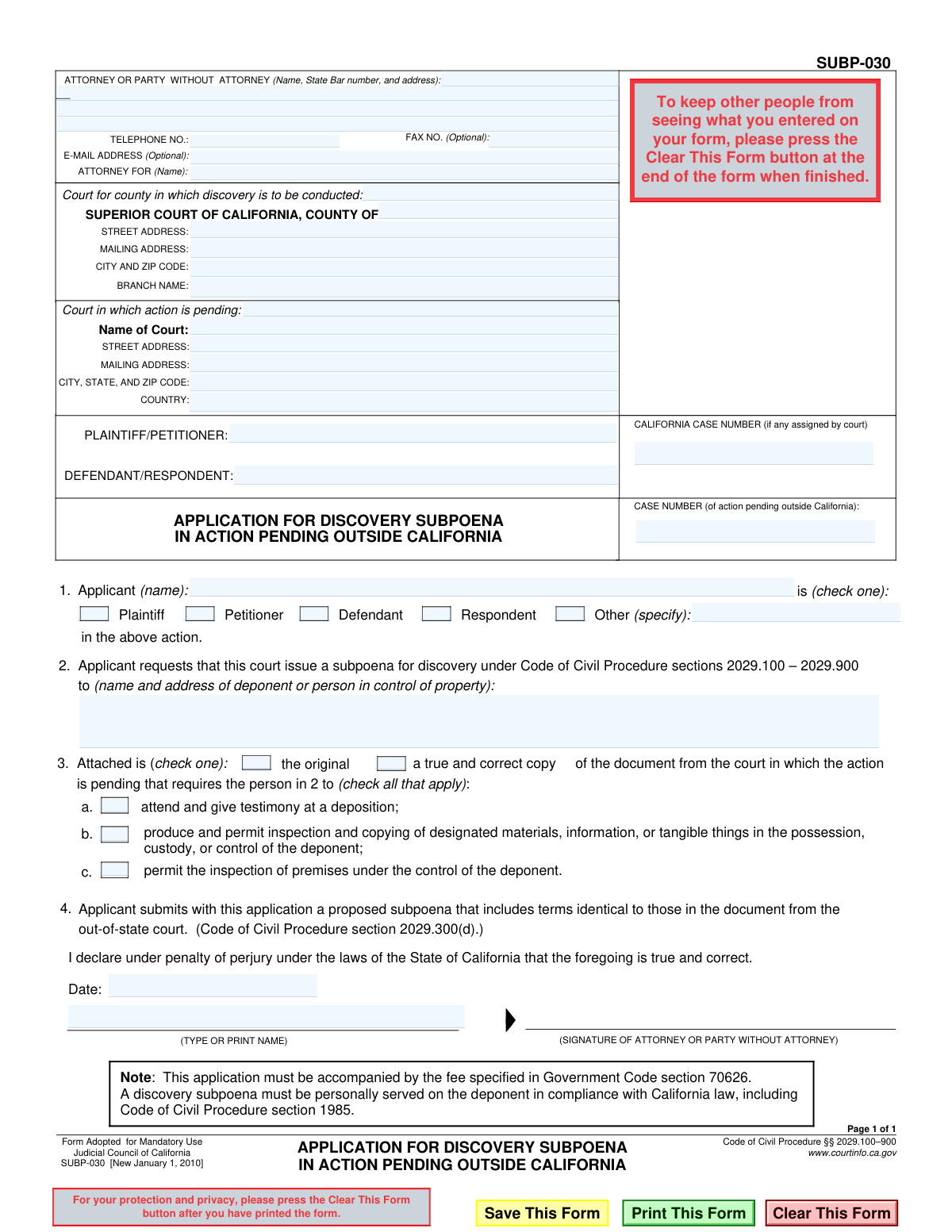
Yes! You can use AI to fill out Form SUBP-030, Application for Discovery Subpoena in Action Pending Outside California
Form SUBP-030, Application for Discovery Subpoena in Action Pending Outside California, is a legal document used to ask a California court to issue a subpoena for discovery in a lawsuit that is active in another state. This is necessary to compel a person or entity in California to provide testimony, produce documents, or permit inspection of property for an out-of-state case. Today, this form can be filled out quickly and accurately using AI-powered services like Instafill.ai, which can also convert non-fillable PDF versions into interactive fillable forms.
SUBP-030 is part of the
California court forms category on Instafill.
Our AI automatically handles information lookup, data retrieval, formatting, and form filling.
It takes less than a minute to fill out SUBP-030 using our AI form filling.
Securely upload your data. Information is encrypted in transit and deleted immediately after the form is filled out.
Form specifications
| Form name: | Form SUBP-030, Application for Discovery Subpoena in Action Pending Outside California |
| Number of fields: | 44 |
| Number of pages: | 1 |
| Language: | English |
Instafill Demo: How to fill out PDF forms in seconds with AI
How to Fill Out SUBP-030 Online for Free in 2026
Are you looking to fill out a SUBP-030 form online quickly and accurately? Instafill.ai offers the #1 AI-powered PDF filling software of 2026, allowing you to complete your SUBP-030 form in just 37 seconds or less.
Follow these steps to fill out your SUBP-030 form online using Instafill.ai:
- 1 Navigate to Instafill.ai and upload or select Form SUBP-030, Application for Discovery Subpoena in Action Pending Outside California.
- 2 Enter the information for the attorney or party filing the application, including name, address, and contact details.
- 3 Provide the details of the California Superior Court where discovery is sought and the out-of-state court where the case is pending, including case numbers.
- 4 Identify the applicant (plaintiff, defendant, etc.) and provide the name and address of the deponent from whom discovery is being requested.
- 5 Check the appropriate boxes to indicate the type of discovery required: attending a deposition, producing materials, or permitting inspection of premises.
- 6 Review the completed application with the AI assistant to ensure all information is accurate and consistent with the attached out-of-state court documents.
- 7 Electronically sign the declaration under penalty of perjury, then download the completed form for filing with the court along with the required fee.
Our AI-powered system ensures each field is filled out correctly, reducing errors and saving you time.
Why Choose Instafill.ai for Your Fillable SUBP-030 Form?
Speed
Complete your SUBP-030 in as little as 37 seconds.
Up-to-Date
Always use the latest 2026 SUBP-030 form version.
Cost-effective
No need to hire expensive lawyers.
Accuracy
Our AI performs 10 compliance checks to ensure your form is error-free.
Security
Your personal information is protected with bank-level encryption.
Frequently Asked Questions About Form SUBP-030
This form is an application used to ask a California Superior Court to issue a subpoena for discovery (like testimony or documents) from a person or entity in California for a lawsuit that is pending in another state or country.
Any party (plaintiff, defendant, etc.) or their attorney in a legal case outside of California who needs to obtain evidence from a witness, person, or business located within California must file this form.
You must file this application in the Superior Court of the California county where the person you need discovery from resides or where the discovery is set to take place.
You must submit the completed application, a proposed subpoena with terms identical to the out-of-state discovery document, and a copy of the document from the out-of-state court authorizing the discovery. A filing fee is also required.
Yes, the form states that the application must be accompanied by the fee specified in Government Code section 70626. Check with the local court clerk for the current fee amount.
The 'Court in which action is pending' is the court outside of California where your lawsuit is filed. The 'Court for county in which discovery is to be conducted' is the California Superior Court where you are filing this application.
The deponent is the person or entity located in California from whom you are seeking discovery. This could be an individual who needs to give testimony or a company that needs to produce documents.
You must attach a true and correct copy (or the original) of the document from the out-of-state court that requires the deponent to testify, produce documents, or permit inspection of premises.
After you file the application and pay the fee, the court clerk will issue the California subpoena. This subpoena must then be personally served on the deponent according to California's laws for service.
Yes, this process can be used for actions pending in other nations. The form includes a field to specify the country where the action is pending.
Yes, services like Instafill.ai use AI to accurately auto-fill form fields from your saved profiles, which can save you significant time and help prevent errors.
You can use Instafill.ai to easily fill out this form online. Simply upload the form, and the AI will identify the fields for you to complete, save, and download.
If you have a non-fillable PDF, you can upload it to a service like Instafill.ai. It can convert flat PDFs into interactive, fillable forms that you can complete on your computer.
Compliance SUBP-030
Validation Checks by Instafill.ai
1
Ensures Applicant Identification is Complete
This check verifies that the name and address fields under 'ATTORNEY OR PARTY WITHOUT ATTORNEY' are filled out. This information is critical for the court to identify who is filing the application and to send official correspondence. A failure would result in the application being rejected for incompleteness.
2
Validates State Bar Number Presence for Attorneys
This check ensures that if an attorney is filing the application, their State Bar number is provided. The State Bar number is a unique identifier that confirms the attorney is licensed and in good standing. If an attorney's name is present but the number is missing, the form submission should be flagged for review or rejected.
3
Verifies California Court County is Specified
This validation confirms that the 'COUNTY OF' field for the Superior Court of California is filled with a valid California county name. This is essential as it determines the correct jurisdiction for filing the application and issuing the subpoena. An invalid or missing county will prevent the application from being routed to the correct court.
4
Requires Out-of-State Case Number
This check ensures that the 'CASE NUMBER (of action pending outside California)' field is not empty. This number is the primary identifier for the original legal action and is necessary to link the California discovery request to the correct case. Without it, the application is meaningless and cannot be processed.
5
Confirms Out-of-State Court Location
This validation verifies that the address of the court where the action is pending is complete, and specifically that the state listed is not California. This is a logical check to ensure the form is being used correctly for an 'action pending outside California'. An entry of 'California' would indicate a misunderstanding of the form's purpose.
6
Ensures Case Party Names are Provided
This check verifies that both the 'PLAINTIFF/PETITIONER' and 'DEFENDANT/RESPONDENT' fields are filled in. These names are fundamental to identifying the parties involved in the out-of-state litigation. Missing party information would make the application incomplete and unprocessable.
7
Validates Completeness of Deponent Information
This check ensures that the name and address of the deponent (the person or entity to be subpoenaed) in section 1 are fully provided. The subpoena cannot be issued or legally served without this specific information. An omission here would make the entire application futile.
8
Enforces Single Selection for Applicant's Role
This validation ensures that in section 2, exactly one checkbox is selected to identify the applicant's role as 'Plaintiff', 'Defendant', or 'Other'. Selecting none or more than one creates ambiguity about the filer's standing in the case. The form should be rejected if this condition is not met.
9
Requires Specification for 'Other' Applicant Role
This is a conditional check that verifies if the 'Other' checkbox is selected in section 2, the corresponding text field specifying the role must be filled out. This provides necessary context when the applicant is not a primary plaintiff or defendant. Failure to specify the 'Other' role would result in an incomplete and potentially confusing application.
10
Enforces Single Selection for Attached Document Type
This validation ensures that in section 3, exactly one of the checkboxes for 'original' or 'a true and correct copy' is selected. This declaration is a legal requirement to inform the court about the nature of the supporting documentation from the out-of-state court. The form is incomplete without this selection.
11
Requires at Least One Type of Discovery
This check verifies that at least one of the checkboxes in section 4 (a, b, or c) is selected. This specifies the purpose of the subpoena, whether for testimony, production of materials, or inspection of premises. An application without a specified discovery purpose is invalid as it does not state what is being requested.
12
Validates Signature Date Format and Presence
This check ensures the 'Date' field in the declaration section is filled and contains a valid date format (e.g., MM/DD/YYYY). The date is crucial as it establishes when the declaration under penalty of perjury was made. An invalid or missing date can nullify the legal effect of the signature.
13
Verifies Signatory's Printed Name is Provided
This validation confirms that the 'TYPE OR PRINT NAME' field accompanying the signature line is completed. This ensures the identity of the person signing the declaration is clear and legible. The signature is not legally sufficient without the corresponding printed name for identification.
14
Validates Phone Number Format
This check ensures the 'TELEPHONE NO.' field is not only present but also conforms to a standard phone number format. This is the primary contact method for the court clerk if there are questions or issues with the filing. An invalid number would hinder communication and delay the application process.
15
Ensures Consistency in Attorney Representation
This validation checks that if an attorney's name is provided in the header, the 'ATTORNEY FOR (Name)' field is also filled out. This explicitly links the attorney to the party they are representing in this action. A mismatch or omission creates ambiguity about the attorney's authority to file the application.
Common Mistakes in Completing SUBP-030
A critical and frequent error is failing to submit a separate, proposed California subpoena form (e.g., SUBP-015, SUBP-020) along with this application. This SUBP-030 form is merely the application to the clerk; the clerk then issues the separate subpoena form you provide. Submitting the application alone will result in an immediate rejection, halting the discovery process until the complete package is filed.
Applicants often mistakenly list the court where the primary action is pending or a random California court. The application must be filed in the Superior Court of the California county where the deponent resides or where the evidence is located. Filing in the wrong county court will cause the clerk to reject the application, forcing the applicant to refile in the correct jurisdiction and causing significant delays.
In Section 3, the boxes checked for the type of discovery (deposition, document production, premises inspection) must exactly match the scope authorized by the attached out-of-state court document. Applicants sometimes check boxes for discovery not explicitly permitted, which will invalidate the application. The California court's role is only to domesticate the foreign discovery order, not to expand its scope.
This application is invalid unless accompanied by the official document from the out-of-state court that authorizes the discovery (e.g., a subpoena, notice of deposition, or commission). Applicants sometimes forget to attach this crucial document or attach an unofficial draft. Without this official proof, the California court has no legal basis to issue a subpoena, and the application will be rejected outright.
Section 1 requires the full legal name and complete California address of the deponent. Providing an incomplete address, using P.O. boxes for physical service, or misspelling the deponent's name are common errors. These mistakes can make personal service of the issued subpoena impossible or give the deponent grounds to challenge its validity, leading to failed service attempts and costly delays.
The form's notes state that the application must be accompanied by a specific filing fee. Failing to include a check for the correct amount is a frequent administrative error that causes the court clerk to reject the entire submission. Court fees can change, so it is essential to verify the current fee on the specific county court's website before filing to avoid delays.
The form requires details for both the out-of-state action and the new California proceeding. A common mistake is to mix these up, such as putting the California court's address in the section for the 'Court in which action is pending'. This creates confusion and will likely result in the clerk rejecting the form for correction. AI-powered tools like Instafill.ai can help prevent this by using smart field recognition to guide data into the correct locations.
The declaration at the bottom of the form must be signed and dated to be valid. Forgetting to sign or date the application is a simple but fatal error that invalidates the declaration made under penalty of perjury. An unsigned application is considered incomplete and will be rejected by the court, forcing a refiling. Using a form-filling tool can help by flagging empty required fields like the signature and date lines.
Many court forms are distributed as flat, non-fillable PDFs, forcing manual completion by hand. This often results in illegible handwriting, which can lead to data entry errors by the court clerk or outright rejection of the form if key information cannot be read. To avoid this, services like Instafill.ai can convert a flat PDF into a fillable version, ensuring all entries are typed, clear, and professional.
The top section requires the attorney's name, address, and State Bar number. Out-of-state attorneys may forget to associate with local California counsel if required, or parties may enter information inconsistently with the case record. Any errors or omissions in this section can lead to rejection or delays while the clerk's office verifies the filer's standing. Using a tool that saves and reuses validated attorney information can prevent these data entry mistakes.
Saved over 80 hours a year
“I was never sure if my IRS forms like W-9 were filled correctly. Now, I can complete the forms accurately without any external help.”
Kevin Martin Green
Your data stays secure with advanced protection from Instafill and our subprocessors

Robust compliance program
Transparent business model
You’re not the product. You always know where your data is and what it is processed for.
ISO 27001, HIPAA, and GDPR
Our subprocesses adhere to multiple compliance standards, including but not limited to ISO 27001, HIPAA, and GDPR.
Security & privacy by design
We consider security and privacy from the initial design phase of any new service or functionality. It’s not an afterthought, it’s built-in, including support for two-factor authentication (2FA) to further protect your account.
Fill out SUBP-030 with Instafill.ai
Worried about filling PDFs wrong? Instafill securely fills form-subp-030-application-for-discovery-subpoena-in-action-pending-outside-california forms, ensuring each field is accurate.