Yes! You can use AI to fill out Form SV-109, Notice of Court Hearing (Postsecondary School Violence Prevention)
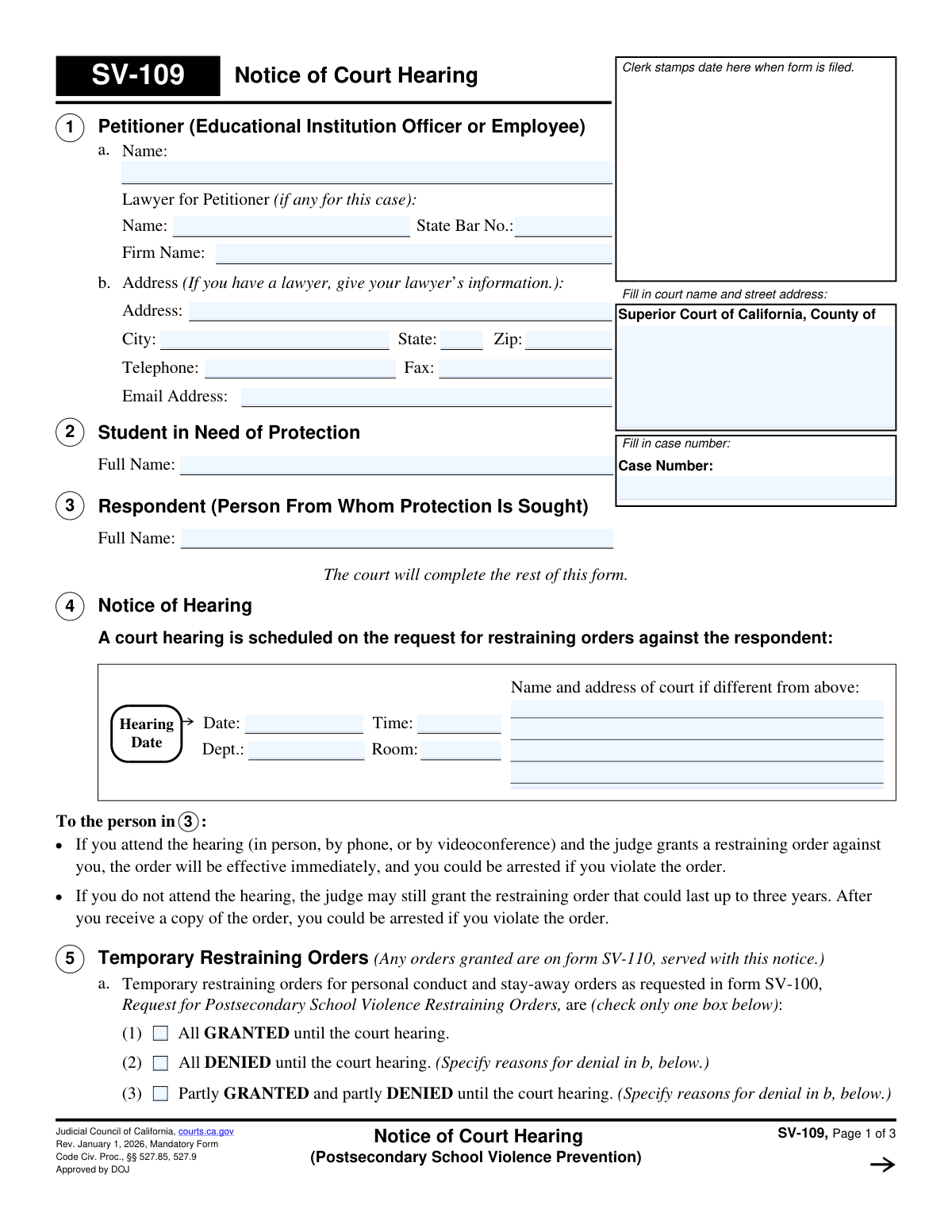
Form SV-109, Notice of Court Hearing, is a legal document issued by the California courts in cases related to postsecondary school violence. It officially informs the respondent about the date, time, and location of a court hearing for a restraining order petition filed against them, and details any temporary orders made by the judge. This notice is a critical step in the legal process, ensuring the respondent has the opportunity to appear in court. Today, this form can be filled out quickly and accurately using AI-powered services like Instafill.ai, which can also convert non-fillable PDF versions into interactive fillable forms.
SV-109 is part of the
California court forms category on Instafill.
Our AI automatically handles information lookup, data retrieval, formatting, and form filling.
It takes less than a minute to fill out SV-109 using our AI form filling.
Securely upload your data. Information is encrypted in transit and deleted immediately after the form is filled out.
Form specifications
| Form name: | Form SV-109, Notice of Court Hearing (Postsecondary School Violence Prevention) |
| Number of fields: | 41 |
| Number of pages: | 1 |
| Language: | English |
Instafill Demo: How to fill out PDF forms in seconds with AI
How to Fill Out SV-109 Online for Free in 2026
Are you looking to fill out a SV-109 form online quickly and accurately? Instafill.ai offers the #1 AI-powered PDF filling software of 2026, allowing you to complete your SV-109 form in just 37 seconds or less.
Follow these steps to fill out your SV-109 form online using Instafill.ai:
- 1 Navigate to Instafill.ai and upload your SV-109 form or select it from the template library.
- 2 Enter the petitioner's information, including the name of the educational institution officer or employee and details for any legal representation.
- 3 Provide the full name of the student requiring protection and the full name of the respondent from whom protection is sought.
- 4 Input the specific court information, including the Superior Court name, county, and address, along with the case number.
- 5 Review all the information you've entered using the AI assistant to check for accuracy and completeness before proceeding.
- 6 Download and print the form for filing. The court clerk will then complete the sections regarding the hearing date, time, and any temporary orders granted.
Our AI-powered system ensures each field is filled out correctly, reducing errors and saving you time.
Why Choose Instafill.ai for Your Fillable SV-109 Form?
Speed
Complete your SV-109 in as little as 37 seconds.
Up-to-Date
Always use the latest 2026 SV-109 form version.
Cost-effective
No need to hire expensive lawyers.
Accuracy
Our AI performs 10 compliance checks to ensure your form is error-free.
Security
Your personal information is protected with bank-level encryption.
Frequently Asked Questions About Form SV-109
This form officially notifies the respondent (the person from whom protection is sought) of the date, time, and location for a court hearing regarding a postsecondary school violence restraining order. It is issued by the court after a school official files a petition.
The petitioner (the school official or their lawyer) fills out their information and the names of the student and respondent in sections 1-3. The court clerk and judge complete the rest of the form, including the hearing details and any temporary orders.
If you do not attend the hearing, the judge can still grant a restraining order against you that may last for up to three years. After you receive a copy of the order, you could be arrested if you violate its terms.
A TRO is a short-term order granted by a judge before the full court hearing to provide immediate protection. Section 5 of this form will be checked by the court to show if a temporary order was granted, denied, or partially granted until the hearing.
You must have someone who is 18 or older—and not you or the protected student—personally deliver (serve) a copy of the filed SV-109 and other required forms to the respondent. This must be done at least five days before the hearing, and the server must fill out a Proof of Service form (SV-200).
You can respond in writing by filling out Form SV-120, Response to Petition for Postsecondary School Violence Restraining Orders, and filing it with the court. Whether or not you respond in writing, you should attend the hearing to tell the judge your side of the story.
The respondent must be served with this form (SV-109), the original petition (SV-100), a blank response form (SV-120), and an information sheet (SV-120-INFO). If a temporary restraining order was granted, Form SV-110 must also be included.
Yes, both the petitioner and the respondent may ask the court to reschedule the hearing date for a valid reason. You should read Form SV-115-INFO, How to Ask for a New Hearing Date, for instructions on how to file a request.
The petitioner must arrange for the respondent to be legally served with the court papers and then attend the scheduled hearing. You should bring any evidence or witnesses you have to support your request for a restraining order.
If the judge grants the order, it can last up to three years and will prohibit you from certain contact with the student. You may also be ordered to turn in any firearms, firearm parts, and body armor you own or possess.
Yes, services like Instafill.ai use AI to accurately auto-fill form fields, which can save time and help avoid errors. The petitioner would use this for sections 1-3 before filing the form with the court.
You can use a service like Instafill.ai to easily fill out the petitioner sections of the form online. After you provide your information, the platform populates the fields for you to review and download before filing with the court.
If you have a non-fillable or 'flat' PDF, you can upload it to a service like Instafill.ai. The platform can convert it into an interactive, fillable form that you can complete on your computer.
You should contact the court clerk's office at least five days before your hearing to request an accommodation. You may need to fill out Form MC-410, Disability Accommodation Request.
Compliance SV-109
Validation Checks by Instafill.ai
1
Ensures Case Number Consistency Across All Pages
This check verifies that the Case Number entered in the header of page 1, 2, and 3 is identical. Maintaining a consistent Case Number is critical for document integrity and ensures all pages are correctly associated with the same legal case file. If the numbers do not match, the form could be rejected by the clerk, leading to delays in processing.
2
Validates Hearing Date is a Future Date
This validation ensures that the date entered in the 'Hearing Date' field (Section 4) is a valid calendar date that occurs after the form's filing date. A hearing cannot be scheduled for a past date, as this would be a logical and legal impossibility. An invalid or past date would render the notice legally defective and require the court to issue a corrected notice, delaying the proceedings.
3
Ensures Exclusive Selection for TRO Disposition
This check validates that in Section 5a, only one of the three checkboxes ('All GRANTED', 'All DENIED', 'Partly GRANTED and partly DENIED') is selected. These options are mutually exclusive, and selecting more than one creates an ambiguous and unenforceable order. A validation failure would require the judicial officer to correct the form before it can be officially filed and served.
4
Requires Reason for TRO Denial or Partial Grant
This validation rule ensures that if the temporary restraining order is 'All DENIED' or 'Partly GRANTED' (Section 5a), a reason for the denial must be specified in Section 5b. This is a legal requirement to provide transparency and justification for the court's decision. Failure to provide a reason would make the order incomplete and subject to legal challenge or rejection by a higher court.
5
Verifies Petitioner Name is Provided
This check ensures that the Petitioner's name field (Section 1a) is not left blank. The petitioner is the party initiating the legal action, and their identity is fundamental to the case. Without this information, the form is incomplete and cannot be processed, as the court would not know who is requesting the protective order.
6
Verifies Respondent Name is Provided
This validation confirms that the Respondent's full name (Section 3) is filled in. The respondent is the individual against whom the restraining order is sought, and they must be clearly identified for the order to be enforceable and properly served. An omission of the respondent's name would make the entire notice invalid and halt the legal process.
7
Validates State Bar Number Format
This check verifies that the 'State Bar No.' field (Section 1a) contains only numbers and conforms to the expected format for a California State Bar license. This is important for correctly identifying the petitioner's legal counsel and verifying their credentials. An invalid number could prevent proper notification to counsel or indicate an error in the provided information.
8
Ensures Lawyer's Bar Number is Present if Name is Provided
This rule checks that if a lawyer's name is entered in Section 1a, the corresponding 'State Bar No.' field is also filled. The State Bar number is the unique identifier for an attorney, and it is required for official court records and communication. Submitting a lawyer's name without their bar number results in an incomplete filing that may be rejected by the court clerk.
9
Validates Petitioner's ZIP Code Format
This validation ensures the ZIP code in the petitioner's address (Section 1b) is in a valid 5-digit or 9-digit (e.g., 90210 or 90210-1234) format. A correct ZIP code is essential for the proper mailing of court documents and legal notices to the petitioner or their lawyer. An invalid format can lead to returned mail and critical delays in communication.
10
Ensures Service of Granted Temporary Order is Marked
This check verifies that if a Temporary Restraining Order is 'GRANTED' or 'Partly GRANTED' (Section 5a), the checkbox for serving form SV-110 in Section 6b must also be checked. The respondent must be served with a copy of any active orders against them for the orders to be legally enforceable. Failure to mark this box could result in the respondent not being properly served with the TRO, making it invalid.
11
Requires Specification for 'Other' Service Documents
This validation ensures that if the 'Other' checkbox in Section 6e is checked, the adjacent text field specifying the document(s) is not empty. This provides a clear record of all documents that must be served on the respondent. Leaving the specification blank creates ambiguity and could lead to improper service, jeopardizing the case.
12
Validates Petitioner's Email Address Format
This check ensures the email address provided in Section 1b follows the standard '[email protected]' format. A valid email address is crucial for modern court communications, including electronic service and notifications. An invalid format would cause communication failures and could result in the petitioner missing important updates or documents.
13
Judicial Officer Signature Date Logic
This validation confirms that the Judicial Officer's signature date in Section 6 is a valid date and occurs on or before the scheduled Hearing Date from Section 4. A judge cannot sign an order for a hearing that has already passed relative to the signature date. This chronological check ensures the logical consistency and validity of the court's order.
Common Mistakes in Completing SV-109
Users often enter a generic name like 'County Courthouse' or an incomplete street address in the top section. This happens due to not knowing the precise, official name and location of the Superior Court branch. An incorrect address can lead to the form being rejected by the clerk or filed in the wrong venue, causing significant delays in obtaining a hearing date. Always verify the exact court name and full street address on the official court website for your county before filling out the form.
Section 1b instructs filers to use their lawyer's information if they are represented, but petitioners often fill in their own contact details out of habit. This mistake can cause official court notices and correspondence from the opposing party to be sent to the petitioner directly, bypassing their legal counsel. This leads to communication breakdowns, missed deadlines, and potential legal missteps; always provide the attorney's firm name, address, and State Bar Number as required.
A common misunderstanding is entering the student's name in the 'Petitioner' section (Section 1). On this specific form, the petitioner is the educational institution's officer or employee filing on behalf of the student. This error creates confusion about the parties involved and requires correction, delaying the case. The student's name should only be entered in Section 2, 'Student in Need of Protection'.
In Sections 2 and 3, filers may use nicknames, initials, or omit middle names for the student or respondent. For a restraining order to be legally valid and enforceable by law enforcement, it must contain the person's full legal name as it appears on official identification. Using an incomplete name can make the order difficult or impossible to enforce and may require amending the petition, causing delays.
Petitioners sometimes mistakenly fill in Section 4 (Notice of Hearing details) or Section 5 (Temporary Restraining Order status), which are explicitly for the court clerk or judicial officer to complete. This creates confusion, requires the clerk to correct the form, and can delay the processing and scheduling of the hearing. Filers must only complete the sections designated for them (primarily 1, 2, and 3) and leave all other fields blank.
The form requires the Case Number at the top of pages 1, 2, and 3, but it's a frequent oversight to only fill it in on the first page. If the pages of the document become separated during processing, the unnumbered pages can be misfiled or lost. This can jeopardize the integrity of the case file and cause significant delays. To avoid this, carefully review each page before filing, or use a tool like Instafill.ai that can automatically populate the case number on all required pages.
The instructions in Section 6 clearly state that the petitioner cannot be the one to serve the court documents on the respondent. However, due to stress or a misunderstanding of legal procedure, petitioners may attempt to deliver the papers themselves. This legally invalidates the 'service of process' and will require the court to postpone the hearing until proper service is completed, causing significant delays.
Section 6 lists several other forms (SV-100, SV-110, SV-120, etc.) that must be served along with the SV-109. A critical error is forgetting to include one or more of these required documents in the packet given to the respondent. Incomplete service violates the respondent's due process rights and will almost certainly result in the judge postponing the hearing until all documents are properly served.
When filling out a printed form by hand, poor penmanship can make names, addresses, and other critical details unreadable. This can lead to data entry errors by the court clerk, such as misspelling a name on the final order or sending notices to the wrong address, which can have severe legal consequences. AI-powered tools like Instafill.ai can convert non-fillable PDFs into fillable versions and populate them with clear, typed text to prevent this issue.
If an attorney is representing the petitioner, their State Bar Number is required in Section 1. Filers may not know the number, leave it blank, or enter it incorrectly. An incorrect or missing bar number prevents the court from quickly verifying the attorney's credentials and good standing with the State Bar, which can slow down the initial processing and acceptance of the filing.
Saved over 80 hours a year
“I was never sure if my IRS forms like W-9 were filled correctly. Now, I can complete the forms accurately without any external help.”
Kevin Martin Green
Your data stays secure with advanced protection from Instafill and our subprocessors

Robust compliance program
Transparent business model
You’re not the product. You always know where your data is and what it is processed for.
ISO 27001, HIPAA, and GDPR
Our subprocesses adhere to multiple compliance standards, including but not limited to ISO 27001, HIPAA, and GDPR.
Security & privacy by design
We consider security and privacy from the initial design phase of any new service or functionality. It’s not an afterthought, it’s built-in, including support for two-factor authentication (2FA) to further protect your account.
Fill out SV-109 with Instafill.ai
Worried about filling PDFs wrong? Instafill securely fills form-sv-109-notice-of-court-hearing-postsecondary-school-violence-prevention forms, ensuring each field is accurate.