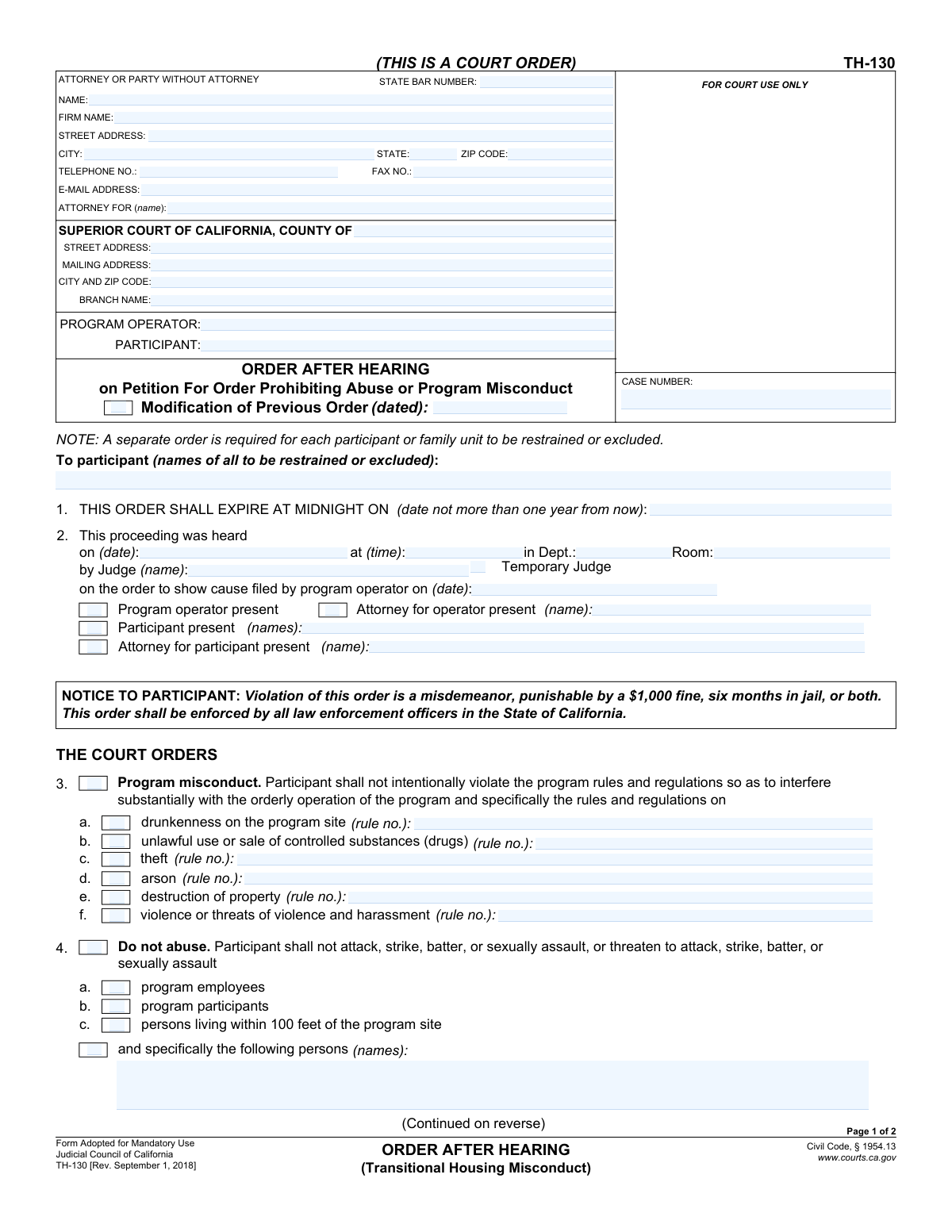
Yes! You can use AI to fill out Form TH-130, Order After Hearing (Transitional Housing Misconduct)

California Form TH-130, Order After Hearing (Transitional Housing Misconduct), is a court order issued by a judge after a hearing. It details the court's rulings regarding a transitional housing program participant's alleged misconduct, which can include abuse, violence, or other rule violations, and is enforceable by law enforcement. Today, this form can be filled out quickly and accurately using AI-powered services like Instafill.ai, which can also convert non-fillable PDF versions into interactive fillable forms.
TH-130 is part of the California court forms category on Instafill.
Our AI automatically handles information lookup, data retrieval, formatting, and form filling.
It takes less than a minute to fill out TH-130 using our AI form filling.
Securely upload your data. Information is encrypted in transit and deleted immediately after the form is filled out.

Form specifications

Form name: Form TH-130, Order After Hearing (Transitional Housing Misconduct)
Number of fields: 88
Number of pages: 1
Language: English
main-image

Instafill Demo: How to fill out PDF forms in seconds with AI

How to Fill Out TH-130 Online for Free in 2026

Are you looking to fill out a TH-130 form online quickly and accurately? Instafill.ai offers the #1 AI-powered PDF filling software of 2026, allowing you to complete your TH-130 form in just 37 seconds or less.
Follow these steps to fill out your TH-130 form online using Instafill.ai:
  1. 1 Navigate to Instafill.ai and upload or select Form TH-130.
  2. 2 Enter the Superior Court information, party details, and the case number in the header section.
  3. 3 Input the hearing details, including the date, time, department, and the name of the presiding judge.
  4. 4 Specify the court's orders by checking the relevant boxes for program misconduct, prohibitions on abuse, and stay-away requirements, filling in any required names or rule numbers.
  5. 5 If the participant is being excluded from the program, check the appropriate boxes and detail the court's findings that justify the exclusion order.
  6. 6 Indicate how the order will be delivered to law enforcement agencies and list the specific agencies responsible for enforcement.
  7. 7 Review all entered information for accuracy, then finalize the document for the judge's signature and the court clerk's certification.

Our AI-powered system ensures each field is filled out correctly, reducing errors and saving you time.

Why Choose Instafill.ai for Your Fillable TH-130 Form?

Speed

Complete your TH-130 in as little as 37 seconds.

Up-to-Date

Always use the latest 2026 TH-130 form version.

Cost-effective

No need to hire expensive lawyers.

Accuracy

Our AI performs 10 compliance checks to ensure your form is error-free.

Security

Your personal information is protected with bank-level encryption.

Frequently Asked Questions About Form TH-130

This form is a legally binding court order issued after a hearing regarding a participant's misconduct in a transitional housing program. It specifies actions the participant is prohibited from doing and may require them to stay away from or move out of the program site.

This is an official court order, so it is completed and signed by a Superior Court Judge following a hearing. The program operator or participant would fill out the initial petition forms that lead to the hearing, not this final order form.

Violating this court order is a misdemeanor offense in California. It is punishable by a fine of up to $1,000, a jail sentence of up to six months, or both.

The order has a specific expiration date listed in Item 1. By law, this date cannot be more than one year from the date the order was issued.

The order is enforced by any law enforcement agency in California that has received a copy or is shown a copy of the order. They are required to enforce it immediately upon receipt.

A 'Stay away' order (Item 5) requires you to maintain a specific distance from program locations. A 'Move from program site' order (Item 8) is an exclusion order that requires you to immediately vacate your assigned dwelling and not return.

This order can result from various types of misconduct listed in Item 3, such as violence, threats, theft, arson, or drug-related offenses. It can also be issued for abuse against program employees or other participants as detailed in Item 4.

To issue an order requiring you to move, the court must find clear and convincing evidence that you abused someone and that great or irreparable injury would result if the order were not issued. This finding is noted in Item 7 of the form.

Yes, Item 8, which covers the order to move from the program site, specifies that the participant shall take their personal property with them.

The court ensures that the restrained participant receives a copy. As noted in Item 10, a copy is also delivered to specified law enforcement agencies so they can enforce the order.

While this specific order is filled out by the court, you can use AI for the initial petition forms. Services like Instafill.ai use AI to accurately auto-fill form fields with your information, saving time and helping to prevent errors.

You can upload the petition form PDF to the Instafill.ai platform. Its AI technology identifies all the fillable fields, allowing you to enter your information once and have it populated correctly throughout the document.

If you have a 'flat' or non-fillable PDF, you can use a tool like Instafill.ai. It is designed to convert such documents into interactive, fillable forms that you can easily complete and save online.

Compliance TH-130
Validation Checks by Instafill.ai

1
Case Number Consistency Across Pages
This check verifies that the 'CASE NUMBER' field is populated on both page 1 and page 2 and that the values are identical. This is crucial for ensuring all pages are correctly associated with the same legal case file. If the numbers are missing or mismatched, it could lead to filing errors and misidentification of the order.
2
Order Expiration Date Validity
Validates that the expiration date in Section 2 is a valid future date and is not more than one year from the hearing date, as specified by the form's instructions. This is a legal requirement for the order's term. An invalid or out-of-range date would make the order unenforceable or legally incorrect, requiring correction by the court.
3
Hearing Date Format and Plausibility
This check ensures the 'on (date)' field for the hearing is a validly formatted date (e.g., MM/DD/YYYY) and that the date is not in the future. An order cannot be issued for a hearing that has not yet occurred. This validation prevents logical impossibilities and ensures the record accurately reflects past events.
4
Modification Date Logic
If the 'Modification of Previous Order' checkbox is selected, this validation ensures the associated date field is populated. It also checks that this modification date is chronologically before the main hearing date. This maintains the logical sequence of events, as a modification hearing must occur after the order it intends to modify.
5
Attorney Presence Requires Name
This validation checks that if either the 'Attorney for operator present' or 'Attorney for participant present' checkbox is ticked, the corresponding name field is not empty. This is essential for creating a complete and accurate record of who was present at the hearing. An incomplete record could be challenged or cause confusion later.
6
Program Misconduct Rule Number Entry
This check verifies that for each type of program misconduct checked in Section 3 (e.g., 'drunkenness', 'theft'), the corresponding '(rule no.)' field is populated. This links the general violation to a specific program rule, which is necessary for the order's clarity and enforceability. A missing rule number makes the order vague and difficult to enforce.
7
Specific Protected Persons Named
Validates that if the checkbox next to 'and specifically the following persons' in Section 4 is marked, the adjacent text field for names is not blank. This ensures that the order is specific and enforceable for the named individuals who require protection. Without the names, this specific provision of the order is meaningless and unenforceable.
8
Stay Away Order Address Specificity
This check ensures that if the 'Other program site locations' checkbox in Section 5b is selected, the corresponding address field is populated. A stay-away order is unenforceable without a specific location. This validation prevents the creation of a legally ineffective order by requiring a defined place from which the participant must stay away.
9
Law Enforcement Delivery Method Selection
This validation ensures that at least one of the three checkboxes in Section 7 (Program operator shall deliver, Program operator's attorney shall deliver, or The clerk of the court shall mail) is selected. This is critical to ensure there is a clear instruction for how the order will be transmitted to law enforcement for enforcement. Failure to select a method could result in the order never being officially registered or enforced.
10
Law Enforcement Agency Details
This check verifies that if any delivery method is selected in Section 7, the table below it contains at least one entry with both a 'Law enforcement agency' and its 'Address'. The order cannot be delivered if the destination is not specified. This ensures the order can be properly served to the agencies responsible for its enforcement.
11
Participant Name Completeness
This validation confirms that the 'PARTICIPANT' field in the header and the 'To participant (names of all to be restrained or excluded)' field in Section 1 are populated. The order is directed at a specific individual, and their name is the most critical piece of identifying information. An order without a named participant is invalid and unenforceable.
12
Superior Court County Presence
This check ensures that the 'COUNTY OF' field in the court address block is filled out. The jurisdiction of the court is a fundamental component of a legal order's validity. Omitting the county makes it unclear which court issued the order, potentially invalidating it or causing jurisdictional challenges.
13
State Bar Number Format
This validation checks that the value entered in the 'STATE BAR NUMBER' field, if provided, consists only of digits. State Bar numbers are unique numerical identifiers for attorneys in California. Ensuring the correct format helps maintain data integrity and allows for proper identification and verification of the attorney of record.
14
Judge Name Presence
This validation ensures the 'by Judge (name)' field is populated. A court order must be issued by a judicial officer to be valid. This check confirms that the name of the presiding judge who heard the matter and issued the order is recorded, which is a fundamental requirement for a valid legal document.

Common Mistakes in Completing TH-130

Omitting or Mistyping the Case Number

The case number is the primary identifier linking the order to the correct court file, yet it's often mistyped or left blank, especially on the second page. This error can cause the document to be rejected by the clerk, misfiled, or deemed unenforceable because it cannot be tied to a specific case. To prevent this, carefully copy the case number from existing case documents and ensure it is entered identically on the top of both page 1 and page 2.

Entering an Invalid Order Expiration Date

Item 2 specifies that the order's expiration date cannot be more than one year from the hearing date, a rule that is frequently overlooked. Entering a date further than one year in the future can invalidate the order's duration, requiring a corrected version to be resubmitted to the court, causing delays. Always double-check this date to ensure it complies with the one-year maximum period to guarantee the order's validity.

Failing to List All Restrained Individuals by Name

The order is only enforceable against the individuals explicitly named in Item 1, 'To participant (names of all to be restrained or excluded)'. A common mistake is to list only one person when the order should apply to a whole family unit, or to misspell a name. This oversight means law enforcement cannot enforce the order against the unnamed or incorrectly named individuals, undermining its purpose. Ensure every person to be restrained is listed with their full, correct legal name.

Using Vague or Incomplete 'Stay Away' Addresses

Items 5 and 6 require precise addresses for 'Stay away' and 'Move from program site' orders, but people often enter vague descriptions like 'the main facility' instead of a full street address. This ambiguity makes it impossible for law enforcement to determine the exact boundaries of the prohibited zone, rendering the order unenforceable. Always provide a complete and unambiguous street address, including city and zip code, for all locations listed.

Not Specifying Violated Program Rule Numbers

In Item 3, after checking a box for a type of misconduct like 'theft' or 'violence', there is a space to enter the specific program rule number that was violated. Filers often check the box but neglect to provide the corresponding rule number from the program's regulations. This omission weakens the order by making the prohibited conduct less specific, which can create challenges in future enforcement or contempt proceedings.

Incorrectly Marking Judicial Finding Checkboxes

The checkboxes in Item 7 represent the judge's specific legal findings, which are required to support certain orders like exclusion from a property. The person preparing the order may misunderstand the judge's ruling and check the wrong box or fail to check a necessary one. An incorrect finding can invalidate the most critical parts of the order, so the preparer must carefully confirm the judge's stated findings before marking these boxes.

Failing to Identify Law Enforcement Agencies for Service

Item 8 requires listing the specific law enforcement agencies that must receive and enforce the order, but filers may forget to list the correct agencies or provide incomplete addresses. If the designated agencies (e.g., local police, county sheriff) do not receive a copy, they will be unaware of the order and unable to enforce it. Research and provide the full name and correct address for all relevant law enforcement agencies to ensure the order is effective.

Illegible Handwriting on a Non-Fillable PDF

This form is often available as a non-fillable PDF, leading people to fill it out by hand, which can result in illegible entries for names, addresses, and dates. Poor handwriting can lead to critical data entry errors by court clerks and make the order difficult for law enforcement to read and enforce, potentially leading to its rejection. Using a tool like Instafill.ai can convert the form into a fillable version, ensuring all information is clear, legible, and accurate.

Omitting the Original Order Date for a Modification

The form includes a checkbox and date field to indicate if it is a 'Modification of Previous Order.' When modifying an existing order, filers sometimes check the box but forget to enter the date of the original order being modified. This omission creates ambiguity in the court record and can cause confusion or delays in processing the modification. To avoid this, always include the date of the prior order when filing a modification.
Saved over 80 hours a year

“I was never sure if my IRS forms like W-9 were filled correctly. Now, I can complete the forms accurately without any external help.”

Kevin Martin Green

Your data stays secure with advanced protection from Instafill and our subprocessors

Robust compliance program

Transparent business model

You’re not the product. You always know where your data is and what it is processed for.

ISO 27001, HIPAA, and GDPR

Our subprocesses adhere to multiple compliance standards, including but not limited to ISO 27001, HIPAA, and GDPR.

Security & privacy by design

We consider security and privacy from the initial design phase of any new service or functionality. It’s not an afterthought, it’s built-in, including support for two-factor authentication (2FA) to further protect your account.

Fill out TH-130 with Instafill.ai

Worried about filling PDFs wrong? Instafill securely fills form-th-130-order-after-hearing-transitional-housing-misconduct forms, ensuring each field is accurate.