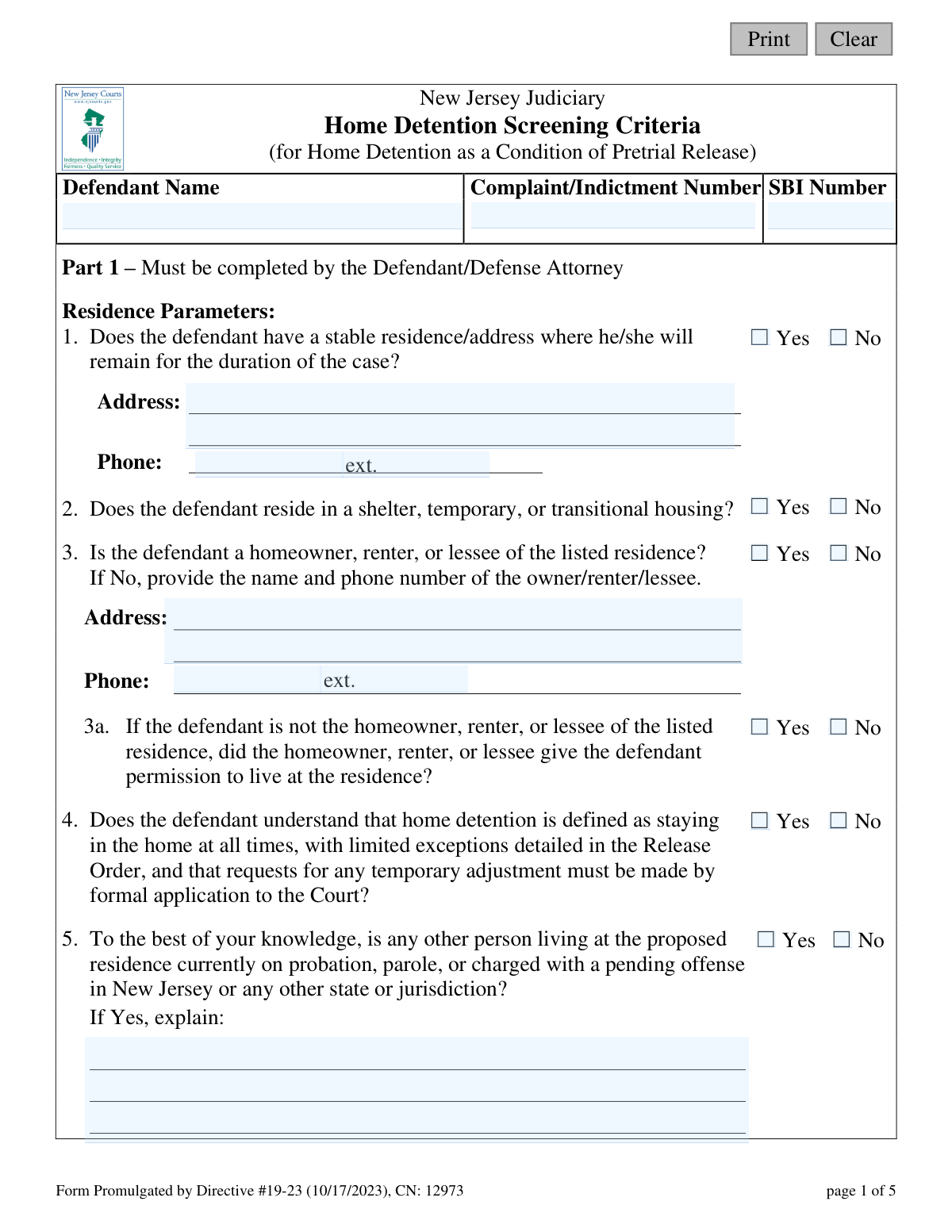
Yes! You can use AI to fill out Home Detention Screening Criteria (for Home Detention as a Condition of Pretrial Release)
This form, promulgated by New Jersey Judiciary Directive #19-23, is a crucial document for defendants and their attorneys seeking home detention as an alternative to jail during the pretrial phase. It gathers detailed information about the defendant's residence, employment, medical needs, and ability to comply with strict monitoring to determine their suitability for the program. Today, this form can be filled out quickly and accurately using AI-powered services like Instafill.ai, which can also convert non-fillable PDF versions into interactive fillable forms.
CN: 12973 is part of the
New Jersey forms category on Instafill.
Our AI automatically handles information lookup, data retrieval, formatting, and form filling.
It takes less than a minute to fill out CN: 12973 using our AI form filling.
Securely upload your data. Information is encrypted in transit and deleted immediately after the form is filled out.
Form specifications
| Form name: | Home Detention Screening Criteria (for Home Detention as a Condition of Pretrial Release) |
| Number of fields: | 105 |
| Number of pages: | 1 |
| Language: | English |
Instafill Demo: How to fill out PDF forms in seconds with AI
How to Fill Out CN: 12973 Online for Free in 2026
Are you looking to fill out a CN: 12973 form online quickly and accurately? Instafill.ai offers the #1 AI-powered PDF filling software of 2026, allowing you to complete your CN: 12973 form in just 37 seconds or less.
Follow these steps to fill out your CN: 12973 form online using Instafill.ai:
- 1 Navigate to Instafill.ai and upload or select the New Jersey Home Detention Screening Criteria form.
- 2 Use the AI assistant to accurately fill in the defendant's name, complaint/indictment number, and SBI number at the top of the form.
- 3 Complete the 'Residence Parameters' section by providing details about the proposed address, living situation, and understanding of home detention rules.
- 4 Fill out the sections on 'Compliance Verification', 'Employment Information', 'Medical Information', and 'Attorney Visits' to detail any necessary and pre-approved reasons for leaving the residence.
- 5 Specify any other requests to leave the home, including the purpose, frequency, and duration for each request.
- 6 The defendant and defense attorney should carefully review all entered information for accuracy before providing their names, signatures, and the date in the final certification section.
- 7 Download, print, or securely submit the completed and signed form as directed by the court or Pretrial Services.
Our AI-powered system ensures each field is filled out correctly, reducing errors and saving you time.
Why Choose Instafill.ai for Your Fillable CN: 12973 Form?
Speed
Complete your CN: 12973 in as little as 37 seconds.
Up-to-Date
Always use the latest 2026 CN: 12973 form version.
Cost-effective
No need to hire expensive lawyers.
Accuracy
Our AI performs 10 compliance checks to ensure your form is error-free.
Security
Your personal information is protected with bank-level encryption.
Frequently Asked Questions About Form CN: 12973
This form is used by the New Jersey Judiciary to evaluate if a defendant is a suitable candidate for home detention as a condition of their pretrial release. It gathers necessary information about the defendant's residence, employment, and other factors.
Part 1 of the form must be completed by the defendant and/or their defense attorney. Both the defendant and the attorney are required to sign the completed document.
You will need your Complaint/Indictment Number, SBI Number, the full address and phone number for your proposed residence, and details about your employment and any regularly scheduled medical or attorney appointments.
You must provide the name and phone number of the homeowner or lessee and confirm that they have given you permission to live there. This permission is essential for your application to be considered.
No, the form explicitly states not to provide specific medical information. You only need to provide the frequency and schedule of any appointments, not the nature or type of the appointment.
This section confirms that you have a device, like a smartphone, for video calls or sending pictures to verify your location upon request. It also confirms your willingness to comply with random remote checks by Pretrial Services.
You must be honest about your work schedule's stability. The form notes that while on home detention, you cannot make last-minute schedule changes or accept overtime without getting approval from Pretrial Staff at least 5 business days in advance.
Requests to meet your attorney must be made to Pretrial Services Staff and approved at least 48 hours before the appointment. Your defense counsel will also need to verify the appointment with Pretrial Services.
You are required to disclose this information on the form. This information will be used by the court to assess the suitability of the proposed residence for home detention.
Use this section for any other necessary and recurring reasons you would need to leave your home, such as for religious services, educational classes, or childcare responsibilities. Be sure to specify the purpose, frequency, and duration for each request.
Yes, services like Instafill.ai use AI to auto-fill form fields accurately and save time. This can be particularly helpful for ensuring consistency and reducing errors when filling out legal paperwork.
You can upload the PDF of the Home Detention Screening Criteria form to the Instafill.ai platform. Their service will make the document interactive, allowing you to type your answers directly into the fields and then download the completed form.
If you have a non-fillable or 'flat' PDF, you can use a tool like Instafill.ai to instantly convert it into a fillable form. This allows you to easily type your information instead of having to print the form and fill it out by hand.
By signing, you certify that living at the proposed address does not violate any court orders, such as a restraining order or a Division of Child Protection and Permanency order. Your defense attorney must also sign the form.
Compliance CN: 12973
Validation Checks by Instafill.ai
1
Ensures Defendant Identification is Complete
This check verifies that the 'Defendant Name', 'Complaint/Indictment Number', and 'SBI Number' fields in the header are all filled out. These fields are critical for uniquely identifying the defendant and linking the form to the correct case file. A submission with missing information in these fields would be ambiguous and could not be processed correctly.
2
Validates Conditional Residence Information
If the defendant answers 'Yes' to having a stable residence (Question 1 in 'Residence Parameters'), this validation ensures that the corresponding 'Address' and 'Phone' fields are not empty. This information is fundamental to the home detention program, as it defines the location of confinement. Failure to provide these details makes the application incomplete and unverifiable.
3
Validates Phone Number Format
This check ensures that all phone number fields ('res1Phone', 'res3Phone', 'employ1Phone') adhere to a standard format, such as (XXX) XXX-XXXX or XXX-XXX-XXXX. Consistent formatting is crucial for data integrity and ensures that automated systems or personnel can successfully use the number to make contact. An invalid format would prevent communication and verification.
4
Requires Homeowner/Lessee Information if Defendant is Not
This validation is triggered if the defendant answers 'No' to being the homeowner, renter, or lessee (Question 3). It checks that the name and phone number of the actual homeowner/lessee are provided. This is essential for verifying that the defendant has permission to reside at the property, a prerequisite for home detention approval.
5
Enforces Logical Dependency for Residence Permission
This check ensures that Question 3a ('did the homeowner... give permission?') can only be answered if the answer to Question 3 ('Is the defendant a homeowner...?') is 'No'. It prevents contradictory data entry where a defendant who is the homeowner is also asked if they have permission from the homeowner. This maintains the logical flow and integrity of the form's data.
6
Requires Explanation for Other Residents on Supervision
If the defendant answers 'Yes' to Question 5 ('is any other person living at the proposed residence currently on probation, parole...'), this validation requires that the explanation text box is filled. This information is critical for a risk assessment, as the presence of other individuals under legal supervision could impact the defendant's compliance and the suitability of the residence. A missing explanation leaves a critical risk factor unevaluated.
7
Validates Conditional Employment Details
When a defendant indicates they are employed by answering 'Yes' to Question 1 in the 'Employment Information' section, this check verifies that the 'Business Name', 'Business Address', 'Business Phone', and 'Current Work Schedule' fields are all completed. This information is necessary for Pretrial Services to verify employment and establish approved hours for the defendant to be away from the residence. Incomplete information prevents the creation of a viable home detention with work release schedule.
8
Enforces Logical Dependency for Work Schedule Stability
This validation ensures that Question 6 ('does the defendant know of changes to his/her work schedule ahead of time...') is only enabled and required if the answer to Question 5 ('Does the defendant have stable work hours?') is 'No'. This prevents irrelevant data collection and ensures that follow-up questions are only asked when applicable. It streamlines the form-filling process and improves data quality.
9
Requires Medical Schedule if Appointments are Indicated
If the defendant answers 'Yes' to Question 1 in the 'Medical Information' section ('Will the defendant need to leave the residence for regularly scheduled medical appointments?'), this check ensures the 'current schedule' field is filled out. This detail is necessary to pre-approve leave from the residence in the release order. Without this information, the defendant would have to make a formal application for every appointment, creating an unnecessary administrative burden.
10
Requires Attorney Appointment Details if Scheduled
This validation is triggered if the defendant answers 'Yes' to Question 1 in the 'Attorney Visits' section. It ensures that the specifics of the scheduled appointment are provided in the corresponding text field. This information allows Pretrial Services to be aware of and verify pre-existing, necessary appointments that require the defendant to leave the residence.
11
Validates Conditional Attorney Contact Information
If the defendant and counsel answer 'Yes' to Question 2 in the 'Attorney Visits' section, this check ensures that the defense counsel's contact information is provided. This contact information is explicitly requested so Pretrial Services can verify future attorney visits. Failure to provide it would prevent the approval of any attorney visits not specified in the original order.
12
Validates Signature Date Format and Plausibility
This check verifies that the 'Date' fields next to the defendant's and defense attorney's signatures are filled with a valid date in a recognized format (e.g., MM/DD/YYYY). It also ensures the date is not in the future. This is crucial for establishing the legal timeline and validity of the signed attestations.
13
Ensures Consistency Between Header and Signature Defendant Names
This validation compares the 'Defendant Name' from the header of the form with the name written in the defendant's signature block ('I, (defendant)...'). The names must match to confirm that the individual signing the certification is the same person for whom the form is being completed. A mismatch would invalidate the legal certification.
14
Flags 'No' Answers on Critical Understanding Questions
This check reviews key acknowledgment questions (e.g., res4, comply2, employ7, med4) where the defendant confirms their understanding of the rules. If any of these are answered 'No', it should trigger a high-priority flag for manual review. A 'No' answer indicates the defendant may not be a suitable candidate or does not fully comprehend the strict conditions of home detention, potentially leading to non-compliance.
15
Verifies Completeness of Signature Blocks
This check ensures that all parts of both the Defense Attorney and Defendant signature blocks are complete, including name, signature, and date. A form is not legally complete or binding without the proper signatures and dates from all required parties. An incomplete signature block would render the entire submission invalid.
Common Mistakes in Completing CN: 12973
Applicants often enter the Defendant Name, Complaint/Indictment Number, or SBI Number incorrectly, or leave them blank. This usually happens due to transcription errors or not having the documents readily available. Inaccurate identifiers can cause significant processing delays or lead to the form being associated with the wrong case file, jeopardizing the entire application. To avoid this, double-check all numbers against official court documents before entry.
A common error is providing a partial address, such as omitting the apartment number, city, or ZIP code in Question 1 of the Residence Parameters. This oversight prevents officials from verifying the proposed residence, which is a critical step for approval. An un-verifiable address will lead to an automatic rejection or delay of the home detention request. Always provide the full, exact mailing address, including any unit or apartment numbers.
When the defendant is not the homeowner or lessee (Question 3), they often check 'No' but fail to provide the name and phone number of the actual owner or renter. This information is mandatory for Pretrial Services to verify that the defendant has permission to live at the residence. Omitting these details makes the residence plan invalid and will halt the screening process until the information is provided and consent is verified.
In the Employment section, applicants frequently write 'Varies' or provide an unclear work schedule instead of specific days and times. Home detention requires a precise, predictable schedule for compliance monitoring, and a vague entry makes it impossible for Pretrial Staff to establish approved hours for work. To ensure approval for work-related leave, provide a detailed weekly schedule, and if it changes, explain the pattern and notification process as requested in Question 6.
The Medical Information section explicitly states not to provide specific medical details, yet applicants often describe the nature of their illness or treatment. This happens because they want to justify the need for leave, but it violates privacy and the form's instructions. Disclosing this protected health information can create legal and administrative issues, requiring the form to be resubmitted. Only provide the frequency and schedule of appointments as requested.
Applicants often overlook the section for 'Other requests to leave the home' or fail to anticipate recurring, essential needs like childcare, religious services, or mandatory support group meetings. Once under home detention, any leave not pre-approved in the release order requires a formal court application, causing significant delays. It is crucial to think ahead and list all predictable, necessary reasons for leave with their frequency and duration to build them into the initial order.
People sometimes provide conflicting answers, such as stating they have stable work hours (Employment Q5: Yes) but then explaining how their schedule changes (Employment Q6). This occurs from rushing or misunderstanding the questions' intent and can undermine the applicant's credibility. Such contradictions raise red flags for the reviewing officers, suggesting the defendant may not fully comprehend or be able to comply with the detention conditions, potentially leading to denial.
This form may be distributed as a flat, non-fillable PDF, leading users to print it and fill it out by hand, often resulting in illegible handwriting. Illegible information can cause data entry errors on the court's end, leading to delays or rejections. To prevent this, it's best to use a tool that can convert the document into a fillable format. For instance, AI-powered tools like Instafill.ai can make any PDF fillable, ensuring all entries are clear, legible, and properly formatted.
Despite questions (like Residence Q4 and Employment Q7) designed to confirm understanding, some defendants fail to grasp the strictness of home detention. They may agree to the terms without fully realizing they cannot make last-minute schedule changes, run quick errands, or pick up a paycheck on a day off. This misunderstanding can lead to immediate violations and revocation of pretrial release. It is vital to read these questions carefully and ask the defense attorney for clarification if any part is unclear.
In sections like Residence Question 5, the form asks for an explanation if the answer is 'Yes' (e.g., if another resident is on parole/probation). Applicants sometimes check 'Yes' but neglect to provide the required written explanation. This omission is treated as an incomplete answer and stops the review process, as the missing context is critical for assessing potential risks at the residence. Always provide a full, detailed explanation in the space provided whenever a 'Yes' answer prompts for more information.
Saved over 80 hours a year
“I was never sure if my IRS forms like W-9 were filled correctly. Now, I can complete the forms accurately without any external help.”
Kevin Martin Green
Your data stays secure with advanced protection from Instafill and our subprocessors

Robust compliance program
Transparent business model
You’re not the product. You always know where your data is and what it is processed for.
ISO 27001, HIPAA, and GDPR
Our subprocesses adhere to multiple compliance standards, including but not limited to ISO 27001, HIPAA, and GDPR.
Security & privacy by design
We consider security and privacy from the initial design phase of any new service or functionality. It’s not an afterthought, it’s built-in, including support for two-factor authentication (2FA) to further protect your account.
Fill out CN: 12973 with Instafill.ai
Worried about filling PDFs wrong? Instafill securely fills home-detention-screening-criteria-for-home-detention-as-a-condition-of-pretrial-release forms, ensuring each field is accurate.