Yes! You can use AI to fill out Landlord Case Information Statement (LCIS)
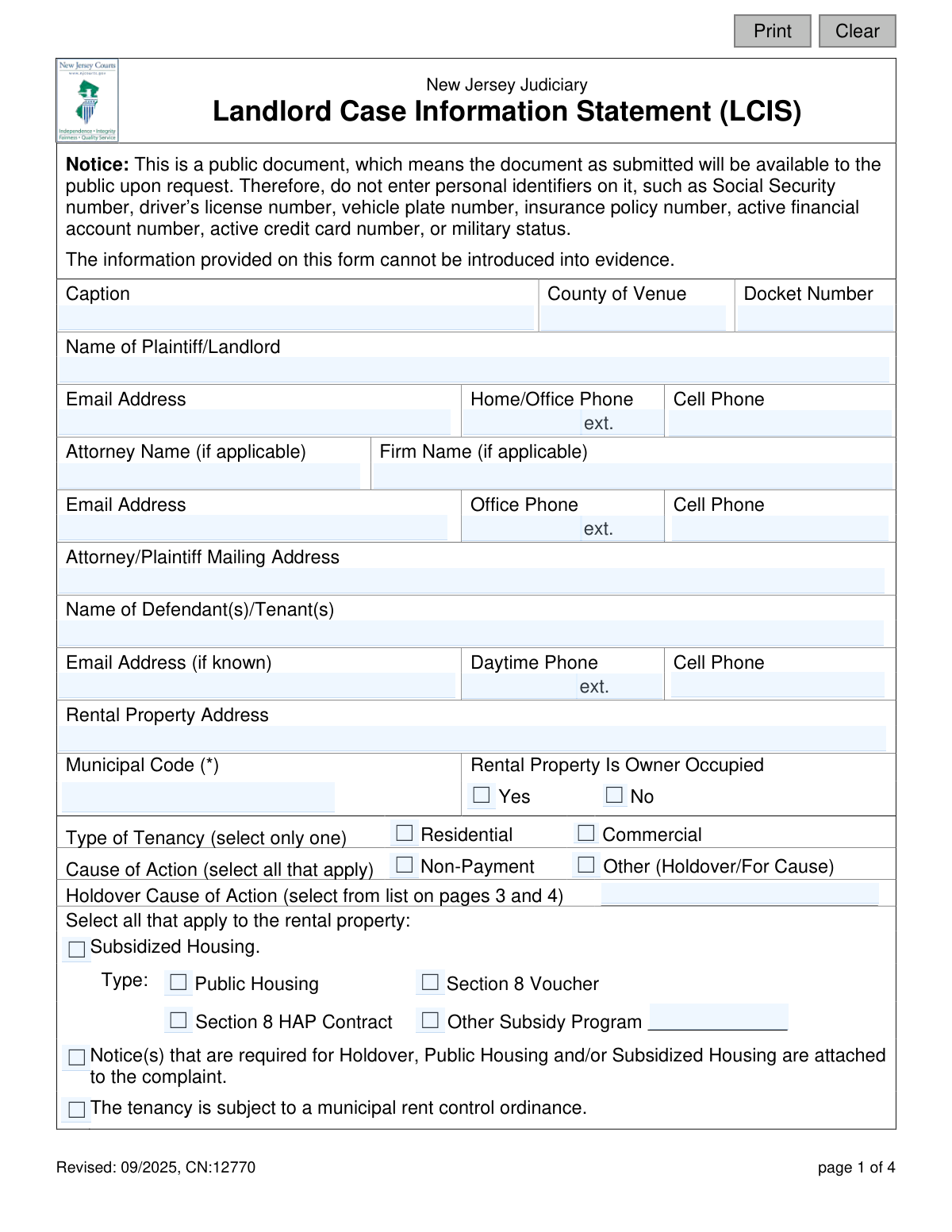
The Landlord Case Information Statement (LCIS) is a mandatory document for landlords in New Jersey when filing a case against a tenant in court. It provides the court with essential details about the landlord, tenant, rental property, and the specific cause of action, such as non-payment of rent or other lease violations. This public document is crucial for organizing case information but requires redacting personal identifiers. Today, this form can be filled out quickly and accurately using AI-powered services like Instafill.ai, which can also convert non-fillable PDF versions into interactive fillable forms.
LCIS (CN:12770) is part of the
New Jersey forms category on Instafill.
Our AI automatically handles information lookup, data retrieval, formatting, and form filling.
It takes less than a minute to fill out LCIS (CN:12770) using our AI form filling.
Securely upload your data. Information is encrypted in transit and deleted immediately after the form is filled out.
Form specifications
| Form name: | Landlord Case Information Statement (LCIS) |
| Number of fields: | 45 |
| Number of pages: | 1 |
| Language: | English |
Instafill Demo: How to fill out PDF forms in seconds with AI
How to Fill Out LCIS (CN:12770) Online for Free in 2026
Are you looking to fill out a LCIS (CN:12770) form online quickly and accurately? Instafill.ai offers the #1 AI-powered PDF filling software of 2026, allowing you to complete your LCIS (CN:12770) form in just 37 seconds or less.
Follow these steps to fill out your LCIS (CN:12770) form online using Instafill.ai:
- 1 Navigate to Instafill.ai and upload or select the Landlord Case Information Statement (LCIS) form.
- 2 Provide information for the Plaintiff/Landlord and their attorney, including names, contact details, and mailing address.
- 3 Enter the known details for the Defendant(s)/Tenant(s), such as name, email, and phone number.
- 4 Input the rental property address, municipality code, and specify the tenancy type (Residential or Commercial).
- 5 Select the cause of action (Non-Payment or Other), and if applicable, choose the specific holdover reason from the provided list and detail the amount owed.
- 6 Indicate if the property involves subsidized housing or is subject to a municipal rent control ordinance.
- 7 Review all the information populated by the AI, certify the statements are true, and provide your digital signature and date to complete the form.
Our AI-powered system ensures each field is filled out correctly, reducing errors and saving you time.
Why Choose Instafill.ai for Your Fillable LCIS (CN:12770) Form?
Speed
Complete your LCIS (CN:12770) in as little as 37 seconds.
Up-to-Date
Always use the latest 2026 LCIS (CN:12770) form version.
Cost-effective
No need to hire expensive lawyers.
Accuracy
Our AI performs 10 compliance checks to ensure your form is error-free.
Security
Your personal information is protected with bank-level encryption.
Frequently Asked Questions About Form LCIS (CN:12770)
The LCIS is a required document for landlords filing an eviction case in New Jersey. It provides the court with a summary of the case, including landlord/tenant details, the property address, and the reason for the eviction.
Any landlord, or their attorney, who is initiating an eviction lawsuit in the New Jersey court system must complete and submit this form along with their complaint.
This form is a public document, so to protect your privacy and prevent identity theft, you must not include sensitive information. The court requires you to redact, or remove, this information from all submitted documents.
As noted on the form, you can find the correct municipality code for the property's location by visiting the New Jersey Judiciary's official website at njcourts.gov.
Select 'Non-Payment' if the tenant is being evicted solely for not paying rent. Select 'Other (Holdover/For Cause)' for all other reasons, such as lease violations, disorderly conduct, or the owner wishing to occupy the unit.
If you selected 'Other (Holdover/For Cause),' you must review the list of reasons on pages 3 and 4 of the form. Find the number that corresponds to your specific reason for eviction and enter it in the 'Holdover Cause of Action' box.
Yes, if you are filing for a holdover, public housing, or subsidized housing case, you must check the box confirming that all legally required notices have been attached to the complaint you are filing with the court.
Yes, the form is used for both types of tenancies. You must select either 'Residential' or 'Commercial' under 'Type of Tenancy,' as different legal causes for eviction may apply.
This means the LCIS is an administrative summary for the court and cannot be used as proof during your trial. You must present separate testimony and evidence to prove your case.
If you have a non-fillable PDF, you can use a service like Instafill.ai to convert it into an interactive, fillable form. This allows you to easily type your information directly into the fields online.
Yes, AI-powered services like Instafill.ai can help you complete the form faster and more accurately. These tools can auto-fill fields with your saved information, reducing repetitive data entry.
Simply upload the LCIS form to the Instafill.ai platform. The AI will make the document fillable online, and you can use its features to quickly populate your information before printing the completed form for submission.
You must state the total number of months of unpaid rent, the first month and year the rent was missed, and the total dollar amount currently due and owing from the tenant.
By signing the form, you are legally certifying under penalty of punishment that all information you have provided is true and that you have removed all confidential personal identifiers from the documents.
Compliance LCIS (CN:12770)
Validation Checks by Instafill.ai
1
Ensures at least one Cause of Action is selected
This check verifies that the user has selected at least one checkbox under 'Cause of Action' (either 'Non-Payment' or 'Other (Holdover/For Cause)'). This is a critical field as it defines the legal basis for the landlord's case. If neither is selected, the form is incomplete and cannot be processed, as the court would not know the reason for the filing.
2
Conditional Requirement for Holdover Cause of Action Code
This validation ensures that if the 'Other (Holdover/For Cause)' checkbox is selected, the 'Holdover Cause of Action' field must be filled in. This field specifies the exact legal reason for a holdover case, referencing the list on pages 3 and 4. Failure to provide this code when required would make the filing ambiguous and legally insufficient.
3
Validates Holdover Cause of Action Code against Tenancy Type
This check cross-references the 'Holdover Cause of Action' code with the selected 'Type of Tenancy'. For example, codes 1-21 are for 'Residential' tenancies, while codes 22-27 are for 'Commercial' or other specific types. This prevents logical errors in the filing, ensuring the legal cause cited is applicable to the type of property in question.
4
Conditional Requirement for Non-Payment Details
This validation rule ensures that if 'Non-Payment' is selected as a Cause of Action, the fields 'The total number of months of unpaid rent', 'The first month of unpaid rent', and 'The amount due and owing' must all be completed. These details are essential for a non-payment case. A failure to provide this information would result in an incomplete claim.
5
Validates Format for 'Amount Due and Owing'
This check verifies that the value entered in 'The amount due and owing by the tenant' is a valid positive numerical or currency format (e.g., '1500.00'). It should not contain letters or special characters other than a decimal point and currency symbol. This ensures data integrity for financial calculations and court records.
6
Validates Format for 'First Month of Unpaid Rent'
This check ensures that the entry for 'The first month of unpaid rent' is in a valid month and year format (e.g., 'January 2023' or '01/2023'). This is important for establishing the timeline of the non-payment claim. An invalid format could lead to misinterpretation by the court.
7
Conditional Requirement for Subsidy Type
This validation rule is triggered if the 'Subsidized Housing' checkbox is selected. It ensures that at least one of the specific subsidy types (e.g., 'Public Housing', 'Section 8 Voucher', 'Other Subsidy Program') is also checked. This provides necessary context about the tenancy, which can affect legal procedures and requirements.
8
Conditional Requirement for 'Other Subsidy' Description
If the 'Other Subsidy Program' checkbox is selected, this validation ensures that the accompanying text field for describing the program is not empty. This is crucial for clarity, as simply checking 'Other' without explanation provides no useful information to the court. The form cannot be considered complete without this description.
9
Ensures Plaintiff/Landlord Name is Provided
This check verifies that the 'Name of Plaintiff/Landlord' field is not empty. The plaintiff's name is a fundamental piece of information required to identify the party initiating the legal action. A submission without this information would be invalid and cannot be docketed.
10
Ensures Rental Property Address is Provided
This validation confirms that the 'Rental Property Address' field has been filled out. This address is essential as it identifies the location of the dispute and establishes the court's jurisdiction. Without this information, the case cannot proceed as the subject of the legal action is unknown.
11
Validates Format for Email Address Fields
This check applies to all email address fields on the form (Plaintiff, Attorney, Defendant). If a value is entered, it must conform to a standard email format (e.g., '[email protected]'). This ensures that any electronic communications sent by the court will be deliverable, which is critical for case notifications.
12
Validates Format for Phone Number Fields
This validation ensures that all phone number fields, if filled, contain a valid number of digits and an appropriate format (e.g., (555) 555-5555 or 5555555555). This is important for maintaining accurate contact information for all parties involved. An invalid phone number hinders communication and can delay proceedings.
13
Ensures Selection for 'Rental Property Is Owner Occupied'
This check verifies that either 'Yes' or 'No' has been selected for the 'Rental Property Is Owner Occupied' question. This information can be legally significant, as different laws may apply to owner-occupied properties with a small number of units. An unanswered question creates ambiguity and makes the form incomplete.
14
Validates Docket Number Format
This check verifies that the 'Docket Number' field, if entered, follows the expected format for the New Jersey Judiciary (e.g., LT-######-##). This ensures data consistency and helps prevent errors when linking the form to the correct case file in the court's system. An incorrectly formatted docket number could cause the document to be misfiled.
15
Ensures Certification Section is Complete
This validation confirms that the 'Date' and 'Attorney/Plaintiff Name' fields in the final certification section are filled out. The signature and date certify the truthfulness of the statements made in the document. A submission without a complete certification is legally invalid and will be rejected.
Common Mistakes in Completing LCIS (CN:12770)
Landlords often leave the 'Municipal Code' field blank or enter the city name instead of the required numerical code. This happens because it requires an external lookup on the njcourts.gov website, which is an extra step many filers miss. An incorrect or missing code can lead to filing delays or rejection by the court clerk. To avoid this, always look up the specific code before filling out the form; AI-powered tools like Instafill.ai can often auto-populate this information based on the property address.
A frequent error is checking 'Other (Holdover/For Cause)' on page 1 but failing to enter the corresponding numerical code from pages 3-4 in the 'Holdover Cause of Action' field. This creates a legally insufficient complaint because the specific grounds for the holdover are not stated. To prevent this, ensure that if you select the holdover option, you carefully review the list and enter all applicable codes on the first page.
Despite a prominent warning on the form, filers sometimes include personal identifiers like Social Security or driver's license numbers. This mistake occurs when rushing or overlooking instructions, and it results in sensitive personal data becoming part of a public court document. Always double-check the entire form to ensure no confidential information is present before submitting it.
Forgetting to check the 'Subsidized Housing' box and specify the type (e.g., Section 8, Public Housing) is a critical error. Tenancies involving housing subsidies are subject to different laws and notice requirements, and failing to disclose this status can lead to the case being dismissed on procedural grounds. Always verify if any subsidy is involved and accurately complete this section.
The fields for 'total number of months of unpaid rent,' 'first month of unpaid rent,' and 'amount due and owing' are often filled out with conflicting information. For example, the total amount might not equal the number of months multiplied by the monthly rent. This inconsistency weakens the landlord's claim and can be easily challenged by the tenant. Carefully calculate and cross-reference these figures for accuracy before submission.
For holdover or subsidized housing cases, specific legal notices must be attached to the complaint, and the form requires checking a box to certify this. Filers may attach the notices but forget to check the corresponding box, creating a procedural defect in the filing. This can cause the court to question whether proper procedure was followed, potentially jeopardizing the case.
The list of holdover causes on pages 3-4 is long and tied to specific statutes, making it easy to select the wrong code. For instance, a landlord might choose a code for a 3-unit building when their property has 5 units, invalidating the legal basis for the eviction. It is crucial to read the descriptions carefully and select the code that precisely matches the legal and factual situation.
Filers sometimes list only one tenant when multiple adults are on the lease, or they misspell a tenant's name. This is a serious error, as an eviction judgment is only effective against the individuals named in the case. To ensure a legally enforceable eviction, you must list the full, correct legal names of all adult tenants residing in the property.
An unsigned or undated form is legally invalid and will be rejected by the court. This simple oversight is a common reason for filing delays, as the landlord must correct and resubmit the document. Always perform a final review to ensure the certification is properly signed and dated. Using a tool like Instafill.ai can help by highlighting required signature fields.
Incorrectly selecting between 'Residential' and 'Commercial' tenancy is a fundamental mistake with major consequences. The laws, notice periods, and causes for action are vastly different for each type. Choosing the wrong one means the entire case is based on the wrong legal standard and will likely be dismissed, forcing the landlord to start over. Since this form is a non-fillable PDF, a service like Instafill.ai can convert it into an interactive version, making it easier to navigate and avoid such errors.
Saved over 80 hours a year
“I was never sure if my IRS forms like W-9 were filled correctly. Now, I can complete the forms accurately without any external help.”
Kevin Martin Green
Your data stays secure with advanced protection from Instafill and our subprocessors

Robust compliance program
Transparent business model
You’re not the product. You always know where your data is and what it is processed for.
ISO 27001, HIPAA, and GDPR
Our subprocesses adhere to multiple compliance standards, including but not limited to ISO 27001, HIPAA, and GDPR.
Security & privacy by design
We consider security and privacy from the initial design phase of any new service or functionality. It’s not an afterthought, it’s built-in, including support for two-factor authentication (2FA) to further protect your account.
Fill out LCIS (CN:12770) with Instafill.ai
Worried about filling PDFs wrong? Instafill securely fills landlord-case-information-statement-lcis forms, ensuring each field is accurate.