Yes! You can use AI to fill out New Jersey Judiciary How to File a Judgment Obtained from a Foreign Jurisdiction (CN 10519)

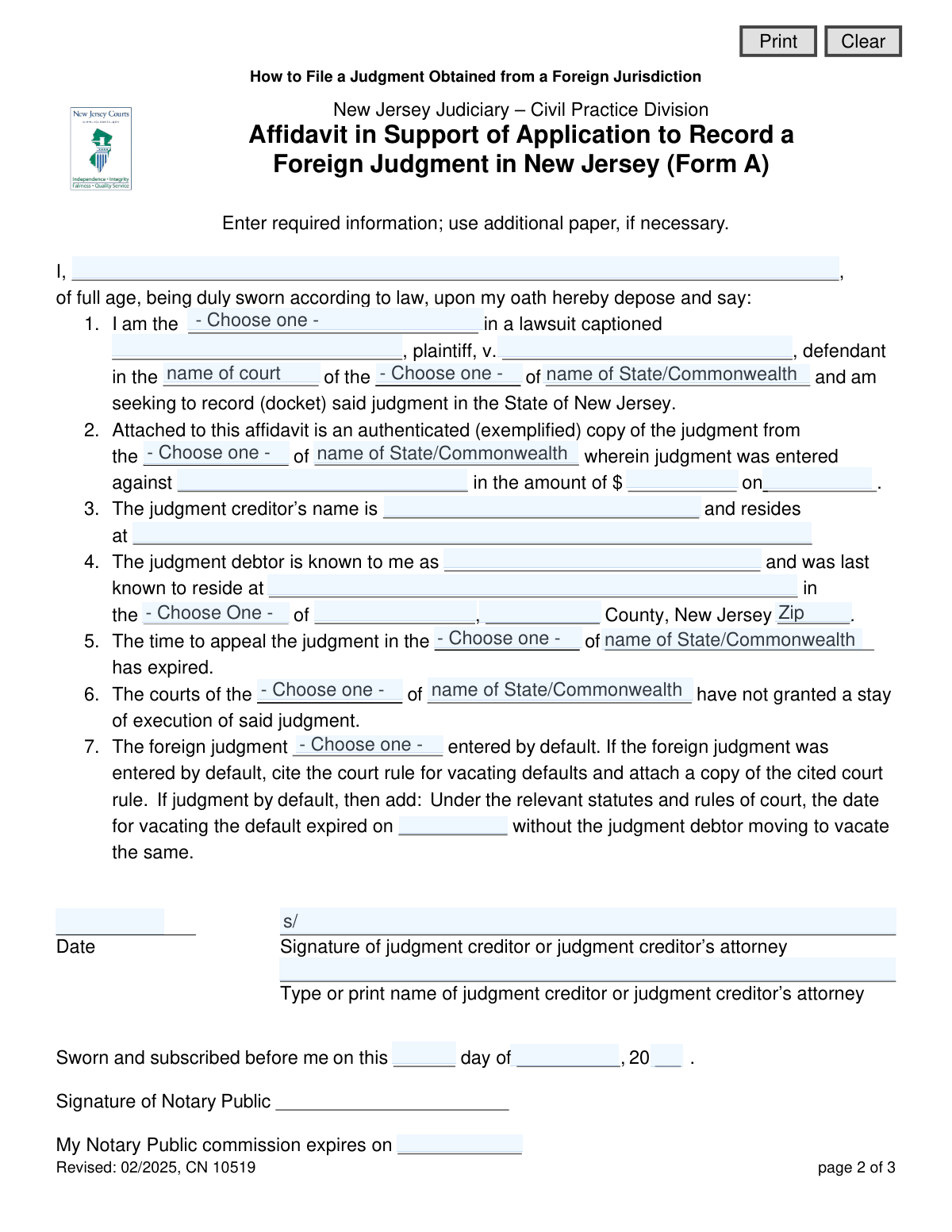
This New Jersey Judiciary package, CN 10519, explains the process for docketing a foreign judgment under the Uniform Enforcement of Foreign Judgments Act. It includes the 'Affidavit in Support of Application to Record a Foreign Judgment in New Jersey (Form A),' which a judgment creditor must file to make a judgment from another state or country enforceable in New Jersey. This process is crucial for collecting on out-of-state court awards. Today, this form can be filled out quickly and accurately using AI-powered services like Instafill.ai, which can also convert non-fillable PDF versions into interactive fillable forms.
CN 10519 is part of the New Jersey forms category on Instafill.
Our AI automatically handles information lookup, data retrieval, formatting, and form filling.
It takes less than a minute to fill out CN 10519 using our AI form filling.
Securely upload your data. Information is encrypted in transit and deleted immediately after the form is filled out.

Form specifications

Form name: New Jersey Judiciary How to File a Judgment Obtained from a Foreign Jurisdiction (CN 10519)
Number of fields: 35
Number of pages: 1
Language: English
main-image

Instafill Demo: How to fill out PDF forms in seconds with AI

How to Fill Out CN 10519 Online for Free in 2026

Are you looking to fill out a CN 10519 form online quickly and accurately? Instafill.ai offers the #1 AI-powered PDF filling software of 2026, allowing you to complete your CN 10519 form in just 37 seconds or less.
Follow these steps to fill out your CN 10519 form online using Instafill.ai:
  1. 1 Navigate to Instafill.ai and upload or select the New Jersey 'How to File a Judgment Obtained from a Foreign Jurisdiction' package (CN 10519).
  2. 2 Use the AI assistant to provide the required information for the affidavit, including the names and addresses of the judgment creditor and debtor.
  3. 3 Enter the specific details of the foreign judgment, such as the court of origin, the date of the judgment, and the monetary amount.
  4. 4 Answer the AI's guided questions regarding the judgment's appeal status, any stays of execution, and whether it was entered by default.
  5. 5 Review all the information automatically populated by the AI onto the 'Affidavit in Support of Application to Record a Foreign Judgment in New Jersey (Form A)' for accuracy.
  6. 6 Securely download the completed affidavit, print it, and get it signed and notarized as required.
  7. 7 Assemble the notarized affidavit, an authenticated copy of the foreign judgment, and the filing fee to submit to the New Jersey Superior Court Clerk's Office as per the package instructions.

Our AI-powered system ensures each field is filled out correctly, reducing errors and saving you time.

Why Choose Instafill.ai for Your Fillable CN 10519 Form?

Speed

Complete your CN 10519 in as little as 37 seconds.

Up-to-Date

Always use the latest 2026 CN 10519 form version.

Cost-effective

No need to hire expensive lawyers.

Accuracy

Our AI performs 10 compliance checks to ensure your form is error-free.

Security

Your personal information is protected with bank-level encryption.

Frequently Asked Questions About Form CN 10519

This packet is used to officially record a money judgment from another state or country in New Jersey, making it legally enforceable within the state.

The judgment creditor (the person or entity owed money) or their attorney must complete this form to enforce a judgment against a debtor who has assets in New Jersey.

You must submit the completed Affidavit (Form A), an authenticated (exemplified) copy of the foreign judgment with the court's seal, and the filing fee.

It is an official copy of the judgment from the original court, bearing the court's seal and certification to prove it is genuine. You must request this from the court that issued the judgment.

If the judgment was by default, you must state this on the affidavit, cite the rule for vacating defaults from the original court, and attach a copy of that rule.

The filing fee is $35.00. It must be paid with a check or money order made payable to 'Treasurer, State of New Jersey'.

You can mail the documents to the Superior Court Clerk’s Office, P.O. Box 971, Trenton, NJ 08625, or hand-deliver them to the office at the Richard J. Hughes Justice Complex in Trenton.

The Clerk records the judgment and notifies the debtor, who has 14 days to object. No enforcement actions, such as seizing assets, can take place during this 14-day period.

Yes, any attorney submitting the affidavit must be licensed to practice law in New Jersey and be in good standing.

Yes, services like Instafill.ai use AI to accurately auto-fill form fields, which can save you time and help ensure the information is entered correctly.

You can upload the PDF of the form to the Instafill.ai platform. Its AI will make the form fillable online, allowing you to easily enter your information before printing for submission.

You can use a tool like Instafill.ai, which can convert non-fillable PDFs into interactive forms that you can complete and save on your computer.

An affidavit must be signed in the presence of a Notary Public. A certification can be used in lieu of an affidavit and does not require a notary, but you certify that the statements are true under penalty of law.

If you have questions about filing foreign judgments, you can call the Superior Court Clerk’s Office directly at 609-421-6100.

Compliance CN 10519
Validation Checks by Instafill.ai

1
Validates Judgment Amount is a Positive Number
This check ensures the 'amount of judgment' field contains a valid, positive monetary value formatted as currency. It prevents the submission of forms with zero, negative, or non-numeric amounts, which are invalid for a money judgment. A failure would require the user to correct the entry to reflect the exact amount awarded in the foreign judgment.
2
Ensures Judgment Date is in the Past
This validation verifies that the date the foreign judgment was entered is a valid date that occurred before the current submission date. This is crucial for establishing the judgment's existence and legal history. Submitting a future or invalid date would block the filing until a correct, historical date is provided.
3
Cross-Validates Plaintiff and Judgment Creditor Names
This check compares the name of the plaintiff listed in the lawsuit caption with the name of the judgment creditor. These two fields should identify the same legal entity or person to ensure consistency throughout the document. A mismatch could indicate a significant clerical error, leading to rejection until the names are corrected and consistent.
4
Cross-Validates Defendant and Judgment Debtor Names
This validation ensures the name of the defendant in the lawsuit caption matches the name of the judgment debtor listed elsewhere on the affidavit. Consistency is critical for correctly identifying the party against whom the judgment is being enforced. A discrepancy would halt the process and require correction to prevent enforcement against the wrong party.
5
Requires Complete Judgment Creditor Address
This check confirms that the full address for the judgment creditor is provided, including street, city, state, and zip code. This information is required by the court for official correspondence and record-keeping as specified in the instructions. An incomplete or missing address will result in a validation error, prompting the user to provide the full address before submission.
6
Requires Complete Last Known Debtor Address
This validation ensures the last known address of the judgment debtor is fully entered. This address is essential for the Clerk of the Superior Court to send the required 14-day notice of the filing. Failure to provide a complete address will prevent the form's submission, as it would impede the legal notification process.
7
Conditional Validation for Default Judgments
This check is triggered if the applicant indicates the foreign judgment was entered by default. It then requires the user to provide the date on which the period for vacating the default expired in the original jurisdiction. This information is legally required to prove the judgment is final, and its absence will block the submission of any default judgment filing.
8
Logical Date Order for Default Judgments
If a judgment was entered by default, this check ensures the provided 'default vacation expiration date' is chronologically after the 'judgment entry date'. It is logically impossible for the time to vacate a default to expire before the judgment itself exists. An error here indicates a data entry mistake that must be corrected to ensure the legal timeline is accurate.
9
Verifies Attachment of Authenticated Foreign Judgment
The system must confirm that a file has been uploaded for the 'authenticated (exemplified) copy of the foreign judgment.' This document is the primary evidence for the filing and is a non-negotiable requirement listed in the instructions. The submission cannot proceed without this attachment, and the user will be prompted to upload the required document.
10
Ensures Notary Commission is Active
This validation checks that the notary public's commission expiration date is in the future, relative to the date of notarization. This confirms that the affidavit was notarized by an individual with a valid, active commission as required by law. An expired commission would invalidate the notarization and cause the filing to be rejected.
11
Verifies Attorney is Licensed in New Jersey
Based on Court Rule 1:21, this check validates that if the affidavit is submitted by an attorney, they are licensed and in good standing to practice law in New Jersey. This could involve checking a provided NJ Bar ID against a state database. This is critical for compliance, and a failure would prevent the attorney from filing on behalf of the creditor.
12
Ensures Signature Date Matches Notarization Date
This check verifies that the date the affiant signed the document is the same as the date the notary witnessed the signature ('Sworn and subscribed before me'). These dates must match to confirm that the oath was administered and the signature was witnessed on the specified day. A mismatch suggests a procedural error in the signing process and would require correction.

Common Mistakes in Completing CN 10519

Failing to Attach an Authenticated/Exemplified Copy

The instructions explicitly require an 'authenticated (exemplified) copy of the foreign judgment'. Many filers mistakenly submit a standard photocopy, which lacks the official court seal and certification needed to prove its validity. This error results in an automatic rejection of the application, as the court cannot verify the judgment's authenticity. To avoid this, you must contact the clerk of the court that issued the judgment and specifically request an 'exemplified' or 'authenticated' copy for the purpose of enforcement in another state.

Incorrectly Handling a Default Judgment

Section 7 of the affidavit has specific, complex requirements if the judgment was entered by default. Filers often fail to indicate that the judgment was by default, or if they do, they neglect to attach a copy of the foreign court's rule for vacating defaults and state the date the vacation period expired. This omission makes the application incomplete and leads to its rejection. To prevent this, confirm if the judgment was by default and, if so, obtain a copy of the relevant court rule from the original jurisdiction to include with your filing.

Submitting an Un-notarized or Improperly Executed Affidavit

This form is an 'Affidavit,' which is a sworn statement that must be signed in the presence of a Notary Public. A common mistake is for the filer to sign the document without having it notarized, or to use a certification without understanding the specific formatting rules. An un-notarized affidavit is legally invalid and will cause the entire filing to be rejected. Always wait to sign the form until you are physically in front of a notary, and ensure the notary fully completes their section, including their signature, seal, and commission expiration date.

Mismatched or Incomplete Party and Court Information

The names of the judgment creditor, judgment debtor, and the originating court must be transcribed exactly as they appear on the foreign judgment. People often use abbreviations, informal names, or make typographical errors, creating discrepancies that can invalidate the filing. For example, writing 'Superior Court, CA' instead of the full 'Superior Court of California, County of Los Angeles' can cause issues. To avoid this, carefully copy all names and titles from the authenticated judgment document. AI-powered form filling tools like Instafill.ai can help prevent transcription errors by ensuring data consistency across fields.

Filing Prematurely Before Appeal Rights Expire

The affidavit requires the filer to swear that the time to appeal the foreign judgment has expired and that no stay of execution is in effect. Eager to collect, a creditor might file this application while the debtor still has the legal right to appeal in the original jurisdiction. This renders the judgment 'not final' and therefore ineligible for enforcement in New Jersey, leading to rejection. Before filing, you must verify the specific appeal deadlines of the original court and confirm that the time has fully passed without an appeal being filed.

Errors in Filing Fee Payment

The instructions specify a $35.00 fee payable to 'Treasurer, State of New Jersey'. Common mistakes include sending a check for the wrong amount, making it payable to the wrong entity like 'NJ Courts', or forgetting to include the payment entirely. The clerk's office will not process the application until the correct fee is received from the correct payee, causing significant delays. Always double-check the fee amount and payee name in the most current instructions before preparing your payment.

Providing Incorrect or Incomplete Addresses

The form requires the 'last known address' for both the creditor and the debtor, which is critical for providing legal notice. Filers may enter a P.O. Box instead of a physical address, provide an old address, or make typos in the street name or zip code. An incorrect debtor address can prevent the court from delivering the 14-day notice of docketing, potentially invalidating the enforcement action. Use tools to verify addresses and ensure you are providing the most accurate, complete, last known physical address for both parties. If the form is a non-fillable PDF, tools like Instafill.ai can convert it to a fillable version to reduce data entry errors.

Filing by an Unauthorized Out-of-State Attorney

New Jersey Court Rule 1:21 requires that an attorney submitting this filing must be licensed and in good standing to practice law in New Jersey. An attorney from another state cannot file this application on their own. This mistake leads to the filing being rejected for unauthorized practice of law. To avoid this, any attorney signing the affidavit must be a member of the NJ Bar, or the creditor must file as a self-represented litigant.

Forgetting to Submit the Required Number of Copies

The instructions on page 3 clearly state that the filer must submit the 'original and two copies' of the foreign judgment and the affidavit. Self-represented litigants, in particular, often overlook this requirement and send only the original documents. This forces the clerk's office to either return the packet as incomplete or make copies, delaying the process. To ensure smooth processing, make two complete sets of high-quality copies of all documents before mailing or delivering your packet.
Saved over 80 hours a year

“I was never sure if my IRS forms like W-9 were filled correctly. Now, I can complete the forms accurately without any external help.”

Kevin Martin Green

Your data stays secure with advanced protection from Instafill and our subprocessors

Robust compliance program

Transparent business model

You’re not the product. You always know where your data is and what it is processed for.

ISO 27001, HIPAA, and GDPR

Our subprocesses adhere to multiple compliance standards, including but not limited to ISO 27001, HIPAA, and GDPR.

Security & privacy by design

We consider security and privacy from the initial design phase of any new service or functionality. It’s not an afterthought, it’s built-in, including support for two-factor authentication (2FA) to further protect your account.

Fill out CN 10519 with Instafill.ai

Worried about filling PDFs wrong? Instafill securely fills new-jersey-judiciary-how-to-file-a-judgment-obtained-from-a-foreign-jurisdiction-cn-10519 forms, ensuring each field is accurate.