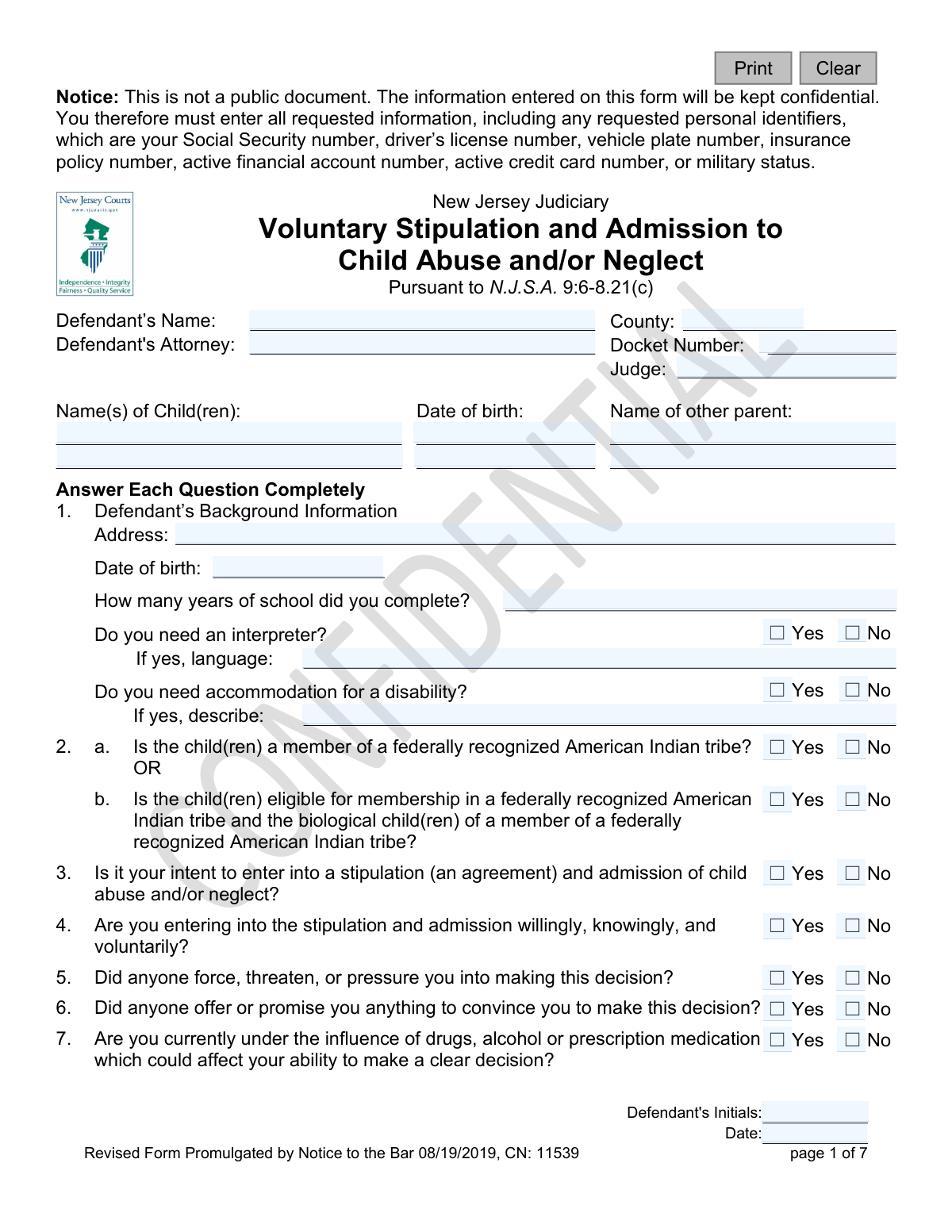
Yes! You can use AI to fill out New Jersey Judiciary Voluntary Stipulation and Admission to Child Abuse and/or Neglect Pursuant to N.J.S.A. 9:6-8.21(c)

This form, officially titled 'Voluntary Stipulation and Admission to Child Abuse and/or Neglect,' is used within the New Jersey Judiciary system by a defendant to formally agree to and admit the facts of a child abuse or neglect case against them. By signing, the defendant waives their right to a fact-finding hearing (trial) and accepts the legal consequences, which may include being listed on the state's child abuse registry. Today, this complex legal form can be filled out quickly and accurately using AI-powered services like Instafill.ai, which can also convert non-fillable PDF versions into interactive fillable forms.
CN: 11539 is part of the New Jersey forms category on Instafill.
Our AI automatically handles information lookup, data retrieval, formatting, and form filling.
It takes less than a minute to fill out CN: 11539 using our AI form filling.
Securely upload your data. Information is encrypted in transit and deleted immediately after the form is filled out.

Form specifications

Form name: New Jersey Judiciary Voluntary Stipulation and Admission to Child Abuse and/or Neglect Pursuant to N.J.S.A. 9:6-8.21(c)
Number of fields: 125
Number of pages: 1
Language: English
main-image

Instafill Demo: How to fill out PDF forms in seconds with AI

How to Fill Out CN: 11539 Online for Free in 2026

Are you looking to fill out a CN: 11539 form online quickly and accurately? Instafill.ai offers the #1 AI-powered PDF filling software of 2026, allowing you to complete your CN: 11539 form in just 37 seconds or less.
Follow these steps to fill out your CN: 11539 form online using Instafill.ai:
  1. 1 Navigate to Instafill.ai and upload or select the 'Voluntary Stipulation and Admission to Child Abuse and/or Neglect' form.
  2. 2 Use the AI assistant to accurately input case details, including the defendant's name, attorney, docket number, county, and the names and birth dates of the children involved.
  3. 3 Carefully answer the series of yes/no questions about your background, understanding of your legal rights, and the voluntary nature of your admission.
  4. 4 In consultation with your attorney, select whether the stipulation is for 'established' or 'substantiated' abuse/neglect and complete the corresponding section (Questions 20 or 21).
  5. 5 Thoroughly review the entire completed form with your legal counsel to ensure all information is correct and you understand the consequences of your admission.
  6. 6 Initial each page where indicated, and then provide your final signature and the date to execute the stipulation.

Our AI-powered system ensures each field is filled out correctly, reducing errors and saving you time.

Why Choose Instafill.ai for Your Fillable CN: 11539 Form?

Speed

Complete your CN: 11539 in as little as 37 seconds.

Up-to-Date

Always use the latest 2026 CN: 11539 form version.

Cost-effective

No need to hire expensive lawyers.

Accuracy

Our AI performs 10 compliance checks to ensure your form is error-free.

Security

Your personal information is protected with bank-level encryption.

Frequently Asked Questions About Form CN: 11539

This legal document is used by a defendant in a New Jersey child protection case to formally admit to allegations of child abuse or neglect. By signing it, you agree to the facts of the case and waive your right to a trial.

This form is for a defendant in a child abuse or neglect case who, after consulting with their attorney, has decided to voluntarily admit to the allegations rather than proceed to a fact-finding hearing.

An 'established' finding means the Division of Child Protection and Permanency (DCPP) keeps a record, but your name is not sent to the child abuse registry. A 'substantiated' finding is more severe, as your name will be added to the registry, which can negatively affect your employment.

By signing this form, you are giving up your right to a trial (fact-finding hearing), where you could challenge evidence, cross-examine witnesses, and present your own defense. You are agreeing that the DCPP does not need to prove the allegations against you in court.

The court will continue to oversee your case, and you must comply with all court orders, which may include services to assist your family. Failure to comply could lead to the child remaining in DCPP custody and potentially the termination of your parental rights.

Yes, this is a complex legal document with serious consequences, and the form itself includes multiple questions about consulting with your attorney. It is crucial to have legal representation to ensure you fully understand your rights and the implications of your admission.

The form states it is not a public document, but it also details specific circumstances where your records may be released to authorized entities like law enforcement or other child welfare agencies.

You should not sign this form if you feel forced, threatened, or pressured. The form includes specific questions to confirm your decision is being made willingly, knowingly, and voluntarily.

This question is required to comply with the federal Indian Child Welfare Act (ICWA). ICWA provides additional legal protections for children who are members of or eligible for membership in a federally recognized tribe.

Yes, services like Instafill.ai use AI to accurately auto-fill your personal information like name, address, and case details, which saves time and reduces errors. However, AI cannot provide legal advice, so you must still consult with your attorney about the legal implications of signing.

You can use a service like Instafill.ai to upload the PDF and fill it out online. Instafill.ai allows you to type directly into the form fields, making it easy to complete, save, and print.

If you have a non-fillable or 'flat' PDF, you can upload it to Instafill.ai. The platform can automatically convert it into an interactive, fillable form that you can complete on your computer.

As stated in question 28, if the court does not accept your stipulation and admission, anything you said during the process cannot be used against you in the case.

Compliance CN: 11539
Validation Checks by Instafill.ai

1
Ensures Core Case Information is Complete
This check verifies that the 'Defendant’s Name', 'Defendant's Attorney', 'County', and 'Docket Number' fields are all populated. These fields are essential for identifying the specific legal case and the parties involved. A failure in this validation means the form cannot be correctly filed or associated with the proper court case.
2
Validates Defendant's Age
This validation confirms that the defendant's 'Date of birth' is a valid date and that the calculated age is 18 years or older. This is crucial because the defendant must be a legal adult to enter into such a binding stipulation. If the date is invalid or the defendant is a minor, the form submission is invalid.
3
Verifies Child Information Pair Completeness
For every child listed, this check ensures that both a name and a corresponding 'Date of birth' are provided. It prevents incomplete records where a child is named without a birth date or vice-versa. This information is fundamental for identifying the children who are the subjects of the proceeding.
4
Conditional Requirement for Interpreter Language
This rule checks that if the 'Do you need an interpreter?' question is answered 'Yes', the subsequent 'If yes, language:' field is filled out. This is important for ensuring proper legal procedure and that the defendant fully understands the proceedings in their native language. If the language is not specified, the court cannot arrange for the necessary interpretation services.
5
Conditional Requirement for Disability Accommodation
This validation ensures that if the 'Do you need accommodation for a disability?' question is answered 'Yes', the 'If yes, describe:' field is completed. This is a critical accessibility requirement to ensure the defendant can participate fairly in the legal process. Failure to describe the needed accommodation prevents the court from making the necessary arrangements.
6
Confirms Voluntariness of Admission
This check validates that the answer to question 5, 'Did anyone force, threaten, or pressure you into making this decision?', is 'No'. A 'Yes' answer would indicate the stipulation was made under duress and is therefore not voluntary. An involuntary admission is legally invalid and cannot be accepted by the court.
7
Confirms Defendant's Capacity
This validation ensures the answer to question 7, 'Are you currently under the influence of drugs, alcohol or prescription medication which could affect your ability to make a clear decision?', is 'No'. A 'Yes' answer raises serious doubts about the defendant's capacity to knowingly and intelligently waive their rights. The court cannot accept a stipulation if the defendant's judgment may be impaired.
8
Validates Intent to Stipulate
This check confirms that the answer to question 3, 'Is it your intent to enter into a stipulation (an agreement) and admission of child abuse and/or neglect?', is 'Yes'. A 'No' answer directly contradicts the purpose of the form. If the defendant does not intend to stipulate, the entire submission is invalid and should be rejected.
9
Exclusive Finding Selection for 'Established' vs. 'Substantiated'
This rule verifies that for question 19, exactly one of the two checkboxes ('established' or 'substantiated') is selected. These options trigger different legal consequences and follow-up questions. Selecting neither or both creates ambiguity and makes the form impossible to process correctly.
10
Conditional Logic for 'Established' Finding Questions
This validation checks that if 'established' is selected in question 19, then questions 20a through 20e must be answered. It also ensures that the questions in section 21 are left blank. This enforces the logical flow of the form, ensuring the defendant acknowledges the specific consequences of an 'established' finding.
11
Conditional Logic for 'Substantiated' Finding Questions
This validation checks that if 'substantiated' is selected in question 19, then questions 21a through 21d must be answered. It also ensures that the questions in section 20 are left blank. This rule is critical for ensuring the defendant has been properly informed of the more severe consequences of a 'substantiated' finding, such as inclusion in the child abuse registry.
12
Consistency of Defendant's Initials Across All Pages
This check verifies that the 'Defendant's Initials' entered in the footer of every page are identical. It also confirms that these initials correspond to the full 'Defendant's Name' provided on page 1. This serves as confirmation that the defendant has reviewed every page of the lengthy and complex document.
13
Consistency of All Date Fields
This validation ensures that all date fields throughout the document, including those in the footers and the final signature blocks, contain the same valid date. This consistency is important to establish that the entire document was reviewed, initialed, and signed on a single occasion. Discrepant dates could call the integrity of the signing process into question.
14
Verifies Understanding of Waived Rights
This check ensures that the answers to questions 9, 10, and 11 are all 'Yes'. These questions confirm the defendant understands they have a right to a trial, that they are giving up that right, and that they understand the burden of proof at such a trial. A 'No' answer to any of these indicates a lack of informed consent, invalidating the waiver of rights.
15
Presence of Required Signatures
This validation confirms that the form has been signed and dated by both the 'Defendant' and the 'Defense Attorney' in the final section. These signatures are the formal execution of the legal document, making it binding. An unsigned or partially signed form is incomplete and legally unenforceable.

Common Mistakes in Completing CN: 11539

Missing Initials and Dates on Each Page

This form requires the defendant's initials and the date on every single page, which is a repetitive and easily missed task. People often complete the main questions and forget to initial the bottom of each page, especially the informational pages. An incomplete set of initials can lead to the court rejecting the document, causing delays and requiring the form to be redone.

Contradictory Answers Regarding Understanding Rights

The form contains numerous questions starting with 'Do you understand...?' (e.g., Q9, Q10, Q11). A defendant under stress may accidentally answer 'No' to one of these, which legally invalidates their stipulation by indicating they do not understand the rights they are waiving. This mistake requires the process to be halted and can undermine the entire agreement.

Incorrectly Selecting 'Established' vs. 'Substantiated'

In Question 19, the defendant must choose between 'established' and 'substantiated' findings, a choice with vastly different consequences, particularly regarding inclusion in the child abuse registry. This decision is often made without fully grasping the legal distinction, leading to severe, long-term repercussions for employment and background checks. It is critical to make this choice only after thorough consultation with an attorney.

Completing Both 'Established' and 'Substantiated' Sections

The form directs the user to complete Section 20 for 'established' findings OR Section 21 for 'substantiated' findings, but not both. A common mistake is to fill out both sections, creating a contradictory and legally void document. This error stems from not carefully following the form's instructions and results in the form being rejected.

Incomplete or Mismatched Child Information

When multiple children are involved, defendants may list all their names but fail to provide a corresponding date of birth for each one, or they may mix up the information. This incomplete or inaccurate data can cause significant delays and legal confusion in identifying the specific children covered by the stipulation. Ensuring each child's full name and correct date of birth are listed is crucial for the document's validity.

Incorrect Docket Number or County

Entering an incorrect docket number or county at the top of the form is a frequent data entry error. Such a mistake can lead to the document being misfiled with the court, lost, or rejected outright. This causes significant administrative delays in a time-sensitive legal process, potentially impacting case timelines and scheduled hearings.

Skipping Interpreter or Accommodation Needs

Defendants may overlook or dismiss the questions in Section 1 regarding the need for an interpreter or a disability accommodation, assuming they are standard boilerplate. Failing to request necessary assistance can lead to a stipulation being challenged later on the grounds that the defendant could not fully understand the proceedings or the document's content. It is vital to accurately report any needs to ensure the agreement is knowing and voluntary.

Improper Use of the 'N/A' Option

Several questions (e.g., 17a, 17b, 18, 22) offer a 'Not Applicable' (N/A) checkbox, which can be confusing. A defendant might guess 'Yes' or 'No' when 'N/A' is the correct choice, or leave the question blank, creating an inaccurate or incomplete record of their circumstances. For example, answering questions about children in custody when the children are at home creates a factual inconsistency in the legal record.

Forgetting the Final Signature and Date

After initialing all seven pages and answering dozens of questions, it is surprisingly common to forget the final, formal signature and date for the defendant and their attorney on page 4. This oversight is critical, as an unsigned form is not legally binding and has no effect. The entire document will be considered incomplete until it is properly signed and dated.

Answering 'Yes' to Being Forced or Pressured

Question 5 asks, 'Did anyone force, threaten, or pressure you into making this decision?'. While it seems obvious to answer 'No', a person in a high-stress state might misread the question and check 'Yes'. This immediately invalidates the 'voluntary' nature of the stipulation and would cause a judge to reject the agreement entirely.
Saved over 80 hours a year

“I was never sure if my IRS forms like W-9 were filled correctly. Now, I can complete the forms accurately without any external help.”

Kevin Martin Green

Your data stays secure with advanced protection from Instafill and our subprocessors

Robust compliance program

Transparent business model

You’re not the product. You always know where your data is and what it is processed for.

ISO 27001, HIPAA, and GDPR

Our subprocesses adhere to multiple compliance standards, including but not limited to ISO 27001, HIPAA, and GDPR.

Security & privacy by design

We consider security and privacy from the initial design phase of any new service or functionality. It’s not an afterthought, it’s built-in, including support for two-factor authentication (2FA) to further protect your account.

Fill out CN: 11539 with Instafill.ai

Worried about filling PDFs wrong? Instafill securely fills new-jersey-judiciary-voluntary-stipulation-and-admission-to-child-abuse-andor-neglect-pursuant-to-njsa-96-821c forms, ensuring each field is accurate.