Yes! You can use AI to fill out Petition for Termination of a Final Extreme Risk Protective Order (FERPO) (CN 12433)

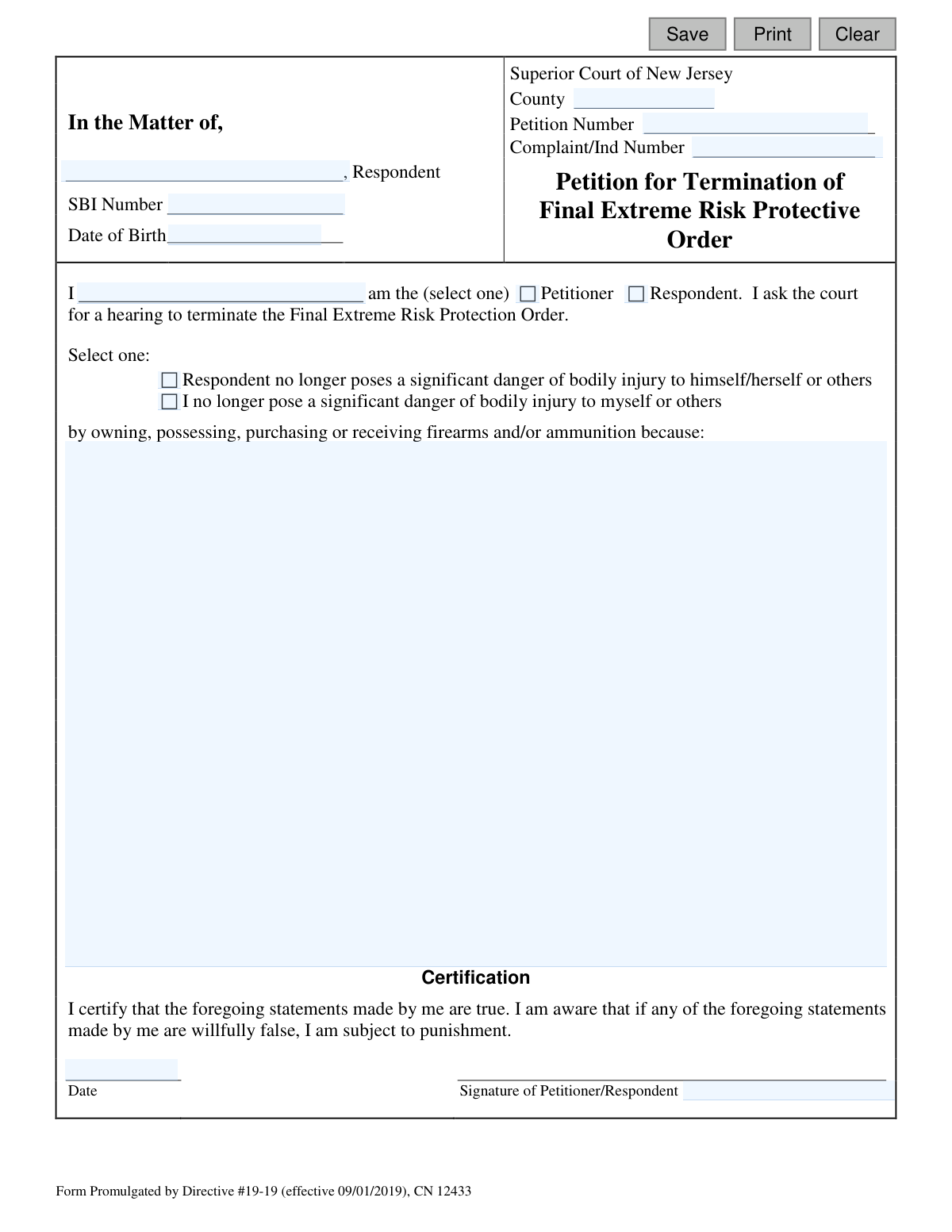
The Petition for Termination of a Final Extreme Risk Protective Order (FERPO), form CN 12433, is a legal document used in the Superior Court of New Jersey. It allows either the original petitioner or the respondent to request a court hearing to end a FERPO, arguing that the individual no longer poses a significant danger that would justify restricting their firearm rights. Today, this form can be filled out quickly and accurately using AI-powered services like Instafill.ai, which can also convert non-fillable PDF versions into interactive fillable forms.
CN 12433 is part of the New Jersey forms category on Instafill.
Our AI automatically handles information lookup, data retrieval, formatting, and form filling.
It takes less than a minute to fill out CN 12433 using our AI form filling.
Securely upload your data. Information is encrypted in transit and deleted immediately after the form is filled out.

Form specifications

Form name: Petition for Termination of a Final Extreme Risk Protective Order (FERPO) (CN 12433)
Number of fields: 17
Number of pages: 1
Language: English
main-image

Instafill Demo: How to fill out PDF forms in seconds with AI

How to Fill Out CN 12433 Online for Free in 2026

Are you looking to fill out a CN 12433 form online quickly and accurately? Instafill.ai offers the #1 AI-powered PDF filling software of 2026, allowing you to complete your CN 12433 form in just 37 seconds or less.
Follow these steps to fill out your CN 12433 form online using Instafill.ai:
  1. 1 Navigate to Instafill.ai and upload or select the Petition for Termination of a Final Extreme Risk Protective Order (FERPO) form.
  2. 2 Enter the case information, including the New Jersey county, petition number, complaint number, and respondent's details.
  3. 3 Identify your role by selecting whether you are the original petitioner or the respondent in the case.
  4. 4 State the reason for the termination request by checking the appropriate box and providing a detailed written explanation in the space provided.
  5. 5 Complete the certification section by digitally signing and dating the form to attest that all statements are true.
  6. 6 Review all the information you've entered for accuracy and completeness.
  7. 7 Download, print, and file the completed form with the appropriate Superior Court of New Jersey as required.

Our AI-powered system ensures each field is filled out correctly, reducing errors and saving you time.

Why Choose Instafill.ai for Your Fillable CN 12433 Form?

Speed

Complete your CN 12433 in as little as 37 seconds.

Up-to-Date

Always use the latest 2026 CN 12433 form version.

Cost-effective

No need to hire expensive lawyers.

Accuracy

Our AI performs 10 compliance checks to ensure your form is error-free.

Security

Your personal information is protected with bank-level encryption.

Frequently Asked Questions About Form CN 12433

This form is used to formally request that the New Jersey Superior Court terminate an existing Final Extreme Risk Protective Order (FERPO), which prevents a person from possessing firearms.

Either the respondent (the person subject to the order) or the original petitioner (the person who first requested the order) can file this form to ask the court for a termination hearing.

You will need the respondent's personal details like name and date of birth, case numbers (Petition, Complaint/Ind, SBI), and a clear written explanation for why the order should be terminated.

Select 'Respondent' if you are the person currently restricted by the FERPO. Select 'Petitioner' if you were the person who originally filed for the FERPO and now believe it is no longer needed.

In this section, you must explain why the individual no longer poses a significant danger of bodily injury to themselves or others by possessing firearms. Be specific about changed circumstances, completed treatment, or other relevant facts.

You must file the completed petition with the Superior Court in the New Jersey county where the original Final Extreme Risk Protective Order was issued.

After filing, the court will schedule a hearing where you will have to present evidence to support your claim. The court will then decide whether to terminate the order.

These numbers are typically found on previous court documents related to the FERPO case. If you cannot locate them, contact the court clerk's office in the relevant county for assistance.

While not explicitly required on the form, it is highly advisable to attach any supporting evidence, such as psychological evaluations, certificates for completed counseling, or letters of support.

Yes, services like Instafill.ai use AI to accurately auto-fill form fields, which saves time and helps prevent errors. This is especially useful for inputting case numbers and personal information.

You can upload the PDF of the form to the Instafill.ai website. The service will make the form fillable online, allowing you to type your information and then download the completed document for printing and filing.

Services like Instafill.ai can convert flat, non-fillable PDFs into interactive forms. Simply upload your file, and the platform will allow you to type directly into the fields.

By signing the certification, you are swearing that all the statements you have made on the form are true. Knowingly providing false information can subject you to legal penalties for perjury.

Compliance CN 12433
Validation Checks by Instafill.ai

1
Ensures County is Provided
This check verifies that the 'County' field is not empty. Specifying the county is mandatory for routing the petition to the correct Superior Court jurisdiction where the original order was issued. If this field is left blank, the form cannot be processed, and the user will be prompted to select or enter the appropriate county.
2
Validates Petition Number Format
This validation ensures the 'Petition Number' field is filled and matches the specific format used by the New Jersey court system. The petition number is the primary identifier for the existing Final Extreme Risk Protective Order (FERPO). An incorrect or missing number would prevent the court from locating the case file, leading to an immediate rejection of the petition.
3
Validates SBI Number Format
This check confirms that the 'SBI Number' (State Bureau of Investigation Number) is provided and adheres to its required format. The SBI number is a unique identifier crucial for law enforcement and court systems to accurately identify the individual and access relevant records. Failure to provide a correctly formatted SBI number will halt the process, as identity verification is a critical step.
4
Verifies Date of Birth is a Valid Past Date
This validation ensures the 'Date of Birth' field contains a complete and valid date in the past. It checks that the date is logically possible (e.g., not in the future) and that the individual is of a reasonable age. This is essential for identity verification and cross-referencing with official records; an invalid date would cause a data mismatch and prevent the petition from being filed.
5
Requires Selection of Filer's Role
This check ensures that the user has selected one of the two options for their role: 'Petitioner' or 'Respondent'. This information is fundamental to understanding the context of the petition and who is making the request. Without this selection, the legal standing of the filer is unclear, and the form will be considered incomplete.
6
Ensures Reason for Termination is Selected
This validation confirms that one of the checkbox options explaining the reason for termination has been selected. This selection forms the legal basis for the petition, stating that the individual no longer poses a danger. The petition cannot proceed without a stated reason, as it is the central argument the court will evaluate.
7
Checks Logical Consistency Between Filer Role and Stated Reason
This check cross-references the selected filer role ('partyType') with the selected reason for termination ('reqReason'). If the filer is the 'Respondent', the reason must be 'I no longer pose a danger'; if the filer is the 'Petitioner', the reason must be 'Respondent no longer poses a danger'. A mismatch indicates a logical error that would confuse the legal argument, so the form will prompt the user to correct the inconsistency.
8
Requires Detailed Explanation for Termination
This validation ensures that the text area explaining why the individual no longer poses a danger is not empty. A simple checkbox selection is insufficient for the court, which requires a detailed narrative and supporting facts to make a determination. An empty or insufficiently detailed description will result in the form being rejected for lack of substance.
9
Validates Signature Date
This check verifies that the 'Date' field in the certification section is a valid date and is not set in the future. The signature date legally attests to the truthfulness of the statements on the day of signing. An invalid or future date would invalidate the certification, making the entire petition legally void.
10
Ensures Signature Name Matches Filer Name
This validation compares the name entered in the signature field ('Signature of Petitioner/Respondent') with the name provided at the top of the form. The names must match to confirm that the person filing the petition is the same person certifying its contents. A mismatch would raise questions about the authenticity of the petition and lead to its rejection.
11
Verifies Existence of Case Number
This is a system-level check to confirm that the provided 'Petition Number' and/or 'Complaint/Ind Number' corresponds to an active, valid FERPO case within the court's database. This prevents the submission of petitions for non-existent, closed, or incorrect cases. If the case number is not found, the user will be notified that the reference is invalid and the submission will be blocked.
12
Completeness Check for Filer's Name
This validation ensures that the name of the person filling out the form ('I [name] am the...') is not left blank. This name identifies the filer and is required for all subsequent processing and communication. The form is considered incomplete and cannot be submitted without this fundamental piece of information.

Common Mistakes in Completing CN 12433

Incorrect or Missing Case Identification Numbers

Filers often omit or mistype the 'Petition Number', 'Complaint/Ind Number', or 'SBI Number'. This usually happens when they don't have the original court order for reference. Missing or incorrect numbers will cause the petition to be rejected or severely delayed, as the court cannot locate the corresponding case file. To avoid this, carefully copy all identification numbers directly from the original Final Extreme Risk Protective Order document.

Incorrectly Identifying as 'Petitioner' or 'Respondent'

The form can be filed by either the original petitioner or the respondent (the person subject to the order), causing confusion. A respondent filing to terminate their own order might mistakenly check the 'Petitioner' box. This creates legal ambiguity about who is making the request and can undermine the petition's credibility, leading to processing delays. If you are the person subject to the FERPO, you must identify yourself as the 'Respondent'.

Providing a Vague or Unsubstantiated Justification

In the free-text section, many people write conclusory statements like 'I am better now' or 'I am no longer a threat'. These justifications lack the specific, factual evidence the court requires to determine if circumstances have changed. A petition with a weak justification is likely to be denied. You must provide concrete details about changes, such as completion of therapy, a positive psychiatric evaluation, or stable employment.

Using Emotional Instead of Factual Language

Filers often use the justification section to express anger or frustration about the original order rather than presenting a legal argument. This emotional language is unprofessional and detracts from the factual evidence needed to prove the risk has been mitigated. It can negatively influence the court's perception of the filer's current emotional state. Always use objective, fact-based language focused on the legal standard.

Forgetting to Select a Reason Checkbox

The form requires the filer to check one of two boxes to indicate the reason for the petition ('Respondent no longer poses a significant danger...' or 'I no longer pose a significant danger...'). People often focus on the written explanation and overlook this simple but mandatory step. An incomplete form will be returned, causing delays. Always double-check that you have selected the appropriate box before signing.

Submitting a Form with Illegible Handwriting

When a form is filled out by hand, poor penmanship can make critical information like names, case numbers, and the detailed justification unreadable. If court staff cannot decipher the handwriting, the form will be rejected, forcing the filer to start over. To prevent this, print clearly in block letters. Since this is a non-fillable PDF, a tool like Instafill.ai can convert it into a fillable version, allowing you to type your answers for maximum clarity.

Missing Signature or Date in the Certification

The certification section requires a physical signature and the current date to be legally valid, affirming the statements are true under penalty of punishment. Forgetting to sign or date the form is a common oversight that automatically invalidates the entire petition. Always perform a final review of the completed document, ensuring you have signed and dated it in the designated spaces before submission.

Leaving the 'County' Field Blank

The petition must be filed in the Superior Court of the New Jersey county where the original FERPO was issued. Filers sometimes forget to write the county name at the top of the form. This omission will cause the petition to be rejected or misrouted, as the court system won't know which jurisdiction the case belongs to. Ensure the correct county is clearly written at the very top of the page.

Entering an Incomplete Name or Incorrect Date of Birth

Using a nickname instead of a full legal name or entering a date of birth in the wrong format (e.g., DD/MM/YYYY) can create identity verification problems. These errors cause mismatches with existing court records, delaying the processing of the petition. You must enter your full legal name as it appears on the original court order and use the standard MM/DD/YYYY format for your date of birth. AI-powered tools like Instafill.ai can help auto-format such data correctly.

Failing to Provide a Coherent Narrative

The justification section should tell a clear story about what has changed since the FERPO was issued. Many filers provide a disjointed list of facts without connecting them to the legal standard of no longer posing a 'significant danger'. A strong petition explains the circumstances that led to the order and then details the specific steps taken to mitigate those risks. This narrative helps the court understand the complete picture of your rehabilitation and changed circumstances.
Saved over 80 hours a year

“I was never sure if my IRS forms like W-9 were filled correctly. Now, I can complete the forms accurately without any external help.”

Kevin Martin Green

Your data stays secure with advanced protection from Instafill and our subprocessors

Robust compliance program

Transparent business model

You’re not the product. You always know where your data is and what it is processed for.

ISO 27001, HIPAA, and GDPR

Our subprocesses adhere to multiple compliance standards, including but not limited to ISO 27001, HIPAA, and GDPR.

Security & privacy by design

We consider security and privacy from the initial design phase of any new service or functionality. It’s not an afterthought, it’s built-in, including support for two-factor authentication (2FA) to further protect your account.

Fill out CN 12433 with Instafill.ai

Worried about filling PDFs wrong? Instafill securely fills petition-for-termination-of-a-final-extreme-risk-protective-order-ferpo-cn-12433 forms, ensuring each field is accurate.