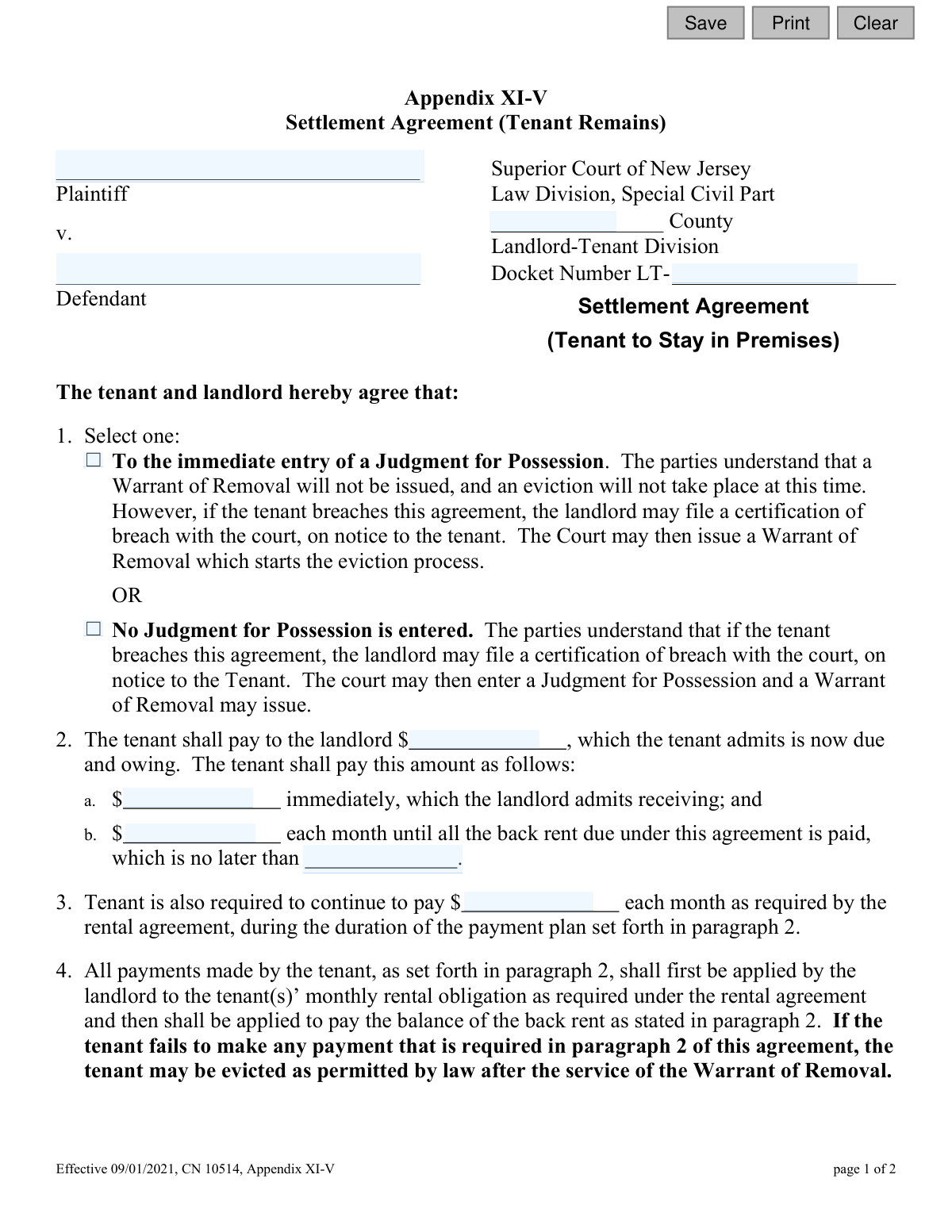
Yes! You can use AI to fill out Settlement Agreement (Tenant Remains) - Appendix XI-V

The Settlement Agreement (Tenant Remains), also known as Appendix XI-V, is a legal document used in the Superior Court of New Jersey's Landlord-Tenant Division. It formalizes an agreement between a landlord and tenant, allowing the tenant to remain in the property, typically by agreeing to a payment plan for overdue rent. This binding agreement outlines the terms, payment schedule, and consequences of a breach, preventing immediate eviction. Today, this form can be filled out quickly and accurately using AI-powered services like Instafill.ai, which can also convert non-fillable PDF versions into interactive fillable forms.
Appendix XI-V is part of the New Jersey forms category on Instafill.
Our AI automatically handles information lookup, data retrieval, formatting, and form filling.
It takes less than a minute to fill out Appendix XI-V using our AI form filling.
Securely upload your data. Information is encrypted in transit and deleted immediately after the form is filled out.

Form specifications

Form name: Settlement Agreement (Tenant Remains) - Appendix XI-V
Number of fields: 21
Number of pages: 1
Language: English
main-image

Instafill Demo: How to fill out PDF forms in seconds with AI

How to Fill Out Appendix XI-V Online for Free in 2026

Are you looking to fill out a APPENDIX XI-V form online quickly and accurately? Instafill.ai offers the #1 AI-powered PDF filling software of 2026, allowing you to complete your APPENDIX XI-V form in just 37 seconds or less.
Follow these steps to fill out your APPENDIX XI-V form online using Instafill.ai:
  1. 1 Navigate to Instafill.ai and upload or select the 'Settlement Agreement (Tenant Remains) - Appendix XI-V' form.
  2. 2 Use the AI assistant to automatically populate the case details, including Plaintiff (Landlord) and Defendant (Tenant) names, County, and Docket Number.
  3. 3 In Section 1, select the appropriate checkbox to determine whether a Judgment for Possession is entered immediately or upon a breach of the agreement.
  4. 4 Enter the financial terms in Sections 2 and 3, specifying the total amount of back rent owed, any immediate payment made, the monthly payment plan amount, and the ongoing monthly rent.
  5. 5 Review the agreement terms in Sections 4 and 5, ensuring all payment application rules and end dates are correct.
  6. 6 Once all information is verified for accuracy, have the landlord, tenant, and their respective attorneys (if any) sign and date the document.
  7. 7 Securely download, print, or share the completed and signed agreement for filing with the Special Civil Part of the New Jersey Superior Court.

Our AI-powered system ensures each field is filled out correctly, reducing errors and saving you time.

Why Choose Instafill.ai for Your Fillable Appendix XI-V Form?

Speed

Complete your Appendix XI-V in as little as 37 seconds.

Up-to-Date

Always use the latest 2026 Appendix XI-V form version.

Cost-effective

No need to hire expensive lawyers.

Accuracy

Our AI performs 10 compliance checks to ensure your form is error-free.

Security

Your personal information is protected with bank-level encryption.

Frequently Asked Questions About Form Appendix XI-V

This form is a legally binding agreement between a landlord and tenant in New Jersey to settle an eviction case. It allows the tenant to remain in the property by agreeing to a payment plan for overdue rent.

Both the landlord (Plaintiff) and the tenant (Defendant) must complete and sign this form as part of a settlement in a landlord-tenant court case where the tenant will be staying in the rental unit.

The first option means a Judgment for Possession is entered immediately but not enforced unless you breach the agreement. The second option means no judgment is entered unless you breach the agreement, at which point the landlord can ask the court for one.

Yes, Section 3 of the agreement makes it clear that you must continue to pay your regular monthly rent on time, in addition to the payments for back rent.

If you miss a payment, the landlord can file a 'certification of breach' with the court. This can lead to the court issuing a Warrant of Removal, which begins the formal eviction process.

You will need the names of the landlord and tenant, the court's county and docket number, the total amount of back rent owed, the details of the payment plan, and the amount of your regular monthly rent.

Once the full amount of back rent is paid, the agreement ends. Any judgment entered against you will be vacated, and the landlord's original eviction complaint will be dismissed.

According to Section 4, all payments you make are first applied to your current month's rent. Any remaining amount from that payment is then applied to the back rent you owe.

The landlord is required to notify the court in writing of any alleged breach within 30 days. If they fail to do so, the case may be automatically dismissed by the date specified in Section 5.

Once signed by all parties, the agreement must be filed with the Special Civil Part of the Superior Court in the county where the landlord-tenant case was originally filed.

Yes, services like Instafill.ai use AI to accurately auto-fill form fields with your information, which can save time and help reduce errors.

To fill this form out online, you can upload the document to Instafill.ai. The platform will make the fields interactive, allowing you to type in your information, save, and print the completed form.

If you have a non-fillable or 'flat' PDF, you can use a service like Instafill.ai. Upload the document, and the platform will convert it into an interactive, fillable form that you can easily complete on your computer.

Compliance Appendix XI-V
Validation Checks by Instafill.ai

1
Docket Number Format Validation
Checks that the Docket Number field follows the required court format, which is 'LT-' followed by a series of numbers. This ensures the document can be correctly filed and referenced within the court system. An incorrect format could lead to filing rejection or misidentification of the case.
2
Exclusive Agreement Choice Selection
Validates that exactly one of the two options in section 1 is selected. This choice determines whether a Judgment for Possession is entered immediately or only upon a breach, which is a critical legal distinction. Failure to select one and only one option makes the agreement ambiguous and unenforceable.
3
Plaintiff and Defendant Name Completeness
Ensures that both the Plaintiff (Landlord) and Defendant (Tenant) name fields are filled out. These names are essential for legally identifying the parties to the agreement. An incomplete agreement is invalid and cannot be enforced by the court.
4
Total Amount Due Numerical Validation
Verifies that the total amount due specified in paragraph 2 is a valid, positive numerical currency value. This amount is the basis for the settlement payment plan. A non-numerical or negative value would make the financial terms of the agreement nonsensical and void.
5
Payment Plan Amount Consistency
Checks that the immediate payment amount is less than or equal to the total amount due. This is a basic sanity check to prevent logical errors where the initial payment is greater than the total debt. An inconsistent payment plan could lead to disputes and challenges to the agreement's validity.
6
Future Payment Deadline Date
Ensures the date by which all back rent must be paid (paragraph 2b) is a valid date set in the future, after the agreement's signature date. A past or invalid date would make the payment deadline impossible to meet, rendering the payment plan unenforceable. This validation confirms the tenant is given a realistic timeframe to fulfill their obligation.
7
Ongoing Monthly Rent Requirement
Validates that the ongoing monthly rent amount in paragraph 3 is a positive numerical value. This confirms the tenant's continuing obligation to pay regular rent in addition to the back rent settlement. Omitting this or entering an invalid amount could create confusion about the tenant's full financial responsibilities.
8
Signature Date Presence and Validity
Confirms that a valid date is entered for when the agreement is signed. The signature date establishes the effective start date of the agreement's terms and timelines. An absent or invalid date makes it impossible to determine when obligations begin or when deadlines for payment or breach notifications occur.
9
Mandatory Party Signatures
Verifies that the signature fields for both the Landlord and the Tenant are completed. Signatures indicate that both parties have read, understood, and consented to the terms of the settlement. An agreement lacking signatures from both primary parties is not legally binding.
10
County Field Completeness
Checks that the County field is filled out, specifying the jurisdiction of the Superior Court handling the case. This is crucial for ensuring the document is filed in the correct court and that the court has proper authority over the matter. Filing in the wrong county would invalidate the proceedings.
11
Payment Plan Financial Logic
Validates that if a total amount is due, then at least one payment amount (immediate or monthly) is also greater than zero. This ensures that an agreement to pay back rent actually includes a mechanism for payment. An agreement with an amount due but no specified payments is incomplete and cannot be acted upon.
12
Automatic Dismissal Date Logic
Ensures the automatic dismissal date in paragraph 5 is a valid future date that occurs after the final payment deadline. This date acts as a failsafe to close the case if the landlord doesn't report a breach. Setting this date before the payment plan concludes would be illogical and could lead to premature case dismissal.
13
Date Format Standardization
Verifies that all date fields adhere to a standard format, such as MM/DD/YYYY. Consistent date formatting is essential for clarity and to prevent misinterpretation by the parties, attorneys, and court staff. Inconsistent or ambiguous formats can lead to disputes over deadlines and compliance.

Common Mistakes in Completing Appendix XI-V

Incorrect or Incomplete Docket Number

Users often forget the 'LT-' prefix or transcribe the numerical part of the docket number incorrectly. This happens due to haste or not having the official court notice handy. An incorrect docket number will cause the court clerk to reject the filing, delaying the legal settlement and potentially nullifying the agreement's timeline.

Ambiguous Judgment for Possession Selection

A critical error is either failing to check one of the two boxes in Section 1 or, conversely, checking both. This ambiguity makes the entire agreement unenforceable as it's unclear whether a Judgment for Possession is entered immediately or only upon a breach. Parties must carefully read and select only one option that reflects their agreement to ensure legal validity.

Inconsistent Payment Plan Calculations

The total amount due in Section 2 often does not match the sum of the immediate payment and the subsequent monthly installments. This mathematical error creates confusion and future disputes over the outstanding balance, potentially leading to a premature claim of breach. It is crucial to double-check that the initial payment plus all monthly payments over the agreed period equal the total admitted debt.

Omitting the Final Payment Deadline

Parties frequently leave the final payment date in Section 2b blank, creating an open-ended and potentially invalid payment plan. Without a firm deadline, it is difficult to determine when the agreement is fulfilled or when a breach for non-payment occurs. Always specify a clear, achievable date by which the entire back rent amount will be paid in full.

Confusing Regular Rent with Back Rent Payments

In Section 3, people mistakenly enter the back rent installment amount from Section 2 instead of their regular, ongoing monthly rent. This leads to an incorrect reflection of the tenant's total monthly financial obligation. The tenant must continue paying their full contractual rent in addition to the back-rent installment, and failing to state this amount correctly can lead to misunderstandings and accusations of underpayment.

Missing Signatures or Dates

A surprisingly common mistake is submitting the form without all necessary signatures (Landlord, Tenant, and attorneys if applicable) or without a date. An unsigned or undated agreement is not legally binding and holds no power in court. All parties must sign and date the document on the same day to execute the agreement properly.

Failing to Specify the County

The form requires the user to specify the county where the case is filed, but this field is often overlooked. Since the Special Civil Part is organized by county, omitting this information will lead to the document being rejected or misfiled. This simple oversight can halt the entire settlement process until the form is corrected and resubmitted.

Forgetting the Automatic Dismissal Date

In Section 5, the clause 'the case shall be dismissed automatically...' is followed by a blank for a date, which is often left empty. This date is crucial for ensuring the case is closed by the court without further action once the agreement is fulfilled. Leaving it blank can result in the case remaining open on the court's docket, creating legal loose ends for both landlord and tenant.

Entering Zero for Immediate Payment Incorrectly

When no immediate payment is made, users may leave the field in Section 2a blank instead of entering '$0.00'. A blank field creates ambiguity, as it's unclear if a payment was intended but forgotten, or if no payment was made. Clearly entering '$0.00' provides explicit confirmation that no immediate funds were exchanged, preventing future disputes.
Saved over 80 hours a year

“I was never sure if my IRS forms like W-9 were filled correctly. Now, I can complete the forms accurately without any external help.”

Kevin Martin Green

Your data stays secure with advanced protection from Instafill and our subprocessors

Robust compliance program

Transparent business model

You’re not the product. You always know where your data is and what it is processed for.

ISO 27001, HIPAA, and GDPR

Our subprocesses adhere to multiple compliance standards, including but not limited to ISO 27001, HIPAA, and GDPR.

Security & privacy by design

We consider security and privacy from the initial design phase of any new service or functionality. It’s not an afterthought, it’s built-in, including support for two-factor authentication (2FA) to further protect your account.

Fill out Appendix XI-V with Instafill.ai

Worried about filling PDFs wrong? Instafill securely fills settlement-agreement-tenant-remains-appendix-xi-v forms, ensuring each field is accurate.