Yes! You can use AI to fill out Tax Court - Consent Order to Delete Data - eCourts

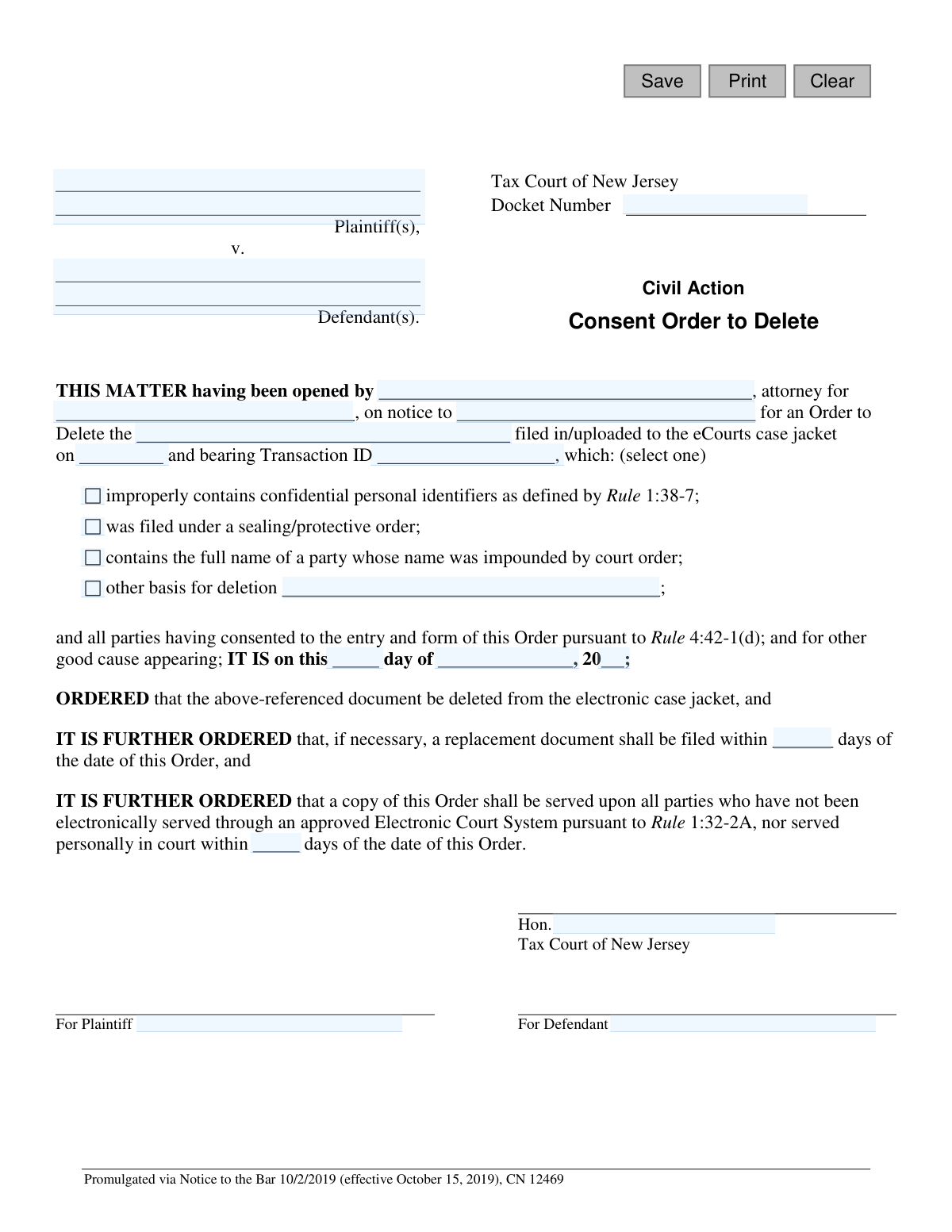
This form is a formal 'Consent Order to Delete Data' for the Tax Court of New Jersey, used when all parties in a case agree to remove a specific document from the official electronic court record (eCourts). It is crucial for correcting filing errors, protecting confidential information improperly disclosed, or complying with sealing orders. Today, this form can be filled out quickly and accurately using AI-powered services like Instafill.ai, which can also convert non-fillable PDF versions into interactive fillable forms.
Tax Court Consent Order to Delete Data is part of the New Jersey forms category on Instafill.
Our AI automatically handles information lookup, data retrieval, formatting, and form filling.
It takes less than a minute to fill out Tax Court Consent Order to Delete Data using our AI form filling.
Securely upload your data. Information is encrypted in transit and deleted immediately after the form is filled out.

Form specifications

Form name: Tax Court - Consent Order to Delete Data - eCourts
Number of fields: 25
Number of pages: 1
Language: English
main-image

Instafill Demo: How to fill out PDF forms in seconds with AI

How to Fill Out Tax Court Consent Order to Delete Data Online for Free in 2026

Are you looking to fill out a TAX COURT CONSENT ORDER TO DELETE DATA form online quickly and accurately? Instafill.ai offers the #1 AI-powered PDF filling software of 2026, allowing you to complete your TAX COURT CONSENT ORDER TO DELETE DATA form in just 37 seconds or less.
Follow these steps to fill out your TAX COURT CONSENT ORDER TO DELETE DATA form online using Instafill.ai:
  1. 1 Navigate to Instafill.ai and upload or select the 'Tax Court Consent Order to Delete Data' form.
  2. 2 Use the AI assistant to input the case details, including the Docket Number, Plaintiff(s), and Defendant(s) names.
  3. 3 Provide the specific details of the document to be deleted, such as its description, the date it was filed, and its Transaction ID.
  4. 4 Indicate the reason for the deletion by selecting the appropriate checkbox (e.g., contains confidential identifiers) or by describing the 'other basis for deletion'.
  5. 5 Enter the names of the attorneys and parties involved in the matter as prompted by the AI.
  6. 6 Review the AI-populated order details, including dates and deadlines for filing replacement documents or serving the order, and make any necessary adjustments.
  7. 7 Once all fields are complete, review the entire form for accuracy, then download the finalized document for signing by the parties and submission to the court.

Our AI-powered system ensures each field is filled out correctly, reducing errors and saving you time.

Why Choose Instafill.ai for Your Fillable Tax Court Consent Order to Delete Data Form?

Speed

Complete your Tax Court Consent Order to Delete Data in as little as 37 seconds.

Up-to-Date

Always use the latest 2026 Tax Court Consent Order to Delete Data form version.

Cost-effective

No need to hire expensive lawyers.

Accuracy

Our AI performs 10 compliance checks to ensure your form is error-free.

Security

Your personal information is protected with bank-level encryption.

Frequently Asked Questions About Form Tax Court Consent Order to Delete Data

This form is used to ask the New Jersey Tax Court to delete a document that was incorrectly uploaded to the eCourts electronic case file, when all parties in the case agree to the deletion.

This form is typically completed and filed by the attorney representing either the plaintiff or the defendant in a New Jersey Tax Court case.

A 'Consent Order' means that all parties involved in the lawsuit have reviewed and agreed to the request being made. This simplifies the process, as it shows the judge there is no dispute about deleting the document.

Valid reasons include the document improperly containing confidential personal identifiers (like Social Security numbers), being filed when it should have been sealed, or other specific errors agreed upon by all parties.

You will need the case docket number, plaintiff and defendant names, a description of the document to be deleted, the date it was filed, and its unique Transaction ID from the eCourts system.

The Transaction ID is generated by the eCourts system upon successful submission of a document. You can typically find this ID in the filing confirmation email or by looking at the case history within the eCourts portal.

You cannot use this 'Consent Order' form if any party disagrees. You would need to file a formal motion with the court to request the deletion, which is a more complex legal procedure.

If the document being deleted is necessary for the case but just contains an error, the court will order you to file a corrected version. This new, corrected version is the 'replacement document'.

Once completed and signed by the attorneys for all parties, the form is filed electronically through the New Jersey eCourts system for a judge's review and signature.

These are sensitive pieces of information that must be redacted from court filings, such as Social Security numbers, driver's license numbers, bank account numbers, and full birth dates.

Yes, services like Instafill.ai use AI to help you accurately auto-fill form fields with your case information. This can save significant time and help prevent data entry errors.

Simply upload the form to the Instafill.ai platform. Their AI will identify all the fillable fields, allowing you to input your information once and have it populate the entire document correctly.

You can use a service like Instafill.ai, which can convert flat, non-fillable PDFs into interactive forms. This allows you to easily type your information directly into the fields online before printing or filing.

Compliance Tax Court Consent Order to Delete Data
Validation Checks by Instafill.ai

1
Ensures Docket Number is Present and Formatted Correctly
This check verifies that the 'Docket Number' field is not empty and conforms to the expected format for the New Jersey Tax Court (e.g., a prefix followed by numbers and a year). The docket number is the primary identifier for a case, and an incorrect or missing number would prevent the order from being associated with the correct legal matter. If validation fails, the user should be prompted to enter a valid docket number before submission.
2
Verifies Completeness of Case Party Information
This validation ensures that both the 'Plaintiff(s)' and 'Defendant(s)' fields are filled out. These names are essential for correctly identifying the parties involved in the civil action and ensuring the order is applied to the right case. A submission without this information is incomplete and legally insufficient, so the form should not be accepted until both fields are populated.
3
Requires Identification of Filer and Represented Client
This check confirms that the attorney's firm name ('firmName') and the client they represent ('clientName') are both provided. This information establishes who is initiating the request for the order, which is critical for accountability and procedural correctness. Failure to provide this information would make the origin of the request unclear and could invalidate the order.
4
Validates Completeness of Document Identifiers
This validation ensures that the document description ('docDesc'), its filing date ('fileDt'), and its Transaction ID ('transId') are all provided. These three pieces of information are used together to uniquely identify the specific document to be deleted from the eCourts system. Omitting any of this information could lead to ambiguity or the deletion of the wrong document, causing serious legal and administrative problems.
5
Validates Filing Date is a Valid Past Date
This check verifies that the 'fileDt' field contains a valid calendar date and that this date is not in the future. A document cannot be filed on a future date, so this check prevents logical errors and typos. If an invalid or future date is entered, the system should reject it and prompt the user for a correction.
6
Ensures a Reason for Deletion is Selected
This validation confirms that the user has selected one of the provided reasons for deleting the document (e.g., 'contains confidential identifiers', 'filed under sealing order', etc.). A justification is legally required to process a deletion request. If no reason is selected, the submission should be blocked until a choice is made.
7
Conditional Requirement for 'Other' Reason Description
This check is triggered if the user selects the 'other basis for deletion' option. It ensures that the corresponding description field ('delDesc') is not empty, requiring the user to provide a specific explanation. This prevents users from choosing the 'other' option without providing the necessary context for the court to review, and the form should not be submitted until the description is provided.
8
Validates Order Date is a Correct Calendar Date
This validation combines the 'orderDay', 'orderMo', and 'orderYr' fields to ensure they form a valid calendar date. For example, it would flag an entry like 'February 30' as invalid. This is crucial for the legal validity of the order, as an impossible date would render it void.
9
Logical Check for Order Date vs. Filing Date
This check ensures the date of the consent order (from 'orderDay', 'orderMo', 'orderYr') is on or after the filing date of the document to be deleted ('fileDt'). An order cannot be dated before the existence of the document it pertains to. This logical check prevents data entry errors that would create a nonsensical timeline of events.
10
Validates Numeric Input for Replacement Document Days
This check verifies that if a value is entered into the 'numDays' field for filing a replacement document, it is a positive integer. The field represents a number of days and cannot be a negative number, a fraction, or text. This ensures the order contains a clear and valid deadline.
11
Validates Numeric Input for Service Days
This validation ensures that if a value is entered into the 'servedDays' field, it is a positive integer. This field dictates the deadline for serving the order on other parties. An invalid entry would create an unenforceable or ambiguous service requirement, so the input must be a valid number of days.
12
Confirms Consent from Both Parties
This check verifies that the signature fields for both the plaintiff's attorney ('attyPlaSig') and the defendant's attorney ('attyDefSig') are completed. The form is a 'Consent Order,' which explicitly requires the agreement of all parties involved. Without both signatures, there is no consent, and the order is not valid for submission under Rule 4:42-1(d).
13
Ensures 'On Notice To' Party is Specified
This validation confirms that the 'partyName' field, indicating who was given notice of this action, is filled out. Proper notice is a fundamental aspect of legal due process. Failing to specify who was notified could be grounds for challenging the validity of the order later.

Common Mistakes in Completing Tax Court Consent Order to Delete Data

Entering an Incorrect or Incomplete Docket Number

Users often mistype the docket number or use an outdated format, which is a critical error. Since the docket number is the primary identifier for the case, any mistake will cause the filing to be associated with the wrong case or rejected entirely by the court clerk. Always double-check the docket number against official court documents or the eCourts portal before submission.

Omitting the eCourts Transaction ID

The Transaction ID is a unique identifier for the specific document you want to delete from the electronic case jacket. Filers frequently forget to include this ID, making it nearly impossible for court staff to locate the correct electronic file, leading to significant delays or outright rejection of the order. This ID can be found in the filing confirmation email or by reviewing the case history in the eCourts system.

Providing a Vague Document Description

Simply writing "letter" or "motion" in the document description field is insufficient and a common mistake. This ambiguity can lead to the wrong document being deleted or the order being denied for lack of specificity. To avoid this, provide a full, detailed description including the document's title and its original filing date, such as "Defendant's Answer to Complaint, filed on June 15, 2023."

Submitting Without Consent from All Parties

This is a "Consent Order," which legally requires the agreement of all parties involved in the case. A frequent error is submitting the form without obtaining and indicating the consent of the opposing counsel, often by leaving their signature field blank. The court will not process an order that lacks the required consent, as it violates the nature of the filing.

Failing to Specify a Valid Reason for Deletion

The form requires a clear legal basis for the deletion request. Users either forget to check one of the boxes or select "other basis" without providing a detailed, legally sufficient explanation in the space provided. An order without a valid justification, such as the presence of confidential identifiers under Rule 1:38-7, will be rejected by the judge.

Leaving Deadlines for Action Blank

The order includes fields to specify the number of days for filing a replacement document and for serving the order on other parties. It's a common oversight to leave these fields blank, which makes the order incomplete and potentially unenforceable. These timeframes must be agreed upon by all parties and clearly stated in the form.

Mismatching Plaintiff and Defendant Names

The names of the plaintiff(s) and defendant(s) must exactly match the official case caption in the court's records. Using abbreviations, including misspellings, or omitting parties can cause the order to be rejected for inconsistency with the case file. To prevent this, carefully copy the party names from the original complaint or the most recent official court filing.

Submitting Illegible Handwritten Information

This form is often distributed as a non-fillable PDF, leading people to print and complete it by hand. Illegible handwriting, especially for critical data like the Docket Number or Transaction ID, is a primary cause for rejection by court clerks. AI-powered tools like Instafill.ai can convert flat PDFs into fillable versions, ensuring all your entries are typed, legible, and professional.

Mistakenly Filling in the Judge's Order Date

The phrase "IT IS on this __ day of __, 20__;" is reserved for the judge to date when they sign the order. A common procedural error is for the filer to enter the date they are preparing the document, which is incorrect. These date fields must be left blank for the court to complete.

Forgetting to Identify the Party on Notice

The line "on notice to..." requires the filer to name the party, typically the opposing counsel, who has been formally notified of this consent order. Omitting this information creates ambiguity about whether proper legal notice was given, which is a fundamental requirement. This oversight can lead to the order being questioned or denied for procedural deficiency.
Saved over 80 hours a year

“I was never sure if my IRS forms like W-9 were filled correctly. Now, I can complete the forms accurately without any external help.”

Kevin Martin Green

Your data stays secure with advanced protection from Instafill and our subprocessors

Robust compliance program

Transparent business model

You’re not the product. You always know where your data is and what it is processed for.

ISO 27001, HIPAA, and GDPR

Our subprocesses adhere to multiple compliance standards, including but not limited to ISO 27001, HIPAA, and GDPR.

Security & privacy by design

We consider security and privacy from the initial design phase of any new service or functionality. It’s not an afterthought, it’s built-in, including support for two-factor authentication (2FA) to further protect your account.

Fill out Tax Court Consent Order to Delete Data with Instafill.ai

Worried about filling PDFs wrong? Instafill securely fills tax-court-consent-order-to-delete-data-ecourts forms, ensuring each field is accurate.