Yes! You can use AI to fill out Direct Deposit Authorization Form

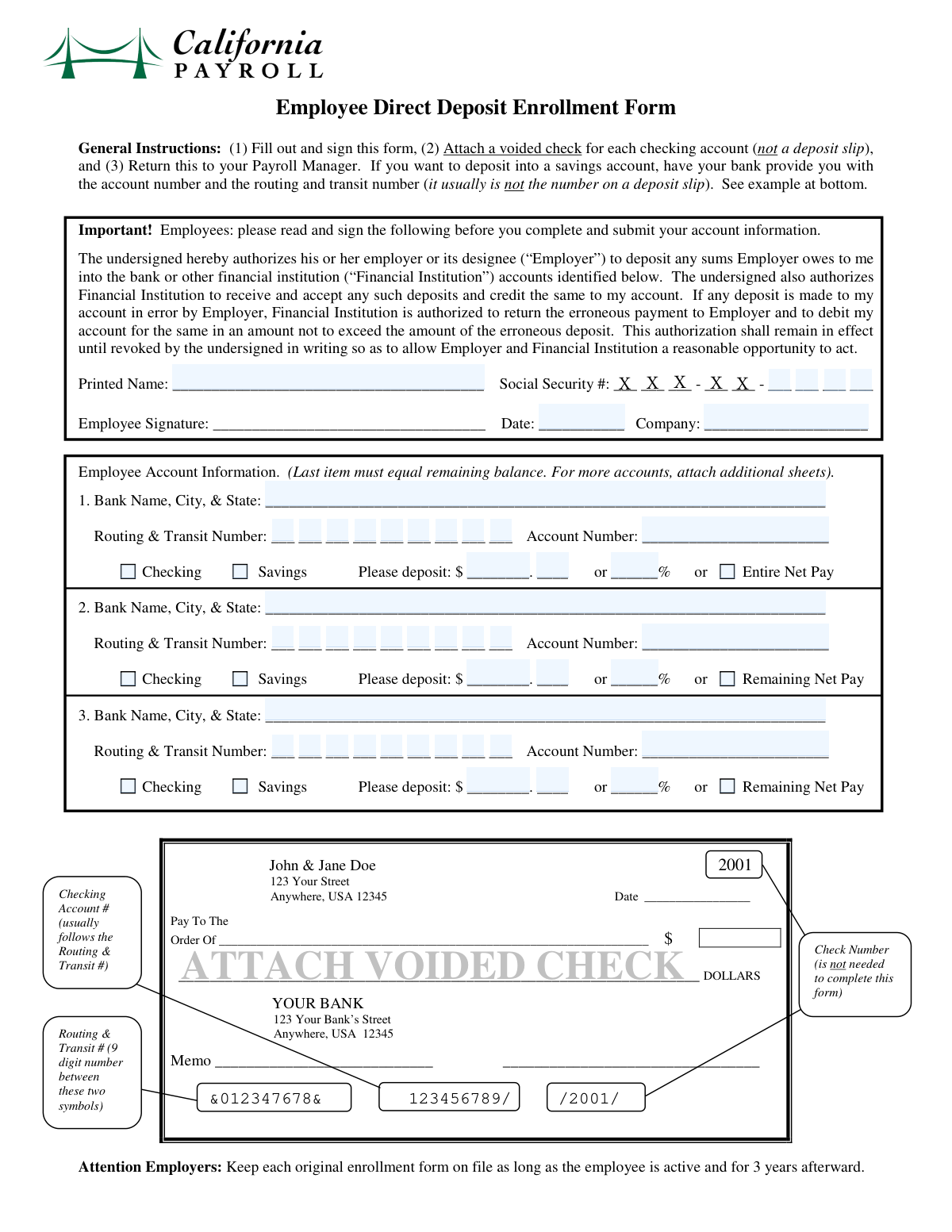
A Direct Deposit Authorization Form is a document that grants an employer permission to transfer an employee's net pay electronically into their designated bank account(s). It is a crucial part of the employee onboarding process, ensuring timely and secure payment by eliminating the need for physical paychecks. This form requires providing personal and banking information, including routing and account numbers, and allows for splitting deposits across multiple accounts. Today, this form can be filled out quickly and accurately using AI-powered services like Instafill.ai, which can also convert non-fillable PDF versions into interactive fillable forms.
Direct Deposit Form is part of the authorization forms and direct deposit forms categories on Instafill.
Our AI automatically handles information lookup, data retrieval, formatting, and form filling.
It takes less than a minute to fill out Direct Deposit Form using our AI form filling.
Securely upload your data. Information is encrypted in transit and deleted immediately after the form is filled out.

Form specifications

Form name: Direct Deposit Authorization Form
Number of fields: 62
Number of pages: 1
Filled form examples: Form Direct Deposit Form Examples
Language: English
main-image

Instafill Demo: How to fill out PDF forms in seconds with AI

How to Fill Out Direct Deposit Form Online for Free in 2026

Are you looking to fill out a DIRECT DEPOSIT FORM form online quickly and accurately? Instafill.ai offers the #1 AI-powered PDF filling software of 2026, allowing you to complete your DIRECT DEPOSIT FORM form in just 37 seconds or less.
Follow these steps to fill out your DIRECT DEPOSIT FORM form online using Instafill.ai:
  1. 1 Navigate to Instafill.ai and upload or select the Direct Deposit Authorization Form to begin.
  2. 2 Enter your personal details, such as your full name, Social Security Number, and company name, into the designated fields.
  3. 3 Input the information for your primary bank account, including the bank name, routing number, and account number.
  4. 4 Choose how your pay will be deposited into the first account, whether it's the entire net pay, a fixed amount, or a percentage.
  5. 5 Optionally, add details for up to two additional bank accounts if you wish to split your paycheck, specifying the deposit amount or percentage for each.
  6. 6 Carefully review all entered information, especially bank account and routing numbers, to ensure accuracy before finalizing.
  7. 7 Electronically sign and date the form, then download the completed document to submit to your employer's HR or payroll department.

Our AI-powered system ensures each field is filled out correctly, reducing errors and saving you time.

Why Choose Instafill.ai for Your Fillable Direct Deposit Form Form?

Speed

Complete your Direct Deposit Form in as little as 37 seconds.

Up-to-Date

Always use the latest 2026 Direct Deposit Form form version.

Cost-effective

No need to hire expensive lawyers.

Accuracy

Our AI performs 10 compliance checks to ensure your form is error-free.

Security

Your personal information is protected with bank-level encryption.

Frequently Asked Questions About Form Direct Deposit Form

This form is a Direct Deposit Authorization. It allows your employer to deposit your paycheck directly into one or more of your bank accounts.

Any employee who wants to set up a new direct deposit, or change their existing bank account information for payroll, needs to complete this form.

You will need your Social Security Number, and the bank name, routing number, and account number for each account you want to use. This information can be found on a check or through your bank's online portal.

Your routing and account numbers are printed on the bottom of your checks. You can also find this information by logging into your online banking account or by contacting your bank directly.

Yes, this form allows you to distribute your pay into as many as three different accounts. You can specify a fixed amount, a percentage, or the remaining balance for each account.

No, you only need to complete the sections for the accounts you wish to use. If you are depositing your entire paycheck into one account, just fill out the 'First Bank Account' section.

'Entire Net Pay' should be checked if you want 100% of your paycheck to go into a single account. 'Remaining Net Pay' is used for a second or third account to receive the balance after other specified deposits have been made.

It can often take one to two pay cycles for the changes to take effect. Check with your HR or payroll department for a specific timeline.

After completing and signing the form, submit it to your company's payroll or human resources department according to their instructions.

Yes, this is standard information required by payroll departments to set up direct deposit securely. You should only submit this form directly to your trusted HR or payroll representative.

Yes, services like Instafill.ai use AI to auto-fill form fields accurately and save time. You can securely store your information and use it to instantly complete forms like this one.

Upload the form to the Instafill.ai platform, and its AI will identify the fields. You can then click to auto-fill your saved information, review the form, and download the completed document.

You can use a service like Instafill.ai, which can convert flat, non-fillable PDFs into interactive, fillable forms. Simply upload your document, and the platform will make it easy to type your information into the correct fields.

Compliance Direct Deposit Form
Validation Checks by Instafill.ai

1
Social Security Number Format
This check verifies that the Social Security Number (SSN) consists of exactly 9 digits. It ensures that the provided number is complete and structurally valid before being processed. If the SSN is not 9 digits, the submission will be rejected to prevent errors in payroll and tax reporting.
2
Routing Number Validity
This validation confirms that each provided bank Routing and Transit Number is exactly 9 digits long and passes the standard ABA routing number checksum algorithm. This is critical for ensuring that funds can be successfully transferred to the correct financial institution. An invalid routing number will cause the direct deposit transaction to fail.
3
Core Employee Information Completeness
Ensures that all mandatory personal information fields ('Printed Name', 'Social Security Number', 'Date', 'Company') are filled out. These fields are fundamental for identifying the employee and processing the form correctly. A failure on this check would halt the submission and prompt the user to complete the required information.
4
Mutually Exclusive Account Type Selection
For each bank account listed, this check ensures that either 'Checking Account' or 'Savings Account' is selected, but not both. An account must be one or the other for processing. If neither or both are selected for an active account entry, the form is considered invalid.
5
Mutually Exclusive Deposit Method
For each individual bank account, this validation verifies that only one deposit allocation method is chosen (e.g., a fixed dollar amount, a percentage, or 'Remaining Net Pay'). A user cannot specify both a fixed amount and a percentage for the same account, as this creates a logical conflict. The form will be rejected if multiple allocation methods are selected for a single account.
6
'Entire Net Pay' Exclusivity
This check validates that if the 'Entire Net Pay' option is selected for the first bank account, no information is provided for the second or third bank accounts. Selecting this option implies all funds go to one destination, making other account details redundant and potentially contradictory. If other accounts are filled in, the user will be prompted to clear them or uncheck the 'Entire Net Pay' box.
7
'Remaining Net Pay' Uniqueness
This validation ensures that the 'Remaining Net Pay' option is selected for, at most, one bank account. By definition, there can only be one 'remainder' of the net pay after other distributions. Selecting this option for multiple accounts is a logical impossibility and will cause the form submission to fail.
8
Total Percentage Limit
This check calculates the sum of all 'Percentage to Deposit' values specified across all bank accounts. The total sum must not exceed 100. This prevents the employee from allocating more than their total net pay, which would result in a processing error. If the sum is over 100, the user must adjust the percentages before the form can be submitted.
9
Bank Account Information Completeness
If any field within a bank account section (e.g., First, Second, or Third Bank Account) is filled out, this validation ensures that all required fields for that section are complete. This includes the Bank Name, Routing Number, Account Number, Account Type (Checking/Savings), and a deposit allocation method. This prevents partial, unusable account entries from being submitted.
10
Date Field Validity
This check verifies that the 'Date' field contains a valid, well-formatted date and is not set to a future date. This ensures the signature date is contextually correct and reflects when the form was actually authorized. A future date would invalidate the form's legal standing as of the submission time.
11
Deposit Cents Amount Range
This validation ensures that any field for a cents amount (e.g., 'Fixed Deposit Cents Amount') contains a numeric value between 0 and 99. This maintains the correct currency format and prevents errors in calculating the exact deposit amount. Values outside this range will be flagged for correction.
12
Logical Conflict with 'Remaining Net Pay'
This check ensures that if 'Remaining Net Pay' is selected for one account, no other account uses a percentage-based deposit. A percentage-based deposit alongside a 'remainder' deposit creates ambiguity, as the base for the percentage calculation becomes unclear. To ensure clear instructions, accounts must use either fixed amounts or percentages, but not both types in combination with a 'remainder' deposit.

Common Mistakes in Completing Direct Deposit Form

Incorrectly Entering Social Security Number

Users often transpose digits when entering their 9-digit SSN, especially when the form splits the number into multiple boxes (e.g., SS1, SS2, SS3, SS4). This is a critical error that leads to identity verification failure and rejection of the form by payroll and tax systems. To avoid this, carefully double-check the number against your Social Security card before submitting and ensure it is entered in the correct sequence across the provided fields.

Entering an Incorrect or Invalid Routing Number

A common mistake is entering the wrong routing number by transposing digits or by copying it from a deposit slip, which can sometimes differ from the one used for direct deposits. An incorrect routing number will cause the electronic transfer to fail, resulting in significant delays in receiving payment. Always verify the 9-digit routing number from a check (it's the first set of numbers on the bottom left) or by logging into your online banking portal.

Making Contradictory Deposit Allocation Choices

This form's flexibility can lead to conflicting instructions, such as checking the 'Entire Net Pay' box for the first account while also providing details for a second bank account. This creates ambiguity that the payroll department cannot resolve, forcing them to contact you for clarification and delaying your direct deposit setup. To prevent this, if you select 'Entire Net Pay', leave all other bank account sections blank.

Using Deposit Percentages That Don't Total 100%

When splitting a deposit by percentage across multiple accounts, users sometimes make calculation errors where the total does not equal 100%. For example, allocating 50% to one account and 40% to another leaves 10% of your pay unallocated, which may result in that portion being issued as a paper check or causing a processing error. To avoid this, either ensure your percentages add up to exactly 100% or use the 'Remaining Net Pay' option for your final account.

Incorrectly Using the 'Remaining Net Pay' Option

The 'Remaining Net Pay' option is intended to be used only for the last account in your deposit sequence to catch all leftover funds. A frequent error is selecting this option for a middle account (e.g., the second of three accounts), which makes any subsequent account instructions invalid. This will cause a processing error, as payroll won't know how to distribute the 'remaining' funds. Only check this box for the very last account you wish to deposit funds into.

Providing Both a Fixed Amount and a Percentage for One Account

For a single bank account, the form allows you to specify either a fixed dollar amount or a percentage of your net pay, but not both. Users sometimes mistakenly fill in both fields, creating a contradiction that payroll cannot process. This requires follow-up to clarify your intent and will delay the setup. You must choose only one method—either the fixed amount or the percentage—for each account listed.

Failing to Specify the Account Type

After carefully entering the routing and account numbers, it's easy to forget to check the 'Checking Account' or 'Savings Account' box. This information is required for the Automated Clearing House (ACH) transaction to be processed correctly. Omitting this selection, or accidentally checking both boxes, makes the form incomplete and will cause it to be returned for correction, delaying your first direct deposit.

Submitting with Illegible Handwriting

If the form is a non-fillable PDF that must be printed, illegible handwriting is a major source of errors, especially for the long strings of digits in the SSN, routing, and account number fields. A single misread digit can cause a deposit to fail or, in a worst-case scenario, be sent to the wrong person's account. To avoid this, print clearly in block letters. AI-powered tools like Instafill.ai can also convert flat PDFs into fillable forms, eliminating handwriting errors entirely.

Providing an Abbreviated or Incomplete Bank Name

Users may enter a shortened bank name like 'BofA' or 'Chase' instead of the full legal name, and may forget to include the city and state. While often acceptable, this can cause delays if manual verification is needed, especially if the routing number is hard to read. Always write the bank's full official name as it appears on your bank statement to ensure clarity and faster processing.

Using an Informal or Incomplete Printed Name

The 'Printed Name' field requires your full legal name as it appears on official documents, but people sometimes use a nickname, a middle initial instead of a full middle name, or an otherwise incomplete version. This can cause a mismatch with the name in the company's payroll system, leading to verification issues and processing delays. Always use your full, official name to ensure a smooth setup process.
Saved over 80 hours a year

ā€œI was never sure if my IRS forms like W-9 were filled correctly. Now, I can complete the forms accurately without any external help.ā€

Kevin Martin Green

Your data stays secure with advanced protection from Instafill and our subprocessors

Robust compliance program

Transparent business model

You’re not the product. You always know where your data is and what it is processed for.

ISO 27001, HIPAA, and GDPR

Our subprocesses adhere to multiple compliance standards, including but not limited to ISO 27001, HIPAA, and GDPR.

Security & privacy by design

We consider security and privacy from the initial design phase of any new service or functionality. It’s not an afterthought, it’s built-in, including support for two-factor authentication (2FA) to further protect your account.

Fill out Direct Deposit Form with Instafill.ai

Worried about filling PDFs wrong? Instafill securely fills direct-deposit-authorization-form forms, ensuring each field is accurate.