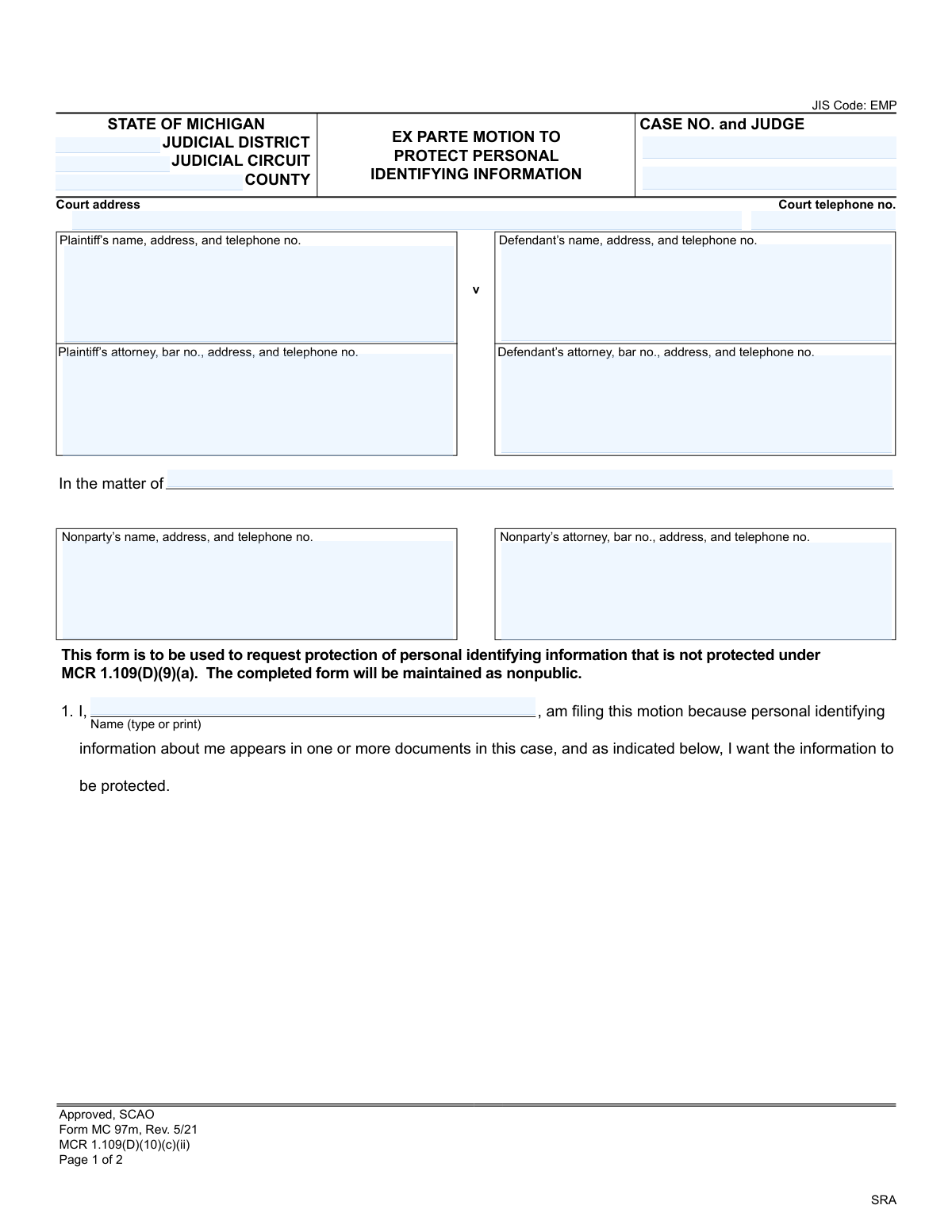
Yes! You can use AI to fill out Ex Parte Motion to Protect Personal Identifying Information

Form MC 97m is a legal document used in the State of Michigan to file a motion with the court requesting the protection of personal identifying information (PII) that appears in case documents. This motion allows a party to ask a judge to redact, make nonpublic, or make confidential specific sensitive details to safeguard their privacy. Today, this form can be filled out quickly and accurately using AI-powered services like Instafill.ai, which can also convert non-fillable PDF versions into interactive fillable forms.
MC 97m is part of the Michigan court forms category on Instafill.
Our AI automatically handles information lookup, data retrieval, formatting, and form filling.
It takes less than a minute to fill out MC 97m using our AI form filling.
Securely upload your data. Information is encrypted in transit and deleted immediately after the form is filled out.

Form specifications

Form name: Ex Parte Motion to Protect Personal Identifying Information
Number of fields: 67
Number of pages: 1
Language: English
main-image

Instafill Demo: How to fill out PDF forms in seconds with AI

How to Fill Out MC 97m Online for Free in 2026

Are you looking to fill out a MC 97M form online quickly and accurately? Instafill.ai offers the #1 AI-powered PDF filling software of 2026, allowing you to complete your MC 97M form in just 37 seconds or less.
Follow these steps to fill out your MC 97M form online using Instafill.ai:
  1. 1 Navigate to Instafill.ai and upload or select the MC 97m, Ex Parte Motion to Protect Personal Identifying Information form.
  2. 2 Use the AI assistant to accurately fill in the court and case information, including the judicial district/circuit, county, case number, and judge's name.
  3. 3 Enter the names, addresses, and attorney information for the plaintiff, defendant, and any other relevant parties.
  4. 4 Identify yourself as the moving party and begin listing the documents that contain the personal information you wish to protect.
  5. 5 For each document, specify its name, filing date, the location of the information (e.g., paragraph number), and the exact PII to be protected.
  6. 6 Select the desired protection for each piece of information by checking the 'redact,' 'make nonpublic,' or 'make confidential' box.
  7. 7 Review the completed motion for accuracy, then electronically sign and date the form before filing it with the appropriate court.

Our AI-powered system ensures each field is filled out correctly, reducing errors and saving you time.

Why Choose Instafill.ai for Your Fillable MC 97m Form?

Speed

Complete your MC 97m in as little as 37 seconds.

Up-to-Date

Always use the latest 2026 MC 97m form version.

Cost-effective

No need to hire expensive lawyers.

Accuracy

Our AI performs 10 compliance checks to ensure your form is error-free.

Security

Your personal information is protected with bank-level encryption.

Frequently Asked Questions About Form MC 97m

This form is used to formally request a Michigan court to protect your personal identifying information (PII) that appears in documents filed in a case. It is specifically for information that is not already automatically protected under court rules.

Any person whose personal information is in a court document can file this motion. This includes the plaintiff, defendant, or even a nonparty involved in the case.

Ex Parte means the motion is made without prior notice to the other parties in the case. This is permitted for this motion because you are protecting your own sensitive information, and the completed form itself is kept nonpublic by the court.

'Redact' means the information is blacked out. 'Make nonpublic' limits access to parties in the case and court staff. 'Make confidential' offers the highest protection, restricting access to only those specified by law or a court order.

You must list the name of the document containing your PII, the date it was filed, and the specific paragraph number if applicable. Then, clearly describe the information you want protected and check one box to indicate whether you want it redacted, made nonpublic, or made confidential.

You must create a separate entry for each document on a new line in the table in Section 2. The form provides multiple rows to list each document and the specific PII within it that you want protected.

While things like Social Security numbers are often automatically protected, other PII like your home address, employer's name, or other sensitive details might be made public unless you file this motion to protect them.

You must file the completed and signed form with the clerk of the court where your case is being heard. The court will then maintain the motion itself as a nonpublic document.

A judge will review your request. If the motion is granted, the judge will issue an order directing the court clerk to protect your information as you have requested on the form.

Yes, services like Instafill.ai use AI to help you accurately auto-fill form fields, which saves time and reduces errors. This is especially helpful for entering case information and personal details that you use frequently.

Simply upload the MC 97m PDF to the Instafill.ai platform. The AI will make the form interactive, allowing you to easily type in your information, select checkboxes, and prepare the document for submission.

You can use a service like Instafill.ai, which can instantly convert flat, non-fillable PDFs into interactive forms. This allows you to type your information directly into the fields online instead of having to print and fill it out by hand.

While you are not required to have an attorney to file this motion, legal cases can be complex. If you are unsure about how to proceed or what information to protect, consulting with an attorney is recommended.

Compliance MC 97m
Validation Checks by Instafill.ai

1
Case Number Presence and Format
This check ensures the 'CASE NO.' field is not empty and follows the expected format for the jurisdiction. The case number is the primary identifier that links this motion to an existing court case. Without a valid case number, the clerk's office cannot file the document correctly, leading to rejection of the motion.
2
Filer's Name Is Required
Validates that the 'Name (type or print)' field in section 1 is filled out. This field identifies the individual (the 'moving party') who is requesting the protection of information. This is legally required to establish who is making the motion, and failure to provide it would render the motion invalid and un-actionable.
3
At Least One Document Must Be Specified for Protection
This check verifies that at least the first full row of the document list in section 2 is completed. The entire purpose of this form is to request protection for PII within specific documents. If no documents are listed, the motion has no subject and is meaningless, and it would be rejected by the court.
4
Completeness of Document Information Row
For each row where a 'Document Name' is entered in section 2, this validation ensures that the 'Date filed', 'PII to be protected', and a 'Protection requested' checkbox are also completed. Incomplete information for a document makes it impossible for the court clerk to act on the request. This check prevents ambiguous or partial requests from being submitted.
5
Exclusive Protection Request Selection
For each document row in section 2, this check ensures that exactly one of the three protection options ('redact', 'make nonpublic', 'make confidential') is selected. The court needs a single, clear instruction on how to protect the information. Allowing zero or multiple selections would create ambiguity, forcing the court to deny the request or seek clarification.
6
Valid 'Date Filed' for Each Document
This validation confirms that each 'Date filed' entry is a valid calendar date and is not a date in the future. A document cannot have been filed on a future date, so this serves as a logical consistency check. An invalid or future date would cause confusion and likely lead to the rejection of the request for that specific document.
7
Moving Party's Signature and Date Presence
Ensures that the 'Moving party's signature' field is signed and the 'Date' field next to it is filled. A signature is a legal requirement to attest to the authenticity and intent of the motion, and the date establishes when it was signed. An unsigned or undated motion is legally invalid and will not be processed by the court.
8
Attorney Bar Number Format
If an attorney's name is provided for the plaintiff, defendant, or nonparty, this check verifies that the corresponding 'bar no.' field is present and follows the expected format (e.g., 'P' followed by digits for Michigan). This validates the attorney's credentials and their authority to act in the case. Missing or improperly formatted bar numbers can delay processing while credentials are verified.
9
Court Telephone Number Format
This check validates that the 'Court telephone no.' field contains a valid phone number format (e.g., (XXX) XXX-XXXX or XXX-XXX-XXXX). While seemingly minor, having a correctly formatted number is important for data integrity and for any automated systems that might use this information. It prevents data entry errors and ensures contact information is usable.
10
Case Number Consistency Across Pages
This validation ensures that the 'Case No.' entered on Page 2 matches the 'CASE NO.' entered on Page 1. This is a critical check for multi-page documents to ensure document integrity, especially if the pages are handled or scanned separately. A mismatch could lead to the second page being misfiled or separated from the motion.
11
Paragraph Number Field Format
Validates that the 'Para. No(s).' field only contains numbers, commas, hyphens, and spaces, which are used to denote specific paragraphs. This prevents users from entering irrelevant text and ensures the data is structured for easy interpretation by the court clerk. For example, it allows '1, 3-5' but would reject 'the third one'.
12
Court Jurisdiction Identification
This check ensures that either the 'Judicial District' or 'Judicial Circuit' field is filled, along with the 'County' field. This information is essential for identifying the specific court that has jurisdiction over the case. Submitting a motion without correctly identifying the court will result in immediate rejection and filing delays.

Common Mistakes in Completing MC 97m

Using an Incorrect or Incomplete Case Number and Caption

Filers often enter the wrong case number, misspell the judge's name, or omit the court's address. Since the case number and caption are the primary identifiers for a legal filing, any error can cause the motion to be rejected, misfiled in another case, or significantly delayed. To avoid this, meticulously double-check the case number and judge's name against official court documents, and ensure all court information is complete and accurate before submission.

Providing Vague or Incorrect Document Names

In the table on page 2, people frequently use generic terms like "court document" or "filing" instead of the specific, official title of the document. This makes it impossible for the court clerk to locate the correct file containing the personal information. The motion may be denied for lack of specificity, forcing the filer to start over. Always use the exact title of the document as it appears in the court record, such as "Plaintiff's First Amended Complaint."

Failing to Specify the Exact Location of the PII

The form explicitly asks for the paragraph number(s) where the personal information is located, but filers often leave this field blank. This happens because locating the exact paragraph requires carefully reviewing the source document, which can be time-consuming. Leaving it blank forces the clerk to search the entire document, which they may refuse to do, leading to the motion being denied for being insufficiently specific. Always review the document and list the precise paragraph numbers.

Describing the Personal Information Too Broadly

When asked to identify the 'PII to be protected,' filers may write vague descriptions like "my personal details" or "my financial info." A court cannot act on such a broad request and requires explicit identification of the data. This ambiguity will almost certainly lead to the motion being rejected. To prevent this, clearly state the exact piece of information, such as "my date of birth (xx/xx/xxxx)" or "my bank account number ending in 1234."

Selecting Multiple or Inappropriate Protection Types

The form requires the filer to choose only one protection method per item: redact, make nonpublic, or make confidential. Confused filers often check multiple boxes, creating an ambiguous request that the court clerk cannot process. This will result in the form being returned for clarification, causing delays. Before filling, understand the legal difference between the options and select only the single most appropriate one for your situation.

Submitting an Unsigned or Undated Motion

Forgetting to sign and date a legal document is a very common but critical mistake. An unsigned motion is not legally valid and will be immediately rejected by the court clerk, rendering the entire filing effort useless until it is corrected and resubmitted. Always perform a final review of the completed form, paying special attention to the signature and date lines before filing.

Omitting Required Information for Parties and Attorneys

The case caption requires complete contact information and bar numbers for all parties and their attorneys. Filers often leave these fields blank or incomplete because they don't have the information readily available. This can prevent the court from properly serving notices to all involved parties, causing procedural delays or even rejection of the form. It is crucial to gather all necessary information before starting the form; AI-powered tools like Instafill.ai can help by storing contact details for repeated use across multiple documents.

Submitting a Form with Illegible Handwriting

When this form is printed and filled out by hand, illegible handwriting can make critical data like case numbers, dates, and names impossible for the court clerk to read accurately. This frequently leads to processing errors, incorrect data entry into the court's system, or outright rejection of the document. To ensure clarity, it is always best to type the information. If the original document is a non-fillable PDF, tools like Instafill.ai can convert it into a fillable format, allowing you to type directly into the fields.

Using the Form for Already Protected Information

This form is specifically for protecting information not already covered by MCR 1.109(D)(9)(a). Filers who are unaware of this rule may waste time and filing fees by requesting redaction of data that is automatically protected by the court, such as a full Social Security number or financial account number. This creates unnecessary work for both the filer and the court. Before filing, review the relevant court rules to understand what information is already protected by default.

Incorrectly Identifying the Court Jurisdiction

The form header includes fields for 'Judicial District' and 'Judicial Circuit.' Michigan's court system is divided, and filers often get confused about which court has jurisdiction over their case, filling in the wrong one or both incorrectly. Filing a motion in the wrong court system will lead to its immediate rejection and require the filer to start the process over in the correct venue. Always confirm the proper jurisdiction by checking previous documents filed in the case.
Saved over 80 hours a year

“I was never sure if my IRS forms like W-9 were filled correctly. Now, I can complete the forms accurately without any external help.”

Kevin Martin Green

Your data stays secure with advanced protection from Instafill and our subprocessors

Robust compliance program

Transparent business model

You’re not the product. You always know where your data is and what it is processed for.

ISO 27001, HIPAA, and GDPR

Our subprocesses adhere to multiple compliance standards, including but not limited to ISO 27001, HIPAA, and GDPR.

Security & privacy by design

We consider security and privacy from the initial design phase of any new service or functionality. It’s not an afterthought, it’s built-in, including support for two-factor authentication (2FA) to further protect your account.

Fill out MC 97m with Instafill.ai

Worried about filling PDFs wrong? Instafill securely fills ex-parte-motion-to-protect-personal-identifying-information forms, ensuring each field is accurate.