Yes! You can use AI to fill out Form ETA-9089 – Appendix A: Foreign Worker Information, Application for Permanent Employment Certification

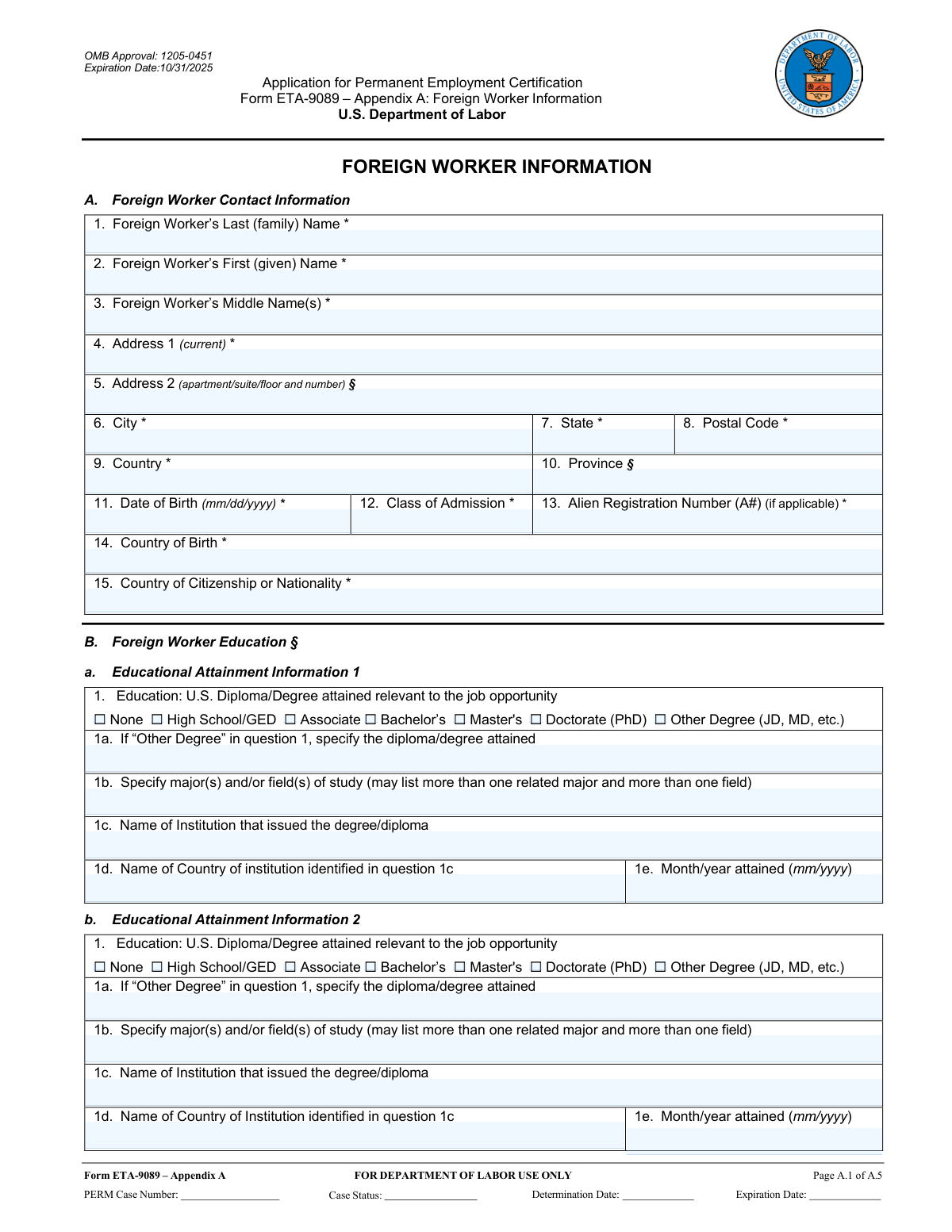
Form ETA-9089 Appendix A is a supplement to the Application for Permanent Employment Certification, used by the U.S. Department of Labor to collect detailed information about the foreign worker's qualifications. This includes their contact details, educational background, training, skills, and work experience, which are crucial for the PERM labor certification process. Today, this form can be filled out quickly and accurately using AI-powered services like Instafill.ai, which can also convert non-fillable PDF versions into interactive fillable forms.
ETA-9089 Appendix A is part of the employment application forms category on Instafill.
Our AI automatically handles information lookup, data retrieval, formatting, and form filling.
It takes less than a minute to fill out ETA-9089 Appendix A using our AI form filling.
Securely upload your data. Information is encrypted in transit and deleted immediately after the form is filled out.

Form specifications

Form name: Form ETA-9089 – Appendix A: Foreign Worker Information, Application for Permanent Employment Certification
Number of fields: 113
Number of pages: 5
Language: English
main-image

Instafill Demo: How to fill out PDF forms in seconds with AI

How to Fill Out ETA-9089 Appendix A Online for Free in 2026

Are you looking to fill out a ETA-9089 APPENDIX A form online quickly and accurately? Instafill.ai offers the #1 AI-powered PDF filling software of 2026, allowing you to complete your ETA-9089 APPENDIX A form in just 37 seconds or less.
Follow these steps to fill out your ETA-9089 APPENDIX A form online using Instafill.ai:
  1. 1 Navigate to Instafill.ai and upload or select the Form ETA-9089 Appendix A.
  2. 2 Provide the foreign worker's personal and contact information in Section A, including name, address, date of birth, and immigration details.
  3. 3 Detail the foreign worker's educational history in Section B, listing all relevant degrees, institutions, and dates of attainment.
  4. 4 Enter information about any specialized training, certifications, or licenses the foreign worker has obtained in Section C.
  5. 5 Describe the foreign worker's specific skills, abilities, and proficiencies that are relevant to the job opportunity in Section D.
  6. 6 List the foreign worker's complete work experience in Section E, including employer details, job titles, duties, and dates of employment.
  7. 7 Review all the information auto-filled by the AI for accuracy, make any necessary corrections, and then download or e-file the completed form.

Our AI-powered system ensures each field is filled out correctly, reducing errors and saving you time.

Why Choose Instafill.ai for Your Fillable ETA-9089 Appendix A Form?

Speed

Complete your ETA-9089 Appendix A in as little as 37 seconds.

Up-to-Date

Always use the latest 2026 ETA-9089 Appendix A form version.

Cost-effective

No need to hire expensive lawyers.

Accuracy

Our AI performs 10 compliance checks to ensure your form is error-free.

Security

Your personal information is protected with bank-level encryption.

Frequently Asked Questions About Form ETA-9089 Appendix A

This form is an appendix to the Application for Permanent Employment Certification and is used to collect detailed information about the foreign worker. It documents the worker's qualifications, including education, training, skills, and experience, to prove they meet the job requirements.

While the employer files the overall PERM application, this appendix requires information directly from the foreign worker. The worker typically provides their personal, educational, and employment details to the employer or their attorney for completion.

Enter your current U.S. immigration status, which can be found on your most recent Form I-94 Arrival/Departure Record. Examples include H-1B, L-1, F-1, or TN.

The form states to provide the A# 'if applicable.' If you have not been assigned an Alien Registration Number, you can leave this field blank.

You should list your foreign degree and institution details as requested in the education section. It is highly recommended to obtain a credential evaluation to demonstrate that your foreign degree is equivalent to a U.S. degree.

The form provides space for a limited number of entries. You should list the qualifications most relevant to the job opportunity first and consult with your immigration attorney on how to best present any additional qualifications.

For a current job, enter your start date, check the 'Yes' box for the 'Present' field, and leave the 'End Date' field blank. This correctly indicates that your employment is ongoing.

This section should be very detailed, describing the specific tasks you performed, tools or software you used, and any supervisory roles. Ensure the duties listed clearly demonstrate you have the experience required for the job opportunity.

You do not submit supporting documents with the initial filing of Form ETA-9089. However, you must have them ready, as the Department of Labor may request them during an audit, and they will be required for the subsequent I-140 petition.

Form ETA-9089 Appendix A is not a standalone form; it must be submitted as part of the complete Form ETA-9089 application package. Your employer or their legal representative files the entire application with the U.S. Department of Labor.

Yes, services like Instafill.ai use AI to help you accurately fill out forms. These tools can auto-populate your information, which saves time and helps prevent common errors.

Simply upload the form's PDF to the Instafill.ai platform. The AI will make the form fillable online, and you can use its features to enter your information quickly and securely before downloading the completed document.

If you have a non-fillable or 'flat' PDF, you can use a service like Instafill.ai. It can convert the document into an interactive, fillable form so you can easily type your answers directly into the fields.

Compliance ETA-9089 Appendix A
Validation Checks by Instafill.ai

1
Date of Birth Validity
This check ensures the 'Date of Birth' (A.11) is a valid, past date in the 'mm/dd/yyyy' format. It prevents the entry of future dates, impossible dates like '02/30/2000', or incorrectly formatted dates. This is critical for verifying the identity and eligibility of the foreign worker, and failure would lead to rejection of the form for containing invalid personal data.
2
Work Experience 'Present' Employment Logic
This validation verifies the relationship between the 'End Date' (E.1i) and the 'Present' checkbox (E.1j) in the Work Experience section. If 'Present' is checked 'Yes', the 'End Date' field must be empty. If 'Present' is checked 'No', the 'End Date' field must be populated with a valid date. This ensures logical consistency in the employment history, and a mismatch would create ambiguity about the worker's current employment status.
3
Work Experience Date Chronology
This check ensures that for any given work experience entry (Section E), the 'End Date' (E.1i) is not chronologically earlier than the 'Start Date' (E.1h). This prevents logical impossibilities in the work history timeline. Submitting a form with an end date before a start date would invalidate that work experience record and could lead to the application being flagged for review or rejected.
4
Conditional 'Other Degree' Specification
This validation rule applies to the Foreign Worker Education sections (B.a through B.e). It checks that if the 'Other Degree' checkbox is selected for any educational attainment, the corresponding 'specify the diploma/degree attained' field (e.g., B.1a) must be filled out. This ensures that selecting a generic category is always accompanied by a required specific detail, preventing incomplete data submission. Failure to provide the specification would make the education entry incomplete and unusable for evaluation.
5
Training Dates Sequence Validation
For each entry in the Foreign Worker Training Qualifications section (C), this check confirms that the 'End date of training' (e.g., C.a.1d) is on or after the 'Start date of training' (C.a.1c). It also checks that the 'Month/year awarded' (C.a.1e) is on or after the 'End date of training'. This maintains the logical flow of events and ensures the training timeline is coherent and accurate.
6
Required Contact Information Completeness
This check verifies that all fields marked with an asterisk (*) in Section A (Foreign Worker Contact Information) are filled. This includes fields like Last Name, First Name, Address 1, City, State, Postal Code, Country, Date of Birth, and Country of Birth. These fields are fundamental for identifying the applicant, and missing information would render the application incomplete and lead to immediate rejection.
7
Alien Registration Number (A#) Format
This validation checks that if an 'Alien Registration Number' (A.13) is provided, it follows the standard USCIS format, typically an 'A' followed by 8 or 9 digits. While the field is optional ('if applicable'), validating the format for entries that are provided ensures data integrity and compatibility with other immigration systems. An incorrectly formatted A# could cause processing delays or data mismatch errors.
8
Job Duties Character Limit
This check ensures the text entered into the 'Job Duties' field (E.1l) does not exceed the specified 3,500-character limit. Enforcing this limit is crucial to prevent database errors and ensure the submitted data conforms to the system's storage capacity. If a user attempts to enter more than 3,500 characters, the system should provide a warning and prevent submission until the text is shortened.
9
Work Experience Age Plausibility
This validation performs a cross-field check between the worker's 'Date of Birth' (A.11) and the 'Start Date' (E.1h) of their earliest work experience. It flags entries where the work experience begins before the worker reached a plausible working age, such as 16. This helps catch significant data entry errors and ensures the provided work history is realistic and credible.
10
Education Attainment Date Logic
This check validates that the 'Month/year attained' for any degree (e.g., B.1e) is a date in the past and occurs after the foreign worker's 'Date of Birth' (A.11). This logical check prevents impossible scenarios, such as a degree being awarded before the applicant was born or on a future date. Such an error would call the validity of the educational claim into question.
11
Address State/Province Consistency
This validation checks for consistency between the 'Country' (A.9), 'State' (A.7), and 'Province' (A.10) fields. If the country is 'United States', the 'State' field must contain a valid US state/territory and the 'Province' field should be empty. Conversely, for countries like Canada, the 'Province' field should be used. This ensures the address information is structured correctly and is geolocatable.
12
Education Block Completeness
This rule ensures that if any educational attainment level (other than 'None') is selected in Section B, then the essential corresponding fields like 'Name of Institution' (1c), 'Name of Country of institution' (1d), and 'Month/year attained' (1e) are also completed. This prevents partial entries where a degree is claimed but no supporting details are provided. An incomplete block would be insufficient for verification and could weaken the application.

Common Mistakes in Completing ETA-9089 Appendix A

Inconsistent Name Spelling

Applicants often enter their name with slight variations from their official documents, such as using a nickname, omitting a middle name, or anglicizing their name. This creates a discrepancy with legal documents like passports and birth certificates, which are used for identity verification. Such inconsistencies can lead to significant processing delays, Requests for Evidence (RFE), or even denial of the application.

Incorrect Date Formatting

The form requires specific date formats, such as 'mm/dd/yyyy' for date of birth and 'mm/yyyy' for employment or education dates. Applicants frequently mix these formats or use their local convention (e.g., dd/mm/yyyy), leading to data entry errors and confusion. This can cause electronic filing systems to reject the form or require manual correction, delaying the entire process. Using a tool like Instafill.ai can help by automatically formatting dates correctly based on the field's requirements.

Omitting the Alien Registration Number (A#)

The form asks for an Alien Registration Number (A#) 'if applicable,' which can be confusing. Applicants who have had previous interactions with U.S. immigration (e.g., an EAD card, a prior petition) may have an A# but forget to include it, thinking it's optional. Missing this crucial identifier forces adjudicators to spend extra time locating the applicant's file, slowing down case processing.

Listing Irrelevant Education

Section B asks for education 'relevant to the job opportunity,' but applicants sometimes list every degree they have ever earned to seem more qualified. This can backfire by confusing the adjudicator and weakening the connection between the applicant's credentials and the specific job requirements listed by the employer. It is crucial to only list degrees and majors that directly support the qualifications needed for the sponsored position.

Vague or Generic Job Duty Descriptions

In Section E, the 'Job Duties' field is often filled with generic descriptions copied from a resume instead of a detailed account of the work performed. This is a critical error, as these duties must explicitly demonstrate the skills required for the job being offered. A vague description fails to prove the worker is qualified, which is a common reason for PERM application denials.

Mismatched Skills and Experience

Applicants may list a specific skill in Section D but fail to describe where and how they acquired or used that skill in the 'Job Duties' (Section E) or 'Training' (Section C) sections. Adjudicators look for a clear narrative where the experience described provides evidence for the skills claimed. A disconnect between these sections undermines the applicant's qualifications and can lead to the application being denied.

Overlapping or Gapped Employment Dates

The work history timeline in Section E must be logical and continuous, without unexplained gaps or overlapping job dates. These errors often happen due to poor record-keeping or simple typos but can raise red flags about the accuracy of the entire application, potentially triggering a time-consuming audit. It is essential to carefully review all start and end dates to ensure they form a coherent history. AI-powered tools can help validate date ranges to prevent such inconsistencies.

Failing to Specify 'Other Degree'

When an applicant's degree is not a standard Bachelor's or Master's, they must check the 'Other Degree' box in Section B and then specify the degree in the corresponding text field. A common mistake is checking the box but leaving the specification field blank. This renders the education section incomplete and makes it impossible for the adjudicator to assess the qualification, leading to an RFE or denial.

Incorrectly Handling 'Present' Employment

For the applicant's current job, the 'End Date' field (1i) should be left blank and the 'Present' box (1j) should be checked 'Yes'. Applicants sometimes mistakenly enter an end date for their current role or forget to check the 'Present' box. This creates a factual error about the applicant's employment status that can cause confusion and require clarification.

Confusing State, Province, and Country Fields

When entering foreign addresses in sections like A or E, applicants may incorrectly place the province name in the 'State' field or the country in the 'City' field. This happens due to unfamiliarity with U.S. address layouts and can lead to data entry problems and a perception of carelessness. For non-U.S. addresses, the 'State' field should be left blank and the 'Province' field should be used instead.

Listing Foreign Degrees in U.S. Degree Section

Section B specifically asks for a 'U.S. Diploma/Degree.' Applicants often mistakenly list their foreign degrees in this section without an official U.S. equivalency evaluation. This is incorrect, as foreign credentials must be formally evaluated to be considered equivalent, and that information must be presented correctly. Listing a foreign degree here can lead to the qualification being disregarded and the application denied.
Saved over 80 hours a year

“I was never sure if my IRS forms like W-9 were filled correctly. Now, I can complete the forms accurately without any external help.”

Kevin Martin Green

Your data stays secure with advanced protection from Instafill and our subprocessors

Robust compliance program

Transparent business model

You’re not the product. You always know where your data is and what it is processed for.

ISO 27001, HIPAA, and GDPR

Our subprocesses adhere to multiple compliance standards, including but not limited to ISO 27001, HIPAA, and GDPR.

Security & privacy by design

We consider security and privacy from the initial design phase of any new service or functionality. It’s not an afterthought, it’s built-in, including support for two-factor authentication (2FA) to further protect your account.

Fill out ETA-9089 Appendix A with Instafill.ai

Worried about filling PDFs wrong? Instafill securely fills form-eta-9089-appendix-a-foreign-worker-information-application-for-permanent-employment-certification forms, ensuring each field is accurate.