Yes! You can use AI to fill out Form MC 200a, Felony Information

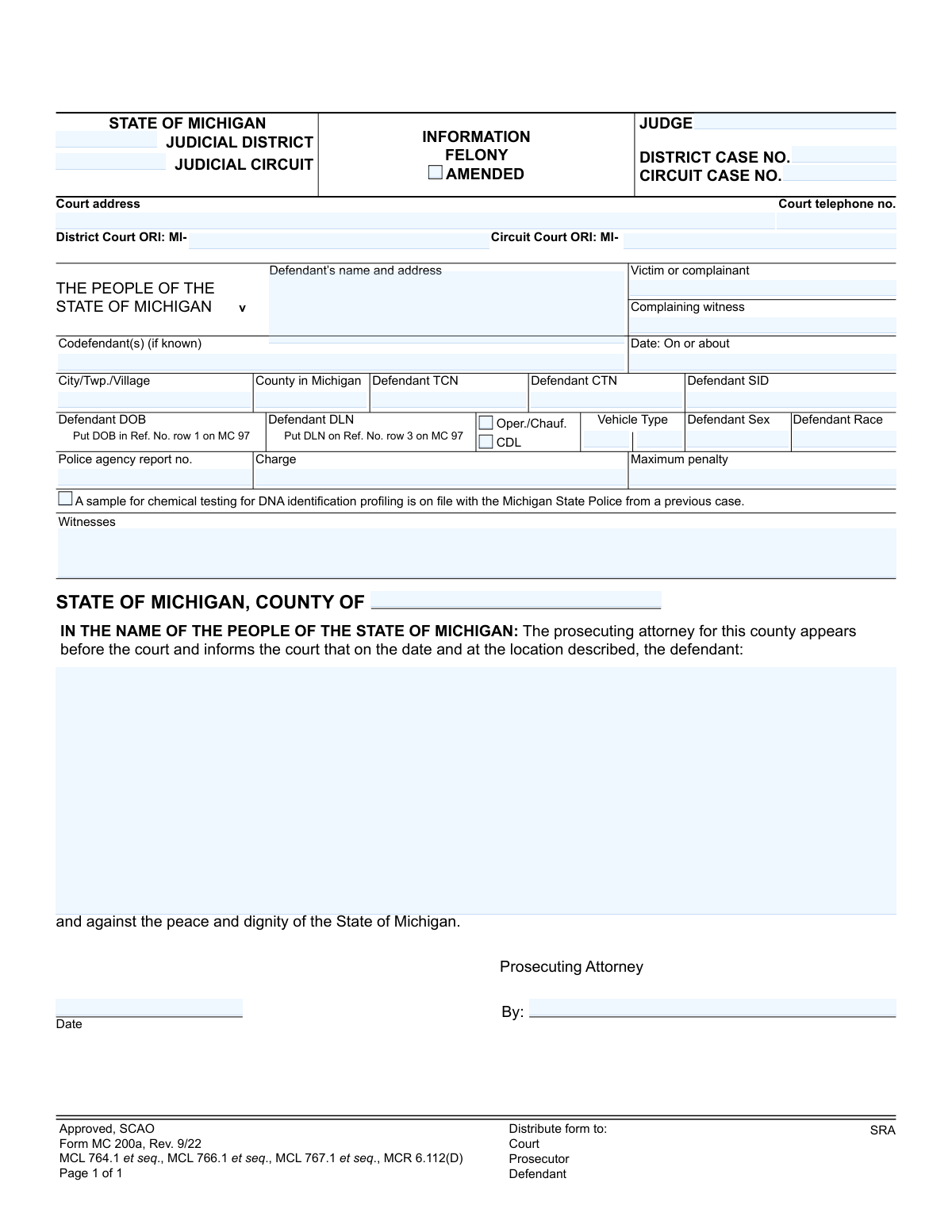
Form MC 200a, Felony Information, is a critical legal document within the Michigan judicial system used by a prosecuting attorney to formally charge an individual with a felony. It outlines the specific charges, defendant information, and case details for the court, initiating the formal felony proceedings. Today, this form can be filled out quickly and accurately using AI-powered services like Instafill.ai, which can also convert non-fillable PDF versions into interactive fillable forms.
MC 200a is part of the Michigan court forms category on Instafill.
Our AI automatically handles information lookup, data retrieval, formatting, and form filling.
It takes less than a minute to fill out MC 200a using our AI form filling.
Securely upload your data. Information is encrypted in transit and deleted immediately after the form is filled out.

Form specifications

Form name: Form MC 200a, Felony Information
Number of fields: 35
Number of pages: 1
Language: English
main-image

Instafill Demo: How to fill out PDF forms in seconds with AI

How to Fill Out MC 200a Online for Free in 2026

Are you looking to fill out a MC 200A form online quickly and accurately? Instafill.ai offers the #1 AI-powered PDF filling software of 2026, allowing you to complete your MC 200A form in just 37 seconds or less.
Follow these steps to fill out your MC 200A form online using Instafill.ai:
  1. 1 Navigate to Instafill.ai and upload your Form MC 200a, or select it from the template library.
  2. 2 Allow the AI to scan and process the form, identifying all the necessary fields for case and defendant information.
  3. 3 Provide the required information, such as court details, defendant's personal data (name, DOB, address), case numbers (TCN, CTN), and the specific charges.
  4. 4 Watch as Instafill.ai's smart technology accurately populates the corresponding fields on the form with the information you provided.
  5. 5 Carefully review the auto-filled form to ensure all details, including court ORI numbers, charge descriptions, and maximum penalties, are correct and complete.
  6. 6 Electronically sign the document in the designated Prosecuting Attorney section and date it to finalize the filing.
  7. 7 Securely download, print, or share the completed Form MC 200a for distribution to the court, prosecutor, and defendant as required.

Our AI-powered system ensures each field is filled out correctly, reducing errors and saving you time.

Why Choose Instafill.ai for Your Fillable MC 200a Form?

Speed

Complete your MC 200a in as little as 37 seconds.

Up-to-Date

Always use the latest 2026 MC 200a form version.

Cost-effective

No need to hire expensive lawyers.

Accuracy

Our AI performs 10 compliance checks to ensure your form is error-free.

Security

Your personal information is protected with bank-level encryption.

Frequently Asked Questions About Form MC 200a

This is a formal legal document used by a prosecuting attorney in Michigan to officially charge a defendant with a felony in the Circuit Court. It outlines the specific crime the defendant is accused of committing and the maximum potential penalty.

The Prosecuting Attorney's office is responsible for preparing and filing this form with the court. The defendant or their attorney receives a copy but does not fill it out.

No, receiving this form does not mean you are convicted. It is a formal accusation that initiates the felony case proceedings in the Circuit Court, where your guilt or innocence will be determined.

Felony cases typically start in District Court, which assigns the initial case number. If the case proceeds to trial, it moves to the Circuit Court, which then assigns its own, new case number for its proceedings.

These are unique identifiers used within the criminal justice system. TCN is the Transaction Control Number, CTN is the Criminal Tracking Number, and SID is the State Identification Number, all used to track the individual and the case.

You should immediately consult with your criminal defense attorney to discuss the specific charges and plan the next steps in your case. If you do not have an attorney, you should seek legal representation without delay.

This checkbox indicates whether the state already has the defendant's DNA profile from a previous case. This information is relevant for identification and legal procedures.

This field states the most severe sentence allowed by law for the crime you are charged with. The actual sentence, if convicted, may be less and is determined by a judge based on various factors.

An ORI, or Originating Agency Identifier, is a unique code assigned to each court and law enforcement agency. It is used for tracking and routing documents and data correctly within the justice system.

As the recipient, you do not fill out this form. However, the prosecutor's office preparing it can use AI services like Instafill.ai to accurately auto-fill fields with case data, saving time and ensuring information is correct.

A prosecutor's office could use Instafill.ai to instantly populate the form by pulling data from a case management system. This ensures all fields, from defendant details to case numbers, are filled in quickly and accurately.

While you don't need to fill out this specific form, if you have other legal documents that are non-fillable PDFs, a service like Instafill.ai can convert them into interactive, fillable forms for easier management and annotation.

This is traditional legal language required by the Michigan Constitution for all criminal prosecutions. It formally signifies that the alleged crime is considered an offense against the public order of the state.

Compliance MC 200a
Validation Checks by Instafill.ai

1
Case Number Format and Presence
Validates that at least one of the 'District Case No.' or 'Circuit Case No.' fields is populated with a value that matches the expected format for Michigan court case numbers. This is critical for uniquely identifying and tracking the case within the judicial system. If a case number is present but improperly formatted, or if both are missing, the submission should be flagged for correction to prevent filing errors.
2
ORI Number Format Validation
Ensures that the 'District Court ORI' and 'Circuit Court ORI' fields, if populated, begin with 'MI-' followed by the specific agency identifier. The Originating Agency Identifier (ORI) is crucial for routing information to the correct law enforcement and judicial agencies. An incorrect ORI can lead to lost documents or significant delays in processing.
3
Logical Date Sequence
Performs a logical check to ensure the 'Information Date' (the date the charge is formally filed) is on or after the 'Date' of the alleged offense. It is logically impossible to file charges for a crime before it has occurred. This validation prevents data entry errors that could invalidate the entire legal document.
4
Offense Date Cannot Be in the Future
Validates that the 'Date' field, representing when the offense occurred, is not a future date. This is a fundamental sanity check to ensure the entered date is plausible. A submission with a future offense date is a clear indicator of a data entry mistake and must be corrected before processing.
5
Defendant DOB Validity
Checks that the 'Defendant DOB' (Date of Birth) is a valid calendar date and represents a plausible age for a defendant. This validation helps prevent typographical errors and ensures the defendant's age is recorded correctly, which can be critical for determining jurisdiction (juvenile vs. adult) and for accurate identification. The system should flag dates that are in the future or imply an unreasonable age.
6
Defendant Driver's License Number (DLN) Format
Validates that the 'Defendant DLN' conforms to the specific format for Michigan driver's licenses. A correctly formatted DLN is a key piece of identifying information used by law enforcement and the courts. This check reduces errors in the defendant's record and ensures accurate data sharing between agencies like the Secretary of State and the judicial system.
7
Michigan County Validation
Ensures the 'County in Michigan' and the 'STATE OF MICHIGAN, COUNTY OF' fields are populated with a valid Michigan county name from a predefined list. Jurisdictional accuracy is paramount in legal filings. This check prevents misfiling a case in the wrong county, which would render the document legally void and require refiling.
8
Defendant Information Completeness
Verifies that the 'Defendant’s name and address' field is not empty. A legal proceeding cannot be initiated without identifying the accused party. This check ensures the most fundamental information required to proceed with the case is present on the form.
9
Charge and Maximum Penalty Completeness
Validates that if the 'Charge' field is filled, the corresponding 'Maximum penalty' field is also filled. The defendant has a legal right to be informed of the potential consequences of the charges against them. This check ensures the form is complete and complies with legal requirements for notifying the defendant.
10
Prosecuting Attorney Presence
Checks that the 'Prosecuting Attorney' name field is populated. The form is a legal instrument initiated by the prosecutor's office, and the signature block must identify the responsible attorney. A missing name would call the document's authority and validity into question.
11
Court Telephone Number Format
Ensures the 'Court telephone no.' field, if entered, is a valid 10-digit phone number format (e.g., (XXX) XXX-XXXX or XXXXXXXXXX). This maintains data quality and ensures that contact information for the court is usable and correctly formatted. An invalid number could hinder communication between parties.
12
Defendant Sex and Race Field Values
Validates that the 'Defendant Sex' and 'Defendant Race' fields contain values from a predefined, standardized list. Using a controlled vocabulary is essential for accurate statistical reporting, data analysis, and consistency across different systems. Free-text entries could lead to ambiguous or unusable demographic data.
13
Defendant Identifier Format (TCN/CTN/SID)
Checks that the 'Defendant TCN', 'Defendant CTN', and 'Defendant SID' fields adhere to their specific alphanumeric formats. These tracking numbers are critical for linking the court case to law enforcement and corrections records. Incorrect formats can break these data links, leading to fragmented and incomplete records for an individual.

Common Mistakes in Completing MC 200a

Incorrect Case or Agency Identifier Numbers

Users frequently transpose digits or make transcription errors when entering the District/Circuit Case No., Police Agency Report No., or the various defendant identifiers (TCN, CTN, SID). These long, specific codes are crucial for linking the document to the correct legal case and individual history. An error here can cause the filing to be rejected, associated with the wrong case, or create a duplicate and confusing record, leading to significant administrative and legal delays.

Incomplete or Inaccurate Defendant Information

Mistakes include using a nickname instead of a full legal name, omitting a middle initial or suffix, or providing an incomplete address that lacks an apartment number or correct ZIP code. This can lead to failed service of process, mistaken identity, and difficulties in locating the defendant. To avoid this, all personal details should be copied exactly from an official source like a driver's license or police report.

Vague or Legally Insufficient Crime Description

The narrative section where the prosecutor describes the offense is often filled out with a simple, informal story of events rather than the precise legal language required. This description must contain all the statutory elements of the crime being charged. A legally insufficient description can be grounds for a judge to dismiss the charge, forcing the prosecution to refile and delaying the case.

Incorrect Statutory Charge or Maximum Penalty

Listing the correct Michigan Compiled Laws (MCL) charge and its corresponding maximum penalty requires specific legal knowledge. A common mistake is citing the wrong statute number or an outdated penalty, which can misinform the defendant of the jeopardy they face and may invalidate the charging document. This information must be carefully verified before submission.

Confusing District and Circuit Court Information

The form has distinct fields for District Court and Circuit Court case numbers and ORI codes. People often get these confused, entering the District Court number in the Circuit Court field or vice versa, especially as a case moves between the two courts. This creates record-keeping confusion that must be manually corrected by court staff, slowing down the process.

Ignoring Cross-Referencing Instructions

The form contains specific instructions, such as 'Put DOB in Ref. No. row 1 on MC 97' and 'Put DLN on Ref. No. row 3 on MC 97'. A frequent error is to ignore these directions, either by writing the information directly on this form or by failing to enter it on the separate MC 97 form at all. This disrupts the court's standardized data management process and can result in an incomplete case file.

Incorrect Jurisdiction for the Offense Location

Specifying the correct 'City/Twp./Village' and 'County' where the crime occurred is critical for establishing legal venue. Users may be unsure of precise municipal boundaries and list the wrong jurisdiction, such as a mailing address city instead of the actual township of the incident. An error in venue is a serious legal issue that could lead to the case being dismissed and needing to be refiled in the correct court.

Illegible Handwriting on a Printed Form

When this form is printed and filled out by hand, illegible handwriting is a major source of errors, especially for complex names, addresses, and alphanumeric case numbers. This forces court clerks to guess at the information, leading to data entry mistakes that can have serious consequences. To avoid this, the form should be filled out electronically. AI-powered tools like Instafill.ai can convert flat, non-fillable PDFs into fillable versions to ensure all entries are typed and perfectly clear.

Missing Prosecuting Attorney Signature or Date

A charging document like this is not legally valid until it is signed and dated by the prosecuting attorney or their authorized representative. Forgetting to sign or date the form is a simple but common oversight that will cause the court to reject the filing. This requires the form to be returned, corrected, and resubmitted, causing unnecessary delays in starting the criminal proceedings.
Saved over 80 hours a year

“I was never sure if my IRS forms like W-9 were filled correctly. Now, I can complete the forms accurately without any external help.”

Kevin Martin Green

Your data stays secure with advanced protection from Instafill and our subprocessors

Robust compliance program

Transparent business model

You’re not the product. You always know where your data is and what it is processed for.

ISO 27001, HIPAA, and GDPR

Our subprocesses adhere to multiple compliance standards, including but not limited to ISO 27001, HIPAA, and GDPR.

Security & privacy by design

We consider security and privacy from the initial design phase of any new service or functionality. It’s not an afterthought, it’s built-in, including support for two-factor authentication (2FA) to further protect your account.

Fill out MC 200a with Instafill.ai

Worried about filling PDFs wrong? Instafill securely fills form-mc-200a-felony-information forms, ensuring each field is accurate.