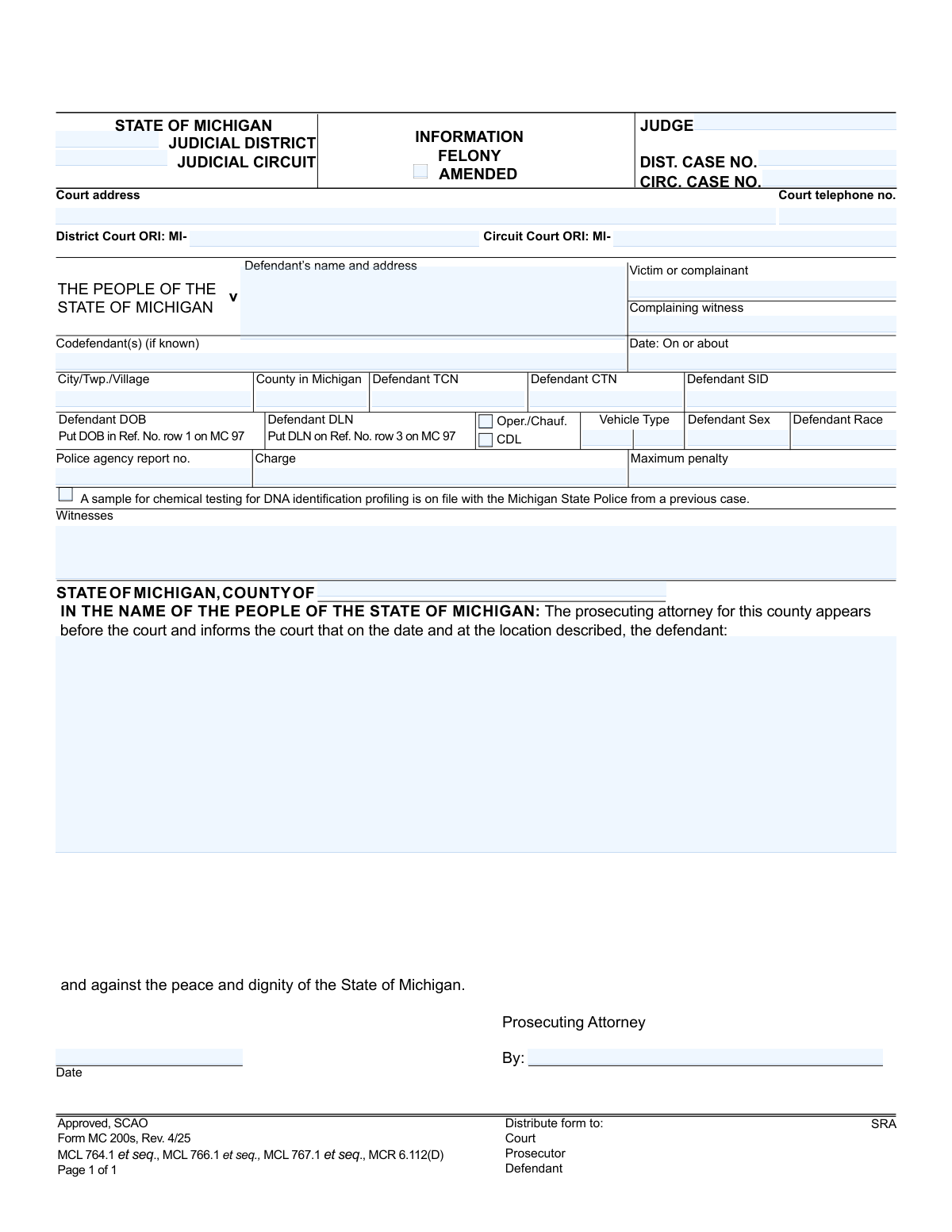
Yes! You can use AI to fill out Form MC 200s, Felony Set, Summons
Form MC 200s, Felony Set, Summons, is a crucial multi-part document utilized by the State of Michigan's judicial system for felony proceedings. It consolidates several key legal actions into one set, including the official Complaint detailing the charges, the Summons ordering the defendant to appear in court, and the Bindover/Transfer form used after a preliminary examination. This standardized format ensures all necessary information is captured and processed consistently throughout the early stages of a felony case. Today, this form can be filled out quickly and accurately using AI-powered services like Instafill.ai, which can also convert non-fillable PDF versions into interactive fillable forms.
MC 200s is part of the
Michigan court forms category on Instafill.
Our AI automatically handles information lookup, data retrieval, formatting, and form filling.
It takes less than a minute to fill out MC 200s using our AI form filling.
Securely upload your data. Information is encrypted in transit and deleted immediately after the form is filled out.
Form specifications
| Form name: | Form MC 200s, Felony Set, Summons |
| Number of fields: | 215 |
| Number of pages: | 1 |
| Language: | English |
More forms in Michigan court forms
Instafill Demo: How to fill out PDF forms in seconds with AI
How to Fill Out MC 200s Online for Free in 2026
Are you looking to fill out a MC 200S form online quickly and accurately? Instafill.ai offers the #1 AI-powered PDF filling software of 2026, allowing you to complete your MC 200S form in just 37 seconds or less.
Follow these steps to fill out your MC 200S form online using Instafill.ai:
- 1 Navigate to Instafill.ai and upload or select the Michigan Form MC 200s.
- 2 Use the AI assistant to automatically identify all fields across the various sections, such as the Complaint, Summons, and Bindover pages.
- 3 Enter the primary case information, including court details, case numbers, defendant and victim names, and charge specifics. The AI will help populate this data across all relevant parts of the form set.
- 4 Complete the specific details for each required section, such as the narrative of the offense in the Complaint, the arraignment date in the Summons, or the service details in the Proof of Service.
- 5 Review all the information entered across the entire document set to ensure accuracy and completeness for the specific legal action being taken.
- 6 Electronically sign the document in the appropriate signature fields for the complaining witness, prosecuting attorney, or judge.
- 7 Download, print, or securely file the completed MC 200s form package as required by the court procedures.
Our AI-powered system ensures each field is filled out correctly, reducing errors and saving you time.
Why Choose Instafill.ai for Your Fillable MC 200s Form?
Speed
Complete your MC 200s in as little as 37 seconds.
Up-to-Date
Always use the latest 2026 MC 200s form version.
Cost-effective
No need to hire expensive lawyers.
Accuracy
Our AI performs 10 compliance checks to ensure your form is error-free.
Security
Your personal information is protected with bank-level encryption.
Frequently Asked Questions About Form MC 200s
This is a comprehensive legal document used in Michigan to formally charge an individual with a felony, summon them to court, and document the initial proceedings like the preliminary examination.
Various parties complete different sections. The prosecuting attorney files the 'Information,' a complaining witness signs the 'Complaint,' and a judge or magistrate authorizes the 'Summons' and completes the 'Bindover' section.
The 'Information' is the formal charge by the prosecutor. The 'Complaint' is a sworn statement by a witness. The 'Summons' is the official court order requiring the defendant to appear for a hearing.
You are legally required to appear in court at the date, time, and location specified. Failing to appear can result in a warrant being issued for your arrest.
This section is used by the judge after a preliminary hearing. It documents the decision to send the case to the circuit court for trial ('bindover') or, for a juvenile, potentially transfer it to the family division.
By signing the waiver, the defendant agrees to skip the hearing where the prosecutor must show probable cause. The case is then automatically sent ('bound over') to the circuit court.
These are unique identifiers used by law enforcement and the courts. TCN is the Transaction Control Number, CTN is the Criminal Tracking Number, and SID is the State Identification Number, all used to track the case and the individual.
The form requires detailed defendant information (name, DOB, address), case numbers, the specific criminal charge and statute, and details of the alleged offense, including date and location.
This page is used to provide legal proof that the defendant was officially served with the summons and complaint. A process server or court officer fills this out and files it with the court.
Yes, services like Instafill.ai use AI to help legal professionals accurately auto-fill form fields from case files, which saves time and helps prevent data entry errors.
You can use a service like Instafill.ai to fill out this form online. Simply upload the document, and its AI will make all fields interactive and fillable on your computer.
If you have a flat or non-fillable PDF, you can upload it to Instafill.ai. The platform can convert it into an interactive, fillable form that you can easily complete, save, and print.
Compliance MC 200s
Validation Checks by Instafill.ai
1
Case Number Format and Consistency
This check validates that the District Case Number and Circuit Case Number fields follow the court's prescribed format, such as YY-#####-FY. It also ensures the same case number is used consistently across all related forms (Complaint, Summons, Bindover) for a given submission. This is critical for linking documents correctly within the case file; failure could lead to misfiled documents or inability to track case progress.
2
Defendant Date of Birth (DOB) Validity
Validates that the Defendant's Date of Birth is a complete and logical date (e.g., MM/DD/YYYY) that occurs in the past. It also checks that the calculated age is reasonable (e.g., between 10 and 120 years) to catch obvious data entry errors. An incorrect DOB can lead to misidentification of the defendant, incorrect application of juvenile vs. adult law, and issues with background checks.
3
Offense Date Chronology
Ensures the 'On or about' date of the offense is a valid date and occurs on or before the date the Complaint or Information form is signed by the complaining witness or prosecutor. This is a fundamental logical check to ensure the charging document is not created before the alleged crime happened. A validation failure indicates a critical error that makes the charging document legally questionable.
4
Michigan Attorney Bar Number Format
This validation verifies that all attorney bar numbers (for the prosecutor, defense counsel, etc.) follow the official State Bar of Michigan format, which is a 'P' followed by a sequence of digits (e.g., P12345). This ensures that the attorney of record is properly identified and is a licensed member of the bar. If the format is incorrect, it could indicate a data entry error or an invalid attorney, preventing proper case processing.
5
Mutually Exclusive Bindover Status
On the Bindover form, this check ensures that either the 'Examination was waived' checkbox is selected or the 'Examination was held' checkbox is selected, but not both. It also requires the corresponding date field ('waivedate' or 'examdate') to be filled for the selected option. This prevents contradictory information about the preliminary examination status, which is a crucial step in the felony court process.
6
Logical Progression of Court Dates
This validation checks the chronological order of key court dates across the forms. It ensures the Summons arraignment date is after the Summons issue date, and the Circuit Court appearance date on the Bindover form is after the preliminary examination or waiver date. This logic is essential for maintaining a coherent and legally sound timeline of events. An illogical date sequence would invalidate the court orders and cause significant procedural delays.
7
MCL/PACC Code Structure Validation
Verifies that the charge code entered in the 'MCL/PACC Code' field follows the standard format for a Michigan Compiled Laws (MCL) or Prosecuting Attorneys Coordinating Council (PACC) code. For example, an MCL code often looks like '750.81'. This validation helps ensure the charge is specific and correctly recorded, which is vital for determining penalties, statistical reporting, and legal accuracy.
8
Proof of Service Method Selection
This check confirms that on the Proof of Service form, exactly one method of service is indicated by selecting either 'personally,' 'by first-class mail,' or 'unable to complete service.' Selecting multiple options or none at all would create ambiguity regarding whether the defendant was properly notified. Proper service is a constitutional requirement, and failure to document it correctly can lead to the dismissal of a case.
9
Service Date and Time Plausibility
Validates that the 'Date and time of service' on the Proof of Service form is on or after the date the Summons was authorized and before the scheduled arraignment hearing. Serving a summons before it is issued or after the hearing has passed is legally invalid. This check prevents the filing of a legally deficient Proof of Service, which could jeopardize the court's jurisdiction over the defendant.
10
Defendant Identifier Format Validation
This check ensures that the Defendant's TCN (Tracking Control Number), CTN (County Tracking Number), and SID (State Identification Number) adhere to their expected formats and lengths. These unique identifiers are critical for linking the individual to their criminal history and tracking them across different justice system databases. Incorrect identifiers can lead to misidentification and a fragmented or inaccurate criminal record.
11
Completeness of Complaint Information
Verifies that the Complaint form contains all minimally required information to be legally sufficient, including the defendant's name, the specific charge(s), the date and location of the offense, and the signature of the complaining witness. An incomplete complaint cannot form the basis for a prosecution, so this check is a critical first step to ensure the case can proceed.
12
Bindover Destination Logic (Adult vs. Juvenile)
This validation cross-references the defendant's DOB with the date of the preliminary examination to determine their age. Based on the age, it verifies that the correct bindover section ('ADULT BINDOVER' or 'JUVENILE BINDOVER/TRANSFER') is completed. Misclassifying a defendant can have severe legal consequences, and this check ensures the case is routed to the correct court division as required by law.
13
Bond Amount and Type Consistency
This check ensures that if a bond amount is entered, the 'Type of bond' field is also completed, and vice-versa (unless it's a personal recognizance bond). This validation ensures clarity and completeness regarding the conditions of the defendant's pre-trial release. An incomplete bond specification can prevent or delay the defendant's release or processing.
14
ORI Number Format
Validates that the District and Circuit Court ORI (Originating Agency Identifier) numbers are present and follow the expected format, which is typically a set number of alphanumeric characters following the 'MI-' prefix. The ORI is essential for routing data to the correct law enforcement and court agencies at the state and national level. An invalid ORI will cause reporting failures to state criminal history repositories.
Common Mistakes in Completing MC 200s
Users often transpose digits or miscopy the various case and identification numbers (e.g., DIST. CASE NO., TCN, CTN, SID) due to their length and complexity. This common manual entry error can lead to documents being misfiled, linked to the wrong case, or lost in the court's system, causing significant legal and administrative delays. To avoid this, always double-check numbers against the source document; using an AI-powered tool like Instafill.ai can auto-populate these fields across related documents, ensuring consistency and reducing errors.
The 'District Court ORI' and 'Circuit Court ORI' fields require specific Originating Agency Identifier codes that are often unknown to the filer. Leaving these fields blank or entering an incorrect code can cause the document to be rejected or misrouted within the state's justice information system. This delays the case's official entry and tracking. To prevent this, filers should use an official list of Michigan ORI codes; for frequent users, tools like Instafill.ai can store and correctly populate these codes based on the selected court, ensuring accuracy.
The defendant's address is critical for serving the summons, but filers often provide an incomplete address (e.g., missing an apartment number) or an outdated one. This mistake leads directly to failed service attempts, as documented on the 'Proof of Service' form, which stalls the entire legal process and may require costly efforts to locate the defendant. Before filing, verify the defendant's current, complete mailing address. AI form-fillers like Instafill.ai can help by validating address formats and flagging potentially incomplete entries.
This set of forms includes a Complaint, Summons, and Information, all for the same case, yet errors arise when details like the defendant's name or charge differ between them. These discrepancies, often from manual data entry, create legal ambiguity that can lead to court challenges or require time-consuming amendments. To avoid this, meticulously cross-reference all shared fields before filing. Using a tool like Instafill.ai is ideal, as it can populate shared data across all related forms from a single entry point, eliminating inconsistencies.
The 'Charge' and 'MCL/PACC Code' fields demand legal precision, but errors like mistyping a Michigan Compiled Laws (MCL) number or using an outdated code are common. An incorrect charge can render the complaint legally insufficient, requiring amendment or, in serious cases, leading to case dismissal. Always verify the exact charge and corresponding MCL code from an official, up-to-date source before entering it on the form.
A process server filling out the 'Proof of Service' may record the wrong date or time, misidentify the person served, or check the wrong box for the service method ('personally' vs. 'first-class mail'). These mistakes, often made under pressure, can lead to the service being legally challenged, potentially invalidating the court's jurisdiction and forcing the process to restart. Process servers must meticulously record service details immediately and double-check the form before filing.
These forms require multiple signatures from different parties, such as the complaining witness, prosecutor, and judge. It is a simple but frequent mistake to overlook a signature or date field, especially on multi-page or complex documents. An unsigned or undated form is legally invalid and will be rejected by the court clerk, halting all progress until the omission is corrected and the document is refiled.
The 'Bindover/Transfer' section documents a critical court decision, but it is prone to clerical errors like checking the wrong box ('Examination was waived' vs. 'held') or entering the wrong date for the next appearance. Such mistakes can result in the defendant being sent to the wrong court on the wrong day or being held on incorrect charges, creating chaos and potential rights violations. Extreme care must be taken to accurately reflect the judge's ruling on this form, with double-checks of all dates, times, and charges.
The form contains small-print instructions like 'Put DLN on Ref. No. row 3 on MC 97,' which are crucial for data synchronization with other systems like state criminal history databases. Filers often overlook these instructions, leading to incomplete ancillary documents and data mismatches that cause administrative problems down the line. To avoid this, filers must read every part of the form carefully. AI tools like Instafill.ai can be programmed to recognize these instructions and automatically format data as required.
These forms are often available only as non-fillable PDFs, leading users to submit handwritten, scanned copies that are illegible. Poor handwriting or low scan quality makes it difficult for court clerks to accurately enter data, leading to errors and potential rejection of the filing. If only a flat PDF is available, a tool like Instafill.ai can convert it into a fillable format, allowing for clean, typed entries that are always legible and professional.
Saved over 80 hours a year
“I was never sure if my IRS forms like W-9 were filled correctly. Now, I can complete the forms accurately without any external help.”
Kevin Martin Green
Your data stays secure with advanced protection from Instafill and our subprocessors

Robust compliance program
Transparent business model
You’re not the product. You always know where your data is and what it is processed for.
ISO 27001, HIPAA, and GDPR
Our subprocesses adhere to multiple compliance standards, including but not limited to ISO 27001, HIPAA, and GDPR.
Security & privacy by design
We consider security and privacy from the initial design phase of any new service or functionality. It’s not an afterthought, it’s built-in, including support for two-factor authentication (2FA) to further protect your account.
Fill out MC 200s with Instafill.ai
Worried about filling PDFs wrong? Instafill securely fills form-mc-200s-felony-set-summons forms, ensuring each field is accurate.