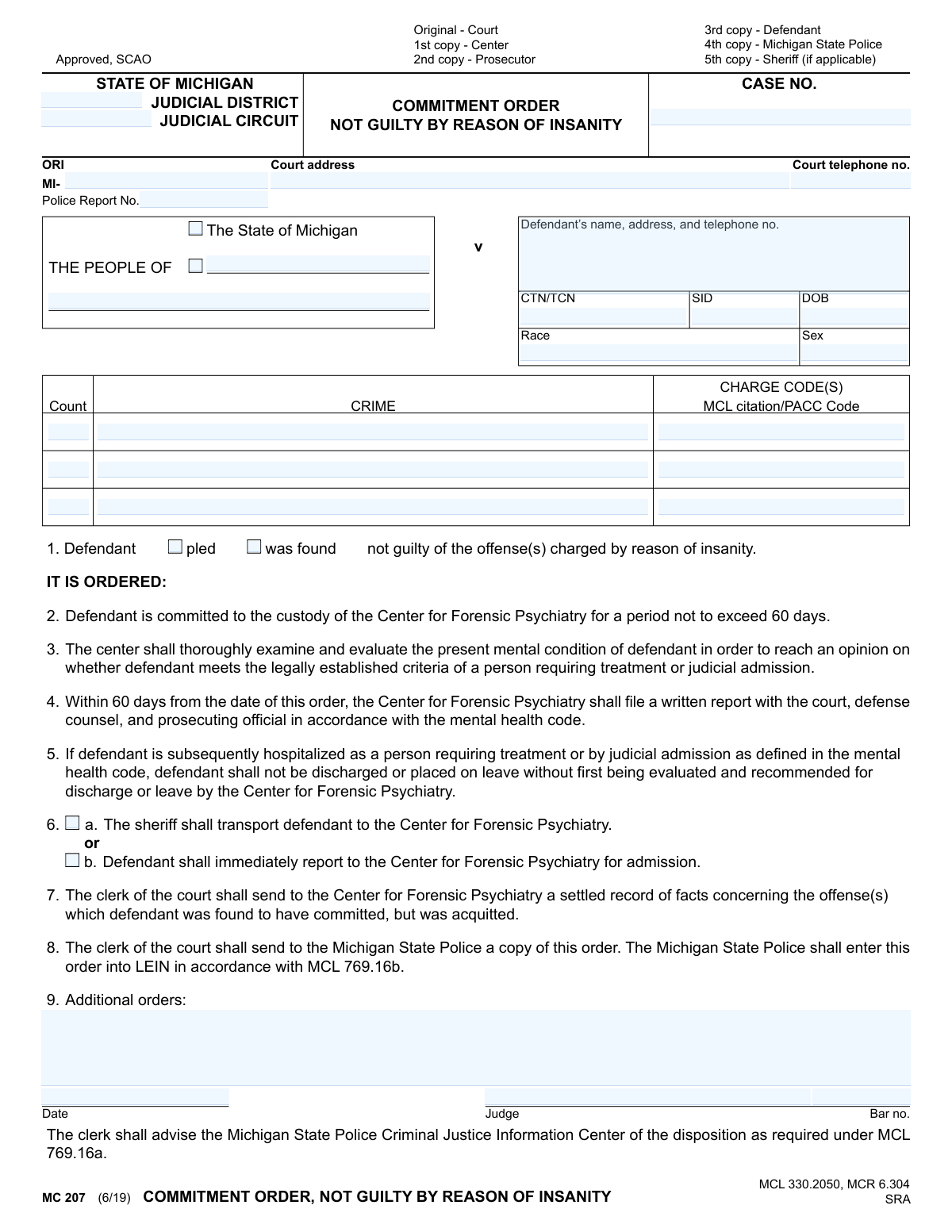
Yes! You can use AI to fill out Form MC 207, Commitment Order, Not Guilty by Reason of Insanity
Form MC 207, Commitment Order, Not Guilty by Reason of Insanity, is a legal document issued by Michigan courts. It is used when a defendant is acquitted of criminal charges on the grounds of insanity, mandating their commitment to the Center for Forensic Psychiatry for a comprehensive mental health evaluation. This evaluation determines if the individual requires further treatment or judicial admission. Today, this form can be filled out quickly and accurately using AI-powered services like Instafill.ai, which can also convert non-fillable PDF versions into interactive fillable forms.
MC 207 is part of the
Michigan court forms category on Instafill.
Our AI automatically handles information lookup, data retrieval, formatting, and form filling.
It takes less than a minute to fill out MC 207 using our AI form filling.
Securely upload your data. Information is encrypted in transit and deleted immediately after the form is filled out.
Form specifications
| Form name: | Form MC 207, Commitment Order, Not Guilty by Reason of Insanity |
| Number of fields: | 34 |
| Number of pages: | 1 |
| Language: | English |
More forms in Michigan court forms
Instafill Demo: How to fill out PDF forms in seconds with AI
How to Fill Out MC 207 Online for Free in 2026
Are you looking to fill out a MC 207 form online quickly and accurately? Instafill.ai offers the #1 AI-powered PDF filling software of 2026, allowing you to complete your MC 207 form in just 37 seconds or less.
Follow these steps to fill out your MC 207 form online using Instafill.ai:
- 1 Navigate to Instafill.ai and upload or select the Form MC 207.
- 2 Provide essential case information, including the judicial district/circuit, case number, and court address.
- 3 Enter the defendant's personal details, such as their full name, address, date of birth, and other identifiers like CTN/SID.
- 4 List the specific criminal charges for which the defendant was acquitted, including the crime, charge codes, and MCL citation.
- 5 Indicate how the verdict was reached and specify the transportation or reporting method to the Center for Forensic Psychiatry.
- 6 Review all the information auto-filled by the AI for accuracy, make any necessary corrections, and add any additional court orders in the designated section.
- 7 Finalize the document for the judge's signature and date, then prepare it for distribution to all required parties like the court, prosecutor, and defendant.
Our AI-powered system ensures each field is filled out correctly, reducing errors and saving you time.
Why Choose Instafill.ai for Your Fillable MC 207 Form?
Speed
Complete your MC 207 in as little as 37 seconds.
Up-to-Date
Always use the latest 2026 MC 207 form version.
Cost-effective
No need to hire expensive lawyers.
Accuracy
Our AI performs 10 compliance checks to ensure your form is error-free.
Security
Your personal information is protected with bank-level encryption.
Frequently Asked Questions About Form MC 207
This is a court order used in Michigan to commit a defendant to the Center for Forensic Psychiatry for evaluation after they have been found not guilty of a crime by reason of insanity.
This official court order is prepared by court personnel or attorneys and is signed by a judge to make it legally binding.
The defendant is committed to the custody of the Center for Forensic Psychiatry for a mandatory evaluation period that will not exceed 60 days.
During this period, the Center for Forensic Psychiatry will thoroughly examine the defendant's mental condition to determine if they require further treatment. The Center must then file a report with the court, defense counsel, and prosecutor.
Copies are distributed to the court, the Center for Forensic Psychiatry, the prosecutor, the defendant, the Michigan State Police, and the sheriff if they are providing transport.
The form requires specific case information, including the court, case number, and police report number, as well as the defendant's personal details and the specific charges they were acquitted of.
The judge will specify on the order whether the local sheriff is required to transport the defendant or if the defendant must report to the Center on their own.
A defendant who is hospitalized cannot be discharged or placed on leave without a specific evaluation and recommendation for release from the Center for Forensic Psychiatry.
The Michigan State Police receives a copy to enter the commitment order into the Law Enforcement Information Network (LEIN), as required by state law.
The Center for Forensic Psychiatry submits its report, and based on its findings, the court will determine the next steps, which may include continued hospitalization or other actions under the mental health code.
Yes, services like Instafill.ai use AI to accurately auto-fill form fields from case files or other documents, which saves time and reduces the risk of clerical errors.
Simply upload the form to Instafill.ai, and its AI will help populate the fields with the correct information. You can then review, edit, and finalize the document online before printing for signature.
You can use a service like Instafill.ai, which can convert flat, non-fillable PDFs into interactive, fillable forms that are easy to complete on your computer.
Compliance MC 207
Validation Checks by Instafill.ai
1
Case Number Format Validation
This check ensures the 'case no' field conforms to the standard format for Michigan judicial cases. A valid case number is essential for linking the order to the correct court file and for all subsequent tracking and legal processes. If the format is incorrect, the system should flag it as an error, as it could lead to misfiling or the inability to locate the case record.
2
Date of Birth Logical Check
Validates that the 'DOB' field contains a legitimate date that is in the past and corresponds to a reasonable human lifespan (e.g., not more than 120 years ago). This prevents data entry errors like typos or future dates from being entered. An invalid DOB can cause significant issues with identity verification and record matching in other systems, such as those used by the forensic center or law enforcement.
3
Charge Code Validity
This validation confirms that the 'charge code' (MCL citation/PACC Code) corresponds to an actual, valid code within the Michigan Compiled Laws or PACC code system. It ensures the legal basis for the commitment is sound and references a legitimate offense. If the code is invalid, the order may be legally unenforceable, so the system should reject the submission until a valid code is provided.
4
Verdict Method Exclusivity
Ensures that for item 1, either the 'pled' checkbox or the 'was found' checkbox is selected, but not both. The form indicates the defendant was found not guilty by reason of insanity, and this check clarifies the procedural path (plea vs. trial finding). An ambiguous or missing selection would make the record unclear, so the form should not be submittable until exactly one option is chosen.
5
Transportation Method Exclusivity
This check validates that for item 6, either 'sheriff shall transport' or 'defendant shall immediately report' is selected, but not both. This selection dictates a critical logistical step in the commitment process. Failure to select one, or selecting both, creates ambiguity that could delay the defendant's admission to the forensic center, so the form must enforce a single, clear choice.
6
Judge's Bar Number Format
Verifies that the 'bar no' field follows the specific format for a Michigan State Bar number (e.g., a 'P' followed by a series of digits). The bar number is a unique identifier for the judge and is crucial for verifying the authenticity and authority of the order. An incorrectly formatted number could indicate a data entry error or call the document's validity into question.
7
Order Date Sanity Check
This validation ensures the 'order date' is a valid calendar date and is not set in the future. A court order cannot be post-dated, as its authority begins from the moment it is signed. This check prevents logical impossibilities and ensures the record reflects an accurate timeline of events. A future date should be rejected as a critical error.
8
Crime Information Completeness
For any 'count' that is entered (e.g., 'count 1'), this check ensures that the corresponding 'crime' description and 'charge code' fields are also filled out. A partial entry is an incomplete record, making it unclear what specific offense the order pertains to. This validation enforces data integrity by requiring all parts of a charge record to be completed together.
9
Defendant Identification Completeness
This check requires that the defendant's name and address block ('d info') is not empty and that at least one of the primary identifiers ('CTN/TCN' or 'SID') is provided. Correctly and uniquely identifying the defendant is the most critical aspect of this form. Missing this information would make it impossible for the forensic center, police, and courts to manage the case, so the form should be blocked until this data is supplied.
10
ORI Number Structure
Validates that the 'ORI' field begins with the 'MI-' prefix and is followed by a code of the correct format and length for an Originating Agency Identifier. This code is essential for routing information back to the correct law enforcement or court agency. An invalid ORI could lead to critical communications, like the forensic report, being sent to the wrong place or not being sent at all.
11
Court Jurisdiction Completeness
This validation ensures that either the 'judicial district' or 'judicial circuit' field is populated. This information is fundamental to establishing which court holds jurisdiction over the case and issued the order. Without it, the order lacks a clear origin of authority, making it difficult to file and legally validate. The form should not be considered complete without this information.
12
Demographic Value Validation
Ensures that the values submitted for the 'd race' and 'd sex' fields are from a predefined, standardized list of options. Using a controlled vocabulary is essential for data consistency, accurate statistical reporting, and reducing ambiguity in defendant records. Free-text entries could lead to unusable or messy data, so the system should enforce the selection from a list.
Common Mistakes in Completing MC 207
Users often enter the 'Case No.', 'ORI', 'CTN/TCN', or 'SID' incorrectly, or mix them up. For example, the 'ORI' field requires a specific 'MI-' prefix which is often omitted. These errors can cause the order to be misfiled, rejected by the court system, or fail to link correctly in law enforcement databases like LEIN, leading to significant administrative delays and record-keeping failures.
Filling out only one of the 'Judicial District' or 'Judicial Circuit' fields, or entering the same information in both, is a frequent mistake. These represent different levels of the court system, and both are required to properly identify the issuing court's jurisdiction. An incomplete or incorrect entry can lead to the document being routed to the wrong court or rejected for processing.
The 'MCL citation/PACC Code' field requires a precise legal code corresponding to the crime. Users may enter an outdated code, a partial code, or a simple typo, which is a critical error. An incorrect citation can invalidate the legal basis of the commitment order, leading to its rejection and requiring a corrected order to be re-issued, delaying the defendant's evaluation.
In section 1, users must select whether the defendant 'pled' or 'was found' not guilty by reason of insanity. Forgetting to check one of these boxes leaves the basis of the acquittal ambiguous. This omission can cause the Center for Forensic Psychiatry or the Michigan State Police to question the order's validity, halting the commitment process until the court clarifies the disposition.
The form requires a clear choice in section 6 between the sheriff transporting the defendant (6a) or the defendant reporting independently (6b). Failing to select one of these options creates a critical logistical gap. This ambiguity can lead to dangerous delays in the defendant's admission to the Center for Forensic Psychiatry, confusion among agencies, and potential public safety risks.
While a judge's signature is applied, the typed name and, more critically, the 'Bar no.' are often forgotten by the person preparing the form. The Bar Number is a unique identifier that officially validates the judge's authority to issue the order. Its absence can lead to verification issues and potential rejection of the document by receiving agencies.
Entering the wrong date, such as the hearing date instead of the date the judge actually signed the order, is a common mistake. This is a significant error because the 60-day evaluation period for the Center for Forensic Psychiatry begins from the date of the order. An incorrect date can disrupt this critical legal timeline and cause compliance issues with the mental health code.
Mistakes in the defendant's 'DOB', 'Race', or 'Sex' fields are frequent and problematic. A wrong date of birth (e.g., MM/DD/YY vs DD/MM/YY) or other identifier can cause a mismatch with existing records in state and federal databases. This can lead to the creation of a duplicate record or failure to update the correct criminal history, compromising data integrity.
The 'CRIME' field is sometimes filled with an abbreviation or a vague description that doesn't precisely match the official charge listed in the MCL citation. This can create confusion for the staff at the Center for Forensic Psychiatry, who rely on an accurate description of the offense to inform their evaluation. To avoid this, the full, official name of the crime should always be used.
The 'Police Report No.' is often seen as secondary and is sometimes left blank. However, this number is crucial for linking the court order back to the original law enforcement incident report, which contains factual details needed by the Center for Forensic Psychiatry. Omitting it complicates the record-settling process and can delay the defendant's evaluation. AI-powered tools like Instafill.ai can help prevent such omissions by flagging empty required fields and can also make non-fillable PDFs, like many court forms, easily fillable.
Saved over 80 hours a year
“I was never sure if my IRS forms like W-9 were filled correctly. Now, I can complete the forms accurately without any external help.”
Kevin Martin Green
Your data stays secure with advanced protection from Instafill and our subprocessors

Robust compliance program
Transparent business model
You’re not the product. You always know where your data is and what it is processed for.
ISO 27001, HIPAA, and GDPR
Our subprocesses adhere to multiple compliance standards, including but not limited to ISO 27001, HIPAA, and GDPR.
Security & privacy by design
We consider security and privacy from the initial design phase of any new service or functionality. It’s not an afterthought, it’s built-in, including support for two-factor authentication (2FA) to further protect your account.
Fill out MC 207 with Instafill.ai
Worried about filling PDFs wrong? Instafill securely fills form-mc-207-commitment-order-not-guilty-by-reason-of-insanity forms, ensuring each field is accurate.