Yes! You can use AI to fill out Form MC 20a, Order Regarding Suspension of Prisoner Fees/Costs

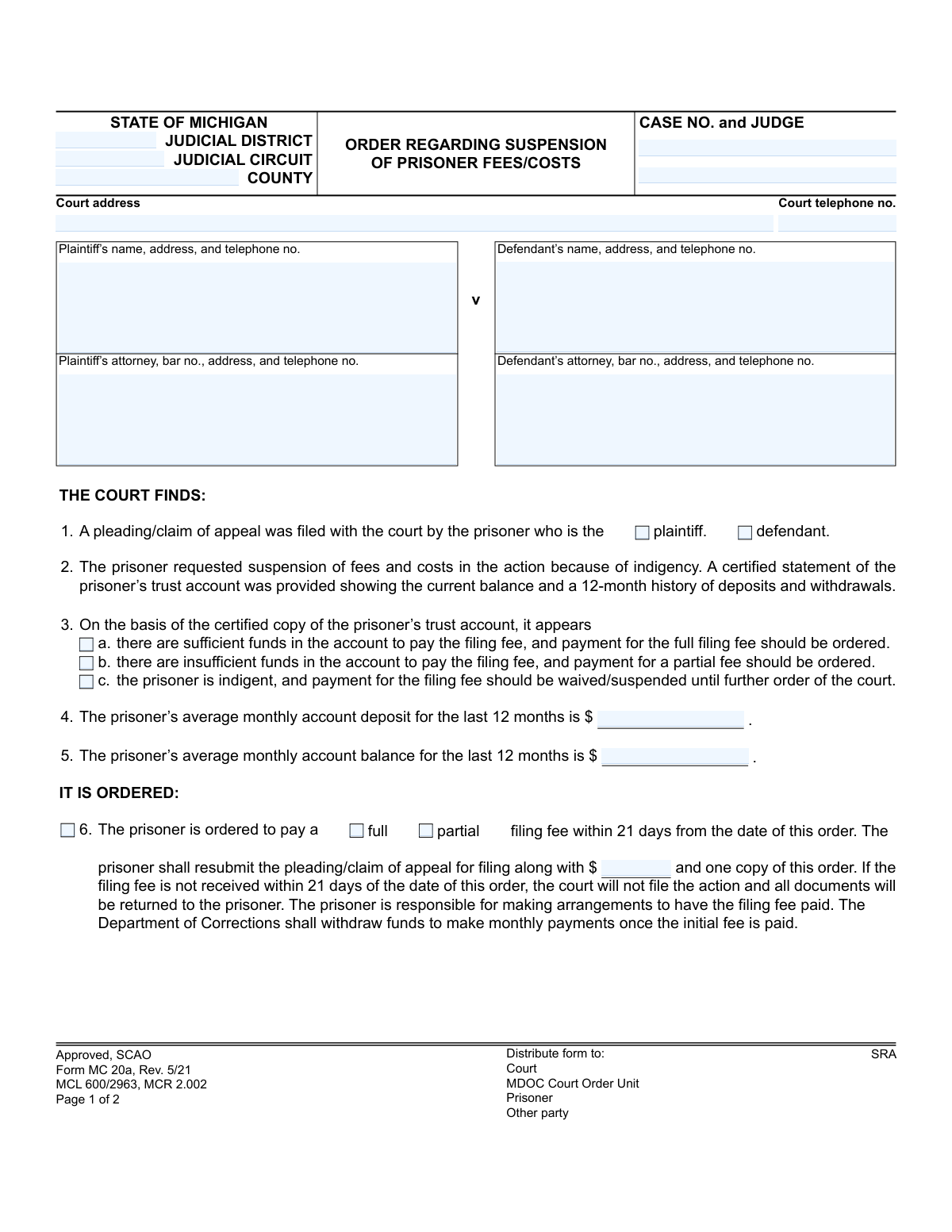
Form MC 20a, Order Regarding Suspension of Prisoner Fees/Costs, is a legal document used by Michigan courts to rule on a prisoner's request to waive or suspend court fees. Based on a review of the prisoner's trust account, a judge uses this form to order full payment, partial payment, or a complete waiver of fees. Today, this form can be filled out quickly and accurately using AI-powered services like Instafill.ai, which can also convert non-fillable PDF versions into interactive fillable forms.
MC 20a is part of the Michigan court forms category on Instafill.
Our AI automatically handles information lookup, data retrieval, formatting, and form filling.
It takes less than a minute to fill out MC 20a using our AI form filling.
Securely upload your data. Information is encrypted in transit and deleted immediately after the form is filled out.

Form specifications

Form name: Form MC 20a, Order Regarding Suspension of Prisoner Fees/Costs
Number of fields: 27
Number of pages: 1
Language: English
main-image

Instafill Demo: How to fill out PDF forms in seconds with AI

How to Fill Out MC 20a Online for Free in 2026

Are you looking to fill out a MC 20A form online quickly and accurately? Instafill.ai offers the #1 AI-powered PDF filling software of 2026, allowing you to complete your MC 20A form in just 37 seconds or less.
Follow these steps to fill out your MC 20A form online using Instafill.ai:
  1. 1 Navigate to Instafill.ai and upload or select the MC 20a, Order Regarding Suspension of Prisoner Fees/Costs.
  2. 2 Enter the case information, including the judicial district/circuit, county, case number, and judge's name.
  3. 3 Provide the full details for the plaintiff and defendant, along with their respective attorneys.
  4. 4 Indicate the court's findings by checking the appropriate boxes regarding the prisoner's financial status and trust account analysis.
  5. 5 Clearly state the court's order by selecting whether the prisoner must pay a full or partial fee, or if fees are waived/suspended.
  6. 6 If a payment is ordered, specify the amount and payment deadline.
  7. 7 Review all entered information for accuracy before the judge signs the order and the certificate of mailing is completed.

Our AI-powered system ensures each field is filled out correctly, reducing errors and saving you time.

Why Choose Instafill.ai for Your Fillable MC 20a Form?

Speed

Complete your MC 20a in as little as 37 seconds.

Up-to-Date

Always use the latest 2026 MC 20a form version.

Cost-effective

No need to hire expensive lawyers.

Accuracy

Our AI performs 10 compliance checks to ensure your form is error-free.

Security

Your personal information is protected with bank-level encryption.

Frequently Asked Questions About Form MC 20a

This is a court order issued by a judge in Michigan. It communicates the court's decision on a prisoner's request to have court filing fees waived or reduced due to indigency.

This form is an official order completed by the court, not the prisoner. The prisoner receives a copy to be informed of the judge's decision regarding their fee waiver request.

The court makes its decision based on a certified statement of your prisoner trust account. It reviews your current balance and a 12-month history of deposits and withdrawals to assess your ability to pay.

You must pay the amount specified in the order within 21 days and resubmit your legal documents. If the fee is not paid on time, the court will not file your action and will return your paperwork.

The Michigan Department of Corrections (MDOC) will automatically withdraw monthly payments equal to 50% of the deposits made to your prisoner trust account. These withdrawals continue until the full filing fee is paid.

This means you do not have to pay the filing fee at this time, and your case can proceed. However, if your financial situation improves during the litigation, the court can order you to pay the fees later.

If you do not pay the required fees and costs, you will be prohibited from filing any new civil actions or appeals in the future until the outstanding amount has been paid in full.

The court used the certified 12-month history of your prisoner trust account to calculate these averages. This information helps the judge determine your financial status.

Copies of the order are distributed to the court file, the prisoner, the other party in the case, and the MDOC Court Order Unit if payments are required.

Yes, services like Instafill.ai use AI to help you accurately auto-fill your information on various court forms. This can save significant time and help reduce errors.

Simply upload your form to the Instafill.ai platform. The AI will identify the fields, and you can enter your information once to have it automatically and accurately placed throughout the document.

You can use a service like Instafill.ai, which can convert flat, non-fillable PDFs into interactive forms. This allows you to easily type your information directly into the fields online.

This section is for the court clerk to sign, certifying that they have mailed a copy of the judge's order to you and any other parties involved in the case.

Compliance MC 20a
Validation Checks by Instafill.ai

1
Case Number Format Validation
This check ensures the 'CASE NO.' field adheres to the court's standard format (e.g., YY-######-XX). The case number is the primary identifier for the legal action, and an incorrect format can lead to misfiling or the inability to locate the case in the court's system. If the validation fails, the form submission should be rejected with an error message indicating the correct format.
2
Mutually Exclusive Prisoner Role
Validates that only one of the 'plaintiff' or 'defendant' checkboxes is selected in item 1 to identify the prisoner. It is logically impossible for the prisoner to be both parties in this context. Selecting both or neither makes the order ambiguous and legally unenforceable, so the form must be corrected before processing.
3
Mutually Exclusive Finding Selection
Ensures that only one of the three findings (3a, 3b, or 3c) is selected. These options represent distinct and mutually exclusive conclusions about the prisoner's financial status. Allowing multiple selections would create a contradictory and invalid basis for the subsequent order.
4
Mutually Exclusive Order Selection
This check verifies that either item 6 (Order to Pay) or item 7 (Order to Waive/Suspend) is selected, but not both. An order cannot simultaneously require payment and waive it. A failure in this validation would indicate a critical logical error, rendering the order void due to contradiction.
5
Conditional Requirement for Partial Fee Amount
If the order is for a 'partial filing fee' (item 6), this validation ensures that the dollar amount field is filled in. Without a specified amount, the order to pay is incomplete and cannot be acted upon by the prisoner or the Department of Corrections. The form should be considered incomplete until this amount is provided.
6
Certificate of Mailing Date Validity
This validation confirms that the 'Date' in the Certificate of Mailing section is a valid, properly formatted date that is not in the future. This date is legally significant as it often starts a countdown for compliance (e.g., the 21-day payment window). An invalid or future date would compromise the legal timeline and enforceability of the order.
7
Required Court Jurisdiction Information
Ensures that the 'Judicial District', 'Judicial Circuit', and 'County' fields are all populated. This information is essential for identifying the specific court with jurisdiction over the case. Omitting these details would make it impossible to determine the origin of the order, leading to rejection or significant processing delays.
8
Numeric Validation for Account Averages
Verifies that the values entered for 'average monthly account deposit' (item 4) and 'average monthly account balance' (item 5) are valid numerical currency values. This financial data is the primary evidence for the court's finding of indigency. Non-numeric or improperly formatted data would prevent the system from processing the information and invalidate the basis for the court's decision.
9
Logical Consistency Between Finding and Order
This check cross-references the 'FINDINGS' section with the 'IT IS ORDERED' section. For example, if the finding is 'indigent' (3c), the order must be to 'waive/suspend' fees (7). A mismatch, such as finding a prisoner indigent but then ordering them to pay a full fee, creates a legally contradictory document that must be corrected.
10
Attorney Bar Number Presence
If an attorney's name is entered for either the plaintiff or defendant, this validation ensures the corresponding 'bar no.' field is also filled. The bar number is the official unique identifier for a licensed attorney and is required on official court filings. Failure to include it can result in the document being rejected for being improperly filed.
11
Judge's Signature and Date Presence
Validates the presence of the judge's signature and the date of signing. An order is not legally binding until it has been signed and dated by a judge. A missing signature or date renders the document a draft with no legal authority, and it cannot be processed or enforced.
12
Mutually Exclusive Partial/Full Fee Order
Within item 6, this check ensures that if the order is to pay a fee, only one of 'full' or 'partial' is selected. A prisoner cannot be ordered to pay both a full and a partial fee simultaneously. This prevents ambiguity in the payment amount required.

Common Mistakes in Completing MC 20a

Incorrect or Incomplete Case Number

Users often transpose digits, omit characters, or fail to include the judge's identifier in the 'CASE NO. and JUDGE' field. This typically happens due to manual data entry from other documents. An incorrect case number can lead to the order being misfiled, causing significant delays and preventing it from being linked to the correct legal action.

Misidentifying the Prisoner's Role

In section 1, incorrectly checking whether the prisoner is the 'plaintiff' or 'defendant' is a common oversight. This mistake can occur when a clerk is processing a large volume of forms and misreads the initial filing. The consequence is a legally confusing order that may need to be amended, delaying the process and potentially affecting how fees are assessed and collected.

Calculation Errors for Prisoner's Finances

Sections 4 and 5 require calculating the 'average monthly account deposit' and 'average monthly account balance' from a 12-month history. People often make arithmetic mistakes or confuse the two values, leading to an inaccurate financial assessment. An incorrect calculation can result in the court making an improper determination of indigency, either unfairly charging a fee or improperly waiving one.

Contradictory Selections Between Findings and Order

A frequent error is selecting conflicting options, such as finding the prisoner is 'indigent' in section 3(c) but then ordering a 'partial filing fee' in section 6. This creates an ambiguous and unenforceable order that will be rejected or require clarification. To avoid this, ensure the finding in section 3 directly corresponds to the order in either section 6 (for payment) or section 7 (for waiver).

Omitting the Specific Fee Amount

When ordering a 'full' or 'partial' filing fee in section 6, users sometimes check the box but forget to write in the specific dollar amount. This renders the order ineffective, as the prisoner and the Department of Corrections have no instruction on the amount to be paid or withdrawn. The form will be returned for completion, halting the progress of the prisoner's case.

Incomplete Prisoner Identification Information

When filling out the plaintiff or defendant information for the prisoner, it is crucial to include their full name and prisoner identification number along with the facility address. Omitting the prisoner ID number is a common mistake that makes it difficult for the Michigan Department of Corrections (MDOC) to locate the correct individual and their trust account. This can prevent or delay the withdrawal of funds as ordered by the court.

Failure to Distribute Order to MDOC

The form explicitly states that if item 6 is checked (ordering payment), a copy must be sent to the MDOC Court Order Unit via mail or email. Clerks can overlook this critical distribution step, especially when dealing with a high volume of paperwork. If MDOC is not notified, they will not withdraw funds from the prisoner's account, leading to non-payment and potential dismissal of the prisoner's action.

Incomplete or Unsigned Certificate of Mailing

Forgetting to sign or date the 'CERTIFICATE OF MAILING' section is a critical procedural error. This certificate serves as legal proof that the order was sent to all relevant parties. An unsigned or undated certificate can invalidate the proof of service, creating grounds for appeal and undermining the enforceability of the order.

Illegible Handwriting on a Printed Form

This form is often available as a non-fillable PDF, leading users to fill it out by hand. Illegible handwriting, especially for critical information like the case number, financial figures, and names, can cause significant processing errors. Data may be entered incorrectly into court or MDOC systems, leading to misdirected funds or filing delays. Using a tool like Instafill.ai can convert such forms into digitally fillable versions, ensuring all entries are clear and legible.

Using an Outdated Version of the Form

The form is marked 'Rev. 5/21', indicating its revision date. Courts and agencies periodically update forms to comply with new laws or procedures, and using an old version is a common mistake. An outdated form may be rejected outright or may lack crucial information, such as the correct MDOC email address, causing processing failures and delays.
Saved over 80 hours a year

“I was never sure if my IRS forms like W-9 were filled correctly. Now, I can complete the forms accurately without any external help.”

Kevin Martin Green

Your data stays secure with advanced protection from Instafill and our subprocessors

Robust compliance program

Transparent business model

You’re not the product. You always know where your data is and what it is processed for.

ISO 27001, HIPAA, and GDPR

Our subprocesses adhere to multiple compliance standards, including but not limited to ISO 27001, HIPAA, and GDPR.

Security & privacy by design

We consider security and privacy from the initial design phase of any new service or functionality. It’s not an afterthought, it’s built-in, including support for two-factor authentication (2FA) to further protect your account.

Fill out MC 20a with Instafill.ai

Worried about filling PDFs wrong? Instafill securely fills form-mc-20a-order-regarding-suspension-of-prisoner-feescosts forms, ensuring each field is accurate.