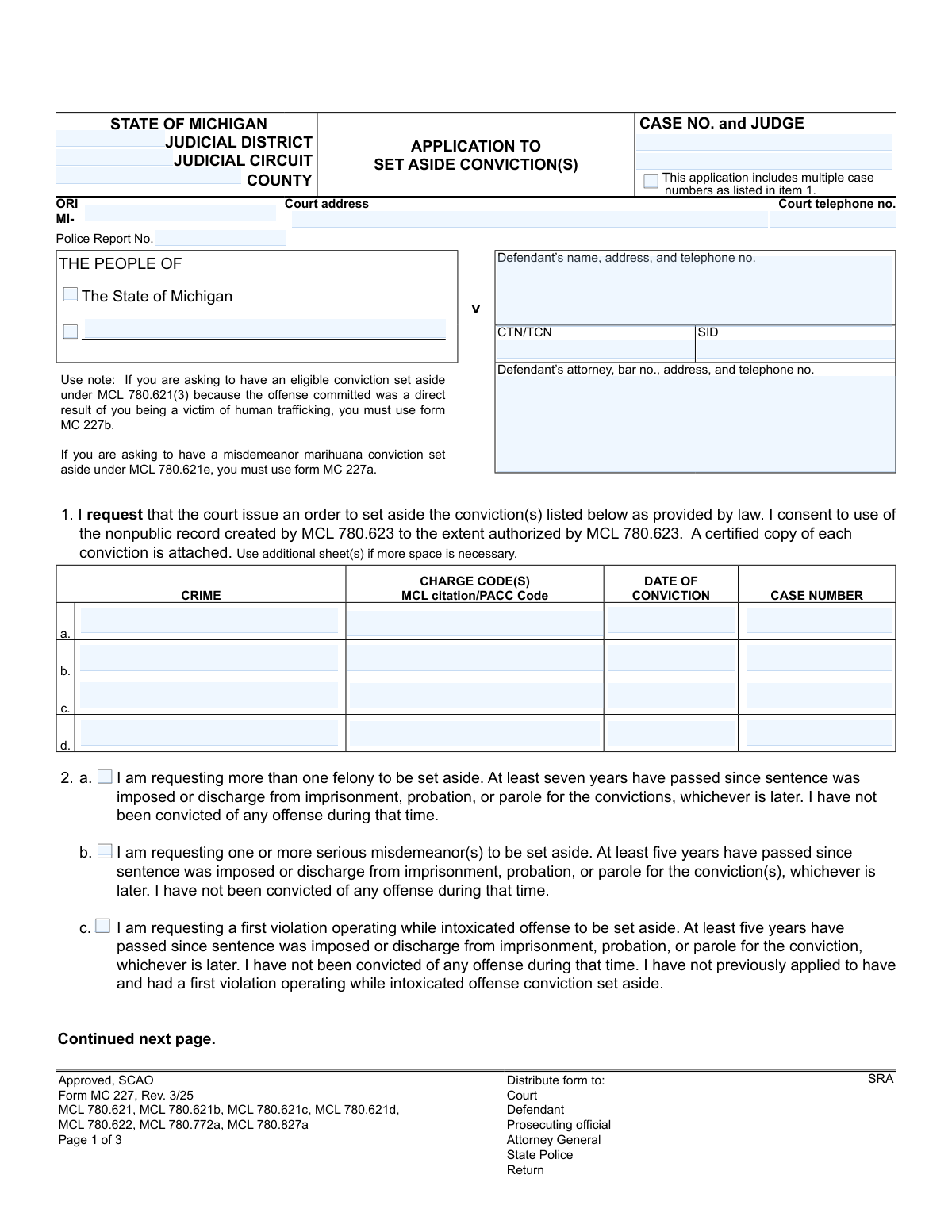
Yes! You can use AI to fill out Form MC 227, Application to Set Aside Conviction(s)
Form MC 227 is a legal document used in Michigan by individuals seeking to have their criminal convictions expunged or 'set aside' from their public record. Filing this application is a critical step towards clearing a past offense, which can improve opportunities for employment, housing, and other benefits. Today, this form can be filled out quickly and accurately using AI-powered services like Instafill.ai, which can also convert non-fillable PDF versions into interactive fillable forms.
MC 227 is part of the
Michigan court forms category on Instafill.
Our AI automatically handles information lookup, data retrieval, formatting, and form filling.
It takes less than a minute to fill out MC 227 using our AI form filling.
Securely upload your data. Information is encrypted in transit and deleted immediately after the form is filled out.
Form specifications
| Form name: | Form MC 227, Application to Set Aside Conviction(s) |
| Number of fields: | 108 |
| Number of pages: | 1 |
| Language: | English |
More forms in Michigan court forms
Instafill Demo: How to fill out PDF forms in seconds with AI
How to Fill Out MC 227 Online for Free in 2026
Are you looking to fill out a MC 227 form online quickly and accurately? Instafill.ai offers the #1 AI-powered PDF filling software of 2026, allowing you to complete your MC 227 form in just 37 seconds or less.
Follow these steps to fill out your MC 227 form online using Instafill.ai:
- 1 Navigate to Instafill.ai and upload or select the Michigan Application to Set Aside Conviction(s), Form MC 227.
- 2 Provide your personal details, court information, and the specific details of the conviction(s) you wish to set aside, including case numbers and conviction dates.
- 3 Indicate the type of conviction by checking the appropriate box (e.g., single felony, serious misdemeanor, etc.) and confirm you meet the required waiting period.
- 4 Disclose information about any previous applications to set aside convictions and any charges that were deferred and dismissed.
- 5 Review all the information populated by the AI for accuracy and completeness across all sections of the form.
- 6 Download the completed form. You must then sign it in the presence of a notary public or court clerk as required.
- 7 Follow the official instructions to gather supporting documents, get fingerprinted, and serve copies to the Michigan State Police, Attorney General, and the prosecuting official.
Our AI-powered system ensures each field is filled out correctly, reducing errors and saving you time.
Why Choose Instafill.ai for Your Fillable MC 227 Form?
Speed
Complete your MC 227 in as little as 37 seconds.
Up-to-Date
Always use the latest 2026 MC 227 form version.
Cost-effective
No need to hire expensive lawyers.
Accuracy
Our AI performs 10 compliance checks to ensure your form is error-free.
Security
Your personal information is protected with bank-level encryption.
Frequently Asked Questions About Form MC 227
This form is used to formally request a Michigan court to set aside, or expunge, one or more eligible criminal convictions from your public record.
Individuals who have been convicted of certain misdemeanors or felonies in Michigan and have completed their sentence and the required waiting period may fill out this form to clear their public record.
You must attach a certified copy of each conviction you want set aside, obtained from the court clerk, and you must also get a completed fingerprint card (RI-008) from a local law enforcement agency.
The waiting period varies: it's 3 years for most misdemeanors, 5 years for serious misdemeanors or a single felony, and 7 years for multiple felonies, starting after your sentence is complete.
Yes, there is a $50.00 application fee payable to the State of Michigan. You may also incur separate fees for obtaining certified court records and for getting fingerprinted.
You must file the application in the court where you were convicted. You also need to mail copies to the Michigan State Police, the Attorney General, and the prosecuting official's office.
This is a general application. You must use form MC 227a for misdemeanor marihuana convictions and form MC 227b if the offense was a direct result of you being a victim of human trafficking.
You need the crime, charge code, date of conviction, and case number for each conviction you are applying to set aside. This information can be found on the certified copy of the conviction from the court.
After you file and serve the application, the court will set a hearing date. The hearing cannot be held until the court receives a required report from the Michigan State Police.
Yes, you must sign the application in the presence of a court clerk or a notary public, who will then complete the 'Subscribed and sworn to' section.
Yes, services like Instafill.ai use AI to help you accurately auto-fill form fields, which can save time and help prevent errors.
Simply upload the Application to Set Aside Conviction(s) form to Instafill.ai. The platform's AI will make the document fillable online, allowing you to type your information directly into the fields and save your progress.
You can use a service like Instafill.ai, which can convert flat, non-fillable PDFs into interactive, fillable forms that you can complete on your computer.
If you have never previously filed an application to set aside any of the convictions listed, you simply check box 3a, 'No other application was previously filed...'
Compliance MC 227
Validation Checks by Instafill.ai
1
At Least One Conviction Listed
Validates that at least one full conviction record (including Crime, Charge Code, Date of Conviction, and Case Number) is entered in Section 1. The primary purpose of the application is to set aside convictions, so it cannot be submitted without specifying which ones. If this information is missing, the application is incomplete and cannot be processed.
2
Date of Conviction is in the Past
Ensures that any date entered in the 'DATE OF CONVICTION' fields in Section 1 is a valid date that occurs before the current date. This is a logical check, as a conviction cannot have a future date. An invalid or future date would indicate a data entry error and prevent the system from calculating eligibility periods correctly.
3
Single Eligibility Category Selection
Verifies that the applicant has selected exactly one checkbox from the eligibility categories listed in Section 2 (items 2a through 2e). These options are mutually exclusive and determine the legal basis and waiting period for the application. Failure to select one, or selecting multiple, makes the applicant's eligibility ambiguous and halts processing.
4
Eligibility Time Period Verification
Performs a critical logical check by comparing the 'DATE OF CONVICTION' from Section 1 against the time requirement of the selected eligibility category in Section 2. For example, if the applicant checks box 2d (one felony, 5 years), the system verifies that at least five years have passed since the conviction date. If the time period has not elapsed, the application is premature and will be rejected.
5
Conviction Count and Type Consistency
Cross-references the convictions listed in Section 1 with the eligibility category chosen in Section 2. For instance, if the applicant selects 2d ('I am requesting only one felony to be set aside'), the validation ensures exactly one felony is listed in Section 1. This prevents logical inconsistencies between the applicant's declaration and the evidence provided, which would cause the application to be rejected.
6
Conditional Requirement for Previous Applications
Checks that if the box for item 3b ('An application was previously filed...') is checked, the corresponding table with details of the prior filing is filled out. Conversely, if the table is empty, the 'No other application' box (3a) should be checked. This ensures complete disclosure when required and prevents submission of an incomplete form.
7
Conditional Requirement for Deferred Convictions
Validates that if the applicant checks the box in item 5 indicating they have had convictions deferred and dismissed, the corresponding text area must contain details of those convictions. An empty text area after checking this box would render the declaration incomplete. This check enforces full disclosure of the applicant's criminal history as required by the form.
8
Notary Commission Expiration Date
Ensures the date entered for the notary's commission expiration ('My commission expires on') is a valid date that is in the future relative to the date the document was signed ('Subscribed and sworn to before me on'). A notarization with an expired commission is legally invalid. This check prevents the submission of a document with a defective notarization.
9
Proof of Service Date Sequence
Verifies that the dates entered in the 'PROOF OF SERVICE' section are on or after the date the application was signed by the applicant. Service of a document cannot legally occur before it has been created and signed. This validation prevents logical and legal impossibilities in the service timeline.
10
ORI Format Validation
Checks that the Originating Agency Identifier (ORI) field begins with the prefix 'MI-'. This is a specific format requirement for Michigan state forms. Enforcing this format ensures the identifier is valid for routing and processing by state agencies, preventing rejections due to incorrect data entry.
11
Defendant Contact Information Completeness
Ensures the field for the defendant's name, address, and telephone number is not empty. The telephone number should also be validated for a standard format (e.g., 10 digits). This information is essential for the court and other parties to communicate with the applicant, and its absence would impede the case.
12
Case Number Presence
Validates that a Case Number is provided, either in the header field or within the details for at least one conviction in Section 1. The case number is the primary identifier for the legal proceeding and is essential for the court to locate the correct record. An application without a case number cannot be processed.
Common Mistakes in Completing MC 227
Applicants often enter incorrect information in Section 1, such as the wrong MCL citation, charge code, or date of conviction. This usually happens when relying on memory instead of official records, leading to an immediate mismatch with the court's files and likely rejection of the application. To avoid this, you must obtain a certified copy of each conviction from the court clerk and transcribe the details exactly as they appear on that document.
In Section 2, choosing the wrong checkbox for the type of conviction (e.g., felony, serious misdemeanor, OWI) is a frequent error. The legal definitions and waiting periods are complex, causing confusion and leading applicants to select a category for which they don't qualify, resulting in denial. Carefully read each option and cross-reference it with your certified conviction records to ensure you meet the specific time-since-sentencing and offense-type requirements for the box you check.
A critical mistake is incorrectly calculating the required waiting period (3, 5, or 7 years) before eligibility. Applicants often miscalculate from the date of conviction instead of the date the sentence was fully completed, which includes the end of imprisonment, parole, or probation, whichever is later. This error leads to premature filing and automatic denial, forcing the applicant to restart the process after the correct waiting period has passed.
The application explicitly requires a certified copy of each conviction to be attached, but many applicants forget this step or attach a non-certified court printout. A certified copy has an official seal or stamp from the court clerk, verifying its authenticity. Submitting the application without these certified documents will render it incomplete and cause significant delays or rejection.
Applicants frequently sign the application on Page 2 before taking it to a notary public or court clerk. The signature must be witnessed by the notary to be valid, as you are swearing to the truth of the statements. Signing beforehand invalidates the oath and requires a new form to be completed, wasting time and effort.
The 'Proof of Service' section on Page 3 is a common source of errors, as it requires certifying that copies have been sent to multiple government agencies. Applicants may forget to serve one of the parties (Attorney General, State Police, Prosecutor) or enter the wrong dates of mailing. An incomplete or inaccurate Proof of Service can lead to the hearing being canceled or the entire application being dismissed on procedural grounds.
This application process involves more than just the form itself; it requires submitting a separate fingerprint card (RI-008) and a $50 fee to the Michigan State Police. Applicants often overlook these external requirements, which are detailed in the instructions. Failure to send the correct card and fee will halt the background check, indefinitely stalling the application until the missing items are received.
This general application (MC 227) is not appropriate for all situations, a detail many applicants miss. The instructions specify that misdemeanor marihuana convictions require form MC 227a, and convictions resulting from human trafficking require MC 227b. Using the wrong form will result in an automatic rejection and require the applicant to start over with the correct paperwork.
In Sections 3, 4, and 5, applicants may fail to disclose previous applications to set aside convictions or any charges that were deferred and dismissed. This can happen due to poor memory or a misunderstanding of what needs to be disclosed. Since the state maintains records of these events, any omission will be discovered during the background check and can severely damage the applicant's credibility with the court.
The top of the form requires specific court information like 'JUDICIAL DISTRICT,' 'JUDICIAL CIRCUIT,' and 'CASE NO.' People often guess, leave these fields blank, or enter information for the wrong court, such as the court in their current county of residence instead of the one where the conviction occurred. This can cause the filing to be rejected or misrouted, leading to major delays. AI-powered tools like Instafill.ai can help prevent this by validating case numbers and associated court data.
A foundational error is filing the application in the wrong courthouse. The instructions clearly state the application must be filed in the court where the conviction occurred, but an applicant with convictions in multiple counties may mistakenly try to file them all in one location. This results in an immediate rejection for any convictions not originating from that specific court. If the form is a non-fillable PDF, Instafill.ai can convert it into a fillable version to streamline the process for each court.
Saved over 80 hours a year
“I was never sure if my IRS forms like W-9 were filled correctly. Now, I can complete the forms accurately without any external help.”
Kevin Martin Green
Your data stays secure with advanced protection from Instafill and our subprocessors

Robust compliance program
Transparent business model
You’re not the product. You always know where your data is and what it is processed for.
ISO 27001, HIPAA, and GDPR
Our subprocesses adhere to multiple compliance standards, including but not limited to ISO 27001, HIPAA, and GDPR.
Security & privacy by design
We consider security and privacy from the initial design phase of any new service or functionality. It’s not an afterthought, it’s built-in, including support for two-factor authentication (2FA) to further protect your account.
Fill out MC 227 with Instafill.ai
Worried about filling PDFs wrong? Instafill securely fills form-mc-227-application-to-set-aside-convictions forms, ensuring each field is accurate.