Yes! You can use AI to fill out Form MC 227a, Application to Set Aside Misdemeanor Marihuana Conviction(s)
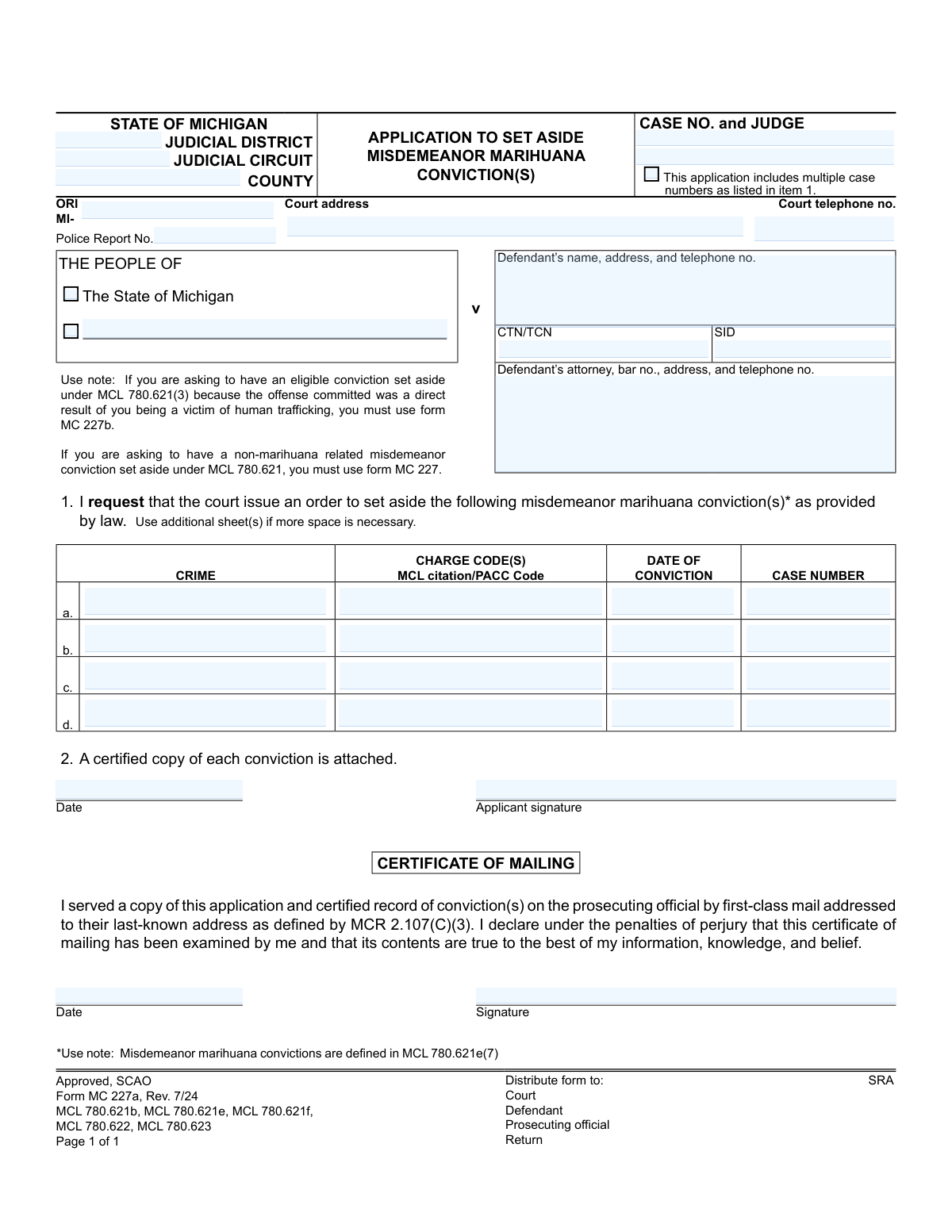
This is the State of Michigan's official 'Application to Set Aside Misdemeanor Marihuana Conviction(s),' Form MC 227a. It is used by individuals to formally petition the court to clear their record of specific past marihuana-related misdemeanors, such as possession or use. Successfully setting aside a conviction can remove legal barriers to employment, housing, and other opportunities. Today, this form can be filled out quickly and accurately using AI-powered services like Instafill.ai, which can also convert non-fillable PDF versions into interactive fillable forms.
MC 227a is part of the
Michigan court forms category on Instafill.
Our AI automatically handles information lookup, data retrieval, formatting, and form filling.
It takes less than a minute to fill out MC 227a using our AI form filling.
Securely upload your data. Information is encrypted in transit and deleted immediately after the form is filled out.
Form specifications
| Form name: | Form MC 227a, Application to Set Aside Misdemeanor Marihuana Conviction(s) |
| Number of fields: | 37 |
| Number of pages: | 1 |
| Language: | English |
More forms in Michigan court forms
Instafill Demo: How to fill out PDF forms in seconds with AI
How to Fill Out MC 227a Online for Free in 2026
Are you looking to fill out a MC 227A form online quickly and accurately? Instafill.ai offers the #1 AI-powered PDF filling software of 2026, allowing you to complete your MC 227A form in just 37 seconds or less.
Follow these steps to fill out your MC 227A form online using Instafill.ai:
- 1 Navigate to Instafill.ai and upload or select Form MC 227a, the Application to Set Aside Misdemeanor Marihuana Conviction(s).
- 2 Provide your personal information, including your full name, address, and telephone number, as well as your attorney's information if applicable.
- 3 Enter the court details such as the judicial district, circuit, and court address, along with the original case number(s) and judge's name.
- 4 List the details for each misdemeanor marihuana conviction you are applying to set aside, including the crime, charge code, date of conviction, and case number.
- 5 Review all the information populated by the AI for accuracy, ensuring all case details and personal data are correct.
- 6 Electronically sign and date the application in the designated applicant signature field.
- 7 Download the completed form, attach certified copies of each conviction, and follow the instructions for filing with the court and serving the prosecuting official.
Our AI-powered system ensures each field is filled out correctly, reducing errors and saving you time.
Why Choose Instafill.ai for Your Fillable MC 227a Form?
Speed
Complete your MC 227a in as little as 37 seconds.
Up-to-Date
Always use the latest 2026 MC 227a form version.
Cost-effective
No need to hire expensive lawyers.
Accuracy
Our AI performs 10 compliance checks to ensure your form is error-free.
Security
Your personal information is protected with bank-level encryption.
Frequently Asked Questions About Form MC 227a
This form is used to formally request a Michigan court to set aside, or expunge, specific misdemeanor marihuana convictions from your public record as provided by law.
You are eligible if you have a misdemeanor conviction in Michigan for marihuana possession, use, or selling marihuana paraphernalia under specific state laws or corresponding local ordinances.
You must attach a certified copy of each misdemeanor marihuana conviction you are asking to set aside. You can get these certified copies from the clerk of the court where you were convicted.
There is no filing fee for the application itself. However, the court clerk may charge a fee for providing the required certified copies of your conviction records.
You must file the application in the court where the conviction occurred. If you have eligible convictions in different courts, you must file a separate application in each court.
The prosecuting agency has 60 days to respond. If they do not object, the court will enter an order to set aside the conviction; if they object, the court will schedule a hearing.
If the prosecutor does not object, an order may be issued shortly after the 60-day waiting period. If the prosecutor objects, a hearing will be scheduled within 30 days, extending the timeline.
This section is your sworn statement confirming that you have mailed a copy of your completed application to the prosecuting official who handled your case. You must sign it after mailing the copy.
You should not use this form for non-marihuana offenses. Instead, you must use Form MC 227, 'Application to Set Aside Conviction'.
In that specific situation, you must use a different form, MC 227b, to apply to have your conviction set aside.
You should make three copies of your completed application and all attachments. One is for the court, one is for the prosecuting official, and one is for your personal records.
Yes, services like Instafill.ai use AI to help auto-fill form fields accurately and save time. This can help you complete your application more efficiently and with fewer errors.
Simply upload the MC 227a PDF to the Instafill.ai platform. The AI will make the form interactive, allowing you to type your information directly into the fields and complete it online.
You can use a service like Instafill.ai, which can convert flat, non-fillable PDFs into interactive forms. Just upload your file, and the platform will make it possible to type your answers directly onto the document.
Compliance MC 227a
Validation Checks by Instafill.ai
1
Ensures Charge Code is for an Eligible Marihuana Misdemeanor
This validation checks that the MCL citation provided for each conviction is one of the eligible offenses specified by law (e.g., MCL 333.7403(2)(d), MCL 333.7404(2)(d), MCL 333.7453). This is critical because the form is exclusively for setting aside specific misdemeanor marihuana convictions. If the code is not on the approved list, the application is invalid for this form and will be rejected, requiring the applicant to use a different form or determine their ineligibility.
2
Verifies Completeness of Each Listed Conviction Record
For every conviction the applicant lists, this check ensures that all associated fields (Crime, Charge Code, Date of Conviction, and Case Number) are filled out. An incomplete record prevents the court and prosecuting officials from properly identifying and processing the request. A failure in this validation would prompt the user to complete all required information for each conviction entry before submission.
3
Validates Date of Conviction Format and Logic
This check confirms that the 'DATE OF CONVICTION' field contains a valid date in a recognized format (e.g., MM/DD/YYYY). It also verifies that the entered date is in the past and not a future date, as one cannot be convicted of a crime in the future. An invalid format or a future date would prevent submission and require the user to correct the entry.
4
Confirms Logical Sequence of Signature and Mailing Dates
This validation compares the 'Applicant signature' date with the 'Certificate of Mailing' date. It ensures the mailing date is on or after the application signature date. It is logically impossible to mail a document before it has been signed, and this check prevents procedural errors. If the mailing date precedes the signature date, the system will flag it as an error.
5
Requires Applicant Signature and Date
This check verifies that the applicant has provided a signature and a corresponding date on the application. An unsigned application is legally invalid and cannot be processed by the court. This validation ensures the form is legally binding and complete before it is officially filed.
6
Validates Michigan Attorney Bar Number Format
If attorney information is provided, this check validates the format of the attorney's bar number. Michigan bar numbers typically follow a 'P' followed by a sequence of digits (e.g., P12345). This ensures that the attorney listed is identifiable within the state bar registry, which is essential for legal correspondence and verification. An incorrectly formatted number would trigger a warning to review the entry.
7
Checks for Valid Case Number Format
This validation examines the 'CASE NO.' field in the header and in each conviction row to ensure it conforms to the standard Michigan court case number format. While formats can vary slightly, they often follow a pattern like 'YY-######-XX' (Year-Sequence-CaseType). This check helps ensure the case can be accurately located in the court's records system, preventing processing delays or rejections due to clerical errors.
8
Verifies Attachment of Certified Conviction Copies
The form explicitly states that a certified copy of each conviction must be attached. This validation ensures that a file has been uploaded for each conviction listed in the application. Without these certified documents, the court cannot verify the details of the conviction, making the application incomplete and subject to immediate rejection.
9
Validates Originating Agency Identifier (ORI) Format
This check ensures the 'ORI' field begins with the 'MI-' prefix, as specified on the form for Michigan agencies. The ORI is a unique identifier for a law enforcement agency and is crucial for routing information to the correct arresting agency. An invalid format could lead to miscommunication or failure to notify the proper authorities.
10
Ensures Court Telephone Number is in a Valid Format
This validation checks that the 'Court telephone no.' field contains a valid 10-digit phone number, allowing for common formatting like parentheses and hyphens. A valid phone number is necessary for court staff or other parties to contact the court if questions arise. An invalid number would prompt the user for correction to ensure communication channels are clear.
11
Confirms Certificate of Mailing is Signed and Dated
This check verifies that the 'Certificate of Mailing' section has been signed and dated by the person who mailed the application. This certification serves as proof of service to the prosecuting official, which is a required procedural step. An incomplete certificate could invalidate the service and delay the entire legal process.
12
Requires Defendant's Name and Address
This validation ensures that the field for the defendant's information is not empty and contains, at a minimum, a name and an address. This information is fundamental for identifying the applicant and for the court to mail notices and orders. The check prevents the submission of an anonymous or incomplete application that cannot be processed.
Common Mistakes in Completing MC 227a
Applicants frequently use this form for any misdemeanor, not just the specific marihuana offenses it covers. The instructions clearly state this form (MC 227a) is only for eligible misdemeanor marihuana convictions, and different forms (MC 227 or MC 227b) must be used for other types of convictions. Using the wrong form results in an automatic rejection by the court clerk, wasting time and effort.
The table in Section 1 requires precise information like the MCL citation, case number, and charge code, which are often entered incorrectly or left blank. These errors occur because applicants guess or rely on memory instead of official court records. This forces the court to manually search for the case, causing significant delays or outright rejection of the application if the record cannot be found.
The application is considered incomplete without an attached certified copy of each conviction being set aside, as stated in Section 2. Applicants often forget this step, don't understand the difference between a certified copy and a regular photocopy, or are deterred by the potential fee. Submitting without these official documents will lead to the court returning the application as incomplete.
A common data entry error is entering the date of the arrest or offense instead of the official date of conviction. The court's records are organized by the conviction date, so providing the wrong one creates a mismatch that can prevent the clerk from locating the case file. To avoid this, applicants must obtain the exact conviction date from their court records before filling out the form.
The process for serving the prosecutor and certifying it is complex and often done incorrectly. Applicants may sign the certificate before actually mailing the documents, fail to serve the prosecuting official, or forget to file a copy with the completed certificate back with the court. This procedural error can invalidate the service requirement, halting the application until service is properly completed and proven.
The application must be filed in the specific court where the conviction originally occurred, not the court in the applicant's current county of residence. People often mistakenly file in their local courthouse out of convenience or misunderstanding. Filing in the wrong jurisdiction will result in the case being dismissed, forcing the applicant to start the entire process over in the correct court.
Fields for specific identifiers like Case Number, CTN/TCN, and SID are frequently left blank because applicants may not know where to find them. These numbers are the primary way the court and state police locate the correct records in their systems. Omitting them creates ambiguity and extra work for court staff, leading to processing delays. If the form is a non-fillable PDF, AI-powered tools like Instafill.ai can convert it into a fillable version, making it easier to manage and accurately complete these fields.
This form is strictly limited to setting aside misdemeanors for marihuana possession, use, or paraphernalia under specific statutes. Applicants sometimes mistakenly list other related but ineligible offenses, such as cultivation, distribution, or operating while intoxicated. Because these crimes are not covered by this specific legal process, including them will result in that portion of the application, or the entire application, being denied.
Forgetting to sign and date the application is a simple but critical error that renders the document legally invalid. An unsigned form cannot be processed and will be immediately rejected by the court clerk, requiring the applicant to correct the mistake and refile. It is essential to perform a final review to ensure the signature and date fields are completed before submission.
The form header requires the applicant to specify the correct Judicial District and Judicial Circuit, which can be confusing. Entering the wrong court level or leaving these fields blank can cause the filing to be misrouted or delayed while court staff determine the proper jurisdiction. This information can be found on the original judgment of conviction and must be transcribed accurately to ensure smooth processing.
Saved over 80 hours a year
“I was never sure if my IRS forms like W-9 were filled correctly. Now, I can complete the forms accurately without any external help.”
Kevin Martin Green
Your data stays secure with advanced protection from Instafill and our subprocessors

Robust compliance program
Transparent business model
You’re not the product. You always know where your data is and what it is processed for.
ISO 27001, HIPAA, and GDPR
Our subprocesses adhere to multiple compliance standards, including but not limited to ISO 27001, HIPAA, and GDPR.
Security & privacy by design
We consider security and privacy from the initial design phase of any new service or functionality. It’s not an afterthought, it’s built-in, including support for two-factor authentication (2FA) to further protect your account.
Fill out MC 227a with Instafill.ai
Worried about filling PDFs wrong? Instafill securely fills form-mc-227a-application-to-set-aside-misdemeanor-marihuana-convictions forms, ensuring each field is accurate.