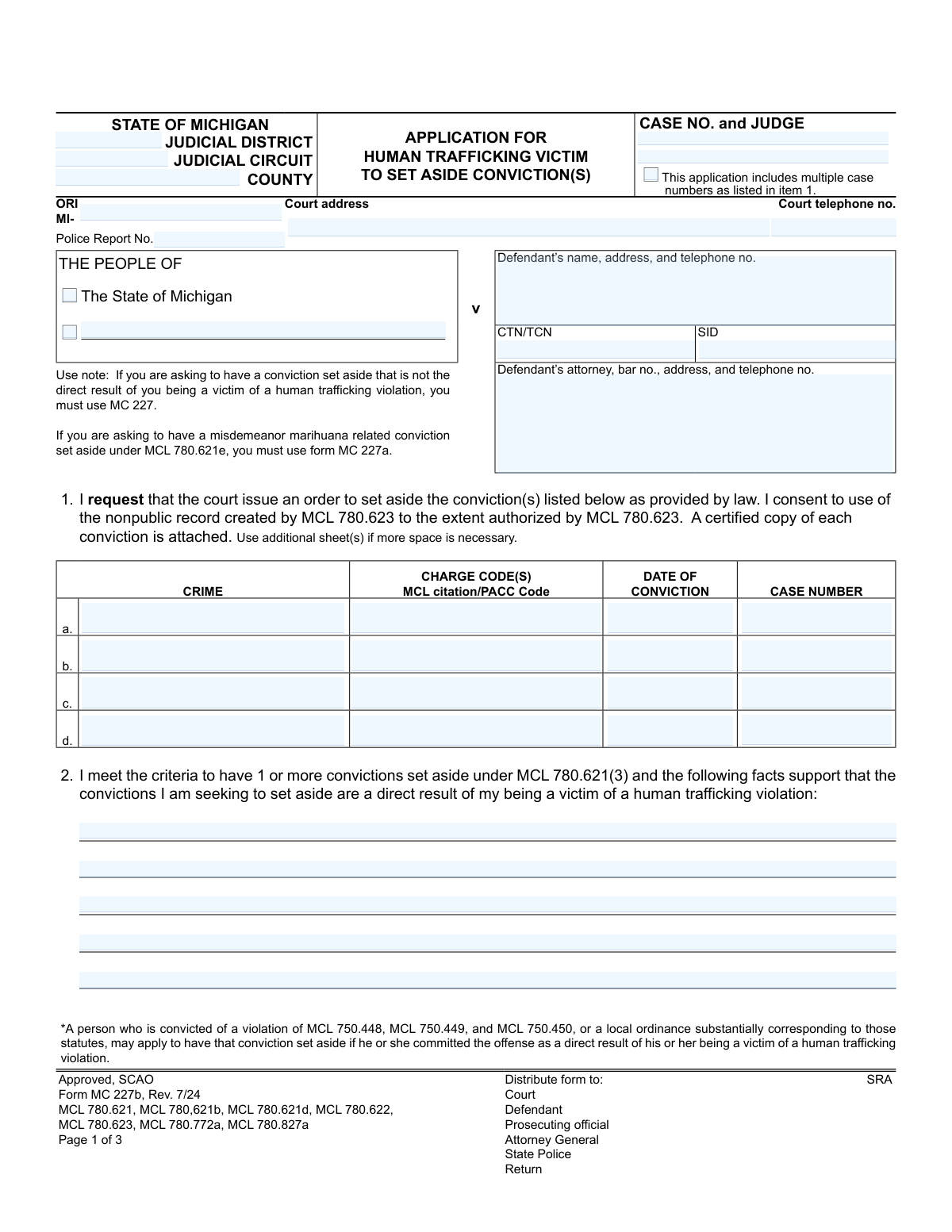
Yes! You can use AI to fill out Form MC 227b, Application for Human Trafficking Victim to Set Aside Conviction(s)
Form MC 227b is a legal document used in the State of Michigan by individuals who have been convicted of certain crimes as a direct result of being a victim of human trafficking. Filing this application is the first step in the legal process to have those convictions expunged, which is crucial for survivors seeking to clear their records and overcome barriers to employment and housing. Today, this form can be filled out quickly and accurately using AI-powered services like Instafill.ai, which can also convert non-fillable PDF versions into interactive fillable forms.
MC 227b is part of the
Michigan court forms category on Instafill.
Our AI automatically handles information lookup, data retrieval, formatting, and form filling.
It takes less than a minute to fill out MC 227b using our AI form filling.
Securely upload your data. Information is encrypted in transit and deleted immediately after the form is filled out.
Form specifications
| Form name: | Form MC 227b, Application for Human Trafficking Victim to Set Aside Conviction(s) |
| Number of fields: | 104 |
| Number of pages: | 1 |
| Language: | English |
More forms in Michigan court forms
Instafill Demo: How to fill out PDF forms in seconds with AI
How to Fill Out MC 227b Online for Free in 2026
Are you looking to fill out a MC 227B form online quickly and accurately? Instafill.ai offers the #1 AI-powered PDF filling software of 2026, allowing you to complete your MC 227B form in just 37 seconds or less.
Follow these steps to fill out your MC 227B form online using Instafill.ai:
- 1 Navigate to Instafill.ai and upload or select the Form MC 227b, Application for Human Trafficking Victim to Set Aside Conviction(s).
- 2 Use the AI assistant to accurately input your personal information, court details (judicial district, circuit, case number), and defendant information.
- 3 Enter the specific details of each conviction you are seeking to set aside, including the crime, charge code, date of conviction, and case number.
- 4 Provide a detailed statement explaining how the convictions were a direct result of you being a victim of a human trafficking violation, as required in item 2.
- 5 Answer the questions regarding any previously filed applications to set aside convictions and any convictions that were deferred and dismissed.
- 6 Review all the information populated by the AI for completeness and accuracy, then follow the platform's instructions for signing, notarizing, and preparing the form for submission to the court, Michigan State Police, and Attorney General.
Our AI-powered system ensures each field is filled out correctly, reducing errors and saving you time.
Why Choose Instafill.ai for Your Fillable MC 227b Form?
Speed
Complete your MC 227b in as little as 37 seconds.
Up-to-Date
Always use the latest 2026 MC 227b form version.
Cost-effective
No need to hire expensive lawyers.
Accuracy
Our AI performs 10 compliance checks to ensure your form is error-free.
Security
Your personal information is protected with bank-level encryption.
Frequently Asked Questions About Form MC 227b
This form, MC 227b, is used by victims of human trafficking in Michigan to request that the court set aside (expunge) criminal convictions that occurred as a direct result of them being trafficked.
You are eligible to use this form if you have been convicted of a crime in Michigan and you believe the offense was a direct result of you being a victim of a human trafficking violation.
This form is exclusively for setting aside convictions related to being a human trafficking victim. For setting aside general convictions, you must use form MC 227, and for misdemeanor marihuana convictions, you must use form MC 227a.
You must attach a certified copy of each conviction you want to set aside, which you can obtain from the court clerk. You will also need to get a fingerprint card from a law enforcement agency.
In Section 2 of the form, you must write a statement explaining the facts that show your conviction was a direct result of you being a victim of a human trafficking violation.
To file this application, you must be able to state that there are no other criminal charges pending against you, as indicated in Section 6 of the form.
You must fill out the form, have it notarized, get fingerprinted, and then mail copies to the Michigan State Police (with a $50 fee), the Attorney General, and the prosecutor. Finally, you file the original with the court.
Yes, there is a $50.00 application fee payable to the State of Michigan, sent to the Michigan State Police. There may also be separate fees for obtaining certified court records and for fingerprinting services.
A hearing date may be set when you file the application, but the hearing cannot actually take place until the court receives a required report from the Michigan State Police.
You must disclose any previous applications to set aside convictions, whether for the same or different offenses, in Sections 3 and 4 of the form, including the disposition of those prior applications.
Yes, services like Instafill.ai use AI to accurately auto-fill form fields, which can save you time and help you complete the application correctly.
You can upload the form to the Instafill.ai platform, which will make it fillable online. After you enter your information, you can download the completed document to print for submission.
Services like Instafill.ai can convert flat, non-fillable PDFs into interactive forms. This allows you to easily type your information directly into the fields on your computer or phone.
Yes, you must sign the application in front of a court clerk or a notary public. They will then complete the 'Subscribed and sworn to' section to validate your signature.
Compliance MC 227b
Validation Checks by Instafill.ai
1
At Least One Conviction Listed
Validates that at least one full conviction record has been entered in the table under item 1. The purpose of the application is to set aside convictions, so it cannot be submitted without specifying at least one. If this check fails, the user should be prompted to add the crime, charge code, date, and case number for the conviction they wish to have set aside.
2
Conviction Date Must Be in the Past
Ensures that any date entered in the 'DATE OF CONVICTION' fields (cdate1, cdate2, etc.) is a valid date that occurs before the current date. This is important for data integrity, as a conviction cannot have a future date. If validation fails, the system should flag the date field as an error and require the user to enter a valid past date.
3
Justification for Trafficking Link is Provided
Checks that the free-text explanation in item 2 is not empty. This section is the core of the application, providing the factual basis for the claim that the conviction was a direct result of being a human trafficking victim. An empty justification would lead to an automatic denial, so this check prevents the submission of an incomplete and non-viable application.
4
Conditional Previous Application Details (Item 3)
Verifies the logical consistency of item 3. If the checkbox indicating a previous application was filed ('prevappcheck') is selected, the system must ensure that at least one row detailing that previous application (crime, case number, disposition) is filled out. Conversely, if the 'No other application' checkbox is selected, these detail fields should be empty or disabled.
5
Conditional Deferred Conviction Details (Item 5)
Checks the logic of item 5 regarding deferred and dismissed convictions. If the applicant selects the checkbox 'I have had the following conviction(s) deferred and dismissed' ('defercheck'), this validation ensures the corresponding text area ('deferlist1') is not empty. This prevents a contradictory state where the applicant indicates they have deferred convictions but fails to list them.
6
Applicant Signature and Date Presence
Ensures the 'Applicant Signature' field ('appsig') is not empty and the adjacent 'Date' field ('sworndate') contains a valid date. The signature and date are legally required to attest to the truthfulness of the application's contents. Failure to provide them would render the document invalid and unprocessed.
7
Valid Notary Commission Expiration Date
Validates that the date entered in the 'My commission expires on' field ('expcom') is a valid date that occurs in the future. A notarization is only valid if performed by a notary with an active commission. This check prevents the submission of a form with an invalid or expired notarization, which would require the applicant to get the form re-signed and re-notarized.
8
Proof of Service Date Consistency
Checks that the dates entered in the Proof of Service section ('posofficialdate', 'posattygendate', 'posmspdate') are on or after the application signature date ('sworndate'). Service of the application cannot logically occur before the application itself is signed. This prevents chronological errors and ensures the service record is plausible.
9
Attachment Confirmation for Conviction Records
Validates that the user has acknowledged the attachment of required documents. The form instructions explicitly state that a 'certified copy of each conviction is attached.' This check would prompt the user to confirm, via a checkbox or similar UI element, that a separate file has been uploaded or attached for each conviction listed in item 1, preventing procedural rejection.
10
Case Number Header Logic
Validates the main 'CASE NO. and JUDGE' field at the top of the form. If the 'This application includes multiple case numbers' checkbox ('multcaseno') is checked, this validation confirms that item 1 contains at least one case. If the checkbox is not checked, it ensures the 'CASE NO. and JUDGE' field itself is populated, preventing ambiguity about which case(s) the application pertains to.
11
ORI Number Format
Ensures the 'ORI' field follows the expected format, which appears to be 'MI-' followed by a specific sequence of characters or numbers. This identifier is crucial for routing and tracking within law enforcement and judicial systems. An incorrectly formatted ORI could cause the application to be misfiled or delayed.
12
Defendant and Court Phone Number Format
Validates that the 'Court telephone no.' ('cttelno') and the defendant's phone number (part of 'dinfo') adhere to a standard 10-digit phone number format (e.g., XXX-XXX-XXXX). This ensures that contact information is correctly captured and usable by court staff for any necessary communication. An invalid format could lead to communication breakdowns.
Common Mistakes in Completing MC 227b
The form explicitly states that this application (MC 227b) is only for setting aside convictions that are a direct result of being a human trafficking victim. Applicants often mistakenly use this form for other types of convictions, such as general misdemeanors or marihuana-related offenses, which require forms MC 227 or MC 227a, respectively. This fundamental error results in an immediate rejection of the application, wasting the applicant's time and filing fees. To avoid this, carefully read the notes on the first page and ensure your situation matches the specific criteria for this form.
Item 1 requires precise information for each conviction, including the crime, charge codes (MCL citation/PACC Code), date of conviction, and case number. Applicants often provide partial information, use incorrect formats, or leave fields blank. The court uses this data to locate the official case file, and any inaccuracies can lead to significant delays or rejection. To prevent this, applicants must obtain official records for each conviction. Using an AI-powered tool like Instafill.ai can also help by validating data formats and ensuring all required fields are completed before submission.
A critical requirement clearly stated in Item 1 and the instructions is to attach a certified copy of each conviction being requested to be set aside. Many applicants overlook this step, attaching regular photocopies or forgetting the documents entirely. An application submitted without the required certified copies is considered incomplete and will be returned or denied, halting the process until the correct documentation is provided. Always obtain these certified copies from the court clerk where you were convicted before submitting your application.
Item 2 requires the applicant to provide a factual narrative explaining how their conviction was a 'direct result' of being a human trafficking victim. A common mistake is to provide an emotional but legally insufficient account that fails to establish a clear, causal link between the trafficking and the criminal offense. This can lead a judge to deny the application for failing to meet the statutory standard. To avoid this, applicants should write a clear, detailed, and factual timeline of events, focusing on how the circumstances of their victimization compelled them to commit the offense.
The application is a sworn statement that must be signed in the presence of a court clerk or a notary public. A frequent error is for applicants to sign the document at home and then take it to be notarized, which invalidates the oath. This procedural error can force the applicant to restart the process. To avoid this, do not sign the application until you are physically in front of the authorized official who will witness your signature and complete the notarization block.
The legal process requires the applicant to formally notify multiple government agencies by mailing them a copy of the application packet. Applicants often forget to serve one of the required parties: the prosecuting official, the Michigan Attorney General, and the Michigan State Police. Failure to complete service on all parties will prevent the case from moving forward. To avoid this, create a checklist based on the form's instructions. Advanced form-filling tools can also help by providing guided workflows that remind users of critical procedural steps like service requirements.
The instructions specify that the Michigan State Police must receive a packet containing a copy of the application, a completed fingerprint card (RI-008), and the $50.00 application fee. A very common and critical mistake is omitting one of these three components, especially the fingerprint card or the fee. The State Police will not process an incomplete submission, which is necessary to generate the criminal history report for the judge. This stalls the entire application indefinitely until the complete packet is correctly submitted.
Items 3 and 4 ask about any previous applications filed to set aside convictions. Applicants may misunderstand the question, forget about a past attempt, or think a denied application doesn't need to be reported. Omitting this information or checking the 'No other application was previously filed' box incorrectly can be viewed as a misrepresentation to the court. This can damage the applicant's credibility and negatively impact the judge's decision. It is crucial to be completely honest and thorough when disclosing any and all prior applications.
The top of the form requires specific administrative details like the Judicial District, Judicial Circuit, and Case Number. Applicants, often dealing with old cases, may not know this information or may enter it incorrectly, leading to filing errors. Since many court forms are distributed as non-fillable PDFs, this can lead to messy, handwritten entries that are hard to read. Tools like Instafill.ai can convert flat PDFs into fillable forms, and once the correct information is verified, it can be stored and accurately populated across all necessary documents, ensuring consistency and legibility.
In Item 5, the form asks applicants to disclose any convictions that were deferred and later dismissed. Many people do not consider these to be 'convictions' and mistakenly check the 'I have not had any...' box, failing to list them. However, these cases are part of the official record and must be disclosed. Failing to report them can be discovered during the background check and may be considered a deliberate omission, harming the applicant's case. It is vital to recall and list all such cases, even if they did not result in a permanent conviction.
Saved over 80 hours a year
“I was never sure if my IRS forms like W-9 were filled correctly. Now, I can complete the forms accurately without any external help.”
Kevin Martin Green
Your data stays secure with advanced protection from Instafill and our subprocessors

Robust compliance program
Transparent business model
You’re not the product. You always know where your data is and what it is processed for.
ISO 27001, HIPAA, and GDPR
Our subprocesses adhere to multiple compliance standards, including but not limited to ISO 27001, HIPAA, and GDPR.
Security & privacy by design
We consider security and privacy from the initial design phase of any new service or functionality. It’s not an afterthought, it’s built-in, including support for two-factor authentication (2FA) to further protect your account.
Fill out MC 227b with Instafill.ai
Worried about filling PDFs wrong? Instafill securely fills form-mc-227b-application-for-human-trafficking-victim-to-set-aside-convictions forms, ensuring each field is accurate.