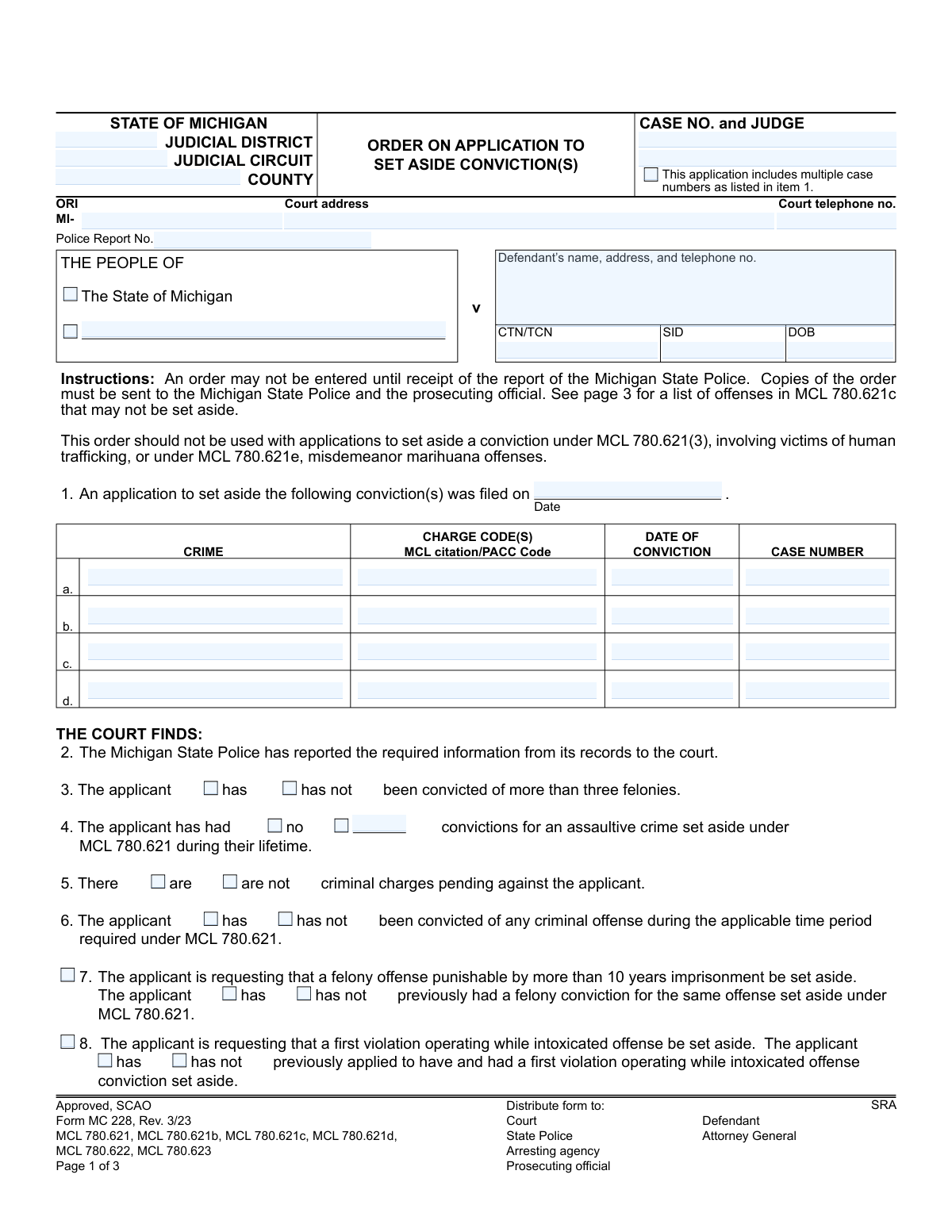
Yes! You can use AI to fill out Form MC 228, Order on Application to Set Aside Conviction(s)
Form MC 228 is a judicial document from the State of Michigan that formalizes a court's decision on an application to expunge one or more criminal convictions. It details the court's findings regarding the applicant's eligibility and records the final order, either granting or denying the request to set aside the conviction(s). Today, this form can be filled out quickly and accurately using AI-powered services like Instafill.ai, which can also convert non-fillable PDF versions into interactive fillable forms.
MC 228 is part of the
Michigan court forms category on Instafill.
Our AI automatically handles information lookup, data retrieval, formatting, and form filling.
It takes less than a minute to fill out MC 228 using our AI form filling.
Securely upload your data. Information is encrypted in transit and deleted immediately after the form is filled out.
Form specifications
| Form name: | Form MC 228, Order on Application to Set Aside Conviction(s) |
| Number of fields: | 73 |
| Number of pages: | 1 |
| Language: | English |
More forms in Michigan court forms
Instafill Demo: How to fill out PDF forms in seconds with AI
How to Fill Out MC 228 Online for Free in 2026
Are you looking to fill out a MC 228 form online quickly and accurately? Instafill.ai offers the #1 AI-powered PDF filling software of 2026, allowing you to complete your MC 228 form in just 37 seconds or less.
Follow these steps to fill out your MC 228 form online using Instafill.ai:
- 1 Navigate to Instafill.ai and upload or select Form MC 228, the Order on Application to Set Aside Conviction(s).
- 2 Provide the case details by letting the AI guide you to fill in the court address, case number, judge, and defendant's information.
- 3 Enter the specifics of each conviction under review, including the crime, charge code (MCL citation), date of conviction, and original case number.
- 4 Complete the 'THE COURT FINDS' section by checking the appropriate boxes regarding the applicant's criminal history, pending charges, and eligibility based on the court's review.
- 5 Indicate the final judicial decision in the 'IT IS ORDERED' section, specifying which convictions are granted or denied and noting any special conditions.
- 6 Review all the information populated by the AI to ensure every field, checkbox, and date is accurate before finalizing the document.
- 7 Download the completed form to be signed by the judge and distribute copies to all required parties, including the court, State Police, and prosecuting official.
Our AI-powered system ensures each field is filled out correctly, reducing errors and saving you time.
Why Choose Instafill.ai for Your Fillable MC 228 Form?
Speed
Complete your MC 228 in as little as 37 seconds.
Up-to-Date
Always use the latest 2026 MC 228 form version.
Cost-effective
No need to hire expensive lawyers.
Accuracy
Our AI performs 10 compliance checks to ensure your form is error-free.
Security
Your personal information is protected with bank-level encryption.
Frequently Asked Questions About Form MC 228
This form, the 'Order on Application to Set Aside Conviction(s),' is not an application. It is the official court document a judge signs to either grant or deny your request to have a criminal conviction set aside (expunged) in Michigan.
A judge or other court official completes and signs this form. As the applicant, you will receive a copy of the completed order which states the court's final decision on your case.
If the box for item 15 is checked, your application was successful and the conviction is set aside. The record becomes nonpublic, but you are still obligated to pay any remaining restitution and will not be refunded for fines or costs you already paid.
If the box for item 14 is checked, your request to set aside the conviction was denied, and it will remain on your public record. The order will specify the earliest date you can file another application, which is often three years later.
Yes, page 3 of the form lists convictions that are ineligible, such as felonies with a maximum punishment of life, certain serious assaultive crimes, and traffic offenses causing injury or death.
Yes, a 'first violation operating while intoxicated offense' may be eligible to be set aside. However, you can only have one such conviction set aside in your lifetime, and you must meet all other eligibility requirements.
Michigan has separate, specific application forms and legal processes for setting aside convictions if you were a victim of human trafficking or for certain misdemeanor marijuana offenses. This form is for general conviction set-asides.
Before ruling on your application, the court must receive a report from the Michigan State Police detailing your criminal history. The judge cannot issue this order until that report has been reviewed.
The conviction becomes nonpublic, meaning it is removed from public view for things like background checks for jobs or housing. However, law enforcement and the courts will still have access to a nonpublic record of the conviction.
The court reviews your application, the police report, and any objections, and considers if enough time has passed. The judge must find that your circumstances and behavior since the conviction warrant setting it aside and that doing so is consistent with the public welfare.
Yes, while the court completes this 'Order' form, AI-powered services like Instafill.ai can help you accurately complete your initial 'Application to Set Aside Conviction(s)' form, saving time and helping to avoid errors.
You can use a service like Instafill.ai to upload the application PDF and make it an interactive, fillable form. This allows you to easily type your information and complete the form from any device.
Instafill.ai can convert flat, non-fillable PDFs into interactive forms. Simply upload the document, and the AI will identify the fields so you can type your information directly into them.
Compliance MC 228
Validation Checks by Instafill.ai
1
Case Number Consistency Across Pages
This check ensures that the 'CASE NO.' field is populated on all pages of the form and that the value is identical on each page. Maintaining a consistent case number is critical for document integrity and ensures that all pages are correctly associated with the same legal proceeding. If the case numbers are missing or mismatched, the form could be rejected, leading to processing delays.
2
Mutually Exclusive Finding Selection
Validates that for findings with opposing options (e.g., item 3: 'has'/'has not' been convicted of more than three felonies), only one option is selected. This prevents contradictory information within the court's official findings. A failure in this check would make the order ambiguous and legally invalid, requiring correction and resubmission by the court.
3
Application Date Validity
Ensures the 'application was filed on' date in item 1 is a valid, correctly formatted date that is not in the future. This date establishes the timeline for the entire proceeding and is used to determine eligibility based on time-lapsed requirements. An invalid or future date would make it impossible to correctly assess the application's timeliness and would cause the form to be rejected.
4
Logical Conviction Date
Verifies that each 'DATE OF CONVICTION' listed in item 1 is a valid date that occurs before the application filing date (from item 1) and after the defendant's date of birth. This check ensures the chronological integrity of the legal facts presented. A conviction date that is after the application date is a logical impossibility and would invalidate the request.
5
Completeness of Conviction Details
For each conviction row (a-d) in item 1, this check ensures that if any information is entered, all required fields for that row ('CRIME', 'CHARGE CODE(S)', 'DATE OF CONVICTION', 'CASE NUMBER') are also completed. Incomplete conviction information prevents proper identification and verification by the Michigan State Police and other agencies. The form would be returned for completion if any part of a listed conviction is missing.
6
Order Outcome Exclusivity
This validation confirms that a specific conviction listed in item 1 is not simultaneously marked as both 'denied' in item 14 and 'granted' in item 15. An order cannot both grant and deny the same request, as this would be a direct logical contradiction. Such an error would render the court's order unenforceable and require immediate correction.
7
Order Outcome Source Verification
Ensures that any conviction listed in the 'denied' (item 14) or 'granted' (item 15) sections is also present in the initial list of convictions in item 1. The order can only rule on applications that were actually filed. Listing a conviction in the order that was not part of the original application is a critical error that would invalidate that portion of the order.
8
Conditional Requirement for Denial Re-application Date
If the application is denied (item 14) and the option 'earlier than three years after the date of this order' is checked, this validation ensures the subsequent date field is populated with a valid future date. This provides a clear, legally binding date for when the applicant may re-apply. Failure to provide this date makes the condition unenforceable and the order incomplete.
9
Time Period Finding Exclusivity
Verifies that selections are not made from both item 9 ('time period... has passed') and item 10 ('time period... has not passed'). These two findings are mutually exclusive, and selecting both creates a contradiction in the court's determination of eligibility. The form must be corrected to reflect a single, clear finding on whether the statutory waiting period has been met.
10
Defendant's Date of Birth Validity
Checks that the defendant's 'DOB' is a valid, past date in a standard format (e.g., MM/DD/YYYY). The DOB is a primary identifier used to retrieve criminal history records from the Michigan State Police. An invalid or nonsensical date would prevent successful record matching and halt the entire set-aside process until corrected.
11
Judge's Signature Date Logic
This check validates that the date next to the judge's signature is a valid date that is on or after the application filing date from item 1. A judge cannot sign an order on an application before it has been officially filed. This ensures the proper sequence of legal events and upholds the chronological integrity of the court record.
12
Completeness of Header Information
Ensures that critical identifying fields in the form header, such as 'CASE NO. and JUDGE', 'Defendant’s name', and 'Court address', are not empty. This information is essential for routing the document to the correct agencies (State Police, prosecuting official) and for proper filing in the court record system. Missing header information would cause the form to be rejected by receiving agencies.
13
Ineligible Offense Check
Validates that none of the charge codes or MCL citations listed in item 1 correspond to the offenses listed on page 3 that are prohibited from being set aside (e.g., felonies punishable by life, certain CSC offenses). This check prevents the court from issuing an illegal order that sets aside a non-expungeable conviction. If an ineligible offense is found, the application for that specific charge must be denied.
14
First Violation OWI Logic
If a 'first violation operating while intoxicated offense' is being set aside (item 8), this check verifies that the 'has not' option is selected, indicating the applicant has not previously had such an offense set aside. The law only permits one such set-aside in a lifetime. Answering 'has' would make the applicant ineligible, and the application for that offense must be denied.
Common Mistakes in Completing MC 228
Applicants frequently fail to review the list of non-expungeable offenses on page 3, such as life-sentence felonies, certain criminal sexual conduct charges, or traffic offenses causing injury or death. This results in an automatic denial of the application, wasting the applicant's time and filing fees. To avoid this, carefully cross-reference each conviction against the exclusion list in MCL 780.621c before filing.
Item 1 requires the precise Crime, Charge Code (MCL citation), Date of Conviction, and Case Number for each offense. Applicants often provide partial information, incorrect dates, or wrong case numbers, which prevents the Michigan State Police from locating the correct record. This error leads to significant delays or rejection, requiring the applicant to refile. It is critical to obtain official court records to ensure every detail is accurate.
The law specifies a waiting period after the completion of one's sentence, including any probation or parole, before an application can be filed. Applicants often miscalculate this date and file prematurely, leading to a mandatory denial as noted in item 10. To prevent this, confirm the exact date your sentence was completed and calculate the waiting period (e.g., 3, 5, or 7 years) from that date, not the date of conviction.
The CTN (Complaint Tracking Number), SID (State Identification Number), and DOB (Date of Birth) are the primary identifiers used to link the application to the correct criminal record. A single mistyped digit can cause the system to pull the wrong person's history or find no record at all. This mistake halts the entire process until corrected. Using a tool like Instafill.ai can help by validating data formats and reducing the chance of such data entry errors.
The form's instructions explicitly state it should not be used for setting aside convictions related to human trafficking victims or misdemeanor marihuana offenses, which have their own specific forms and processes. Filing with this incorrect form (MC 228) will lead to an immediate administrative rejection. Always verify you are using the most current and appropriate form for your specific situation by checking the court's official website.
The application requires disclosing the total number of felony convictions (Item 3) and any pending charges (Item 5). Some applicants omit convictions, believing they won't be found. However, the Michigan State Police conducts a comprehensive background check that will reveal the complete record, and any discrepancy will lead to denial and damage the applicant's credibility with the court.
Applicants with multiple convictions that occurred within a 24-hour period may not realize they can be treated as a single conviction under MCL 780.621b (Item 11). Failing to group these offenses correctly can make an applicant appear ineligible due to having 'too many' felonies when they legally qualify. Understanding this nuance is crucial for accurately determining eligibility before filing.
Simple errors in the header, such as the wrong Case Number, Judicial Circuit/District, or Judge's name, can cause the document to be misfiled, delayed, or rejected by the clerk's office. This information must match the original case records exactly. If the form is a non-fillable PDF, a tool like Instafill.ai can convert it into an interactive version, making it easier to enter and review this critical information for accuracy.
This form is an 'Order' that the judge signs to grant or deny the request; it is not the initial 'Application' the person files. Pro se applicants sometimes mistakenly fill out the judicial findings sections (e.g., items 2-13) or the final order section (items 14-15). This demonstrates a misunderstanding of the process and can cause the filing to be rejected, requiring the applicant to start over with the correct initial application form.
The bottom of page 1 lists all parties that must receive a copy of the order, including the State Police, prosecuting official, and arresting agency. An applicant who only files the paperwork with the court and fails to serve the other entities will have their case stall. The court cannot proceed until proof of service is provided for all necessary parties, delaying the hearing and final decision.
Saved over 80 hours a year
“I was never sure if my IRS forms like W-9 were filled correctly. Now, I can complete the forms accurately without any external help.”
Kevin Martin Green
Your data stays secure with advanced protection from Instafill and our subprocessors

Robust compliance program
Transparent business model
You’re not the product. You always know where your data is and what it is processed for.
ISO 27001, HIPAA, and GDPR
Our subprocesses adhere to multiple compliance standards, including but not limited to ISO 27001, HIPAA, and GDPR.
Security & privacy by design
We consider security and privacy from the initial design phase of any new service or functionality. It’s not an afterthought, it’s built-in, including support for two-factor authentication (2FA) to further protect your account.
Fill out MC 228 with Instafill.ai
Worried about filling PDFs wrong? Instafill securely fills form-mc-228-order-on-application-to-set-aside-convictions forms, ensuring each field is accurate.