Yes! You can use AI to fill out Form MC 228a, Order on Application to Set Aside Misdemeanor Marihuana Conviction(s)
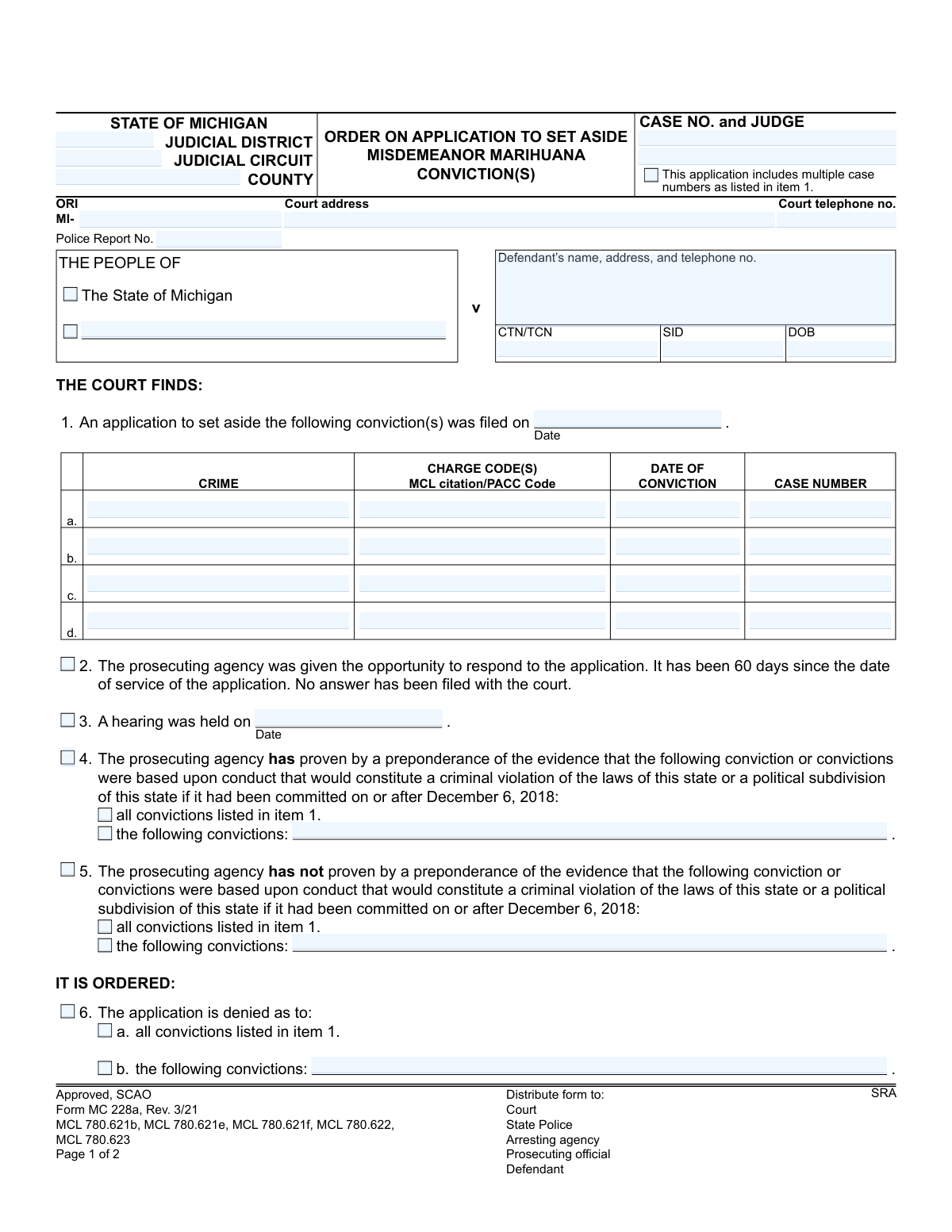
This form, officially titled 'Order on Application to Set Aside Misdemeanor Marihuana Conviction(s)', is a judicial document from the State of Michigan. It is used by the court to formalize its decision on a defendant's request to expunge one or more misdemeanor marijuana convictions. The order specifies which convictions, if any, are set aside, based on findings presented to the court. Today, this form can be filled out quickly and accurately using AI-powered services like Instafill.ai, which can also convert non-fillable PDF versions into interactive fillable forms.
MC 228a is part of the
Michigan court forms category on Instafill.
Our AI automatically handles information lookup, data retrieval, formatting, and form filling.
It takes less than a minute to fill out MC 228a using our AI form filling.
Securely upload your data. Information is encrypted in transit and deleted immediately after the form is filled out.
Form specifications
| Form name: | Form MC 228a, Order on Application to Set Aside Misdemeanor Marihuana Conviction(s) |
| Number of fields: | 54 |
| Number of pages: | 1 |
| Language: | English |
More forms in Michigan court forms
Instafill Demo: How to fill out PDF forms in seconds with AI
How to Fill Out MC 228a Online for Free in 2026
Are you looking to fill out a MC 228A form online quickly and accurately? Instafill.ai offers the #1 AI-powered PDF filling software of 2026, allowing you to complete your MC 228A form in just 37 seconds or less.
Follow these steps to fill out your MC 228A form online using Instafill.ai:
- 1 Navigate to Instafill.ai and upload the MC 228a form or select it from the template library.
- 2 Use the AI assistant to accurately input case information, including the court address, case number, judge, and defendant details.
- 3 List the specific misdemeanor marihuana convictions being considered by providing the crime, charge codes, date of conviction, and case number for each.
- 4 Indicate the court's findings by checking the appropriate boxes, such as whether a hearing was held and the prosecutor's arguments.
- 5 Clearly state the court's final decision in the 'IT IS ORDERED' section by selecting whether the application is granted or denied for all or specific convictions.
- 6 Thoroughly review all the information populated by the AI to ensure complete accuracy before the judge's signature.
- 7 Once signed by the judge, download the completed form for distribution to the required parties, including the State Police, court, and defendant.
Our AI-powered system ensures each field is filled out correctly, reducing errors and saving you time.
Why Choose Instafill.ai for Your Fillable MC 228a Form?
Speed
Complete your MC 228a in as little as 37 seconds.
Up-to-Date
Always use the latest 2026 MC 228a form version.
Cost-effective
No need to hire expensive lawyers.
Accuracy
Our AI performs 10 compliance checks to ensure your form is error-free.
Security
Your personal information is protected with bank-level encryption.
Frequently Asked Questions About Form MC 228a
This form is the official court order that documents a judge's final decision on an application to set aside misdemeanor marihuana convictions. It is not the application itself, but the ruling that results from it.
The court or judge completes and signs this form after reviewing the application. The applicant receives a copy of the completed order but does not fill it out themselves.
Check the 'IT IS ORDERED' section on the second page. If the box next to item 7, 'The application is granted,' is checked, your request was approved for the convictions listed there.
Item 4 indicates a potential reason for denial: if the prosecuting agency proved that the conduct leading to your conviction would still be a crime if committed today. The specific convictions denied will be listed in item 6.
It means the conviction is removed from your public criminal record. A nonpublic record is maintained by the Michigan State Police, but the conviction can no longer be used against you for most purposes.
No. The 'NOTE TO APPLICANT' section clearly states that you are not entitled to the return of any fines, costs, or other money paid as a result of a conviction that is set aside.
Yes. This order does not cancel any restitution you owe to a victim, and the court can still enforce the restitution order.
No. Item 7 specifies that if the conviction was reportable to the Secretary of State, the driving record associated with it will not be expunged.
Yes, the form allows for a partial decision. A judge can grant the application for specific convictions listed in item 7 while denying it for others listed in item 6.
The court clerk distributes copies of the order to the Michigan State Police, the arresting agency, and the prosecutor so they can update their records according to the judge's decision.
Yes. While this MC 228a form is the court's order, you can use AI-powered services like Instafill.ai to accurately auto-fill your initial application form, saving time and reducing errors.
You can use a service like Instafill.ai to fill out your application form online. Simply upload the form to their platform to make it interactive and easy to complete.
You can use a tool like Instafill.ai, which can convert flat, non-fillable PDFs into interactive forms. This allows you to easily type your information into the fields before printing for submission.
Compliance MC 228a
Validation Checks by Instafill.ai
1
Case Number Format Validation
This check ensures that the main Case Number and any case numbers listed for convictions (cno1-cno4) adhere to the standard Michigan court case number format. Validating the format is crucial for data integrity, preventing errors, and ensuring the order can be correctly filed and linked to the proper case record in the court's system. An invalid format could lead to the order being rejected or misfiled.
2
Date Chronology: Hearing vs. Application
This validation verifies that the hearing date ('heardate' in item 3) is on or after the application filing date ('appdate' in item 1). A hearing cannot logically occur before the application that prompted it has been filed. This check prevents illogical date entries and ensures the sequence of legal events is recorded accurately.
3
Date Chronology: Conviction vs. Application
This check ensures that all conviction dates ('cdate1' through 'cdate4') are prior to the application filing date ('appdate'). It is impossible to apply to set aside a conviction that has not yet happened. This validation is essential for maintaining logical consistency and preventing fundamental data entry errors.
4
ORI Code Prefix Validation
This validation confirms that the Originating Agency Identifier ('ori') field begins with the 'MI-' prefix as shown on the form. This format is specific to Michigan and ensures the identifier is correctly structured for state-level databases, like the Michigan State Police. Failure to comply could result in processing rejections by state agencies.
5
Minimum Conviction Entry
This check verifies that at least one complete conviction record (including crime, charge code, conviction date, and case number) is entered in item 1. The entire purpose of the form is to act on one or more convictions, so an application with no convictions listed is incomplete and cannot be processed. This ensures the form has a valid subject for the court's order.
6
Conditional List for 'Proven' Convictions
If the checkbox for 'the following convictions' is selected in item 4, this validation ensures the corresponding text area ('foconvlist') is not empty. This prevents an ambiguous finding where the court indicates specific convictions meet the criteria but fails to list them. It is critical for the clarity and enforceability of the court's findings.
7
Conditional List for 'Denied' Convictions
When the order denies the application for a specific subset of convictions (item 6b), this check ensures the corresponding text area ('foconvlist3') is populated. An order that indicates a partial denial without specifying which convictions are denied is legally ambiguous and unenforceable. This validation mandates clarity in the final judgment.
8
Conditional List for 'Granted' Convictions
If the order grants the application for 'the following convictions' (item 7b), this validation requires that the associated text field ('foconvlist4') is not blank. This is crucial for ensuring there is no ambiguity about which specific convictions are being set aside. The Michigan State Police and other agencies rely on this specific list to update the individual's record correctly.
9
Mutually Exclusive Findings (Items 4 & 5)
This validation prevents a logical contradiction by ensuring the same conviction is not identified in both item 4 ('proven' to be a crime) and item 5 ('not proven'). For example, if 'all convictions' is checked in item 4, no selections can be made in item 5. This check maintains the logical integrity of the court's findings on the record.
10
Mutually Exclusive Orders (Items 6 & 7)
This check ensures that the final order does not simultaneously grant and deny the application for the same conviction. For instance, if 'all convictions' is denied in item 6a, 'all convictions' cannot be granted in item 7a. This is a critical validation to prevent a legally contradictory and void order.
11
Valid Date of Birth (DOB)
This validation ensures the 'dob' field contains a valid date that is in the past and represents a plausible age for a person with a criminal conviction. It prevents errors such as future dates, typos, or dates that would imply the defendant was a toddler at the time of the crime. Accurate DOB is essential for uniquely identifying the defendant in state and national databases.
12
Required Application Filing Date
This check mandates the presence of the application filing date ('appdate') in item 1. This date is a critical piece of information, as it establishes the timeline for the prosecuting agency's 60-day response period and serves as a reference point for other dates on the form. Without it, the procedural correctness of the order is questionable.
13
Defendant Information Completeness
This validation ensures the defendant's name, address, and telephone number block ('dinfo') is not empty. This information is fundamental to identifying the subject of the order. It is required for proper notification, record-keeping, and to ensure the final order is applied to the correct individual's criminal history.
14
Judge's Signature Date Presence
This check verifies that the date field next to the Judge's signature is filled out upon finalization of the order. While the signature itself is physical, the date is a data point that can be validated. This date is legally significant as it marks when the order becomes effective and is crucial for calculating appeal periods and other time-sensitive actions.
Common Mistakes in Completing MC 228a
Applicants often enter the wrong case number or omit crucial parts like the year or case type code (e.g., 'SM'). This mistake happens when relying on memory or incomplete notes. An incorrect case number is one of the most common reasons for rejection, as it prevents the court clerk from locating the official record, leading to significant delays or outright denial of the application.
People frequently confuse the date of arrest, the date of the offense, or the sentencing date with the official date of conviction. The date of conviction is a specific legal date that is critical for determining eligibility and for the court to locate the case file. Using the wrong date can cause the application to be rejected because the records cannot be verified, forcing the applicant to refile.
The MCL (Michigan Compiled Laws) citation is the specific statute number for the crime, which is essential for proving the conviction is eligible for expungement. Applicants often leave this blank or guess because it's a technical detail they don't know. Without the correct MCL code, the court cannot confirm the conviction's eligibility under the marihuana law, which is a primary reason for denial.
An applicant might mistakenly file the application in the court of the county where they currently reside, rather than the court where the conviction occurred. Each court only has jurisdiction over its own cases. Filing in the wrong court results in an automatic rejection, loss of filing fees, and the need to start the entire process over in the correct jurisdiction.
Many applicants are unfamiliar with identifiers like the Complaint Tracking Number (CTN), Transaction Control Number (TCN), or State ID (SID) number and leave them blank. These numbers are crucial for law enforcement and the state police to accurately identify the applicant and their specific criminal record. Omitting them can significantly slow down the background check process and delay the court's decision.
Instead of using the official charge from court records, applicants may write a generic or slang description like 'pot possession'. This ambiguity forces court staff to spend extra time cross-referencing the case number to determine the actual statutory charge. To avoid delays, the crime description should be copied exactly as it appears on the original judgment of sentence or other official court documents.
Applicants sometimes use a nickname instead of their full legal name, or provide an old address and phone number. The court and other agencies use this information for identity verification and official communications. Mismatched or outdated information can lead to failed identity checks and missed notifications about hearings or issues with the application.
The law allows for setting aside multiple eligible misdemeanor marihuana convictions, but applicants sometimes file a separate application for each one or forget about an older conviction. This creates unnecessary work and expense. A thorough review of one's complete criminal history is needed to consolidate all eligible convictions from the same court onto a single application, saving time and filing fees.
When a form is only available as a non-fillable PDF, applicants often print and fill it out by hand. Poor handwriting can lead to court clerks misinterpreting critical information like case numbers or names, causing data entry errors that can derail the entire application. To prevent this, it is best to use a fillable version of the form. AI-powered tools like Instafill.ai can convert flat PDFs into fillable forms and help ensure all data is entered clearly and accurately.
This form (MC 228a) is an 'Order' that is completed by the judge, not the applicant. A common mistake is for an applicant to try filling out sections reserved for the court, such as the findings (items 2-5) or the final order (items 6-7). This shows a misunderstanding of the process and will cause the filing to be rejected. The applicant's responsibility is to provide this information on a separate 'Application' form, which the court then uses to generate this Order.
Saved over 80 hours a year
“I was never sure if my IRS forms like W-9 were filled correctly. Now, I can complete the forms accurately without any external help.”
Kevin Martin Green
Your data stays secure with advanced protection from Instafill and our subprocessors

Robust compliance program
Transparent business model
You’re not the product. You always know where your data is and what it is processed for.
ISO 27001, HIPAA, and GDPR
Our subprocesses adhere to multiple compliance standards, including but not limited to ISO 27001, HIPAA, and GDPR.
Security & privacy by design
We consider security and privacy from the initial design phase of any new service or functionality. It’s not an afterthought, it’s built-in, including support for two-factor authentication (2FA) to further protect your account.
Fill out MC 228a with Instafill.ai
Worried about filling PDFs wrong? Instafill securely fills form-mc-228a-order-on-application-to-set-aside-misdemeanor-marihuana-convictions forms, ensuring each field is accurate.