Yes! You can use AI to fill out Form MC 228b, Order on Application by Human Trafficking Victim to Set Aside Conviction(s)

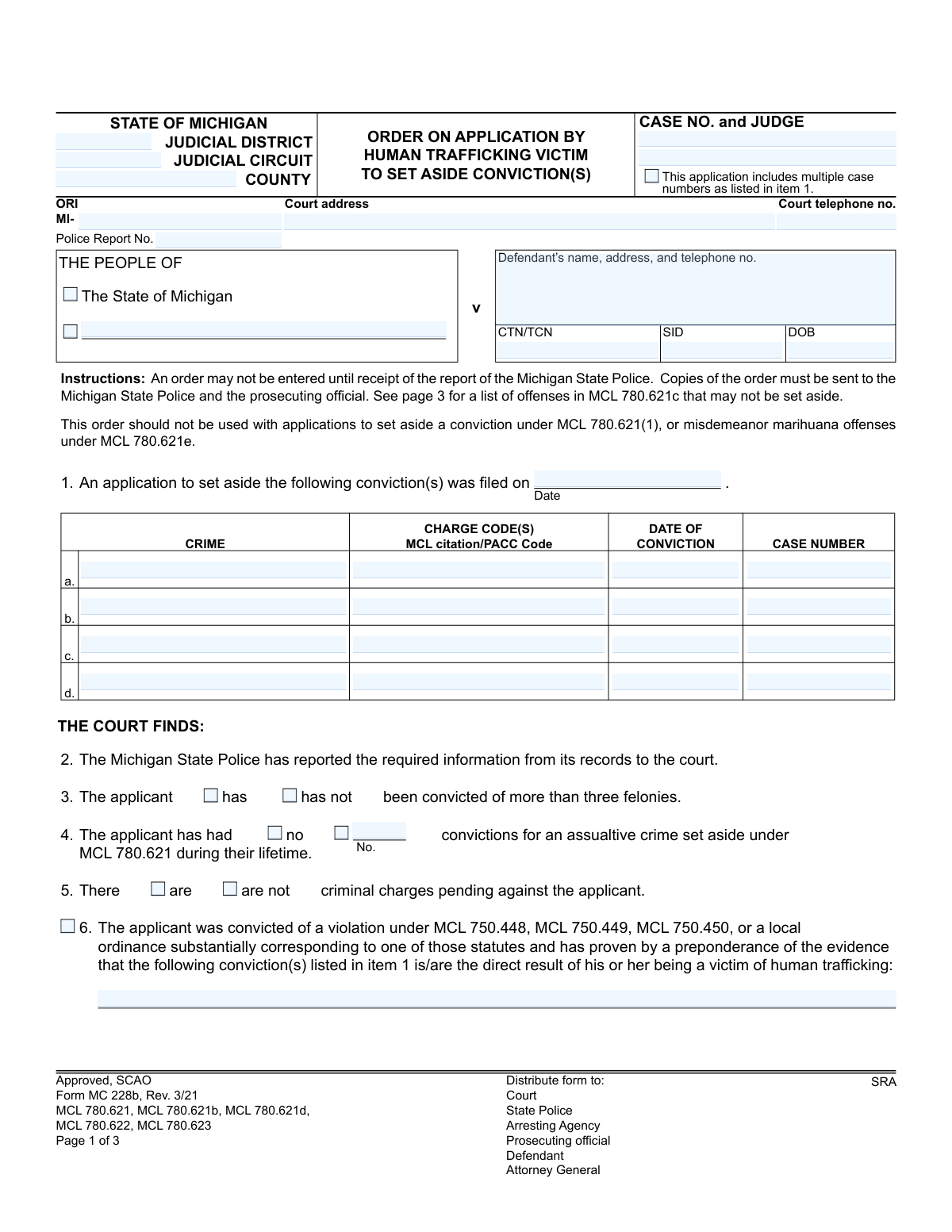
Form MC 228b is a legal document used by the Michigan judicial system to formally grant or deny an application from a victim of human trafficking to set aside, or vacate, certain criminal convictions. This order is crucial for victims seeking to clear their records of crimes they were forced to commit as a direct result of being trafficked. Today, this form can be filled out quickly and accurately using AI-powered services like Instafill.ai, which can also convert non-fillable PDF versions into interactive fillable forms.
MC 228b is part of the Michigan court forms category on Instafill.
Our AI automatically handles information lookup, data retrieval, formatting, and form filling.
It takes less than a minute to fill out MC 228b using our AI form filling.
Securely upload your data. Information is encrypted in transit and deleted immediately after the form is filled out.

Form specifications

Form name: Form MC 228b, Order on Application by Human Trafficking Victim to Set Aside Conviction(s)
Number of fields: 62
Number of pages: 1
Language: English
main-image

Instafill Demo: How to fill out PDF forms in seconds with AI

How to Fill Out MC 228b Online for Free in 2026

Are you looking to fill out a MC 228B form online quickly and accurately? Instafill.ai offers the #1 AI-powered PDF filling software of 2026, allowing you to complete your MC 228B form in just 37 seconds or less.
Follow these steps to fill out your MC 228B form online using Instafill.ai:
  1. 1 Navigate to Instafill.ai and upload or select the MC 228b form.
  2. 2 Enter the court and case information at the top, including the judicial district/circuit, case number, and judge's name.
  3. 3 Provide the defendant's full name, address, and other identifying details like CTN, SID, and DOB.
  4. 4 List the specific convictions the application seeks to set aside, including the crime, charge codes, MCL citation, date of conviction, and case number for each.
  5. 5 Complete the 'THE COURT FINDS' section by checking the appropriate boxes based on the Michigan State Police report, the applicant's history, and the evidence presented.
  6. 6 Fill out the 'IT IS ORDERED' section to either deny or grant the application for the listed convictions, specifying any relevant dates or conditions.
  7. 7 Review all entered information for accuracy, then download the completed order for the judge's signature and distribution to the required parties, such as the Michigan State Police and the prosecuting official.

Our AI-powered system ensures each field is filled out correctly, reducing errors and saving you time.

Why Choose Instafill.ai for Your Fillable MC 228b Form?

Speed

Complete your MC 228b in as little as 37 seconds.

Up-to-Date

Always use the latest 2026 MC 228b form version.

Cost-effective

No need to hire expensive lawyers.

Accuracy

Our AI performs 10 compliance checks to ensure your form is error-free.

Security

Your personal information is protected with bank-level encryption.

Frequently Asked Questions About Form MC 228b

This form is the official court order used by a judge in Michigan to either grant or deny an application from a human trafficking victim to set aside their past criminal convictions. It formalizes the court's final decision on the matter.

No, this is the order the judge signs after reviewing your case. You must first file a separate application form to begin the process of having your convictions set aside.

This form is an official court order, so it is completed and signed by a judge. It is not an application to be filled out by the public.

If the application is granted (item 12), the specified convictions are set aside and become nonpublic. This means they are removed from your public criminal record, though a nonpublic record is maintained by the Michigan State Police.

If the application is denied (item 11), the convictions remain on your record. The order will state when you are allowed to reapply, which is typically three years from the date of the order.

Yes, page 3 of the form lists convictions that are ineligible to be set aside under Michigan law. These include felonies with a maximum punishment of life, certain serious crimes, and specific traffic offenses.

The Michigan State Police must provide a report of the applicant's criminal record to the court before the judge can issue this order. After the order is signed, a copy is sent to the State Police to update their records.

No, the form clearly states that setting aside a conviction does not entitle you to a refund of any fines, costs, or other money paid. It also does not cancel any outstanding restitution you owe to a victim.

This means you must show the court, with a preponderance of the evidence, that the crime you were convicted of happened because you were being trafficked. For example, you were forced to commit the crime by your trafficker.

Under Michigan law, if you have multiple convictions that all occurred within a 24-hour period and were part of the same event, the court may treat them as a single conviction for the purpose of your application.

Yes, while this is a court order, legal professionals or court staff preparing a draft can use AI services like Instafill.ai. These tools can accurately auto-fill case numbers, defendant information, and other fields to save time and ensure accuracy.

Court or legal staff can upload the MC 228b PDF to a platform like Instafill.ai. The service allows you to digitally fill in all the required fields, save progress, and print the completed order for the judge's signature.

If you have a non-fillable or 'flat' PDF, you can use a service like Instafill.ai to automatically convert it into an interactive, fillable form. This allows you to easily type information directly into the fields on your computer.

Compliance MC 228b
Validation Checks by Instafill.ai

1
Date of Birth Validity
This check ensures the 'DOB' field contains a valid date formatted as MM/DD/YYYY. It also verifies that the date is in the past and represents a plausible age for a defendant. This is crucial for correctly identifying the individual and preventing data entry errors that could affect record matching.
2
Logical Date Sequence
This validation verifies that each 'DATE OF CONVICTION' in item 1 occurs before the 'Application filed on' date. An application cannot be filed for a conviction that has not yet occurred. This check maintains the logical and chronological integrity of the legal process.
3
Minimum Conviction Entry
This check ensures that at least one full conviction record (including Crime, Charge Code, Date, and Case Number) is entered in item 1. An application to set aside convictions must specify at least one conviction. If this fails, the form is incomplete and cannot be processed.
4
Mutually Exclusive Felony Count
Validates that in item 3, exactly one of the two checkboxes ('has' or 'has not' been convicted of more than three felonies) is selected. These are mutually exclusive conditions. Forcing a single selection prevents ambiguity in the court's findings, which is essential for determining eligibility.
5
Conditional Assaultive Crime Count
In item 4, if the checkbox indicating a number of prior assaultive crime convictions is selected, this validation ensures the corresponding number field is filled with a positive integer. If the 'no' convictions checkbox is selected, the number field should be disabled or empty. This ensures conditional data is captured accurately.
6
Mutually Exclusive Pending Charges Status
This check ensures that in item 5, either the 'are' or 'are not' checkbox for pending criminal charges is selected, but not both. The presence of pending charges is a critical factor in the judge's decision. An unambiguous statement is required for a valid order.
7
Order Outcome Completeness
This validation confirms that every conviction listed in item 1 is accounted for in the final order section. Each case number from item 1 must appear in either the 'denied' list (item 11) or the 'granted' list (item 12). This ensures a disposition is recorded for every item on the application.
8
Order Outcome Exclusivity
This check prevents a single conviction from being listed as both 'granted' (item 12) and 'denied' (item 11). Such an entry would make the order contradictory and legally void. The system must enforce that a conviction can only have one outcome.
9
Case Number Consistency Across Pages
This validation ensures the 'Case No.' field at the top of pages 2 and 3 is identical to the primary 'CASE NO.' entered on page 1. This is critical for maintaining document integrity, especially if pages are separated. It guarantees all pages refer to the same legal case.
10
Denied Re-application Date Logic
If an application is denied (item 11) and the option for re-application 'earlier than three years' is chosen, this check validates that the specified date is a valid future date. Furthermore, it ensures the date is after the order date but before the three-year mark. This prevents the entry of illogical or invalid re-application timelines.
11
Prohibited Offense Check
This validation cross-references the 'MCL citation' for each conviction in item 1 against the list of non-set-asideable offenses detailed in MCL 780.621c (page 3). If a prohibited offense is entered, the system should flag it, as the court legally cannot set aside such a conviction. This prevents the creation of an unenforceable order.
12
Granted Conviction Reference Integrity
This check verifies that any case number listed in the 'granted' section (item 12) corresponds to a valid case number listed in the application details (item 1). This prevents clerical errors where an incorrect or non-existent case is granted relief. It ensures the order accurately reflects the application.
13
ORI Format Validation
This check ensures the 'ORI' field follows the standard Michigan format, which is 'MI-' followed by a specific code. The Originating Agency Identifier (ORI) is crucial for routing the order to the correct Michigan State Police division. Incorrect formatting can lead to processing delays or misfiling.
14
Phone Number Formatting
This validation ensures that the 'Court telephone no.' and the defendant's telephone number are entered in a valid 10-digit format. Proper formatting is essential for system processing and ensures that the court and defendant can be contacted without issue. Failure could lead to communication breakdowns.
15
Single Conviction Grouping Logic
This check ensures that the convictions listed in item 12 as being 'considered one conviction' are a subset of the convictions being granted in that same item. It is logically impossible to group convictions that are not being granted. This validation maintains consistency within the order's granting clause.

Common Mistakes in Completing MC 228b

Listing Ineligible Convictions

Applicants frequently fail to review page 3, which explicitly lists convictions that cannot be set aside under Michigan law, such as life-sentence felonies or certain traffic offenses. Submitting an application for an ineligible offense results in an automatic denial, wasting the applicant's time and any filing fees. To avoid this, carefully cross-reference every conviction against the list of prohibited offenses in MCL 780.621c on page 3 before filing.

Incorrect or Incomplete Conviction Details

In item 1, applicants often enter incorrect MCL citations, case numbers, charge codes, or dates of conviction. These details must be exact for the Michigan State Police and the court to locate and verify the correct records. Errors can lead to significant delays, rejection of the application, or the wrong conviction being processed. It is crucial to reference original court documents to ensure every detail is accurate.

Using the Wrong Application Form

This form, MC 228b, is exclusively for human trafficking victims. A common error is using it for general felony/misdemeanor set-asides (which require form MC 227) or marihuana-related offenses (form MC 66). Using the incorrect form will lead to the court rejecting the application, forcing the applicant to start the entire process over with the proper paperwork. Always read the instructions at the top of the form to confirm it's the right one for your situation.

Missing or Inaccurate Personal Identifiers (CTN/SID/DOB)

The CTN/TCN, SID, and DOB fields are critical for the Michigan State Police to run an accurate criminal history check. Applicants may leave these fields blank or enter incorrect numbers, leading to a failure to find the records or a report on the wrong individual. This will halt the application process until corrected. These numbers can be found on prior court documents or obtained from the convicting court.

Insufficient Proof of Link to Human Trafficking

Item 6 requires the applicant to prove by a 'preponderance of the evidence' that the conviction was a direct result of being a victim of human trafficking. Many applicants misunderstand this legal standard and fail to attach sufficient supporting documentation, such as police reports, witness statements, or records from support organizations. This failure of proof is a primary reason for denial. Applicants must gather and submit compelling evidence to meet this requirement.

Incomplete Court and Case Header Information

Applicants often neglect to fill out the header section completely, omitting the Case Number, Judge, Court Address, or ORI. This information is essential for the court clerk to properly file and route the document. An incomplete header can cause the form to be rejected at the filing window, delaying the legal process until all required information is provided.

Failure to Disclose Pending Criminal Charges

Item 5 asks whether any criminal charges are currently pending against the applicant. Some individuals may mistakenly or intentionally fail to disclose this information. The court verifies this through the Michigan State Police report, and any discrepancy will severely damage the applicant's credibility and almost certainly result in the denial of the application. It is essential to be completely truthful on the application.

Misinterpreting the 'Same Transaction' Rule

The law allows multiple convictions to be treated as a single conviction if they occurred within 24 hours and arose from the 'same transaction' (MCL 780.621b). Applicants may incorrectly group unrelated crimes or fail to group eligible ones, which can affect their overall eligibility based on the total number of convictions. Understanding this rule is vital for accurately completing items 8 and 12. AI-powered tools like Instafill.ai can help by providing guidance on complex rules and ensuring data is entered consistently.

Forgetting to List All Desired Convictions

An applicant may have several convictions they wish to have set aside but only list one or two in item 1. The court can only rule on the convictions explicitly listed in the application. This oversight means other eligible convictions will remain on the applicant's public record, requiring a new application process later. To prevent this, obtain a complete criminal history and list every conviction you are seeking to set aside. Since this form is a non-fillable PDF, a tool like Instafill.ai can convert it into a fillable version, making it easier to add and manage multiple conviction entries.

Leaving Defendant Contact Information Blank

The field for the defendant's name, address, and telephone number is sometimes left incomplete. The court uses this information to mail crucial documents, including hearing notices and the final order. Missing or outdated contact information can lead to the applicant missing their court date or never receiving the final decision. Always provide a current, reliable mailing address and phone number. Using a service like Instafill.ai can help prevent this by flagging empty required fields before submission.
Saved over 80 hours a year

“I was never sure if my IRS forms like W-9 were filled correctly. Now, I can complete the forms accurately without any external help.”

Kevin Martin Green

Your data stays secure with advanced protection from Instafill and our subprocessors

Robust compliance program

Transparent business model

You’re not the product. You always know where your data is and what it is processed for.

ISO 27001, HIPAA, and GDPR

Our subprocesses adhere to multiple compliance standards, including but not limited to ISO 27001, HIPAA, and GDPR.

Security & privacy by design

We consider security and privacy from the initial design phase of any new service or functionality. It’s not an afterthought, it’s built-in, including support for two-factor authentication (2FA) to further protect your account.

Fill out MC 228b with Instafill.ai

Worried about filling PDFs wrong? Instafill securely fills form-mc-228b-order-on-application-by-human-trafficking-victim-to-set-aside-convictions forms, ensuring each field is accurate.