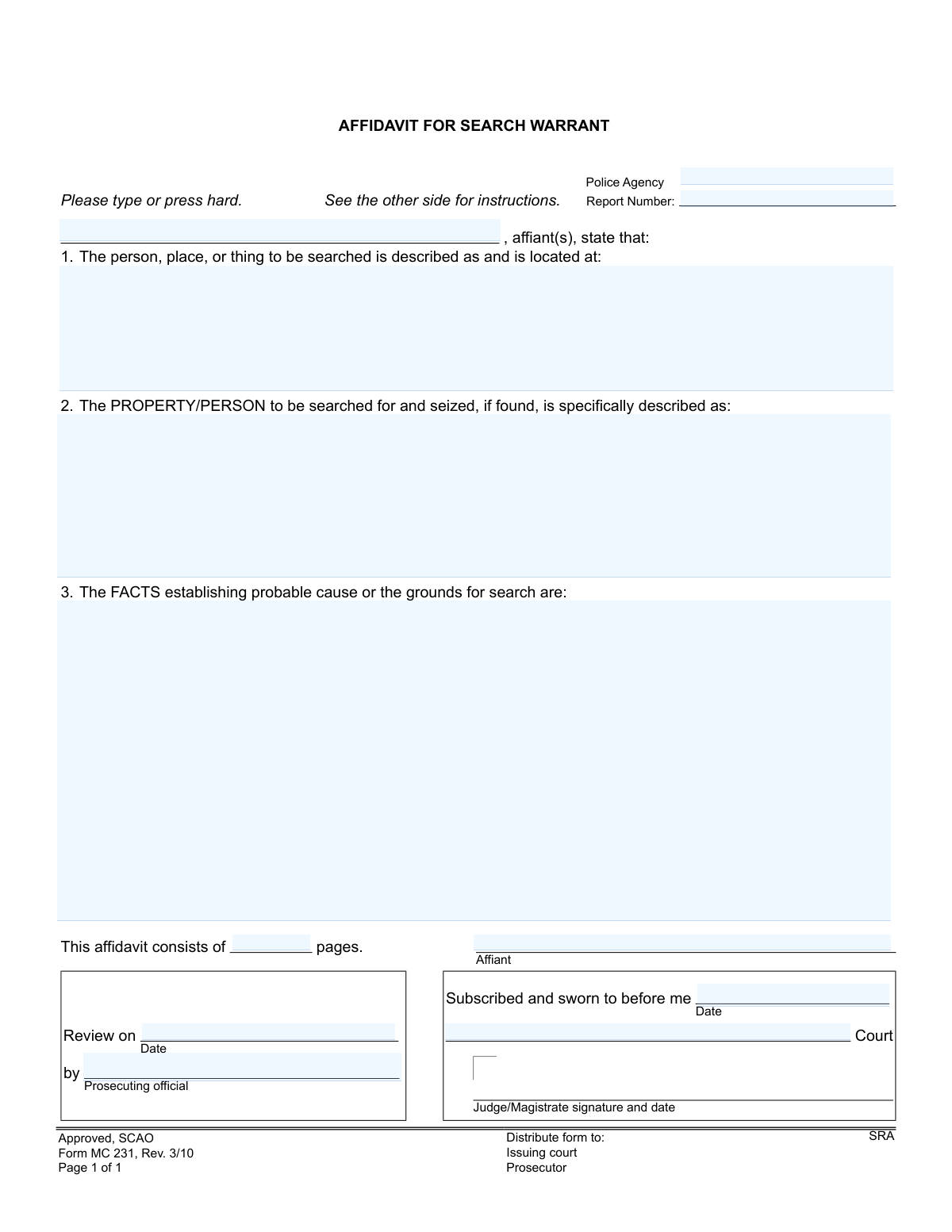
Yes! You can use AI to fill out Form MC 231, Affidavit for Search Warrant
The Affidavit for Search Warrant, Form MC 231, is a sworn statement presented by a law enforcement officer (the affiant) to a judge or magistrate. It details the specific person, place, or thing to be searched, the property to be seized, and the facts that establish probable cause for the search. This document is a critical component of the legal process for obtaining a search warrant, ensuring that searches comply with constitutional requirements. Today, this form can be filled out quickly and accurately using AI-powered services like Instafill.ai, which can also convert non-fillable PDF versions into interactive fillable forms.
MC 231 is part of the
Michigan court forms category on Instafill.
Our AI automatically handles information lookup, data retrieval, formatting, and form filling.
It takes less than a minute to fill out MC 231 using our AI form filling.
Securely upload your data. Information is encrypted in transit and deleted immediately after the form is filled out.
Form specifications
| Form name: | Form MC 231, Affidavit for Search Warrant |
| Number of fields: | 23 |
| Number of pages: | 1 |
| Language: | English |
More forms in Michigan court forms
Instafill Demo: How to fill out PDF forms in seconds with AI
How to Fill Out MC 231 Online for Free in 2026
Are you looking to fill out a MC 231 form online quickly and accurately? Instafill.ai offers the #1 AI-powered PDF filling software of 2026, allowing you to complete your MC 231 form in just 37 seconds or less.
Follow these steps to fill out your MC 231 form online using Instafill.ai:
- 1 Navigate to Instafill.ai and upload or select the Form MC 231, Affidavit for Search Warrant.
- 2 Use the AI assistant to identify and populate key fields, such as the police agency, report number, and affiant's name.
- 3 Clearly input the description of the person, place, or thing to be searched and the property to be seized in the designated sections.
- 4 Carefully detail the facts establishing probable cause, using the AI tool to ensure the information is formatted correctly within the provided space.
- 5 Review all entered information for accuracy and completeness with the help of AI-powered validation checks before finalizing the document.
- 6 Download the completed affidavit, which is now ready for review by a prosecuting official and for the affiant to swear to and sign before a judge or magistrate.
Our AI-powered system ensures each field is filled out correctly, reducing errors and saving you time.
Why Choose Instafill.ai for Your Fillable MC 231 Form?
Speed
Complete your MC 231 in as little as 37 seconds.
Up-to-Date
Always use the latest 2026 MC 231 form version.
Cost-effective
No need to hire expensive lawyers.
Accuracy
Our AI performs 10 compliance checks to ensure your form is error-free.
Security
Your personal information is protected with bank-level encryption.
Frequently Asked Questions About Form MC 231
This form is used by a law enforcement officer, known as the affiant, to present facts and evidence to a judge to establish probable cause for a search warrant.
The affiant is the law enforcement officer who is requesting the search warrant. They must swear that the information provided in the affidavit is true and accurate.
You must provide a complete and exact description of the location to be searched, including the full address and physical details, to ensure the warrant is executed at the correct place.
The property to be searched for and seized must be described with specificity. Vague descriptions are insufficient; list items with as much detail as possible, such as model or serial numbers if known.
This section requires a detailed narrative of the facts, observations, and circumstances that lead you to believe evidence of a crime will be found at the specified location. If you need more space, you can attach form MC 231a.
After completing the affidavit, you may need it reviewed by a prosecuting official. You must then swear to and sign the affidavit before a judge or magistrate, who will then decide whether to issue the search warrant.
After executing the search, you must complete the 'Return and Tabulation' section, listing all seized property. A copy of the warrant and this list must be left at the premises, and the original returned to the court.
The form indicates that review by a prosecuting official is only necessary 'if required locally.' You should confirm the specific procedures for your jurisdiction.
The affiant signs the affidavit after swearing to its contents before a judge or magistrate. The judge or magistrate then signs both the affidavit and the search warrant to authorize the search.
If you have a non-fillable PDF, you can use a service like Instafill.ai. It can convert flat PDFs into interactive, fillable forms that you can easily complete and sign on your computer.
Yes, AI-powered services like Instafill.ai can help you complete this form more efficiently. These tools can accurately auto-fill fields based on your information, saving time and reducing potential errors.
To fill this form using Instafill.ai, simply upload the document to the platform. The AI will make the form fields interactive, allowing you to click and type your information directly into the digital form before printing.
The tabulation is a written inventory of all property seized during the search. It should be completed in the presence of the person from whom the property was taken or another witness, who must then sign it.
The original affidavit is left with the issuing judge, a copy of the warrant and tabulation is served at the premises, and the original warrant and tabulation are returned to the court. The prosecutor and police agency also receive copies.
Compliance MC 231
Validation Checks by Instafill.ai
1
Affiant Name Required
Checks that the 'affiant' field is not empty. The affiant is the officer or individual swearing that the facts are true, and their identity is fundamental to the affidavit's validity. A missing affiant name invalidates the entire document and makes the warrant application legally insufficient.
2
Probable Cause Justification
Validates that the 'pptfacts' field contains text. This section is the legal core of the warrant application, outlining the facts that justify the search. An empty or incomplete probable cause statement means there is no legal basis for the judge to issue the warrant.
3
Specific Search Location
Ensures the 'pptlocation' field is filled with a detailed description and exact location of the place to be searched. Vague or missing location information could lead to searching the wrong place, violating civil rights, and rendering any evidence found inadmissible. The form explicitly requires a 'FULL' description and 'EXACT' location.
4
Specific Seizure Description
Confirms that the 'pptdescribe' field, which details the property or person to be seized, is not empty. This prevents overly broad 'general warrants' and protects against the seizure of items not covered by probable cause. Failure to specify items can invalidate the search.
5
Report Number Presence
Verifies that the 'prno' field for the police report number is populated. This number is a critical administrative and tracking identifier, linking the warrant to a specific case file for record-keeping, retrieval, and auditing purposes. An absent report number complicates case management.
6
Valid Affidavit Page Count
Checks that the 'affpageno' field contains a positive integer greater than or equal to one. This ensures accurate document management, especially when the affidavit spans multiple pages. An incorrect or missing page count can lead to an incomplete review by the judge if pages are missing.
7
Logical Date Sequence
Performs a cross-field validation to ensure dates are in chronological order: Prosecutor Review Date ('revdate') ≤ Sworn Date ('sworndate') ≤ Search Date ('searchdate') ≤ Tabulation Filed Date ('tabdate'). This logical sequence is critical for establishing a clear and legally defensible timeline of events from application to execution and return.
8
Affidavit and Warrant Data Consistency
Compares the core descriptive fields between the affidavit section ('affiant', 'pptlocation', 'pptdescribe') and the warrant section ('affiant2', 'pptlocation2', 'pptdescribe2'). The information must be identical to ensure the warrant issued by the judge accurately reflects the affidavit that was sworn to. Discrepancies could invalidate the warrant.
9
Sworn Date Mandatory
Ensures the 'sworndate' field, indicating when the affiant swore the affidavit before a judge, is populated with a valid date. This date is legally significant as it establishes when probable cause was formally presented and attested to. A missing sworn date invalidates the affidavit.
10
Search Execution Date on Return
Validates that the 'searchdate' field on the 'Return and Tabulation' section is filled out when the return is filed. This date documents when the warrant was executed, which is essential for verifying the search was conducted within the legally permitted timeframe after issuance.
11
Seized Property Tabulation
Checks that the 'seizelist' field is addressed on the return. After a search, an inventory (tabulation) of all seized property must be created. Even if no property was seized, the form should indicate this, ensuring a complete record of the search's outcome.
12
Executing Officer Identification
Verifies that the 'offname' field on the return is populated. Identifying the officer who executed the search and completed the tabulation is necessary for accountability and for potential testimony in court. Failure to record this information can create chain-of-custody issues.
13
Service Recipient Identification
Ensures the 'servname' field is completed, identifying the person who received a copy of the warrant and tabulation. This is a required procedural step to provide notice of the search and seizure, and documenting it is crucial for legal compliance.
14
Police Agency Identification
Validates that the 'pagency' field is not empty. The name of the law enforcement agency applying for the warrant is a fundamental piece of information for establishing jurisdiction, accountability, and proper record-keeping.
Common Mistakes in Completing MC 231
Affiants often provide a vague or incomplete address for the place to be searched, such as 'a house on Elm Street' instead of the full, exact address and physical description. This error can lead to the warrant being legally invalidated for failing to meet the Fourth Amendment's particularity requirement, potentially causing all evidence to be suppressed. To avoid this, officers must provide the most precise description possible, including apartment numbers, distinguishing features, and even GPS coordinates if available.
The affidavit lists property to be seized in general terms like 'any and all evidence of a crime,' creating an unconstitutional 'general warrant.' This will likely be rejected by a judge or challenged in court, jeopardizing the case. The description must be specific to the items for which probable cause exists, such as 'a .38 caliber Smith & Wesson revolver, serial number XYZ123,' or 'approximately 50 grams of a white crystalline substance believed to be methamphetamine.' AI-powered tools like Instafill.ai can help by providing templates or checklists to ensure specificity.
Officers may state conclusions, such as 'I have probable cause to believe drugs are at the location,' instead of detailing the specific facts and observations that led to them. The affidavit must narrate the informant's reliability, surveillance observations, or controlled buys that form the basis for the warrant. A lack of detailed, articulable facts will result in a judge refusing to issue the warrant for lack of probable cause.
The form is a multi-part carbon packet requiring the user to 'TYPE OR PRESS HARD.' Officers often fail to apply sufficient pressure, resulting in faint or illegible information on the underlying copies for the court and prosecutor. This causes significant administrative delays and procedural challenges, as all parties must have a clear, identical copy. Using a typewriter or ensuring firm, even pen pressure is essential to avoid this.
The form includes a field, 'This affidavit consists of ___ pages,' which is often overlooked, especially when continuation pages are used. Failing to accurately state the total number of pages can lead to legal challenges questioning whether the judge reviewed the entire affidavit before signing. It is critical to fill in this number correctly to ensure the affidavit is considered a single, complete document.
The affiant is required to swear to the affidavit's contents and sign it in the presence of the judge or magistrate. A common mistake is signing the document at the station before presenting it, which invalidates the oath and the 'subscribed and sworn to before me' clause. This procedural error can be fatal to the warrant's validity, so officers must always wait to sign until they are physically before the magistrate.
After executing the search, officers must complete the 'Return and Tabulation' section, listing every item seized. Mistakes include failing to list all items, inaccurately describing property, or forgetting to have the inventory witnessed and signed as required. A flawed tabulation can create challenges regarding the chain of custody and the legality of the seizure, complicating the prosecution of the case.
The warrant and instructions mandate that a copy of the warrant and the completed tabulation of seized property be left at the premises. In a fast-paced post-search environment, officers can forget this crucial step. This procedural violation can be grounds for a motion to suppress evidence and may lead to civil liability.
The facts presented to establish probable cause must be timely, suggesting that evidence is currently at the location. Affiants sometimes rely on information that is weeks or months old without explaining why the evidence would still be present. A judge may find the probable cause has gone 'stale' and refuse to issue the warrant, forcing the officer to gather more current intelligence.
The form requires the 'Police Agency' and 'Report Number' to be entered in multiple places. It is easy to make a typo or enter inconsistent information, especially when filling out the form manually. This creates administrative confusion and can be used by defense attorneys to cast doubt on the investigation's accuracy. Using an AI-powered form-filling tool like Instafill.ai prevents this by auto-populating consistent data across all relevant fields.
This form is often a flat, non-fillable PDF, forcing officers to fill it out by hand. This frequently leads to illegible handwriting, especially in the detailed probable cause section, making it difficult for the prosecutor and judge to read and evaluate. This can cause delays or rejection of the warrant. Tools like Instafill.ai can convert non-fillable PDFs into fillable versions, allowing officers to type information clearly and professionally.
Saved over 80 hours a year
“I was never sure if my IRS forms like W-9 were filled correctly. Now, I can complete the forms accurately without any external help.”
Kevin Martin Green
Your data stays secure with advanced protection from Instafill and our subprocessors

Robust compliance program
Transparent business model
You’re not the product. You always know where your data is and what it is processed for.
ISO 27001, HIPAA, and GDPR
Our subprocesses adhere to multiple compliance standards, including but not limited to ISO 27001, HIPAA, and GDPR.
Security & privacy by design
We consider security and privacy from the initial design phase of any new service or functionality. It’s not an afterthought, it’s built-in, including support for two-factor authentication (2FA) to further protect your account.
Fill out MC 231 with Instafill.ai
Worried about filling PDFs wrong? Instafill securely fills form-mc-231-affidavit-for-search-warrant forms, ensuring each field is accurate.