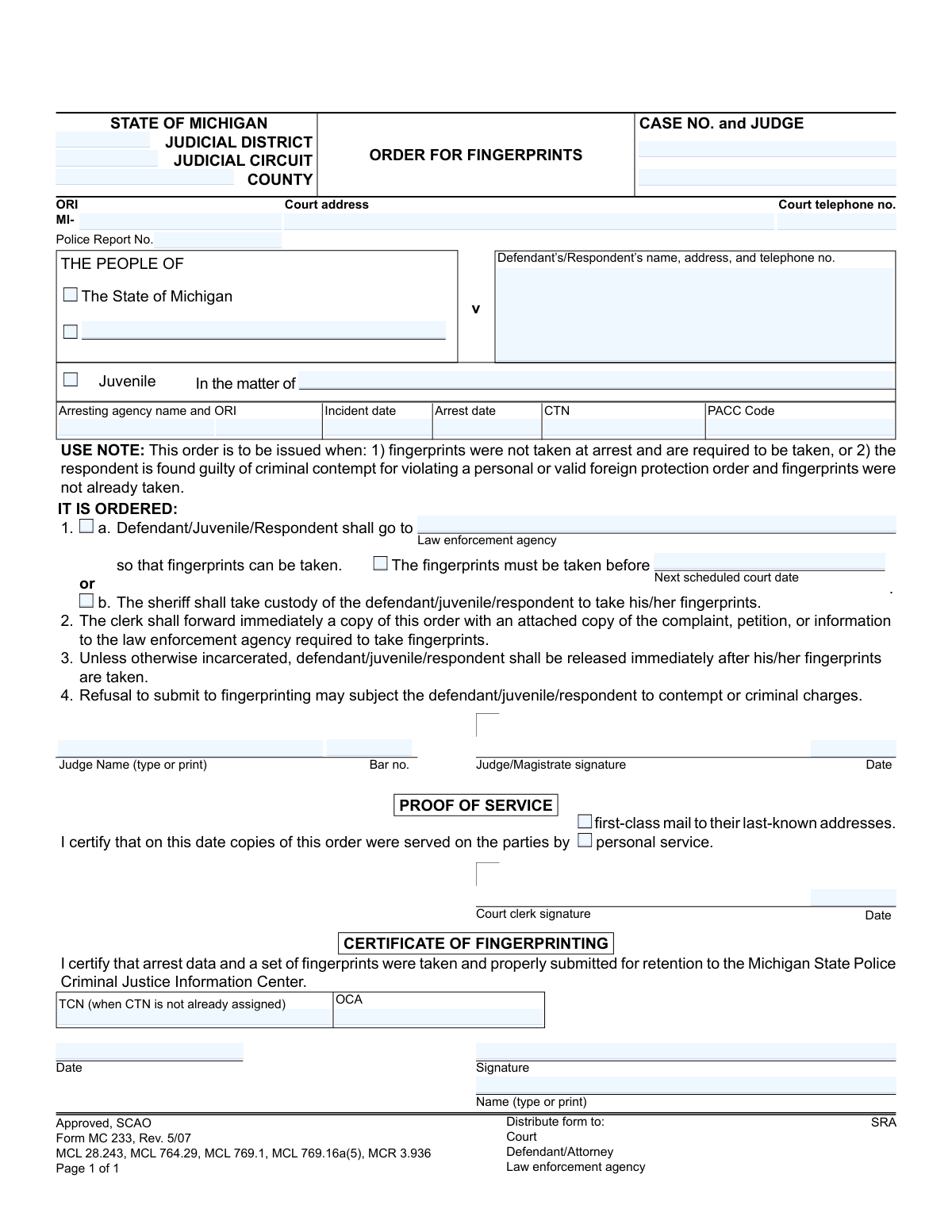
Yes! You can use AI to fill out Form MC 233, Order for Fingerprints
Form MC 233, Order for Fingerprints, is a legal document issued by a Michigan court to require a defendant, juvenile, or respondent to have their fingerprints taken. It is used when fingerprints were not taken at the time of arrest or are required following a conviction for criminal contempt. This order specifies the law enforcement agency responsible and the deadline for compliance. Today, this form can be filled out quickly and accurately using AI-powered services like Instafill.ai, which can also convert non-fillable PDF versions into interactive fillable forms.
MC 233 is part of the
Michigan court forms category on Instafill.
Our AI automatically handles information lookup, data retrieval, formatting, and form filling.
It takes less than a minute to fill out MC 233 using our AI form filling.
Securely upload your data. Information is encrypted in transit and deleted immediately after the form is filled out.
Form specifications
| Form name: | Form MC 233, Order for Fingerprints |
| Number of fields: | 37 |
| Number of pages: | 1 |
| Language: | English |
More forms in Michigan court forms
Instafill Demo: How to fill out PDF forms in seconds with AI
How to Fill Out MC 233 Online for Free in 2026
Are you looking to fill out a MC 233 form online quickly and accurately? Instafill.ai offers the #1 AI-powered PDF filling software of 2026, allowing you to complete your MC 233 form in just 37 seconds or less.
Follow these steps to fill out your MC 233 form online using Instafill.ai:
- 1 Navigate to Instafill.ai and upload or select the Michigan Form MC 233, Order for Fingerprints.
- 2 Use the AI to automatically populate court information, including the judicial district, circuit, county, case number, and judge's name.
- 3 Enter the defendant's or respondent's full name, address, and contact information, along with details of the arresting agency and incident.
- 4 Specify the law enforcement agency where the fingerprints are to be taken and set the deadline, which is typically before the next scheduled court date.
- 5 Indicate whether the individual must go to the agency or if the sheriff will take custody for the procedure.
- 6 Review all entered information for accuracy before the judge or magistrate signs the order.
- 7 Once signed, use the platform to distribute copies to the court, defendant/attorney, and the designated law enforcement agency as required.
Our AI-powered system ensures each field is filled out correctly, reducing errors and saving you time.
Why Choose Instafill.ai for Your Fillable MC 233 Form?
Speed
Complete your MC 233 in as little as 37 seconds.
Up-to-Date
Always use the latest 2026 MC 233 form version.
Cost-effective
No need to hire expensive lawyers.
Accuracy
Our AI performs 10 compliance checks to ensure your form is error-free.
Security
Your personal information is protected with bank-level encryption.
Frequently Asked Questions About Form MC 233
This is a court order issued by a judge in Michigan that legally requires a defendant, juvenile, or respondent to have their fingerprints taken. It is used when fingerprints were not taken at the time of arrest or are otherwise required by law, such as after a criminal contempt conviction.
You received this order because you are involved in a court case and the judge has determined that your fingerprints are required for the official record. You must comply with the instructions on the form.
You must go to the law enforcement agency specified in Box 1a of the form to have your fingerprints taken. Be sure to complete this action before the deadline listed on the order.
Yes, the order specifies a date by which your fingerprints must be taken. This date is written in Box 1a, often listed as before your 'Next scheduled court date'.
Refusing to submit to fingerprinting is a violation of a court order. This may subject you to being found in contempt of court or facing new criminal charges.
No, the form states that unless you are incarcerated for other reasons, you will be released immediately after your fingerprints are taken.
No, this form is completed and signed by a judge or magistrate. Your only responsibility is to follow the order's instructions.
A law enforcement official at the agency will complete and sign the 'Certificate of Fingerprinting' section. This certifies that your fingerprints were taken and submitted to the Michigan State Police.
You should bring the 'Order for Fingerprints' form itself and a valid government-issued photo ID, such as a driver's license or state ID card.
If this box is checked, it means the court has ordered the sheriff to take you into custody for the purpose of obtaining your fingerprints, instead of you going to the agency voluntarily.
Yes, while you don't fill out the form, services like Instafill.ai use AI to help you manage it. The AI can accurately extract key details like deadlines and locations to help you stay organized and compliant.
You can upload a PDF of the order to Instafill.ai to create a secure digital copy. The service can automatically identify and label important fields, making it easy to access your case number, the fingerprinting location, and the deadline.
If you have a non-fillable PDF, you can use a service like Instafill.ai to convert it into an interactive, fillable form. This allows you to add notes, highlight text, and easily copy information from the document.
Compliance MC 233
Validation Checks by Instafill.ai
1
Case Number Format and Completeness
This check ensures the 'caseno' field is not empty and conforms to the standard Michigan court case number format, such as YY-######-XX. The case number is the primary identifier for the legal proceeding, and an incorrect or missing number would cause the order to be rejected by the court clerk or misfiled, detaching it from the correct case record.
2
Logical Date Sequence
This validation verifies that the dates on the form follow a logical chronological order: the Incident Date ('incidate') must be on or before the Arrest Date ('adate'), which must be on or before the Order Date ('odate'). Furthermore, the fingerprint deadline ('hdate') must be a future date that occurs after the Order Date. This prevents data entry errors and ensures the legal timeline presented on the form is coherent and valid.
3
Mutually Exclusive Order Method
The form provides two methods for taking fingerprints under item 1: the defendant goes to an agency ('lawenfcheck') or the sheriff takes custody ('custodycheck'). This validation ensures that exactly one of these two options is selected. Selecting both or neither creates an ambiguous and unenforceable order, which would be legally invalid.
4
Conditional Requirement for Fingerprint Location and Deadline
If the checkbox indicating the defendant shall go to a law enforcement agency ('lawenfcheck') is selected, this validation confirms that both the agency's name ('lawenfname') and the deadline date ('hdate') are provided. These details are essential for the defendant to comply with the order. An order missing this information is incomplete and cannot be enforced.
5
ORI Code Format Validation
This check validates that the Court ORI ('ori') and Arresting Agency ORI ('aori') fields begin with the 'MI-' prefix followed by the specific agency code. The Originating Agency Identifier (ORI) is a critical data point for routing information within the criminal justice system. An invalid format will cause the fingerprint record to be rejected or misdirected by the Michigan State Police.
6
Judge's Bar Number Format
This validation ensures the Judge's Bar Number ('barno') follows the official Michigan State Bar format, which is typically a 'P' followed by a sequence of numbers (e.g., P12345). This number uniquely identifies the signing judicial officer, a requirement for the order's legal authority. An invalid or missing bar number could lead to the order being challenged or rejected.
7
Proof of Service Method Selection
The 'PROOF OF SERVICE' section requires certification that parties were served. This validation ensures that at least one method of service, either 'first-class mail' ('posmailcheck') or 'personal service' ('pospersonalcheck'), is selected. Documenting the method of service is a legal requirement to confirm that all parties received proper notification of the order.
8
Arresting Agency and ORI Co-occurrence
This check ensures that if an Arresting Agency Name ('aagency') is provided, its corresponding Arresting Agency ORI ('aori') is also present, and vice-versa. These two fields are intrinsically linked and are both required by the Michigan State Police to correctly associate the fingerprint record with the arresting event. An incomplete pair creates a deficient record.
9
Consistent Date Formatting
This validation scans all date fields on the form ('incidate', 'adate', 'hdate', 'odate', 'posdate', 'cfdate') to confirm they are entered in a valid and consistent format, such as MM/DD/YYYY. Standardizing date formats is crucial for preventing data processing errors and ensuring the legal document is unambiguous and machine-readable.
10
Defendant Information Completeness
The 'dname' field is intended to capture the defendant's full name, address, and telephone number. This validation checks for the presence of a name, a plausible street address, and a phone number within this field. This information is vital for identifying the correct individual and serving the order, and its absence would make the order difficult or impossible to execute.
11
Mutually Exclusive Case Style
The form's caption can be styled as 'The People of... v Defendant' or 'In the matter of'. This validation ensures that fields for only one of these styles are used, preventing a conflicting case caption. For instance, if 'dname' (Defendant) is filled, 'matterof' should be empty, ensuring clarity on the nature of the legal proceeding (e.g., criminal vs. juvenile).
12
Certificate of Fingerprinting Date Logic
This validation checks the date on the 'CERTIFICATE OF FINGERPRINTING' ('cfdate'). The date must be on or after the court's Order Date ('odate') and should not be later than the compliance deadline ('hdate'). This confirms that the fingerprinting was performed in response to the order and within the legally mandated timeframe.
Common Mistakes in Completing MC 233
Users often confuse the Judicial District, Judicial Circuit, and County, or enter information for the wrong court location. This happens due to the similar-sounding terms and the complex court structure in Michigan. An incorrect jurisdiction can lead to the order being rejected by the receiving agency, causing significant delays in the legal process and requiring the form to be re-filed.
The 'CASE NO. and JUDGE' field is frequently left incomplete or contains typos. This is a critical error as it's the primary identifier linking the fingerprint order to the specific court case. Without the correct case number, the order cannot be processed or linked to the defendant's file, leading to delays and potential non-compliance.
The form requires an ORI (Originating Agency Identifier) for both the court and the arresting agency. These are specific, non-intuitive codes that are often unknown to the filer or transcribed incorrectly. Submitting an order with a wrong or missing ORI will cause it to be rejected by the Michigan State Police system, halting the fingerprinting process until a corrected form is sent.
It's common for filers to accidentally switch the 'Incident date' and 'Arrest date' or use an incorrect date format. The incident date refers to when the alleged crime occurred, while the arrest date is when the individual was taken into custody. This error can create inconsistencies in the criminal record and case timeline, potentially causing legal complications and requiring manual correction later.
The form includes fields for CTN (Charge Tracking Number) and PACC (Prosecuting Attorney Charging Code), which are essential for state record-keeping. These alphanumeric codes are easily confused or entered with typos. An error in these fields can result in the fingerprint data being misfiled or not linked to the correct criminal history record, a mistake that can be difficult to undo.
When checking box 1a, filers often forget to specify the exact 'Law enforcement agency' name or the deadline date by which fingerprints must be taken. This omission makes the order vague and unenforceable, as the defendant doesn't know where or by when to comply. This failure to obtain fingerprints can lead to further legal action, such as a bench warrant.
The field for the defendant's or respondent's name, address, and telephone number is sometimes filled out partially, with missing middle names, old addresses, or no phone number. This lack of complete information can make it difficult to properly identify the individual or serve the order, leading to processing delays. It's essential to provide the full, current legal name and contact details as they appear on other official case documents.
After the judge signs the order, the court clerk must complete the 'PROOF OF SERVICE' section, certifying that copies were sent to the parties. This section is frequently overlooked in a busy court environment. Failure to complete this step means there is no official record that the defendant was notified, which can invalidate the order and any subsequent penalties for non-compliance.
The 'CERTIFICATE OF FINGERPRINTING' section is intended to be completed by the law enforcement agency *after* the fingerprints have been taken. A common mistake is for the person initially preparing the form (e.g., a court clerk) to attempt to fill it out. This creates confusion and requires correction, slowing down the final processing of the fingerprint record. This entire section should be left blank on the initial order sent from the court.
When this form is filled out by hand, illegible writing is a frequent problem, especially for critical data like case numbers, names, and ORI codes. Poor handwriting leads to data entry errors by law enforcement, potentially linking the order to the wrong case or person. Using a fillable PDF or an AI-powered tool like Instafill.ai, which can convert flat PDFs into fillable versions, ensures clarity and prevents these critical errors.
Saved over 80 hours a year
“I was never sure if my IRS forms like W-9 were filled correctly. Now, I can complete the forms accurately without any external help.”
Kevin Martin Green
Your data stays secure with advanced protection from Instafill and our subprocessors

Robust compliance program
Transparent business model
You’re not the product. You always know where your data is and what it is processed for.
ISO 27001, HIPAA, and GDPR
Our subprocesses adhere to multiple compliance standards, including but not limited to ISO 27001, HIPAA, and GDPR.
Security & privacy by design
We consider security and privacy from the initial design phase of any new service or functionality. It’s not an afterthought, it’s built-in, including support for two-factor authentication (2FA) to further protect your account.
Fill out MC 233 with Instafill.ai
Worried about filling PDFs wrong? Instafill securely fills form-mc-233-order-for-fingerprints forms, ensuring each field is accurate.