Yes! You can use AI to fill out Form MC 249, Order, Condemnation and Confiscation
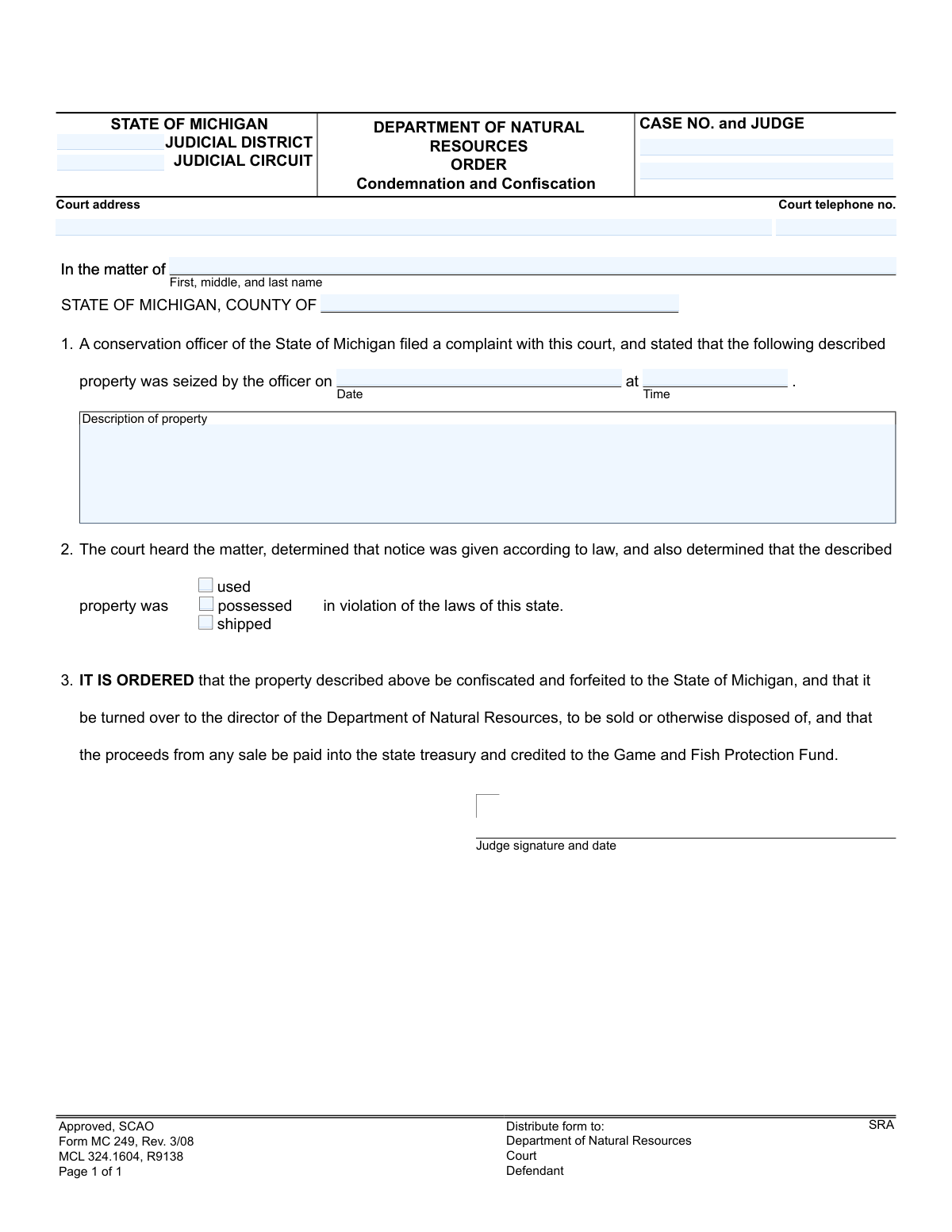
This is a legal document issued by a Michigan court to formalize the condemnation and confiscation of property. It is used when a conservation officer seizes property believed to be involved in a violation of state natural resources laws, and the court orders its forfeiture to the state. Today, this form can be filled out quickly and accurately using AI-powered services like Instafill.ai, which can also convert non-fillable PDF versions into interactive fillable forms.
MC 249 is part of the
Michigan court forms category on Instafill.
Our AI automatically handles information lookup, data retrieval, formatting, and form filling.
It takes less than a minute to fill out MC 249 using our AI form filling.
Securely upload your data. Information is encrypted in transit and deleted immediately after the form is filled out.
Form specifications
| Form name: | Form MC 249, Order, Condemnation and Confiscation |
| Number of fields: | 14 |
| Number of pages: | 1 |
| Language: | English |
More forms in Michigan court forms
Instafill Demo: How to fill out PDF forms in seconds with AI
How to Fill Out MC 249 Online for Free in 2026
Are you looking to fill out a MC 249 form online quickly and accurately? Instafill.ai offers the #1 AI-powered PDF filling software of 2026, allowing you to complete your MC 249 form in just 37 seconds or less.
Follow these steps to fill out your MC 249 form online using Instafill.ai:
- 1 Navigate to Instafill.ai and upload or select the MC 249 form.
- 2 Enter the court information, including the Judicial District, Circuit, case number, and judge's name.
- 3 Provide the details of the case, specifying the name of the individual or entity involved in the matter.
- 4 Input the date and time the property was seized by the conservation officer as stated in the complaint.
- 5 Describe the seized property in detail and check the box indicating whether it was used, possessed, or shipped in violation of state law.
- 6 Review all the auto-filled information for accuracy, ensuring all court and case details are correct.
- 7 Download the completed form for the judge's signature and subsequent distribution to the Department of Natural Resources, the court, and the defendant.
Our AI-powered system ensures each field is filled out correctly, reducing errors and saving you time.
Why Choose Instafill.ai for Your Fillable MC 249 Form?
Speed
Complete your MC 249 in as little as 37 seconds.
Up-to-Date
Always use the latest 2026 MC 249 form version.
Cost-effective
No need to hire expensive lawyers.
Accuracy
Our AI performs 10 compliance checks to ensure your form is error-free.
Security
Your personal information is protected with bank-level encryption.
Frequently Asked Questions About Form MC 249
This form is an official court order issued by a judge in Michigan. It finalizes the legal process of confiscating property that was seized by a Department of Natural Resources (DNR) officer and determined by the court to have been used in violation of state law.
This form is not filled out by the public or the person whose property was seized. It is completed and signed by a judge as part of a court proceeding.
You likely received this form because you are the defendant in a case involving property seized by the DNR. This order serves as the official court notice that your property has been legally forfeited to the State of Michigan.
Condemnation is the court's formal declaration that the property was used illegally. Confiscation is the resulting action of the state taking permanent ownership of that property without compensation.
The property is turned over to the director of the Department of Natural Resources. It may then be sold or disposed of as the DNR sees fit, with any proceeds from a sale going to the Game and Fish Protection Fund.
No, this order signifies the final transfer of ownership to the state. To challenge this outcome, you would need to pursue an appeal through the court system, and it is highly recommended you seek legal counsel.
The form contains the court's judicial district and case number, the judge's name, a description of the seized property, and the date of the seizure. It also specifies that the property was illegally used, possessed, or shipped.
A conservation officer seized property and filed a complaint, leading to a court hearing. This order is the result of the judge's determination after that hearing that the property was involved in a violation of the law.
Since this is a final court order, your primary option is to explore the legal appeals process. You should consult with an attorney immediately to understand your rights and any applicable deadlines for filing an appeal.
The order specifies that any proceeds from the sale of the property are paid into the state treasury. These funds are then credited to the Game and Fish Protection Fund.
You do not fill out this form, as it is a court order completed by a judge. However, for any related legal paperwork you must complete, AI-powered services like Instafill.ai can help auto-fill your information accurately and save time.
You can upload a PDF form to the Instafill.ai platform. Their AI technology identifies the form fields, allowing you to enter your information once and have it populate throughout the document instantly.
Services like Instafill.ai can solve this problem. They can convert flat, non-fillable PDFs into interactive, fillable forms that you can easily complete and manage online.
Compliance MC 249
Validation Checks by Instafill.ai
1
Case Number Format Validation
Ensures the `caseno` field adheres to the standard Michigan court case number format. This is critical for correctly identifying and linking the order to the official court record. A malformed case number could result in the order being unsearchable or misfiled, invalidating the record.
2
Judge Name Completeness Check
Verifies that the `judge` field is not empty, as a judge's name is required to authorize the order. An order without an associated judge is legally invalid and cannot be processed or enforced. This check ensures the form represents a legitimate judicial action.
3
Court Telephone Number Format
Validates that the `cttelno` field contains a properly formatted 10-digit US phone number. Accurate contact information is essential for any follow-up or verification required by the Department of Natural Resources or other parties. An invalid number would impede communication and could delay proceedings.
4
Seizure Date Plausibility
Checks that the `seizedate` is a valid date, is not in the future, and is not a date from the distant past. This prevents data entry errors and ensures the legal record of the seizure is chronologically sound. An impossible date would render the document legally questionable and unreliable.
5
Seizure Time Format
Ensures the `seizetime` is entered in a valid time format, such as HH:MM AM/PM or 24-hour notation. The precise time of seizure is a critical detail for the legal record of the event. An improperly formatted or ambiguous time could be challenged in legal proceedings.
6
Property Description Completeness
Requires the `prop` field, which describes the confiscated property, to be filled out. The entire purpose of the order is to confiscate specific property, so a detailed description is non-negotiable. An empty description makes the order unenforceable as it's unclear what property is being forfeited.
7
At Least One Violation Type Selected
Ensures at least one of the violation checkboxes (`usedcheck`, `possesscheck`, `shipcheck`) is selected. The form requires specification of how the property was involved in a violation of the law. Without this selection, the legal basis for the confiscation is not stated, making the order incomplete and potentially invalid.
8
Valid Michigan County Check
Validates that the `county` field contains the name of an official Michigan county from a predefined list. Jurisdictional accuracy is paramount for court orders, as it establishes the authority of the court that issued the order. An incorrect or misspelled county could lead to legal challenges regarding jurisdiction.
9
Defendant Name Required
Ensures the `matterof` field, identifying the defendant, is not empty. An order of condemnation must be directed at a specific person or entity. Without a defendant's name, it is impossible to know who the order applies to, making it legally void.
10
Judicial District and Circuit Numeric Format
Validates that the `district` and `circuit` fields contain only numeric characters. Michigan's court system uses numbers to identify its districts and circuits. This check prevents data entry errors and ensures the court is identified correctly on the official order.
11
Seizure Date Precedes Order Date
Performs a logical check to ensure the `seizedate` is on or before the date the order is processed. Property must be seized before a court can issue an order to formally confiscate it. This validation upholds the correct legal and chronological sequence of events.
12
Court Address Completeness
Verifies that the `ctaddress` field is not empty. The physical address of the court is essential for official records, mailing, and verifying the location where the order was issued. An incomplete address could lead to misfiled documents or an inability to contact the court.
Common Mistakes in Completing MC 249
Users often enter the case number without the required prefixes, suffixes, or separators specific to the judicial district, such as dashes or year indicators. This happens due to unfamiliarity with court-specific formats and can lead to filing delays, misidentification of the case, or rejection by the court clerk. To avoid this, double-check the number against official court documents; AI-powered tools like Instafill.ai can also validate against known court formats to ensure accuracy.
The 'Description of property' field is frequently filled with general terms like 'hunting gear' instead of specific, identifiable details. This lack of specificity can create legal challenges, as it may be unclear exactly what property is being condemned, potentially rendering the order unenforceable. A proper description must include make, model, serial numbers, and any unique identifying marks to ensure the item is unambiguously identified.
Filers frequently leave the 'Judicial District,' 'Judicial Circuit,' or 'Court address' fields blank or partially filled, often because the information isn't readily available. Incomplete court details can make the order legally insufficient and cause it to be rejected, as it's unclear which court holds jurisdiction. Always verify the full and correct court information before starting; tools like Instafill.ai can help by auto-populating correct court data based on the case number or county.
A common error is using inconsistent formats for the seizure date and time, such as '2/5/24' instead of '02/05/2024,' or omitting AM/PM for the time. These inconsistencies create ambiguity about the timeline of events, which is critical for legal proceedings and can lead to challenges regarding the seizure's legality. Always use a clear, unambiguous format (e.g., MM/DD/YYYY and HH:MM AM/PM) that matches the officer's official report.
The form requires checking whether the property was 'used,' 'possessed,' or 'shipped' in violation of the law, but filers often forget to check any box. This is a critical error as it defines the legal basis for the condemnation, and an order without this specification is incomplete and legally deficient. Carefully review the complaint to determine the correct violation type before marking the appropriate box on the form.
This field is for the subject of the legal action, typically the individual whose property was seized, but people sometimes mistakenly enter the officer's name or leave it blank. An incorrect entry can invalidate the order or cause significant confusion in court records, delaying the confiscation process. Ensure the full, correctly spelled name of the defendant or property owner is entered exactly as it appears on other legal documents.
Filers sometimes overlook the 'COUNTY OF' field, assuming the court address is sufficient information. Omitting the county where the court presides can raise jurisdictional questions and lead to the form's rejection, as legal authority is often defined by county lines. Always ensure the correct county is explicitly stated on the designated line to establish proper venue and jurisdiction for the order.
This form is often available as a flat PDF, leading users to fill it out by hand, which can result in illegible entries and data entry errors by court clerks. This can cause processing delays or rejection of the document. To avoid this, use a service like Instafill.ai, which can convert non-fillable PDFs into interactive forms, ensuring all entries are clear, legible, and properly formatted for submission.
The form asks for both the Judicial District and Judicial Circuit, which are distinct levels of the Michigan court system that filers often confuse. Entering the wrong court system can lead to the form being filed incorrectly, causing significant delays and potential dismissal. It is crucial to confirm the correct district and circuit for the specific case, a task that can be simplified by AI form-fillers that populate these fields based on case type and location.
People may misspell the presiding judge's name, omit their title, or enter the name of a different court official by mistake. An incorrect judge name can cause administrative delays and may require the form to be re-filed, as the order must be attributed to the correct judicial officer. Always verify the judge's full name and spelling from the official case file or court docket before filling out the form.
Saved over 80 hours a year
“I was never sure if my IRS forms like W-9 were filled correctly. Now, I can complete the forms accurately without any external help.”
Kevin Martin Green
Your data stays secure with advanced protection from Instafill and our subprocessors

Robust compliance program
Transparent business model
You’re not the product. You always know where your data is and what it is processed for.
ISO 27001, HIPAA, and GDPR
Our subprocesses adhere to multiple compliance standards, including but not limited to ISO 27001, HIPAA, and GDPR.
Security & privacy by design
We consider security and privacy from the initial design phase of any new service or functionality. It’s not an afterthought, it’s built-in, including support for two-factor authentication (2FA) to further protect your account.
Fill out MC 249 with Instafill.ai
Worried about filling PDFs wrong? Instafill securely fills form-mc-249-order-condemnation-and-confiscation forms, ensuring each field is accurate.