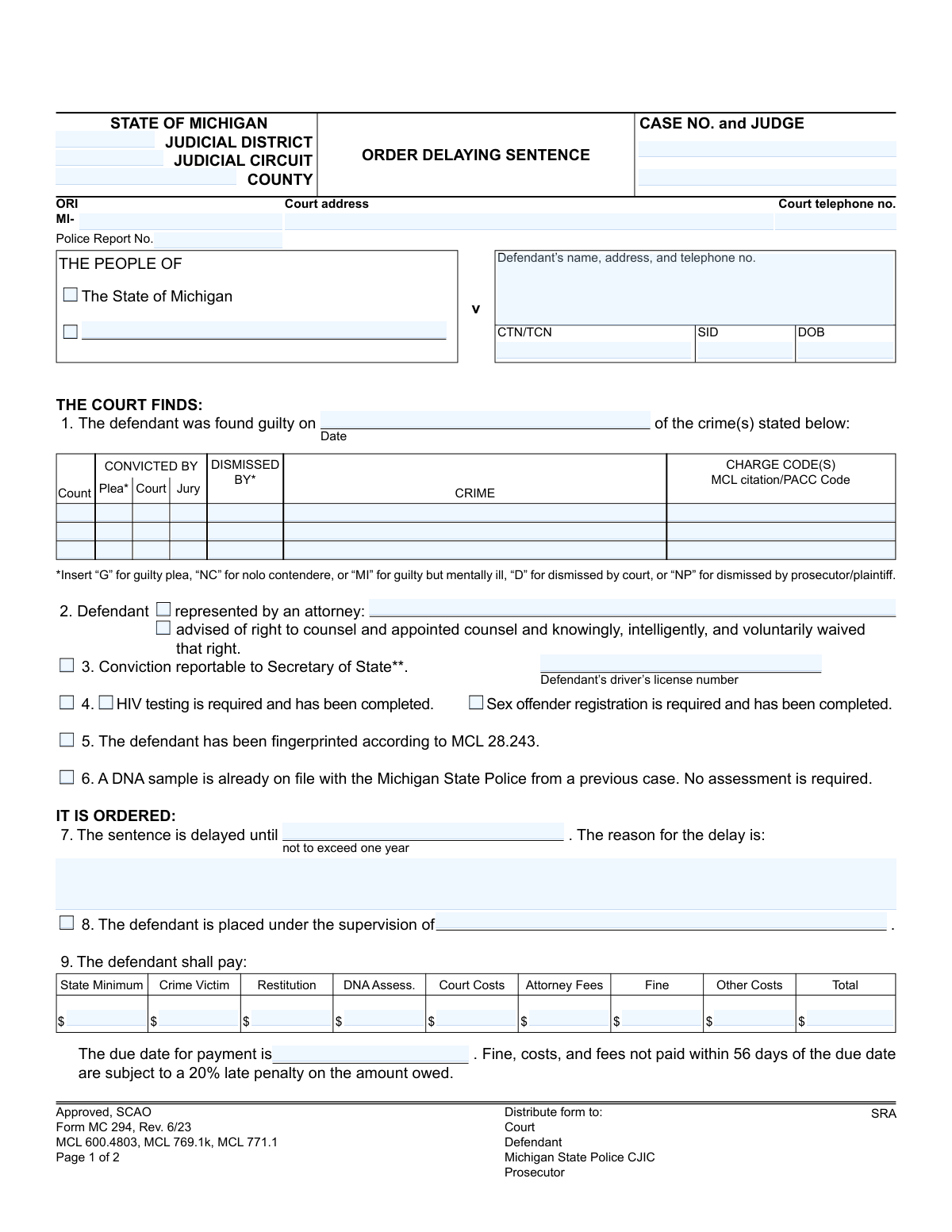
Yes! You can use AI to fill out Form MC 294, Order Delaying Sentence
Form MC 294 is a legal document issued by a Michigan court to delay a defendant's sentence for up to one year after a conviction. It details the reasons for the delay, sets conditions such as supervision and payment of fines, and outlines any required rehabilitative services. This order is not final and is followed by a final order at the end of the delay period. Today, this form can be filled out quickly and accurately using AI-powered services like Instafill.ai, which can also convert non-fillable PDF versions into interactive fillable forms.
MC 294 is part of the
Michigan court forms category on Instafill.
Our AI automatically handles information lookup, data retrieval, formatting, and form filling.
It takes less than a minute to fill out MC 294 using our AI form filling.
Securely upload your data. Information is encrypted in transit and deleted immediately after the form is filled out.
Form specifications
| Form name: | Form MC 294, Order Delaying Sentence |
| Number of fields: | 74 |
| Number of pages: | 1 |
| Language: | English |
More forms in Michigan court forms
Instafill Demo: How to fill out PDF forms in seconds with AI
How to Fill Out MC 294 Online for Free in 2026
Are you looking to fill out a MC 294 form online quickly and accurately? Instafill.ai offers the #1 AI-powered PDF filling software of 2026, allowing you to complete your MC 294 form in just 37 seconds or less.
Follow these steps to fill out your MC 294 form online using Instafill.ai:
- 1 Navigate to Instafill.ai and upload or select the MC 294 Order Delaying Sentence form.
- 2 Use the AI assistant to input case details, including the court, case number, judge, and defendant's personal information.
- 3 Provide the conviction details, such as the date, specific crimes, charge codes, and whether the conviction was by plea, court, or jury.
- 4 Specify the date until which the sentence is delayed and the court's reason for the delay.
- 5 Enter all financial obligations, including fines, court costs, restitution, and any other fees ordered by the court.
- 6 Detail any additional conditions, such as required rehabilitative services, HIV testing, or sex offender registration.
- 7 Review all the information auto-populated by the AI for accuracy before the judge signs and dates the official order.
Our AI-powered system ensures each field is filled out correctly, reducing errors and saving you time.
Why Choose Instafill.ai for Your Fillable MC 294 Form?
Speed
Complete your MC 294 in as little as 37 seconds.
Up-to-Date
Always use the latest 2026 MC 294 form version.
Cost-effective
No need to hire expensive lawyers.
Accuracy
Our AI performs 10 compliance checks to ensure your form is error-free.
Security
Your personal information is protected with bank-level encryption.
Frequently Asked Questions About Form MC 294
This is a court order that postpones your official sentencing for up to one year after being found guilty. It provides an opportunity for you to comply with specific conditions set by the court, which may influence your final sentence.
No, this form is an official court order that is completed and signed by the judge. You will receive a copy for your records, but you are not responsible for filling it out.
This means you will be monitored by a specific person or agency, such as a probation officer, to ensure you follow the court's conditions. You will likely need to report to this supervisor regularly during the delay period.
If your fines, costs, and other fees are not paid within 56 days of the due date, a 20% late penalty will be added to the total amount you owe.
No, this is not a final order. At the end of the delay period, a final order will be entered by the court, and your compliance with this order will be considered when your final sentence is determined.
This means the court will notify the Michigan Secretary of State of your conviction. This can lead to consequences for your driver's license, such as points, suspension, or revocation.
You must carefully read and follow all conditions listed in the order. This includes paying all fees on time, reporting to your supervisor, and completing any required rehabilitative services like treatment or education programs.
These are programs the judge has ordered you to complete, such as alcohol safety education or mental health treatment. Their purpose is to address underlying issues and help with your rehabilitation.
Failing to comply with the terms of the delayed sentence can result in a more severe final sentence. The judge will consider your lack of compliance when you return to court for final sentencing.
These are identifiers used by the justice system. CTN is the Case Tracking Number, SID is the State Identification Number, and DOB is your Date of Birth; they ensure your case is accurately tracked.
Since this is a court order filled out by a judge, you won't fill it out yourself. However, for other legal forms you need to complete, services like Instafill.ai use AI to accurately auto-fill fields and save time.
You can use a service like Instafill.ai to upload any legal form, including PDFs. The platform allows you to fill out the form fields digitally, sign it, and then download or share the completed document.
Services like Instafill.ai can convert flat, non-fillable PDFs into interactive, fillable forms. Simply upload the document, and the tool will automatically detect the fields for you to complete online.
Compliance MC 294
Validation Checks by Instafill.ai
1
Sentence Delay Date Logic
This check ensures the 'delayed until' date in section 7 is a future date and does not exceed one year from the 'Date found guilty' in section 1. This is crucial as the form explicitly states the delay cannot exceed one year. If the date is invalid, the order would be legally non-compliant, requiring the user to correct the date before submission.
2
Financial Fields Summation
Validates that the 'Total' amount in section 9 is the correct sum of all individual financial fields (State Minimum, Crime Victim, Restitution, DNA Assess., Court Costs, Attorney Fees, Fine, Other Costs). This check prevents mathematical errors and ensures the defendant is billed the correct total amount. A mismatch would trigger an alert, forcing a recalculation or correction of the entered values.
3
Conditional Driver's License Number Requirement
This validation checks if the 'Defendant’s driver’s license number' field is populated when the 'Conviction reportable to Secretary of State' box in section 3 is checked. This is important for ensuring compliance with state reporting requirements under MCL 257.732. If the box is checked but the number is missing, the submission should be blocked until the driver's license number is provided.
4
Conviction and Dismissal Code Validity
Ensures that the fields for 'CONVICTED BY' or 'DISMISSED BY' for each crime count contain only the allowed single-character codes ('G', 'NC', 'MI', 'D', 'NP'). Using incorrect codes can lead to misinterpretation of the court's finding and rejection by downstream systems. The validation should prevent submission and prompt the user to enter one of the valid codes as specified in the form's footnote.
5
Crime Entry Completeness
For each count where a 'CRIME' and 'CHARGE CODE(S)' are entered, this check verifies that a corresponding conviction or dismissal method is also selected. An entry cannot be in a legal limbo; it must be adjudicated as a conviction or a dismissal. This prevents incomplete or ambiguous records, forcing the user to complete the disposition for each listed charge.
6
DNA Assessment Consistency Check
This check verifies that if the box for 'A DNA sample is already on file' (Section 6) is checked, the 'DNA Assess.' field in the financial section (Section 9) is set to zero. The form states that no assessment is required if a sample is on file, so this prevents erroneous billing. If the condition is met but a fee is entered, the system should flag the inconsistency for correction.
7
Date Found Guilty Logic
Validates that the 'Date found guilty' in section 1 is a valid, non-future date. A conviction cannot occur on a future date, so this check ensures the chronological accuracy of the legal record. This prevents typographical errors and ensures the timeline of events is logical before the form is finalized.
8
Treatment Specification Requirement
If the 'Treatment' checkbox in section 10 is selected, this validation ensures that at least one of the specific treatment types (outpatient, inpatient, residential, mental health) is also checked. This is important for clarity in the court's order, ensuring the supervising agency knows the exact type of treatment required. An incomplete selection would trigger a prompt for the user to provide more specific details.
9
Case Number Format
This check validates that the 'CASE NO.' field follows the expected format for the specific judicial district or circuit. Case numbers typically have a standardized structure (e.g., YY-######-XX) that is critical for correct filing and retrieval. An incorrectly formatted number could cause the document to be misfiled or rejected by the court's case management system.
10
Defendant DOB Validity
Ensures the 'DOB' (Date of Birth) field for the defendant is a valid, full date in the past and represents a plausible age for a defendant. This check helps catch data entry errors and confirms the identity information is reasonable. An invalid or nonsensical date, such as a future date or a date implying the defendant is a toddler, would require correction.
11
Payment Due Date Logic
This validation ensures the 'due date for payment' in section 9 is a valid date that occurs on or after the 'Date found guilty'. It is logically impossible for a payment to be due before a conviction has occurred. This check maintains the chronological integrity of the order and prevents nonsensical deadlines.
12
Financial Field Format
Verifies that all individual monetary fields in section 9 (e.g., 'Fine', 'Court Costs', 'Restitution') are entered as valid, non-negative numeric or currency values. This prevents text or special characters from being entered into fields intended for calculation. Failure to pass this validation would prevent processing and prompt the user to enter valid dollar amounts.
13
CTN/TCN/SID Format Validation
This check validates the format and length of the CTN (Complaint Tracking Number), TCN (Transaction Control Number), and SID (State Identification Number) fields. These are unique, standardized identifiers crucial for linking records across different criminal justice systems. An invalid format could lead to a failure to link this court order with the defendant's broader criminal history file.
14
Required Field Completeness
Ensures that fundamentally required fields, such as 'Defendant’s name', 'Date found guilty', and the 'delayed until' date, are not left blank. These fields are essential for identifying the case, the defendant, and the core action of the order. The form cannot be considered valid or processed without this basic information.
Common Mistakes in Completing MC 294
The form requires specific single-letter codes in the conviction grid (e.g., 'G' for guilty plea, 'D' for dismissed by court). Users often mistakenly write out the full word or use an incorrect code, leading to data entry failures and inaccurate records. This can cause the order to be rejected by state reporting agencies. To avoid this, carefully consult the key at the bottom of the grid and enter only the specified letter.
When box 3, 'Conviction reportable to Secretary of State,' is applicable, filers frequently forget to enter the defendant's driver's license number. This omission creates delays and extra work, as the Secretary of State requires this information to update the defendant's driving record correctly. Always double-check that the driver's license number is included whenever a conviction is reportable.
The section for itemizing and totaling costs, fines, and fees is prone to manual calculation errors. Users may incorrectly sum the various amounts, leading to an inaccurate 'Total' and subsequent billing and collection problems. This can result in over- or under-payment by the defendant. Using a calculator or an automated system to sum the values is crucial for accuracy.
Fields like 'CASE NO.', 'CTN/TCN', 'SID', and 'ORI' are critical for linking the order to the correct individual and case file across different justice systems. These fields are often left partially blank or filled with incorrectly formatted numbers. An incomplete identifier can cause the document to be misfiled or fail to link to the defendant's criminal history, compromising the entire record. AI-powered tools like Instafill.ai can help by validating the format of these numbers.
The second page of the form includes a separate field for the 'Case No.' at the top. It is a very common mistake to overlook this field, especially when focusing on the substantive orders on that page. If the pages become separated, the second page becomes an orphaned document, making the orders on it (like rehabilitative services) unenforceable until the document is located and re-associated with the case file.
Filers may check a box for 'Treatment' or indicate supervision but fail to provide necessary details in the 'Specify:' or 'supervisor' fields. This ambiguity makes the order difficult to enforce, as probation officers or treatment providers don't have clear direction. It is essential to explicitly name the supervising agency or detail the specific type of mental health or substance abuse treatment required.
While the crime name is entered, the corresponding statutory code ('MCL citation/PACC Code') is sometimes omitted. This code is the official legal and data processing identifier for the offense, and its absence creates ambiguity and problems for state-level criminal history databases. This can lead to inaccurate reporting to the Michigan State Police and other agencies. Ensure the correct, complete code is always entered for each count.
The form explicitly requires a reason for delaying the sentence in section 7. This field is sometimes left blank, which can be a basis for legal challenge or rejection of the order, as it fails to provide a justification for the court's action. The reason must be clearly and concisely stated to ensure the order is legally sound. This is a mandatory field that must be completed for the order to be valid.
The checkboxes in section 2, detailing whether the defendant had an attorney or waived their right to one, are critically important for the legal validity of the conviction. An error here, such as checking 'represented by an attorney' when the defendant was self-represented, can create grounds for an appeal. It is vital to precisely reflect the official court record in this section. If the form is a non-fillable PDF, a tool like Instafill.ai can convert it to a fillable version, making it easier to accurately check the correct boxes.
Saved over 80 hours a year
“I was never sure if my IRS forms like W-9 were filled correctly. Now, I can complete the forms accurately without any external help.”
Kevin Martin Green
Your data stays secure with advanced protection from Instafill and our subprocessors

Robust compliance program
Transparent business model
You’re not the product. You always know where your data is and what it is processed for.
ISO 27001, HIPAA, and GDPR
Our subprocesses adhere to multiple compliance standards, including but not limited to ISO 27001, HIPAA, and GDPR.
Security & privacy by design
We consider security and privacy from the initial design phase of any new service or functionality. It’s not an afterthought, it’s built-in, including support for two-factor authentication (2FA) to further protect your account.
Fill out MC 294 with Instafill.ai
Worried about filling PDFs wrong? Instafill securely fills form-mc-294-order-delaying-sentence forms, ensuring each field is accurate.