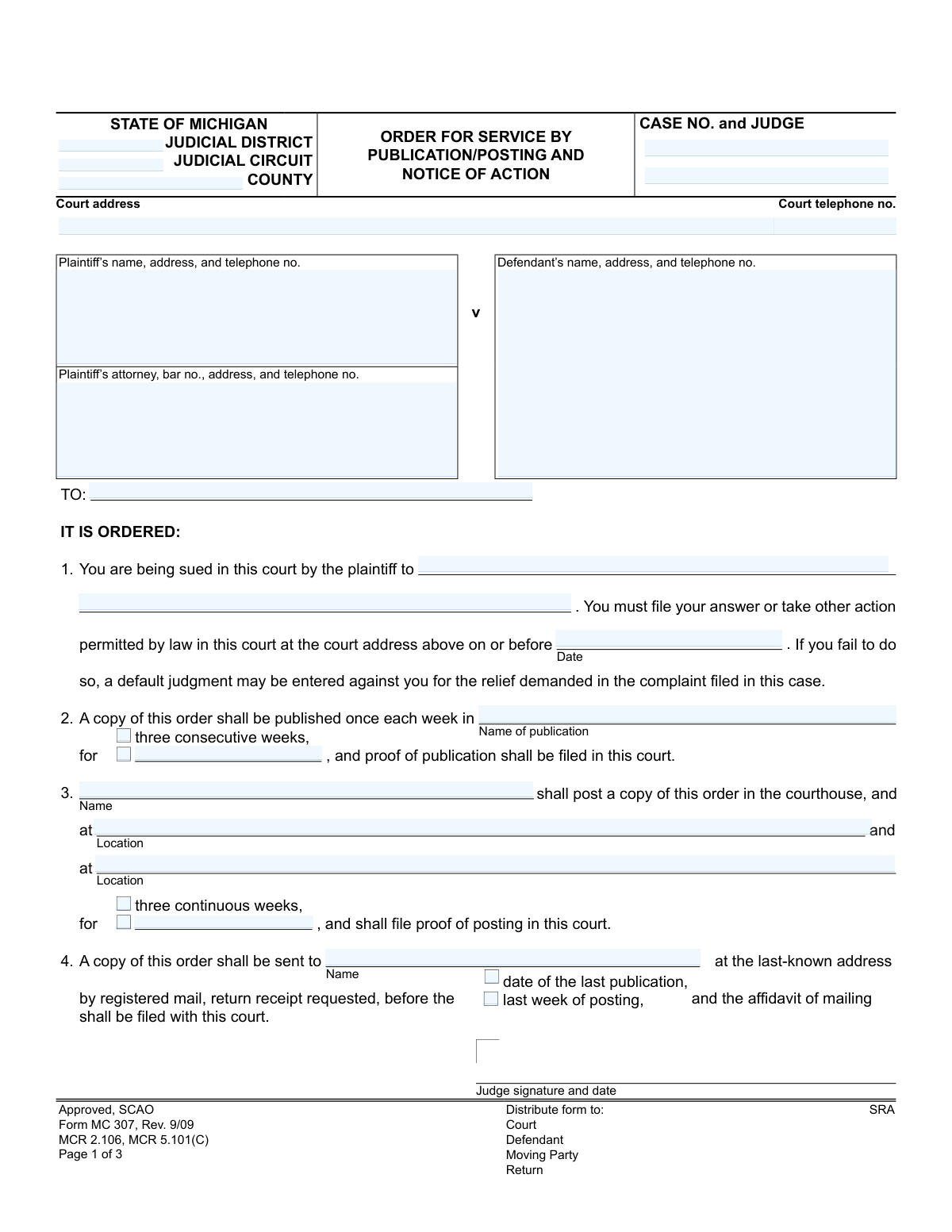
Yes! You can use AI to fill out Form MC 307, Order for Service by Publication/Posting and Notice of Action

Form MC 307 is a legal document used in Michigan courts to authorize an alternative method of serving legal papers to a defendant who cannot be located for personal service. This order allows the plaintiff to notify the defendant by publishing the notice in a newspaper or posting it in designated public places, ensuring the legal case can proceed. Today, this form can be filled out quickly and accurately using AI-powered services like Instafill.ai, which can also convert non-fillable PDF versions into interactive fillable forms.
MC 307 is part of the Michigan court forms category on Instafill.
Our AI automatically handles information lookup, data retrieval, formatting, and form filling.
It takes less than a minute to fill out MC 307 using our AI form filling.
Securely upload your data. Information is encrypted in transit and deleted immediately after the form is filled out.

Form specifications

Form name: Form MC 307, Order for Service by Publication/Posting and Notice of Action
Number of fields: 75
Number of pages: 1
Language: English
main-image

Instafill Demo: How to fill out PDF forms in seconds with AI

How to Fill Out MC 307 Online for Free in 2026

Are you looking to fill out a MC 307 form online quickly and accurately? Instafill.ai offers the #1 AI-powered PDF filling software of 2026, allowing you to complete your MC 307 form in just 37 seconds or less.
Follow these steps to fill out your MC 307 form online using Instafill.ai:
  1. 1 Navigate to Instafill.ai and upload or select Form MC 307.
  2. 2 Provide the essential case information, including the court, county, case number, judge, and details for the plaintiff and defendant.
  3. 3 Indicate the method of service by filling in the details for publication (e.g., newspaper name) or posting (e.g., courthouse location).
  4. 4 Use the AI assistant to accurately populate the order details, deadlines, and specific instructions for service.
  5. 5 Review the entire form to ensure all names, addresses, and court-ordered actions are correct before presenting it to a judge for signature.
  6. 6 After the service is completed as ordered, fill out the corresponding affidavit sections (Publishing, Posting, or Mailing) and have them notarized.
  7. 7 Download the completed and signed form, attach any required receipts or publication copies, and file it with the court.

Our AI-powered system ensures each field is filled out correctly, reducing errors and saving you time.

Why Choose Instafill.ai for Your Fillable MC 307 Form?

Speed

Complete your MC 307 in as little as 37 seconds.

Up-to-Date

Always use the latest 2026 MC 307 form version.

Cost-effective

No need to hire expensive lawyers.

Accuracy

Our AI performs 10 compliance checks to ensure your form is error-free.

Security

Your personal information is protected with bank-level encryption.

Frequently Asked Questions About Form MC 307

This form is a court order used to legally notify a defendant about a lawsuit by publishing the notice in a newspaper or posting it in a public place. It is used when the defendant cannot be located for traditional in-person service.

The plaintiff (or their attorney) prepares the form for a judge's signature. After the order is signed, the newspaper publisher, the person who posts the notice, and the person who mails the documents will each need to complete and sign an affidavit on the form.

Service by publication means the notice is printed in a newspaper for a set number of weeks. Service by posting involves displaying the notice in the courthouse and/or other specified public locations, as determined by the judge.

The affidavits for Publishing, Posting, and Mailing serve as sworn proof to the court that the judge's order for alternative service was carried out correctly. Each affidavit must be completed by the person who performed the action and then notarized.

You must attach a copy of the actual newspaper publication to the Affidavit of Publishing. For the Affidavit of Mailing, you must attach the registered mail receipt and the return receipt as proof of mailing.

This is the legal deadline by which the person being sued must respond to the lawsuit. If the defendant fails to file an answer with the court by this date, a default judgment may be entered against them.

You must arrange for the publication or posting as ordered and mail a copy to the defendant's last-known address. Afterwards, you must file the completed and notarized affidavits with the court to prove that service was completed.

You must demonstrate to the court that you have made diligent efforts to locate the defendant. If a last-known address exists, even if outdated, the court will likely still require you to mail the documents there via registered mail.

Yes, services like Instafill.ai use AI to accurately auto-fill form fields with your case information. This can save significant time and help prevent errors on complex legal forms.

You can upload the MC 307 form to the Instafill.ai platform. Its AI will identify all the form fields, allowing you to easily input your information and have it automatically and accurately placed in the correct sections.

Services like Instafill.ai can convert flat, non-fillable PDFs into interactive, fillable forms. This allows you to easily type your information directly onto the form on your computer before printing it for signatures and filing.

The person who published the notice, the person who posted the notice, and the person who mailed the documents must each sign their respective affidavit section in the presence of a notary public. The judge's signature is not notarized.

Compliance MC 307
Validation Checks by Instafill.ai

1
Ensures Case Number Consistency Across All Pages
This check verifies that the 'Case No.' entered on page 1, page 2, and page 3 are identical. Maintaining a consistent case number is crucial for linking all parts of the document correctly within the court's filing system. A mismatch could lead to the affidavits being misfiled or rejected, invalidating the service process.
2
Validates Defendant's Answer Deadline
This check confirms that the 'answer deadline' is a valid date and is set in the future from the date the order is signed by the judge. This is critical for due process, as it provides the defendant with a legally sufficient amount of time to respond. An invalid or past date would render the notice defective and could be grounds for dismissing a default judgment.
3
Verifies Judge's Signature and Date on Order
This validation confirms that the judge's signature and the date of signing are present on the first page. The judge's signature is what gives the document its legal authority as a court order. Without it, the document is merely a draft and has no legal effect, meaning any actions taken based on it are invalid.
4
Validates Notary Commission Expiration Date
This check confirms that the 'My commission expires on' date for each affidavit (Publishing, Posting, Mailing) is a valid date that has not yet passed. A notary cannot legally perform a notarial act with an expired commission. An expired date would invalidate the affidavit and therefore the proof of service, potentially jeopardizing the entire case.
5
Verifies Logical Chronology of Affidavit Dates
This validation ensures the date an affidavit is sworn ('Subscribed and sworn to before me on...') is logically consistent with the events it describes. For example, the 'Affidavit of Publishing' sworn date must be on or after the last date of publication listed. This is crucial for the affidavit's credibility, proving that the required actions were completed before the affiant swore to them.
6
Ensures Mutually Exclusive Duration for Publication
This validation checks the publication duration section (Item 2). It ensures that either the 'three consecutive weeks' checkbox is selected OR the 'for number of weeks' field is filled, but not both. This prevents ambiguity in the court's order regarding the required service period. If both are selected or neither is selected, the order is unclear and cannot be properly executed.
7
Analyzes Consistency of Publication Dates
This check examines the dates listed in the 'Affidavit of Publishing'. It verifies that the number of dates matches the required number of weeks (e.g., three dates for three weeks) and that the dates are spaced approximately one week apart. This confirms compliance with the court's order for consecutive weekly publication. Inconsistent or missing dates would indicate a failure to properly serve the defendant.
8
Verifies Defendant Name Consistency
This check ensures the defendant's name is consistent across the form: in the case caption, on the 'TO:' line, and in the mailing affidavit section. This is critical to ensure the correct party is being notified of the lawsuit. Any discrepancy could be grounds for challenging the validity of the service and any subsequent judgments.
9
Confirms Selection of Mailing Deadline Trigger
This validation verifies that for the mailing requirement (Item 4), one of the two trigger options ('date of the last publication' or 'last week of posting') is checked. This selection is a critical part of the judge's order, defining the deadline for mailing the notice to the defendant. Failure to select an option makes the order incomplete and unenforceable.
10
Ensures Completeness of Core Case Identification
This validation ensures that the 'JUDICIAL DISTRICT', 'JUDICIAL CIRCUIT', 'COUNTY', and 'CASE NO.' fields are all populated. These fields are essential for identifying the specific court and case to which this order pertains. If this information is missing, the document is legally insufficient and cannot be processed or filed by the court clerk.
11
Confirms Presence of Affiant Signature
This validation verifies that a signature is present in the affiant signature field for each of the three affidavits (Publishing, Posting, Mailing). The affiant's signature is what makes the sworn statement legally binding. A missing signature renders the affidavit invalid, meaning there is no legal proof that service was completed as described.
12
Ensures at Least One Service Method is Ordered
This validation confirms that the judge's order specifies at least one method of service by checking if either the publication details (Item 2) or the posting details (Item 3) are completed. The order must clearly direct how service is to be achieved. If neither section is filled out, the order is incomplete and provides no instructions for notifying the defendant.
13
Ensures Completeness of Mailing Affidavit Details
This check verifies that the 'Affidavit of Mailing' on page 3 is fully completed with the date of mailing, the name of the person mailed to, and their full address. This detailed information is essential to create a complete record of the mailing action. Missing any of these elements weakens the proof of service and could allow the defendant to claim they were never properly notified.
14
Validates Court Telephone Number Format
This check validates that the 'Court telephone no.' is entered in a recognizable US phone number format (e.g., 10 digits, possibly with parentheses, spaces, or hyphens). Proper formatting ensures the contact information is usable and can be correctly parsed by automated systems. It also improves readability and reduces the chance of data entry errors, which is important for court communications.

Common Mistakes in Completing MC 307

Entering an Incorrect Case Number

The case number is the single most important identifier on this form, linking the service action to the correct court file. People often mistype this number from memory or make a transcription error when copying it. An incorrect case number can cause the document to be rejected by the clerk, filed in the wrong case, or completely invalidate the service, forcing the plaintiff to restart the process and incur additional costs. Always double-check the case number against the original complaint before filling out the form.

Providing an Incomplete or Inaccurate Last-Known Address

Section 4 requires mailing the order to the defendant's last-known address. A common mistake is using an old, incomplete, or unverified address, which undermines the purpose of the notice. This can result in the defendant successfully arguing they never received notice, potentially overturning a default judgment. It is critical to perform and document due diligence to find the most current address possible before completing this section.

Failure to Attach Required Proofs

The form explicitly requires attaching physical evidence to the affidavits: a copy of the newspaper publication (page 2) and the mailing/return receipts (page 3). Filers often forget to attach these items or provide illegible copies. Without this tangible proof, the affidavits are considered incomplete, and the court cannot verify that service was performed as ordered, leading to the rejection of the filing and significant delays.

Incomplete or Invalid Notarization

The affidavits on pages 2 and 3 are sworn statements that are legally invalid without proper notarization. Common errors include the affiant forgetting to sign in the notary's presence, or the notary failing to complete all parts of their section, such as their signature, commission expiration date, or county of commission. An improperly notarized affidavit will be rejected by the court, nullifying the proof of service and requiring the form to be re-executed.

Mismatched Information Between the Order and Affidavits

The actions described in the affidavits of publishing, posting, and mailing must perfectly match what the judge commanded in the initial order. For instance, the newspaper listed in the affidavit must be the one specified in Section 2, and the posting locations must be identical to those in Section 3. Discrepancies, which often arise from carelessness, can invalidate the service because the order was not followed exactly as written.

Ambiguous or Contradictory Service Durations

In the publication (Section 2) and posting (Section 3) sections, a user might check the box for 'three consecutive weeks' while also writing a different duration in the 'for...' field. This creates a contradiction that makes the order unclear. Performing the service for the wrong duration can make it legally defective and open to challenge by the defendant. Only one, unambiguous duration should be selected.

Vague Description of Posting Locations

Section 3 of the order and the corresponding Affidavit of Posting require specifying where the notice was posted. People often use vague descriptions like 'the courthouse' without a full address or specific location (e.g., 'the public notice board on the first floor'). This ambiguity can lead to challenges that the posting was not done in a 'conspicuous place' as required by law, potentially invalidating the service.

Incorrectly Identifying Parties

Misspelling the plaintiff's or defendant's name, using a nickname instead of a legal name, or listing an incorrect business entity are frequent errors. An incorrect party name in the header or the 'TO:' field is a critical flaw. It can be argued that the notice was not directed at the correct legal person or entity, which could invalidate the service and any subsequent judgment.

Missing or Incorrect Answer Deadline

Section 1 of the order must state a specific date by which the defendant must file an answer. This field is sometimes left blank, or the date is calculated incorrectly, creating confusion. A missing or improper deadline renders the notice defective because it fails to properly inform the defendant of their legal obligation and timeline, making the service invalid.

Using an Outdated Form Version

This form is marked 'Rev. 9/09'. Courts periodically update their forms, and submitting an outdated version can lead to automatic rejection. Filers often find old versions online or reuse forms from previous cases. It is essential to always obtain the latest version of any court form directly from the official court or state website to ensure compliance. AI-powered tools like Instafill.ai can help by using the most current, fillable versions of forms.
Saved over 80 hours a year

“I was never sure if my IRS forms like W-9 were filled correctly. Now, I can complete the forms accurately without any external help.”

Kevin Martin Green

Your data stays secure with advanced protection from Instafill and our subprocessors

Robust compliance program

Transparent business model

You’re not the product. You always know where your data is and what it is processed for.

ISO 27001, HIPAA, and GDPR

Our subprocesses adhere to multiple compliance standards, including but not limited to ISO 27001, HIPAA, and GDPR.

Security & privacy by design

We consider security and privacy from the initial design phase of any new service or functionality. It’s not an afterthought, it’s built-in, including support for two-factor authentication (2FA) to further protect your account.

Fill out MC 307 with Instafill.ai

Worried about filling PDFs wrong? Instafill securely fills form-mc-307-order-for-service-by-publicationposting-and-notice-of-action forms, ensuring each field is accurate.