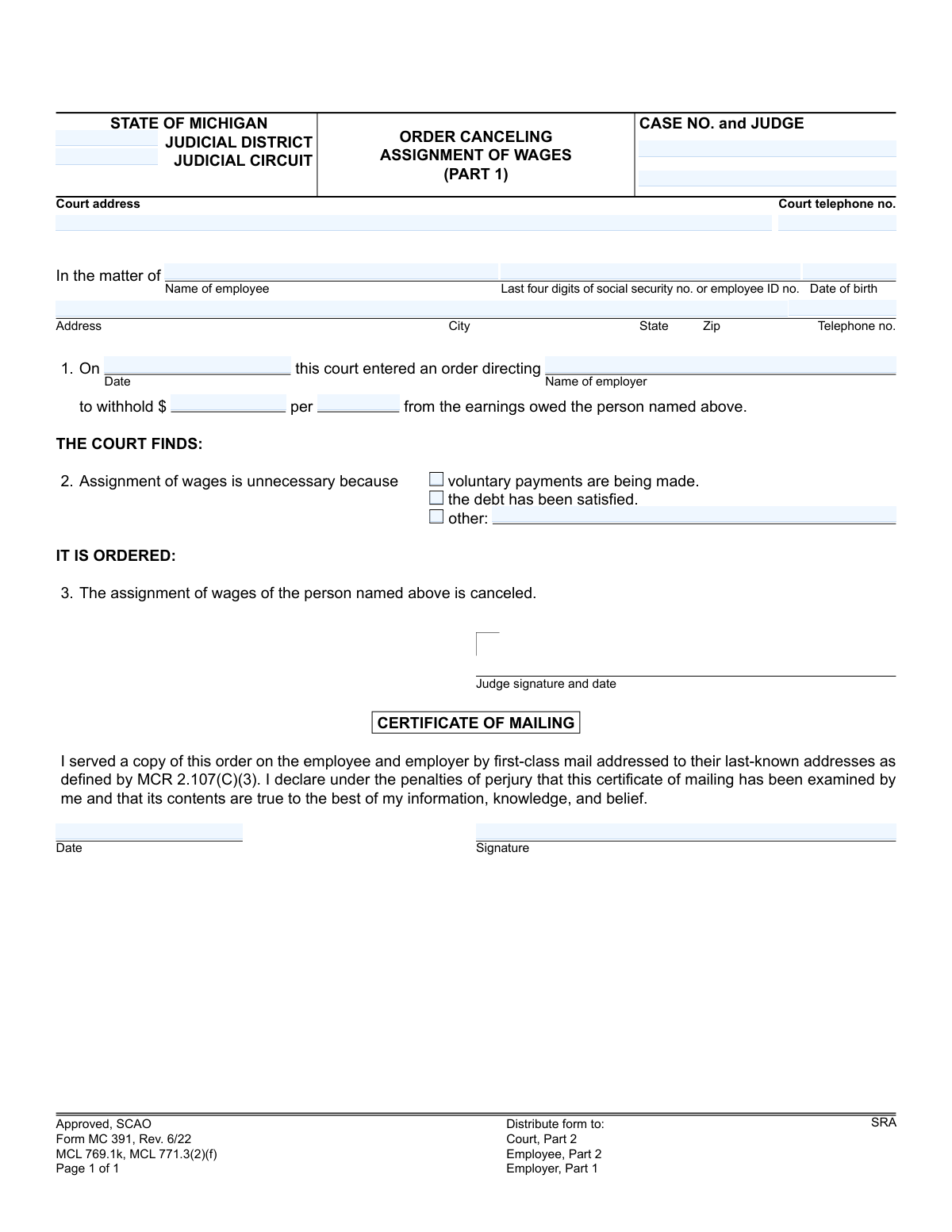
Yes! You can use AI to fill out Form MC 391, Order Canceling Assignment of Wages
Form MC 391 is a legal document issued by a Michigan court to cancel a previously established assignment of wages. This order formally instructs an employer to stop withholding money from an employee's earnings, typically because the underlying debt has been satisfied or alternative payment arrangements have been made. It is crucial for ensuring the employee receives their full pay once the obligation is met. Today, this form can be filled out quickly and accurately using AI-powered services like Instafill.ai, which can also convert non-fillable PDF versions into interactive fillable forms.
MC 391 is part of the
Michigan court forms category on Instafill.
Our AI automatically handles information lookup, data retrieval, formatting, and form filling.
It takes less than a minute to fill out MC 391 using our AI form filling.
Securely upload your data. Information is encrypted in transit and deleted immediately after the form is filled out.
Form specifications
| Form name: | Form MC 391, Order Canceling Assignment of Wages |
| Number of fields: | 40 |
| Number of pages: | 1 |
| Language: | English |
More forms in Michigan court forms
Instafill Demo: How to fill out PDF forms in seconds with AI
How to Fill Out MC 391 Online for Free in 2026
Are you looking to fill out a MC 391 form online quickly and accurately? Instafill.ai offers the #1 AI-powered PDF filling software of 2026, allowing you to complete your MC 391 form in just 37 seconds or less.
Follow these steps to fill out your MC 391 form online using Instafill.ai:
- 1 Navigate to Instafill.ai and upload or select the MC 391 form.
- 2 Provide the court and case information, including the judicial district/circuit, case number, and judge's name.
- 3 Enter the employee's personal details such as name, address, date of birth, and the last four digits of their SSN or employee ID.
- 4 Input the details of the original wage assignment order, including the date it was entered and the employer's name.
- 5 Select the reason for the cancellation, such as the debt being satisfied or voluntary payments being made.
- 6 Review all the information populated by the AI for accuracy and make any necessary corrections.
- 7 Download the completed form to be signed by the judge and distributed to the court, employee, and employer as required.
Our AI-powered system ensures each field is filled out correctly, reducing errors and saving you time.
Why Choose Instafill.ai for Your Fillable MC 391 Form?
Speed
Complete your MC 391 in as little as 37 seconds.
Up-to-Date
Always use the latest 2026 MC 391 form version.
Cost-effective
No need to hire expensive lawyers.
Accuracy
Our AI performs 10 compliance checks to ensure your form is error-free.
Security
Your personal information is protected with bank-level encryption.
Frequently Asked Questions About Form MC 391
This form is a legal court order issued in Michigan to officially stop an employer from withholding money from an employee's paycheck. It formally cancels a previous wage assignment order.
This is an official court order that is completed and signed by a judge. An employee or their attorney would typically file a motion with the court to request that this order be issued.
After the judge signs the order, the court mails a copy (Part 1) directly to your employer. This serves as the official instruction for them to cease the wage deductions.
A wage assignment is usually canceled because the debt has been fully paid off or the employee has resumed making consistent voluntary payments. The court can also cancel it for other specific reasons, which would be detailed on the form.
The form requires the court case number, judge's name, employee's name and personal details, and the employer's name. It also references the date and amount of the original wage assignment order.
You should contact the court handling your case to request that this cancellation order be issued. You will likely need to provide proof that the debt has been satisfied.
The withholding should stop during the next pay cycle after your employer receives the signed order from the court. The exact timing may vary depending on your employer's payroll processing schedule.
The form is distributed to all relevant parties. The employer receives Part 1, while the employee and the court both receive a copy of Part 2 for their records.
This is a declaration by the court clerk confirming that they have mailed a copy of the cancellation order to both the employee and the employer. It serves as the official record that notification was sent.
While the court fills out the final order, you may need to prepare a motion with the same information. Services like Instafill.ai use AI to help you accurately auto-fill your personal and case details onto documents, saving time and reducing errors.
You can upload a blank motion or related document to Instafill.ai. The platform's AI will identify the fields, allowing you to quickly populate your information before printing and filing it with the court to initiate the cancellation.
If you have a non-fillable or 'flat' PDF, you can upload it to a platform like Instafill.ai. It can convert the document into an interactive, fillable form that you can easily complete and save online.
Compliance MC 391
Validation Checks by Instafill.ai
1
Case Number Format and Completeness
This check ensures the 'Case No.' field is populated and follows the standard format for the specified judicial circuit/district. A valid case number is critical for associating the cancellation order with the correct legal file in the court's records. Failure to provide a valid and complete case number will prevent the form from being filed, potentially causing the wage assignment to continue incorrectly.
2
Employee Identifier Format
This validation verifies that the 'Last four digits of social security no. or employee ID no.' field contains either exactly four digits or a valid alphanumeric employee ID. This identifier is crucial for the employer to accurately identify the correct employee and cease wage withholding. An invalid or missing identifier could lead to the cancellation being applied to the wrong person or being rejected by the employer.
3
Employee Date of Birth Validity
This check ensures the 'Date of birth' is a valid date in a recognized format (e.g., MM/DD/YYYY) and represents a plausible age for a member of the workforce. This field serves as a secondary confirmation of the employee's identity, helping to prevent errors. An invalid date, such as one in the future or one indicating an impossible age, would flag the form for manual review.
4
Logical Date Sequence for Order and Mailing
This validation compares the 'Order Date' (from section 1, referencing the original order) and the 'Certificate of Mailing Date'. The mailing date must be on or after the date the cancellation order is signed by the judge. It is logically impossible to mail a legal order before it is officially executed, so a failure indicates a significant data entry error that must be corrected.
5
Mandatory Reason for Cancellation Selection
This check ensures that at least one of the checkboxes in section 2 ('voluntary payments are being made', 'the debt has been satisfied', or 'other') is selected. A legal basis for canceling the wage assignment is required for the order to be valid. A form submitted without a specified reason is legally incomplete and will be rejected until a reason is provided.
6
Conditional Requirement for 'Other' Reason
This validation confirms that if the 'other' checkbox is selected in section 2, the corresponding text field must contain a specific explanation. An empty 'other' field fails to provide the necessary legal justification for the cancellation, rendering the order insufficient. The form will be considered incomplete and rejected until a clear reason is entered.
7
Withholding Amount Numeric Format
This check verifies that the 'withhold amount' from the original order, as referenced in section 1, is a valid positive numeric or currency value. Although this is historical data, its accuracy is important for maintaining a complete and correct case file. A non-numeric entry indicates a data entry error and would require correction to ensure the record is accurate.
8
Withholding Period Unit Validation
This validation ensures the 'per' field, which specifies the frequency of the original withholding (e.g., 'week', 'month'), contains a recognized time unit. This detail is part of the official record of the original order being canceled. An unrecognized or blank value would flag the form for manual review to ensure the correct original order is being referenced.
9
Court Identification Completeness
This check verifies that the 'Judicial District' or 'Judicial Circuit' and 'Court Address' fields are fully populated. This information is fundamental for identifying the court with jurisdiction over the case. Missing court details would make it impossible to determine where the order originated or where it should be filed, leading to immediate rejection.
10
Employee and Employer Name Completeness
This validation ensures that both the 'Name of employee' and 'Name of employer' fields are filled out. These are the primary parties involved in the wage assignment. Missing either name makes the order ambiguous and unenforceable, as it's unclear whose wages are affected or which employer must act on the order.
11
Employee Address Completeness
This check confirms that the employee's full address, including 'Address', 'City', 'State', and 'Zip', is provided. A complete address is legally required for the 'Certificate of Mailing' to be valid, as it certifies that the employee was properly notified. An incomplete address could invalidate the service of the order and cause processing to halt.
12
Standard Phone Number Formatting
This validation checks that the 'Court telephone no.' and the employee's 'Telephone no.' adhere to a standard 10-digit format (e.g., ###-###-####). Proper formatting ensures data integrity and usability for any necessary communication. An un-parseable number would trigger a warning for data cleanup, though it may not be a blocking error.
13
Cross-Part Data Consistency
This check compares key fields like 'Case No.', 'Name of employee', and 'Name of employer' between Part 1 and Part 2 of the form. The different parts are distributed to different parties, so they must be identical to ensure everyone has the same correct information. Any mismatch indicates a serious error that must be resolved before the order can be distributed.
14
ZIP Code Format Validation
This check ensures the 'Zip' code in the employee's address is a valid 5-digit or 9-digit (ZIP+4) US postal code. A correct ZIP code is essential for the successful mailing and delivery of the order to the employee, as attested to in the 'Certificate of Mailing'. An invalid format could lead to returned mail and significant delays in the cancellation process.
Common Mistakes in Completing MC 391
Users often mistype the case number or omit important prefixes and suffixes required by the court's filing system. This typically happens due to transcription errors or not referencing the original court documents. An incorrect case number will cause the court clerk to reject the filing, delaying the cancellation of the wage assignment and requiring the form to be resubmitted correctly.
Filers may enter a common brand name or a 'doing business as' (DBA) name instead of the employer's full legal entity name (e.g., 'McDonald's' instead of 'Smithson Franchise Group LLC'). This can cause the order to be rejected by the employer's payroll or legal department, as they cannot match it to their official records. Always use the full, legal name of the employer as it appears on pay stubs or official documents to ensure the order is processed.
The form requires the date, amount, and payment frequency (e.g., 'per week') from the original wage assignment order. People often guess these details or fill them from memory, leading to inaccuracies. If this information does not precisely match the original order on file, the court or employer may be unable to identify which specific assignment to cancel, leading to rejection or continued wage withholding.
When the standard reasons for cancellation ('voluntary payments' or 'debt satisfied') do not apply, users must check 'other' and provide a specific explanation. A common mistake is writing a vague or incomplete reason, such as just 'agreement'. A judge may refuse to sign an order with an insufficient explanation, requiring the filer to amend and resubmit the form with a clear, legally valid reason for the cancellation.
The form is duplicated into 'Part 1' and 'Part 2', intended for different recipients. A frequent error is making a correction or update on one part but forgetting to apply the same change to the other. This inconsistency creates legal ambiguity and can cause confusion for the court, employer, or employee, potentially invalidating the order.
The employee's current address is required for the 'Certificate of Mailing' section, which certifies that all parties were properly notified. If an old address is used, the employee will not receive their copy of the order, and the service of process could be deemed invalid. This can lead to legal challenges or disputes later on, as the employee was not properly informed of the court action.
Mistakes in the employee's 'last four digits of social security no. or employee ID no.' or 'date of birth' are common data entry errors. These identifiers are critical for the employer's payroll system to accurately identify the employee and the specific wage assignment. Even a single-digit error can result in a mismatch, causing the employer to disregard the cancellation order and continue withholding wages.
After the judge signs the order, the filer is typically responsible for mailing copies to the employee and employer and certifying that they have done so. Many people overlook this step, failing to sign and date the 'Certificate of Mailing' section. Without this certification, the service of the order is incomplete, and it may not be considered legally binding, rendering the entire process ineffective.
When the form is printed and filled out by hand, poor penmanship can make critical information like names, dates, and case numbers unreadable. Court clerks or payroll staff may misinterpret the data, leading to processing errors, or reject the form outright. To avoid this, it's best to use a fillable version of the form. If the form is a non-fillable PDF, AI-powered tools like Instafill.ai can convert it into a fillable format, ensuring all entries are clear and legible.
Filers sometimes use a common nickname or an abbreviated version of the employee's legal name (e.g., 'Mike' instead of 'Michael'). This can cause a mismatch in the employer's payroll system, which relies on the employee's full legal name as it appears on their employment records. To prevent rejection, always use the employee's full, official name as it would appear on legal documents.
Saved over 80 hours a year
“I was never sure if my IRS forms like W-9 were filled correctly. Now, I can complete the forms accurately without any external help.”
Kevin Martin Green
Your data stays secure with advanced protection from Instafill and our subprocessors

Robust compliance program
Transparent business model
You’re not the product. You always know where your data is and what it is processed for.
ISO 27001, HIPAA, and GDPR
Our subprocesses adhere to multiple compliance standards, including but not limited to ISO 27001, HIPAA, and GDPR.
Security & privacy by design
We consider security and privacy from the initial design phase of any new service or functionality. It’s not an afterthought, it’s built-in, including support for two-factor authentication (2FA) to further protect your account.
Fill out MC 391 with Instafill.ai
Worried about filling PDFs wrong? Instafill securely fills form-mc-391-order-canceling-assignment-of-wages forms, ensuring each field is accurate.