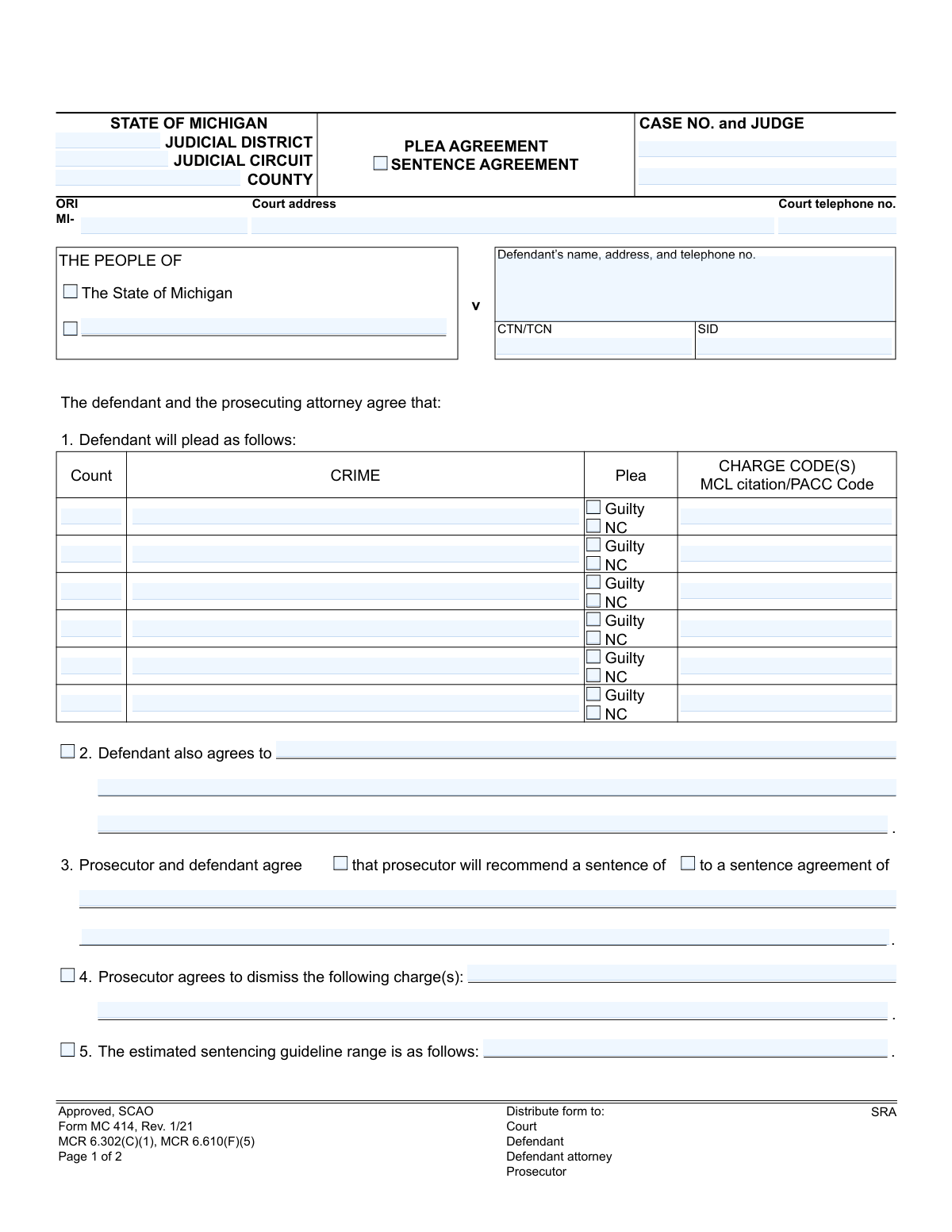
Yes! You can use AI to fill out Form MC 414, Plea Agreement / Sentence Agreement

Form MC 414 is the official State of Michigan document for recording a plea agreement between a defendant and a prosecuting attorney. It outlines the specific charges the defendant will plead to, the terms of the sentence recommendation or agreement, and any charges that will be dismissed as part of the deal. This agreement is crucial for resolving criminal cases without a trial. Today, this form can be filled out quickly and accurately using AI-powered services like Instafill.ai, which can also convert non-fillable PDF versions into interactive fillable forms.
MC 414 is part of the Michigan court forms category on Instafill.
Our AI automatically handles information lookup, data retrieval, formatting, and form filling.
It takes less than a minute to fill out MC 414 using our AI form filling.
Securely upload your data. Information is encrypted in transit and deleted immediately after the form is filled out.

Form specifications

Form name: Form MC 414, Plea Agreement / Sentence Agreement
Number of fields: 70
Number of pages: 1
Language: English
main-image

Instafill Demo: How to fill out PDF forms in seconds with AI

How to Fill Out MC 414 Online for Free in 2026

Are you looking to fill out a MC 414 form online quickly and accurately? Instafill.ai offers the #1 AI-powered PDF filling software of 2026, allowing you to complete your MC 414 form in just 37 seconds or less.
Follow these steps to fill out your MC 414 form online using Instafill.ai:
  1. 1 Navigate to Instafill.ai and upload or select the Michigan Plea Agreement, Form MC 414.
  2. 2 Use the AI to automatically populate case information, including the judicial district, county, case number, and judge's name.
  3. 3 Enter the defendant's information and specify the counts, crimes, and corresponding pleas (Guilty or Nolo Contendere).
  4. 4 Detail the specific terms of the agreement, such as additional actions by the defendant, the prosecutor's sentence recommendation, and a list of charges to be dismissed.
  5. 5 Input the estimated sentencing guideline range as agreed upon by the parties.
  6. 6 Review all entered information for accuracy with the help of AI-powered validation checks to ensure all fields are correctly completed.
  7. 7 Securely sign the document digitally (defendant, prosecutor, attorney) and distribute the final, completed form to the court and all relevant parties.

Our AI-powered system ensures each field is filled out correctly, reducing errors and saving you time.

Why Choose Instafill.ai for Your Fillable MC 414 Form?

Speed

Complete your MC 414 in as little as 37 seconds.

Up-to-Date

Always use the latest 2026 MC 414 form version.

Cost-effective

No need to hire expensive lawyers.

Accuracy

Our AI performs 10 compliance checks to ensure your form is error-free.

Security

Your personal information is protected with bank-level encryption.

Frequently Asked Questions About Form MC 414

This form is used in Michigan courts to formally document an agreement between a defendant and a prosecutor. It outlines the charges the defendant will plead to and the corresponding terms, such as dismissed charges or a specific sentence recommendation.

The form is typically completed by the prosecuting attorney and the defendant's attorney based on their negotiations. It must be signed by the defendant, the defendant's attorney, and the prosecutor to be valid.

A 'Guilty' plea is a direct admission to committing the crime. An 'NC' (Nolo Contendere) plea means you do not contest the charges, which results in a conviction but cannot be used against you as an admission of guilt in a separate civil case.

A 'recommendation' is a suggestion from the prosecutor that the judge is not required to follow. A 'sentence agreement' is a more binding term, and if the judge rejects it, the defendant may be allowed to withdraw their plea.

No, the form clearly states that if the judge does not follow the prosecutor's sentence recommendation, the defendant is not entitled to withdraw their plea. You accept this risk when signing an agreement with only a recommendation.

This section details any additional obligations the defendant must fulfill as part of the deal. Common examples include paying restitution to victims, attending counseling, or cooperating with law enforcement.

This is a calculated range of potential sentences based on the crime's severity and the defendant's criminal history. It serves as a guide for the judge but is not a guaranteed outcome.

The form specifies that if you commit misconduct during this period, you lose your right to withdraw the plea. This could also lead the judge to impose a more severe sentence than originally anticipated.

You will need the case number, court information, judge's name, and the specific MCL/PACC charge codes for the crimes involved. All terms of the agreement should be finalized by your attorney before filling out the form.

Once signed by all parties, the form is filed with the court as part of the official case record. Copies are distributed to the court, the defendant, the defendant's attorney, and the prosecutor.

Yes, services like Instafill.ai use AI to auto-fill form fields accurately and save time. While AI can assist with data entry, the legal terms of the agreement must be negotiated and reviewed by your attorney.

You can upload the Plea Agreement PDF to the Instafill.ai platform. The AI will make the document fillable, allowing you to type your case information directly into the fields and generate a completed form.

You can use a tool like Instafill.ai, which is designed to convert non-fillable PDFs into interactive, fillable forms. This allows you to easily complete the document on your computer without needing to print and write by hand.

Compliance MC 414
Validation Checks by Instafill.ai

1
Case Number Format and Presence
This check ensures the 'CASE NO.' field is not empty and conforms to the standard Michigan court case number format. A valid and correctly formatted case number is essential for associating the plea agreement with the correct court file. If the format is incorrect or the field is empty, the system should flag it for manual review to prevent filing errors.
2
Exclusive Plea Selection
For each count listed in Section 1, this validation verifies that either the 'Guilty' or 'NC' (Nolo Contendere) checkbox is selected, but not both. This is a critical logical check to ensure the defendant's plea is unambiguous for each charge. A failure would indicate a data entry error that makes the plea for that count legally void.
3
Count Row Completeness
This validation ensures that if a 'Count' field is populated, the corresponding 'Crime', 'Plea' (one checkbox), and 'Charge Code(s)' fields are also filled. An incomplete row would create an ambiguous record, making it unclear what crime the defendant is pleading to. The system should reject submissions with partially filled count rows.
4
Michigan Bar Number Validation
This check validates that the 'Prosecutor Bar no.' and 'Defendant’s attorney Bar no.' fields are present and follow the official Michigan State Bar format (typically 'P' followed by 5-6 digits). This is crucial for verifying the credentials and identity of the legal representatives involved in the agreement. An invalid bar number could indicate an unauthorized person is signing the document.
5
Signature Date Logic
This validation checks that the 'Date' fields next to the defendant's and prosecutor's signatures are present, are valid dates, and are not set in the future. It ensures the timeline of the agreement is chronologically sound and legally defensible. An invalid or future date would call the timing and validity of the agreement into question.
6
Sentence Agreement Exclusivity and Completeness
This check verifies that only one of the two options in Section 3, 'that prosecutor will recommend a sentence of' or 'to a sentence agreement of', is selected. Furthermore, it ensures that if a box is checked, the corresponding text area detailing the sentence is not empty. This prevents ambiguity about the nature and terms of the sentencing portion of the agreement.
7
ORI Number Format
This validation checks the 'ORI MI-' field to ensure it contains a value that matches the expected format for a Michigan Originating Agency Identifier (e.g., 7 alphanumeric characters). The ORI is critical for tracking and statistics, linking the case back to the originating law enforcement agency. An incorrect format could lead to data rejection by state-level systems.
8
Defendant Identification Presence
This check ensures the 'Defendant’s name, address, and telephone no.' field is not empty. This information is fundamental to the entire document, as it identifies the individual to whom the plea agreement applies. A missing defendant identity would render the entire form invalid and unenforceable.
9
Attorney Information Completeness
This validation confirms that if the 'Defendant’s attorney signature' is present, then the 'Defendant’s attorney name', 'Address', 'City, state, zip', and 'Telephone no.' fields are all completed. Complete contact information is required for all official correspondence and to verify the attorney of record. Incomplete information can cause significant communication delays and administrative issues.
10
Telephone Number Format
This check scans all telephone number fields on the form to ensure they conform to a standard 10-digit format (e.g., (XXX) XXX-XXXX or XXX-XXX-XXXX). Proper formatting is essential for data integrity and ensures that automated systems can correctly parse and use the contact numbers. It prevents errors when trying to contact the court or attorneys.
11
Dismissed Charges Conditional Requirement
This validation ensures that if the checkbox for 'Prosecutor agrees to dismiss the following charge(s)' in Section 4 is marked, the associated text area is not left blank. It is crucial to explicitly list which charges are being dismissed as part of the plea bargain. A checked box with no listed charges creates a contractual ambiguity that could lead to legal disputes.
12
Minimum Plea Requirement
This check verifies that at least one complete plea row exists in Section 1 of the agreement. A plea agreement form submitted without any actual plea is nonsensical and serves no legal purpose. This validation acts as a basic sanity check to ensure the form's primary function is being fulfilled.
13
Case Number Consistency Across Pages
This validation compares the 'CASE NO.' field on page 1 with the 'Case No.' field on page 2 to ensure they are identical. This is important for multi-page documents to guarantee that all pages belong to the same case file, preventing pages from being mismatched during processing or filing. A mismatch could lead to a page from one case being incorrectly attached to another.
14
Charge Code Format (MCL/PACC)
This check validates that the value in the 'CHARGE CODE(S)' field adheres to the known format for Michigan Compiled Laws (MCL) or PACC codes. Correctly formatted charge codes are essential for accurate criminal history reporting and statistical analysis. An invalid code could cause the record to be rejected by downstream systems or lead to an incorrect criminal record.
15
Judicial Information Presence
This validation ensures the 'Judicial District', 'Judicial Circuit', and 'County' fields are all filled out. This information is mandatory for identifying the correct jurisdiction and court where the plea is being entered. Failure to provide this information would make it impossible to file the document correctly.

Common Mistakes in Completing MC 414

Incorrect Case Number or Court Identifiers

Users often enter the wrong Case Number, or confuse the Judicial District with the Judicial Circuit. This typically happens due to typographical errors or referencing outdated documents. An incorrect case number can lead to the plea agreement being rejected by the clerk's office or filed in the wrong case, causing significant delays and potential legal complications. To avoid this, double-check all court documents for the exact case number and court details before entry.

Confusing CTN, TCN, and SID Numbers

The CTN (Complaint Tracking Number), TCN (Transaction Control Number), and SID (State Identification Number) are distinct identifiers that are frequently mixed up or entered in the wrong fields. This confusion arises because they are all long alphanumeric codes. Incorrect entry can disrupt the proper tracking of the case and the defendant's record across different state justice systems. It is crucial to carefully transcribe each number into its corresponding field on the form.

Mismatched Crime Description and Charge Code

An error occurs when the written description of the crime in the 'CRIME' column does not match the official MCL citation or PACC Code entered in the 'CHARGE CODE(S)' column. This can happen when using unofficial abbreviations or paraphrasing the charge. A mismatch can create legal ambiguity about which specific statute the defendant is pleading to, potentially invalidating the plea. Always use the exact statutory language and corresponding code from the official charging documents.

Ambiguous Plea Selection for a Count

For a given count, filers sometimes forget to check either the 'Guilty' or 'NC' (Nolo Contendere) box, or in rare cases, check both. This oversight leaves the defendant's plea for that specific charge unclear and legally ineffective. The court cannot accept an ambiguous plea, which will halt the proceedings until the form is corrected. Ensure that one, and only one, plea box is checked for every count listed in the agreement.

Misidentifying a Sentence Recommendation vs. a Sentence Agreement

A critical mistake is incorrectly checking the box for a 'prosecutor's recommendation' when a binding 'sentence agreement' (Cobbs agreement) was negotiated, or vice-versa. A recommendation is not binding on the judge, whereas a sentence agreement often allows the defendant to withdraw the plea if the judge doesn't follow it. This misunderstanding can lead to a defendant receiving an unexpected sentence with no recourse. The distinction is legally significant and must be accurately reflected on the form.

Incomplete List of Dismissed Charges

Parties sometimes fail to list every single charge that the prosecutor has agreed to dismiss as part of the plea deal. This omission can be devastating, as any charge not explicitly listed in the written agreement may not be dismissed by the court. This happens due to oversight during drafting. To prevent this, meticulously compare the agreement against the original charging documents and list every count and charge to be dismissed.

Entering an Inaccurate Sentencing Guideline Range

The estimated sentencing guideline range entered in Section 5 is sometimes incorrect due to miscalculation or using outdated scoring. This misinforms the defendant and the court about the likely sentencing outcome, which can be a basis for appealing the plea later. An inaccurate range undermines the 'knowing and voluntary' nature of the plea. The guidelines must be calculated carefully based on the defendant's final score.

Missing Signatures or Incorrect Dates

A plea agreement is not valid until it is signed and dated by the defendant, the defendant's attorney, and the prosecutor. Forgetting a signature or entering the wrong date is a common administrative error that can invalidate the entire document. This often happens when forms are passed between multiple parties for review. Before filing, perform a final check to ensure all signature and date lines are properly completed.

Incorrect or Missing Attorney Bar Numbers

The defense attorney's and prosecutor's bar numbers are required for official identification and verification with the State Bar. These numbers are often entered incorrectly, transposed, or left blank. This can cause delays in processing while the court clerk verifies the attorneys' credentials. Using an AI-powered tool like Instafill.ai can help prevent this by saving and auto-populating correct attorney information, including bar numbers, on recurring forms.

Vague Language in Additional Agreements

In Section 2, 'Defendant also agrees to,' parties may use imprecise or ambiguous language to describe additional conditions like restitution, cooperation, or treatment programs. This ambiguity can lead to future disputes over the terms of the agreement. For example, simply writing 'pay restitution' without specifying the amount or to whom it is owed is insufficient. All terms must be defined with absolute clarity to be enforceable. If the form is a non-fillable PDF, a tool like Instafill.ai can convert it to a fillable version, making it easier to type clear and complete terms.
Saved over 80 hours a year

“I was never sure if my IRS forms like W-9 were filled correctly. Now, I can complete the forms accurately without any external help.”

Kevin Martin Green

Your data stays secure with advanced protection from Instafill and our subprocessors

Robust compliance program

Transparent business model

You’re not the product. You always know where your data is and what it is processed for.

ISO 27001, HIPAA, and GDPR

Our subprocesses adhere to multiple compliance standards, including but not limited to ISO 27001, HIPAA, and GDPR.

Security & privacy by design

We consider security and privacy from the initial design phase of any new service or functionality. It’s not an afterthought, it’s built-in, including support for two-factor authentication (2FA) to further protect your account.

Fill out MC 414 with Instafill.ai

Worried about filling PDFs wrong? Instafill securely fills form-mc-414-plea-agreement-sentence-agreement forms, ensuring each field is accurate.