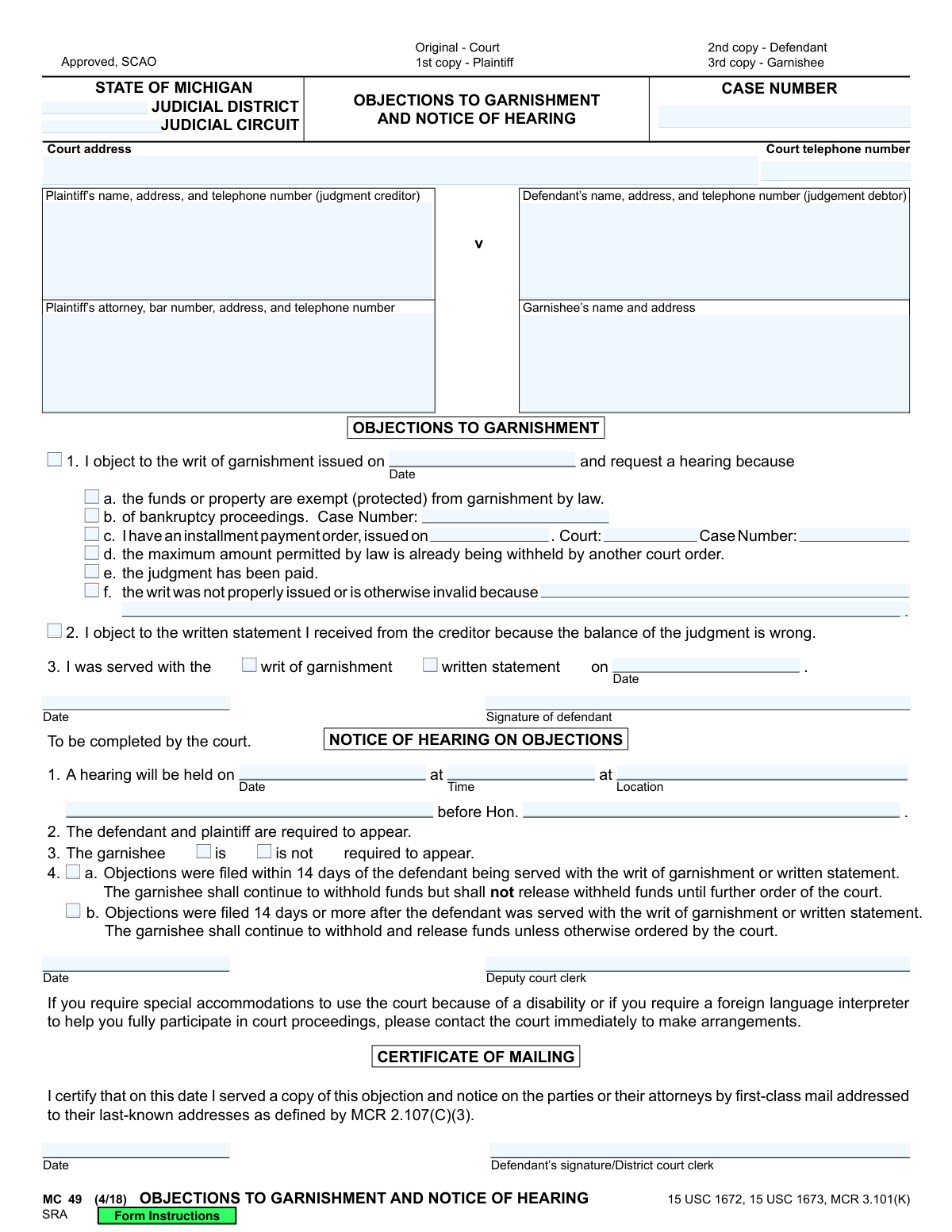
Yes! You can use AI to fill out Form MC 49, Objections to Garnishment and Notice of Hearing
Form MC 49, Objections to Garnishment and Notice of Hearing, is a legal document used in Michigan courts by a debtor to formally contest the garnishment of their wages or property. It is important because it provides a legal mechanism for the debtor to present reasons why the garnishment is improper, such as the funds being exempt, the judgment being paid, or procedural errors. Today, this form can be filled out quickly and accurately using AI-powered services like Instafill.ai, which can also convert non-fillable PDF versions into interactive fillable forms.
MC 49 is part of the
Michigan court forms category on Instafill.
Our AI automatically handles information lookup, data retrieval, formatting, and form filling.
It takes less than a minute to fill out MC 49 using our AI form filling.
Securely upload your data. Information is encrypted in transit and deleted immediately after the form is filled out.
Form specifications
| Form name: | Form MC 49, Objections to Garnishment and Notice of Hearing |
| Number of fields: | 43 |
| Number of pages: | 1 |
| Language: | English |
More forms in Michigan court forms
Instafill Demo: How to fill out PDF forms in seconds with AI
How to Fill Out MC 49 Online for Free in 2026
Are you looking to fill out a MC 49 form online quickly and accurately? Instafill.ai offers the #1 AI-powered PDF filling software of 2026, allowing you to complete your MC 49 form in just 37 seconds or less.
Follow these steps to fill out your MC 49 form online using Instafill.ai:
- 1 Navigate to Instafill.ai and upload the MC 49 form or select it from the platform's template library.
- 2 Use the AI assistant to populate the header with court information, the case number, and the names and addresses of the plaintiff, defendant, and garnishee.
- 3 In the 'Objections to Garnishment' section, check the box or boxes that correspond to your reason for objecting.
- 4 If required, provide additional details for your objection, such as a bankruptcy case number, the date of an installment payment order, or an explanation of why the writ is invalid.
- 5 Enter the date you were served with the garnishment, then date and sign the form to certify your objections.
- 6 Review the completed form for accuracy, then download the final document to file with the court and serve on the other parties as instructed.
Our AI-powered system ensures each field is filled out correctly, reducing errors and saving you time.
Why Choose Instafill.ai for Your Fillable MC 49 Form?
Speed
Complete your MC 49 in as little as 37 seconds.
Up-to-Date
Always use the latest 2026 MC 49 form version.
Cost-effective
No need to hire expensive lawyers.
Accuracy
Our AI performs 10 compliance checks to ensure your form is error-free.
Security
Your personal information is protected with bank-level encryption.
Frequently Asked Questions About Form MC 49
This form is used by a defendant (judgment debtor) to officially object to a writ of garnishment and request a court hearing to dispute it. You should use it if you believe your wages or bank account are being garnished improperly.
The defendant, also known as the judgment debtor, is the person who fills out this form. This is the individual whose money, property, or wages are being garnished.
You will need your court case number, the date the writ of garnishment was issued, and the names and addresses for the plaintiff and the garnishee. You must also select a reason for your objection and provide any supporting details, like a bankruptcy case number.
Common reasons include that the funds are legally protected (exempt), you are in bankruptcy, the judgment has already been paid, or the maximum legal amount is already being withheld by another order. You can also object if you believe the writ was not issued correctly.
After you file the form, the court will schedule a hearing and fill in the 'Notice of Hearing' section. You will receive a copy with the date, time, and location of the hearing, which you are required to attend.
If you file your objection within 14 days of being served, the garnishee must hold the funds but cannot send them to the plaintiff until the court rules. If you file after 14 days, the garnishee may continue to withhold and release funds unless the court orders otherwise.
Yes, the 'Notice of Hearing' section explicitly states that the defendant and plaintiff are required to appear at the scheduled hearing.
You must file the original with the court and mail copies to the plaintiff (or their attorney) and the garnishee. You must then complete the 'Certificate of Mailing' section to confirm you have sent these copies.
In this space, you need to briefly explain the specific procedural or legal error you believe makes the garnishment invalid. This could relate to improper service, incorrect information on the writ, or other legal defects.
Yes, services like Instafill.ai use AI to help you accurately auto-fill form fields with your personal and case information, which saves time and helps reduce errors.
You can use a service like Instafill.ai to complete the form online. Simply upload the MC 49 form to the platform, and it will become an interactive document you can type into directly.
If you have a non-fillable or 'flat' PDF, you can upload it to a service like Instafill.ai. Their technology can convert the document into an interactive, fillable form that you can easily complete on your computer.
Exempt funds are types of income or benefits that are legally protected from being taken by creditors. This often includes Social Security, disability, and unemployment benefits, among others.
Compliance MC 49
Validation Checks by Instafill.ai
1
Case Number Presence and Format
Checks that the 'Case Number' field is not empty and conforms to the standard Michigan court format. This number is the primary identifier for the legal proceeding, and an incorrect or missing number would prevent the objection from being filed in the correct case. Failure to validate could lead to the document being rejected or misfiled.
2
Mandatory Objection Reason Selection
Ensures that the defendant has selected at least one checkbox from the list of objection reasons (sections 1a-f or section 2). An objection must state its legal basis to be considered by the court. If no reason is provided, the form is incomplete and cannot be processed, as the court and plaintiff would not know the grounds for the hearing.
3
Conditional Bankruptcy Case Number Requirement
Validates that if the 'Of bankruptcy proceedings' checkbox is selected, the corresponding 'Case Number 2' field is filled out. This is crucial because a bankruptcy filing creates an automatic stay on collection activities, but the court needs the specific case number to verify the bankruptcy claim. An empty field would render the objection basis unverifiable and likely invalid.
4
Conditional Installment Order Details Requirement
Verifies that if the 'I have an installment payment order' checkbox is checked, the associated fields for issue date, court, and case number are all populated. This information is necessary for the court to locate and confirm the existence and terms of the payment order. Without these details, the claim cannot be substantiated and the objection may be dismissed.
5
Conditional 'Invalid Writ' Explanation
Requires that the 'The Writ Was Not Properly Issued Or Is Otherwise Invalid Reasoning' text field is not empty if the corresponding checkbox is selected. This is a catch-all objection that requires specific facts to be alleged. A blank explanation provides no basis for the claim, making it impossible for the court to evaluate and likely leading to its dismissal.
6
Logical Date Sequence for Writ and Service
Confirms that the 'The Writ Of Garnishment Issue Date' is on or before the date the defendant was served. It is logically impossible for a person to be served with a legal document before it has been officially issued by the court. This check prevents data entry errors that would create a nonsensical timeline of events.
7
Logical Date Sequence for Service and Objection
Ensures the defendant's signature date ('Date 2') is on or after the date they were served ('Date' under section 3). A defendant cannot legally object to a document they have not yet received. This validation maintains the logical and legal integrity of the filing sequence.
8
Future Hearing Date
Validates that the 'Hearing Date' entered by the court clerk is a date in the future. Scheduling a hearing for a past date is a critical error that would make the notice invalid and require correction and re-issuance. This check ensures the notice provides functional information to the parties involved.
9
Defendant Signature Presence
Checks that the 'Signature of defendant' field is not empty. A signature is required to attest to the truthfulness of the statements made in the objection and to make the document legally binding. An unsigned form is considered invalid and will be rejected by the court clerk.
10
Mutually Exclusive Garnishee Appearance Status
Ensures that only one of the two checkboxes, 'The garnishee is required to appear' or 'The garnishee is not required to appear,' can be selected. These options are mutually exclusive and selecting both would create an ambiguous and unenforceable order. This validation prevents contradictory instructions from being issued by the court.
11
Mutually Exclusive 14-Day Filing Status
Validates that only one of the two checkboxes, 'Objections were filed within 14 days' or 'Objections were filed 14 days or more after,' can be selected. This status has direct legal consequences on whether the garnishee can release funds. The system must enforce a single, clear selection to avoid legal ambiguity and improper handling of garnished funds.
12
Defendant Contact Information Completeness
Verifies that the defendant's name, address, and telephone number fields are all populated. This contact information is essential for the court and the plaintiff to send official notices and communications regarding the hearing. Incomplete information can lead to procedural delays or claims of improper notice.
13
Valid Date Formatting
Checks that all date fields on the form are entered in a valid and consistent format (e.g., MM/DD/YYYY). Incorrect or ambiguous date formats can lead to miscalculation of critical deadlines, such as the 14-day objection period. This validation ensures data integrity for all time-sensitive aspects of the legal process.
14
Court Identifier Presence
Ensures that either the 'Judicial District' or 'Judicial Circuit' field is completed. This information, along with the case number, is fundamental to routing the document to the correct court and jurisdiction. Submitting a form without this information would result in it being rejected as it cannot be assigned to a specific court.
Common Mistakes in Completing MC 49
People often mis-enter the case number from the original garnishment writ, leave it blank, or use a number from a different legal matter. This is a critical error because the court clerk cannot file the objection in the correct case file, leading to significant delays or the objection being ignored entirely. Always double-check the case number against the writ of garnishment you received to ensure it is entered exactly as it appears.
The form requires additional information for certain objections, such as a case number for bankruptcy (1b) or a written reason for an invalid writ (1f). Defendants often check a box but forget to provide the necessary supporting details. This makes the objection incomplete and gives the court no basis to grant a hearing, likely resulting in its dismissal and the continuation of the garnishment.
When selecting option 1f ('the writ was not properly issued or is otherwise invalid'), individuals may write a general complaint like 'this is not fair' instead of a specific procedural or legal defect. The court needs a concrete reason, such as improper service or a major calculation error, to evaluate the objection. A vague statement will almost certainly be disregarded, and the garnishment will proceed.
In section 3, defendants must enter the date they were served with (received) the garnishment papers, not the date they are filling out the form. This date is crucial as it starts the 14-day deadline for filing objections. Entering the wrong date can make a timely objection appear late, potentially causing the court to allow the garnishee to release the funds to the creditor before a hearing.
An unsigned legal document is invalid. In the rush to file, defendants may forget to sign and date the 'Objections to Garnishment' section. The court will reject an unsigned form, meaning the objection is not officially filed, which can cause the defendant to miss the filing deadline and lose their chance to be heard.
The 'Garnishee' is the third party holding the funds, such as an employer or a bank, not the plaintiff (creditor). A common mistake is to re-enter the plaintiff's information in the garnishee field. This error prevents the garnishee from receiving the notice of objection, meaning they may continue to release funds to the creditor when they should be holding them pending a court order.
After filling out the objections, the defendant must mail a copy to the plaintiff and/or their attorney and then sign the 'Certificate of Mailing' to prove it was done. Forgetting to complete this step means there is no official record that the other party was notified of the objection. This procedural failure can lead to the court dismissing the objection entirely.
The middle section of the form, titled 'NOTICE OF HEARING ON OBJECTIONS,' is clearly marked 'To be completed by the court.' Some individuals mistakenly try to fill in a hearing date, time, or judge's name themselves. This creates confusion and may require the court clerk to issue a corrected notice, delaying the process. Leave this entire section blank.
When objecting due to bankruptcy (1b) or an existing installment payment order (1c), it is crucial to provide the case number for that specific proceeding, not the case number for the current garnishment. Using the wrong number prevents the court from verifying the existence of the bankruptcy or payment order. This failure of proof will cause the objection to be denied. AI-powered tools like Instafill.ai can help by validating data formats to reduce such errors.
A surprising number of people fill out their personal information and sign the form but fail to check any of the boxes (1a-1f or 2) to specify the reason for their objection. The form is useless without a stated legal basis for the objection. The court will simply reject it, and the garnishment will continue as if no objection was ever filed. If the form is a non-fillable PDF, a tool like Instafill.ai can convert it to a fillable version to ensure all necessary fields are completed.
Saved over 80 hours a year
“I was never sure if my IRS forms like W-9 were filled correctly. Now, I can complete the forms accurately without any external help.”
Kevin Martin Green
Your data stays secure with advanced protection from Instafill and our subprocessors

Robust compliance program
Transparent business model
You’re not the product. You always know where your data is and what it is processed for.
ISO 27001, HIPAA, and GDPR
Our subprocesses adhere to multiple compliance standards, including but not limited to ISO 27001, HIPAA, and GDPR.
Security & privacy by design
We consider security and privacy from the initial design phase of any new service or functionality. It’s not an afterthought, it’s built-in, including support for two-factor authentication (2FA) to further protect your account.
Fill out MC 49 with Instafill.ai
Worried about filling PDFs wrong? Instafill securely fills form-mc-49-objections-to-garnishment-and-notice-of-hearing forms, ensuring each field is accurate.