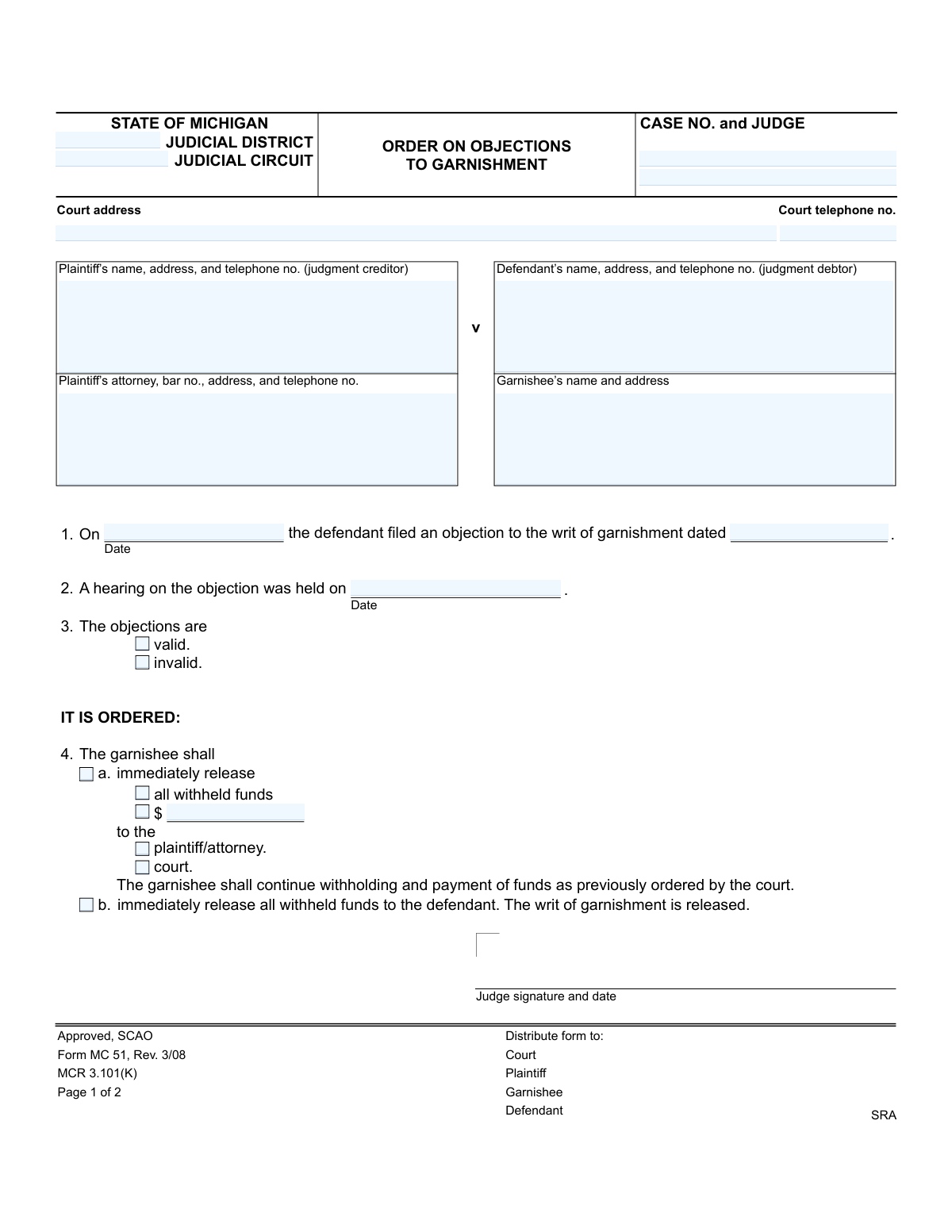
Yes! You can use AI to fill out Form MC 51, Order on Objections to Garnishment
Form MC 51, Order on Objections to Garnishment, is a legal document issued by a judge in Michigan to rule on a debtor's challenge to a garnishment. This order is crucial as it determines whether a creditor can continue to collect funds from a debtor's wages or bank account, and it provides clear instructions to the garnishee (e.g., an employer or bank). The form officially records the court's decision, making it binding for all parties involved. Today, this form can be filled out quickly and accurately using AI-powered services like Instafill.ai, which can also convert non-fillable PDF versions into interactive fillable forms.
MC 51 is part of the
Michigan court forms category on Instafill.
Our AI automatically handles information lookup, data retrieval, formatting, and form filling.
It takes less than a minute to fill out MC 51 using our AI form filling.
Securely upload your data. Information is encrypted in transit and deleted immediately after the form is filled out.
Form specifications
| Form name: | Form MC 51, Order on Objections to Garnishment |
| Number of fields: | 25 |
| Number of pages: | 1 |
| Language: | English |
More forms in Michigan court forms
Instafill Demo: How to fill out PDF forms in seconds with AI
How to Fill Out MC 51 Online for Free in 2026
Are you looking to fill out a MC 51 form online quickly and accurately? Instafill.ai offers the #1 AI-powered PDF filling software of 2026, allowing you to complete your MC 51 form in just 37 seconds or less.
Follow these steps to fill out your MC 51 form online using Instafill.ai:
- 1 Navigate to Instafill.ai and upload or select the MC 51, Order on Objections to Garnishment form.
- 2 Enter the court and case information, including the judicial district/circuit, case number, and judge's name.
- 3 Provide the full names, addresses, and contact information for the plaintiff (creditor), defendant (debtor), and the garnishee.
- 4 Input the relevant dates, including when the objection was filed, the date of the original writ of garnishment, and the date of the hearing.
- 5 Indicate the court's ruling by checking if the objections are 'valid' or 'invalid' and specifying the order for the garnishee regarding the withheld funds.
- 6 Review all auto-filled information for accuracy before the judge signs and dates the order to finalize the ruling.
- 7 Complete the Certificate of Mailing section after the order is signed, and distribute copies to the court, plaintiff, garnishee, and defendant.
Our AI-powered system ensures each field is filled out correctly, reducing errors and saving you time.
Why Choose Instafill.ai for Your Fillable MC 51 Form?
Speed
Complete your MC 51 in as little as 37 seconds.
Up-to-Date
Always use the latest 2026 MC 51 form version.
Cost-effective
No need to hire expensive lawyers.
Accuracy
Our AI performs 10 compliance checks to ensure your form is error-free.
Security
Your personal information is protected with bank-level encryption.
Frequently Asked Questions About Form MC 51
This is a legal document issued by a judge in Michigan. It states the court's final decision after a defendant has objected to their wages or bank account being garnished.
The judge or court staff fills out this form after a hearing on the garnishment objection. It is not a form for the plaintiff, defendant, or garnishee to complete.
This form informs you of the judge's ruling on the garnishment objection. It will state whether the objection was found 'valid' or 'invalid' and what the garnishee (like your employer or bank) must do with the withheld money.
If the judge marks the objection as 'valid,' the garnishee will be ordered to immediately release all withheld funds back to you (the defendant). The writ of garnishment will then be canceled.
If the objection is found 'invalid,' the garnishee will be ordered to release the withheld funds to the plaintiff (the creditor) or the court. The garnishment will likely continue as previously ordered.
A copy of the completed and signed order is sent to the court, the plaintiff (creditor), the defendant (debtor), and the garnishee (the party holding the funds, like an employer or bank).
You must follow the judge's instructions in section 4 of the order precisely. This will direct you to either release funds to the defendant and stop the garnishment, or release funds to the plaintiff/court and continue withholding.
The order instructs the garnishee to 'immediately release' the funds. The exact timing depends on the garnishee's processing procedures, but you should contact them if you don't see the funds within a few business days.
The Certificate of Mailing on the second page is signed by a court clerk to certify that a copy of the order was officially mailed to all parties involved in the case. This serves as proof of notification.
The judge uses the case information, the dates of the garnishment and objection, and the evidence and arguments presented at the hearing to make their decision and complete the order.
While you don't fill out this specific order, AI services like Instafill.ai can help you accurately fill out related forms, such as the initial 'Objection to Garnishment' form you would file with the court.
To fill out a related form like the objection itself, you can upload the PDF to Instafill.ai. The platform allows you to type directly into the fields, add your signature, and then download the completed document for filing.
Services like Instafill.ai can convert non-fillable, 'flat' PDFs into interactive forms. Simply upload the document, and the AI will identify the fields, allowing you to fill it out easily on your computer.
Compliance MC 51
Validation Checks by Instafill.ai
1
Case Number Presence and Consistency
This check verifies that the 'Case No.' field is populated on both page 1 and page 2 of the form and that the values are identical. The case number is the primary identifier for the legal proceeding, and its absence or inconsistency can lead to misfiling and incorrect application of the order. If the check fails, the user will be prompted to enter a valid and consistent case number in all required locations.
2
Date Sequence Logic
Validates the chronological order of key dates: the 'garnishment date' must be on or before the 'objection date', which must be on or before the 'hearing date'. This ensures the legal timeline is logical and accurately reflects the sequence of events. An illogical date sequence would invalidate the order's premise, so the system will flag the error and require correction.
3
Exclusive Objection Status Selection
This validation ensures that only one of the two checkboxes, 'valid' or 'invalid' (in section 3), is selected. The objections cannot be both valid and invalid simultaneously. This check prevents ambiguity in the court's ruling. If both or neither are selected, the form submission will be blocked until a single, clear choice is made.
4
Exclusive Order Disposition
Verifies that only one of the primary order actions, either 4a (release funds to plaintiff/court) or 4b (release funds to defendant), is selected. These actions are mutually exclusive outcomes of the hearing. An order with conflicting or missing dispositions is unenforceable. The system will require the user to select exactly one of these options to proceed.
5
Conditional Fund Release Amount Logic
If order action 4a is selected, this check ensures that either the 'all withheld funds' box is checked, or the specific amount box is checked and the corresponding amount field contains a valid, positive currency value. This prevents an incomplete or ambiguous instruction to the garnishee regarding the amount of money to release. Failure will result in an error message requiring the user to specify the funds correctly.
6
Conditional Payee Selection
When order action 4a is selected, this validation confirms that a payee, either 'plaintiff/attorney' or 'court', has been designated. The garnishee must have clear instructions on who to send the funds to. If no payee is selected, the order is incomplete, and the system will prompt the user to make a selection.
7
Required Party Information Completeness
Ensures that the name, address, and telephone number for the Plaintiff (judgment creditor) and Defendant (judgment debtor) are fully provided. This information is legally required to identify the parties involved and ensure proper notification. Incomplete party information will halt submission until all required fields are filled.
8
Garnishee Information Completeness
This check verifies that the Garnishee's name and address are filled out. The garnishee is the entity holding the funds and the direct recipient of this order, so their correct identification is critical for the order to be executed. The form cannot be processed without complete garnishee information.
9
Court and Judge Identification
Validates that the 'judicial district', 'judicial circuit', 'court address', and 'judge' name fields are all populated. This information establishes the jurisdiction and authority behind the order. An order without proper court identification is invalid, so the system will flag these fields as required.
10
Michigan Bar Number Format
If the 'Plaintiff’s attorney' section is filled out, this check validates that the 'bar no.' field follows the specific format for Michigan State Bar numbers (a 'P' followed by 5 digits, e.g., P12345). This ensures the attorney is properly identified and is a valid member of the state bar. An incorrect format will trigger a validation error.
11
Standard Phone Number Format
This validation checks all phone number fields (for the court, plaintiff, defendant, and plaintiff's attorney) to ensure they conform to a standard 10-digit format (e.g., XXX-XXX-XXXX or (XXX) XXX-XXXX). Proper formatting ensures the contact information is usable and consistent. The system will request re-entry for any non-compliant phone numbers.
12
Certificate of Mailing Date Validation
Ensures the 'Date' field in the 'Certificate of Mailing' section is populated with a valid date. This date is legally significant as it establishes when the order was served on the parties. The check also verifies this date is on or after the judge's signature date, as the order cannot be mailed before it is signed. An error will be shown if the date is missing or precedes the order date.
Common Mistakes in Completing MC 51
Users often forget to enter the case number on the second page or write it differently than on the first page. This is a critical error as the case number links the order to the correct court file. An incorrect or missing number can lead to the document being misfiled or rejected, delaying the entire process. To avoid this, ensure the case number is entered identically on all pages; AI tools like Instafill.ai can auto-populate this field across the document to ensure consistency.
A frequent mistake is confusing the roles of the Plaintiff (judgment creditor), Defendant (judgment debtor), and Garnishee (the party holding the funds, like an employer). Incorrectly listing these parties can render the order unenforceable or cause it to be sent to the wrong individuals. Always double-check that each party is listed in the correct field with their full, accurate name and address.
This form requires three distinct dates: the objection filing date, the original garnishment writ date, and the hearing date. People often mix these up, creating a confusing and inaccurate timeline for the court record. An incorrect date can create legal vulnerabilities or require the order to be amended, causing delays. Carefully review the case file to ensure each date is entered correctly in its respective field.
In Section 3, the person filling out the form must check either 'valid' or 'invalid' to reflect the judge's decision, but sometimes neither box is checked, or both are. This ambiguity makes the order defective because the basis for the subsequent action in Section 4 is unclear. This critical error requires the form to be returned for correction, halting any action by the garnishee.
Section 4 contains several checkboxes that dictate the garnishee's actions, and it's easy to make conflicting selections. For example, checking both box 4a (release funds to plaintiff) and 4b (release funds to defendant) creates an impossible instruction. Such contradictions make the order unenforceable and require clarification from the court, causing significant delays for all parties involved.
In Section 4a, if the option to release a specific dollar amount is chosen, the filer must enter the precise value in the space provided. A common mistake is checking the box for a partial amount but leaving the dollar field blank. This makes the order vague and non-actionable, as the garnishee has no instruction on how much money to release.
The garnishee is the party who must comply with the order, so their name and address must be perfectly accurate. Mistakes like using a general corporate address instead of the specific legal/payroll department, or misspelling the name, can result in the order never being received. This means funds will remain frozen and the court's order will not be executed until the error is corrected and the form is re-sent.
The Certificate of Mailing on page 2 is legal proof that all parties have been notified of the court's order. Fillers, especially clerks or attorneys, sometimes forget to sign and date this section. Without a completed certificate, a party could claim they were never served the order, potentially creating grounds to challenge it later.
This official court form is often available as a non-fillable PDF, requiring users to print and complete it by hand. Illegible handwriting can lead to misinterpretation of names, addresses, or case numbers, causing the form to be rejected by the court clerk. To prevent this, use an AI-powered tool like Instafill.ai, which can convert flat PDFs into digitally fillable forms, ensuring all entries are clear and legible.
The form requires the bar number for the plaintiff's attorney, which is a unique identifier for practicing attorneys. This field is often left blank, either by oversight or because the person filling out the form doesn't have it handy. Court clerks may reject filings with a missing bar number, as it is essential for verifying the attorney's credentials and good standing.
Saved over 80 hours a year
“I was never sure if my IRS forms like W-9 were filled correctly. Now, I can complete the forms accurately without any external help.”
Kevin Martin Green
Your data stays secure with advanced protection from Instafill and our subprocessors

Robust compliance program
Transparent business model
You’re not the product. You always know where your data is and what it is processed for.
ISO 27001, HIPAA, and GDPR
Our subprocesses adhere to multiple compliance standards, including but not limited to ISO 27001, HIPAA, and GDPR.
Security & privacy by design
We consider security and privacy from the initial design phase of any new service or functionality. It’s not an afterthought, it’s built-in, including support for two-factor authentication (2FA) to further protect your account.
Fill out MC 51 with Instafill.ai
Worried about filling PDFs wrong? Instafill securely fills form-mc-51-order-on-objections-to-garnishment forms, ensuring each field is accurate.