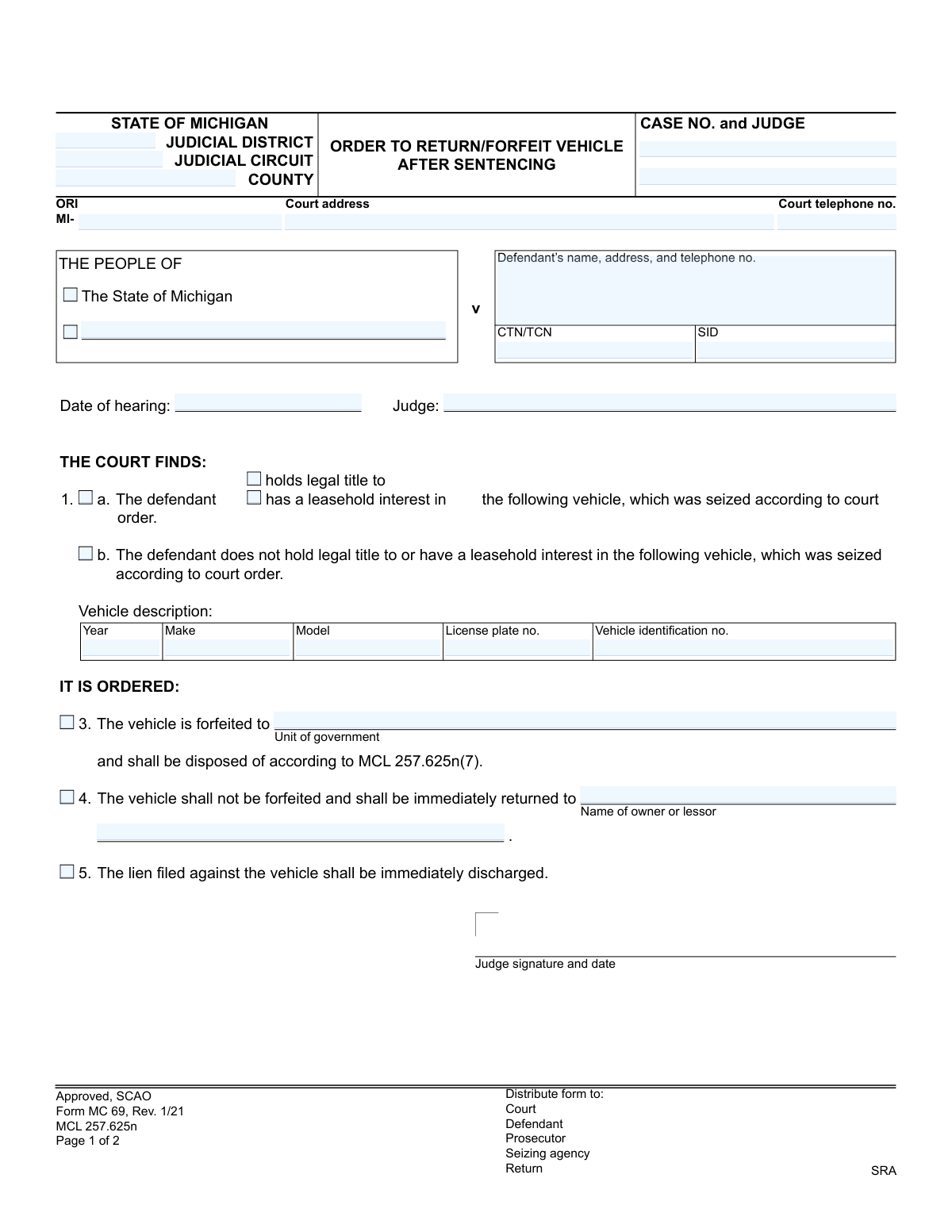
Yes! You can use AI to fill out Form MC 69, Order to Return/Forfeit Vehicle after Sentencing

Form MC 69, Order to Return/Forfeit Vehicle after Sentencing, is a legal document issued by a Michigan court. It formalizes the court's decision regarding a vehicle seized in connection with a criminal case after the defendant has been sentenced. The order specifies whether the vehicle is forfeited to a government entity or returned to its legal owner or lessor. Today, this form can be filled out quickly and accurately using AI-powered services like Instafill.ai, which can also convert non-fillable PDF versions into interactive fillable forms.
MC 69 is part of the Michigan court forms category on Instafill.
Our AI automatically handles information lookup, data retrieval, formatting, and form filling.
It takes less than a minute to fill out MC 69 using our AI form filling.
Securely upload your data. Information is encrypted in transit and deleted immediately after the form is filled out.

Form specifications

Form name: Form MC 69, Order to Return/Forfeit Vehicle after Sentencing
Number of fields: 38
Number of pages: 1
Language: English
main-image

Instafill Demo: How to fill out PDF forms in seconds with AI

How to Fill Out MC 69 Online for Free in 2026

Are you looking to fill out a MC 69 form online quickly and accurately? Instafill.ai offers the #1 AI-powered PDF filling software of 2026, allowing you to complete your MC 69 form in just 37 seconds or less.
Follow these steps to fill out your MC 69 form online using Instafill.ai:
  1. 1 Navigate to Instafill.ai and upload or select the MC 69 form.
  2. 2 Enter the court and case information, including the judicial district, county, case number, and judge's name.
  3. 3 Provide the defendant's name, address, and other identifying numbers like CTN/SID.
  4. 4 Detail the seized vehicle by entering its year, make, model, license plate number, and Vehicle Identification Number (VIN).
  5. 5 Indicate the court's finding on whether the defendant holds legal title or a leasehold interest in the vehicle.
  6. 6 Specify the court's final order: check the box for forfeiture to a government unit or for the vehicle's return to the owner/lessor.
  7. 7 Once completed by the court, the judge signs and dates the order. If the vehicle is returned, the seizing official completes the 'Return of Property' section.

Our AI-powered system ensures each field is filled out correctly, reducing errors and saving you time.

Why Choose Instafill.ai for Your Fillable MC 69 Form?

Speed

Complete your MC 69 in as little as 37 seconds.

Up-to-Date

Always use the latest 2026 MC 69 form version.

Cost-effective

No need to hire expensive lawyers.

Accuracy

Our AI performs 10 compliance checks to ensure your form is error-free.

Security

Your personal information is protected with bank-level encryption.

Frequently Asked Questions About Form MC 69

This is a court order issued by a judge after a defendant's sentencing. It officially decides whether a vehicle seized during a case will be permanently kept by a government agency (forfeited) or given back to its rightful owner or lessor.

This form is an official court order, so it is completed and signed by a judge based on the findings of a court hearing. The parties involved, such as the prosecutor or defendant's attorney, may prepare a draft for the judge's review and signature.

If the order states the vehicle is forfeited, it means legal ownership is transferred to the specified unit of government. The government can then dispose of the vehicle as allowed by law, and you will not get it back.

If the judge orders the vehicle to be returned, the order will specify your name as the owner or lessor. You will need to coordinate with the seizing agency to arrange for the vehicle's pickup once the order is signed.

The form requires court case details, the defendant's information, and a complete description of the seized vehicle, including its year, make, model, license plate number, and Vehicle Identification Number (VIN).

The order states the vehicle shall be 'immediately returned.' You should contact the seizing agency promptly with the signed order to arrange the return, but the exact timing can vary depending on the agency's procedures.

This section is to be completed by the seizing agency after they have physically returned the vehicle to the owner or lessor. It serves as an official record and proof that the court's order has been carried out.

If the judge checks box number 5, any lien filed against the vehicle as part of the seizure process must be immediately discharged. This clears the title from encumbrances related to the case.

The form is distributed to the court, the defendant, the prosecutor, the seizing agency, and the Secretary of State's office (SRA) to ensure all parties are aware of the vehicle's legal status.

This is a reference to a specific section of the Michigan Compiled Laws. This particular law governs the seizure, forfeiture, and return of vehicles, often in cases related to driving under the influence.

Yes, services like Instafill.ai use AI to help you or your attorney pre-fill the case and vehicle information accurately onto a digital copy. This can save time and reduce errors before submitting the proposed order to the court.

You can use Instafill.ai to upload the form and easily fill in all the required fields online. The platform's AI can help auto-fill details like court addresses and personal information to streamline the process.

If you have a non-fillable or 'flat' PDF, you can upload it to Instafill.ai. The service's technology can convert it into an interactive, fillable form that you can complete, save, and print.

Compliance MC 69
Validation Checks by Instafill.ai

1
Ensures Case Number Consistency Across Pages
This validation checks that the 'Case No.' field on page 1 is identical to the 'Case No.' field on page 2. This is critical to ensure that the return of property certification on the second page is correctly associated with the judicial order on the first. A mismatch could lead to incorrect record-keeping and serious legal complications.
2
Validates Mutually Exclusive Findings on Vehicle Ownership
The form requires a finding on whether the defendant has a legal interest in the vehicle (option 1a) or not (option 1b). This check ensures that one and only one of these two options is selected. Selecting both or neither would make the court's finding ambiguous and legally invalid.
3
Validates Mutually Exclusive Orders for Forfeiture or Return
This check ensures that either order #3 (forfeiture) or order #4 (return) is selected, but not both. These actions are mutually exclusive; a vehicle cannot be simultaneously forfeited and returned. Failure to enforce this would result in a contradictory and unenforceable order.
4
Conditional Requirement for Forfeiture Recipient
If order #3 (forfeiture) is selected, this validation ensures that the 'Unit of government' field is completed. It is essential to specify which government entity is receiving the forfeited vehicle for legal transfer of ownership and accountability. An incomplete order would leave the vehicle's disposition unclear.
5
Conditional Requirement for Return Recipient
If order #4 (return) is selected, this validation ensures that the 'Name of owner or lessor' field is completed. The order must clearly state who the vehicle is being returned to, preventing disputes and ensuring the property is returned to the correct legal owner. An empty field would render the return order ineffective.
6
Validates Vehicle Identification Number (VIN) Format
This check verifies that the 'Vehicle identification no.' field contains a standard 17-character alphanumeric string, excluding the letters I, O, and Q. A valid VIN is a unique identifier for a specific vehicle, and ensuring its accuracy is paramount to prevent ambiguity and legal challenges regarding the vehicle in question.
7
Validates Vehicle Year Format and Range
This validation ensures the 'Year' field for the vehicle is a 4-digit number within a logical range (e.g., between 1900 and the current year + 1). This prevents data entry errors such as typos or nonsensical years. Accurate vehicle information is necessary for proper identification and valuation.
8
Ensures Logical Date Sequence for Order and Return
This check verifies that the 'Return of property date' on page 2 is on or after the 'Judge signature and date' on page 1. A vehicle cannot be legally returned before a judge has officially signed the order authorizing it. This validation prevents chronological impossibilities in the legal record.
9
Completeness of Vehicle Description
This validation ensures that if a vehicle is being forfeited or returned, all descriptive fields ('Year', 'Make', 'Model', 'License plate no.', 'Vehicle identification no.') are filled out. A complete and unambiguous description is necessary to positively identify the vehicle subject to the court order. Incomplete information could lead to the wrong vehicle being seized or returned.
10
Validates Defendant Information is Present
This check ensures that the 'Defendant’s name, address, and telephone no.' field is not empty. This information is fundamental to the legal proceeding, identifying the primary party involved in the case. Without it, the order lacks a clear subject and would be invalid for record-keeping and enforcement.
11
Requires Judge's Signature Date for Validity
This validation confirms that a date is entered next to the judge's signature line. The date of the judge's signature is what gives the order its legal effect and establishes the official date of the ruling. An undated order is legally deficient and its enforceability would be questionable.
12
Conditional Logic for 'Return of Property' Section
This check ensures that the 'RETURN OF PROPERTY' section on page 2 is only completed if order #4 (return of vehicle) was selected on page 1. If the vehicle was forfeited (order #3), this section should be blank. This prevents contradictory information and ensures the form's second page is only used when applicable.
13
Completeness of Seizing Official Information on Return
If the 'Return of property date' is filled out, this validation requires that the 'Signature of seizing official', 'Name of seizing official', 'Title', and 'Unit of government' fields are also completed. This creates a clear and complete audit trail, certifying who returned the vehicle and under what authority, which is crucial for liability and record-keeping.

Common Mistakes in Completing MC 69

Incorrect or Incomplete Vehicle Identification Number (VIN)

The 17-character VIN is complex and highly susceptible to transcription errors, such as swapping digits or confusing the letter 'O' with the number '0'. An incorrect VIN renders the court order legally unenforceable for the intended vehicle, leading to disputes over forfeiture or return and significant processing delays. To avoid this, meticulously double-check the VIN against official vehicle documentation. AI-powered form filling tools like Instafill.ai can help prevent this by validating the VIN's format and checksum during data entry.

Contradictory Checkbox Selections

This form contains several mutually exclusive options, such as checking both Box 3 (forfeiture) and Box 4 (return), or both Box 1a (defendant has interest) and 1b (defendant does not have interest). This common mistake, often made in haste, creates a logically impossible and ambiguous order. Such a document is legally invalid and will be rejected by the court clerk, requiring correction and resubmission.

Incomplete Case and Court Identifiers

Fields like 'Case No.', 'Judge', 'Judicial Circuit', and 'County' are critical for routing and filing the order correctly. People often leave these blank or enter partial information, especially if they are handling multiple cases. This error can cause the document to be misfiled in the wrong court or not linked to the correct case file, delaying the execution of the order for weeks or months.

Missing Beneficiary on Forfeiture or Return

When a vehicle is forfeited, the specific 'Unit of government' (Box 3) must be explicitly named. Likewise, if the vehicle is to be returned, the 'Name of owner or lessor' (Box 4) is required. Leaving these fields blank makes the order incomplete and non-actionable, as the seizing agency has no clear instruction on who should take possession of the vehicle, leaving it in impound indefinitely.

Failure to Complete the 'Return of Property' Certification

The second page, 'Return of Property', is often overlooked or forgotten by the seizing official after the vehicle is returned. Failing to complete, sign, and date this section means there is no official record or proof that the court's order was executed. This lack of documentation can create a gap in the chain of custody and potential liability for the agency if the return is ever disputed.

Using an Illegible Signature Without a Printed Name

The form requires signatures from both the judge and the seizing official, with the latter also requiring a printed name. An illegible signature without a clearly printed name makes it impossible to identify the authorizing or acting official. This can call the document's authenticity into question during an audit or legal challenge, potentially invalidating the action taken.

Inaccurate Criminal Tracking Numbers (CTN/TCN/SID)

The CTN, TCN, and SID are unique identifiers essential for linking the order to the defendant's record in state and national criminal justice databases. Entering these numbers incorrectly can cause the vehicle forfeiture or return disposition to be logged against the wrong case or not at all. This data must be transcribed with extreme care from the official case file. Using a tool like Instafill.ai can ensure accuracy by auto-populating these fields from a verified source.

Omitting Secondary Vehicle Description Details

While the VIN is the most critical identifier, filers sometimes neglect to include the 'Year', 'Make', 'Model', and 'License plate no.'. These details are vital for the impound lot or seizing agency to perform a quick visual confirmation that they are handling the correct vehicle. Omitting them increases the risk of errors, such as releasing or forfeiting the wrong car, and can cause delays while staff manually verify the vehicle.

Incorrect Defendant Information

Entering a misspelled name, an outdated address, or an incorrect phone number for the defendant is a frequent oversight. This mistake can prevent the defendant from receiving crucial notices regarding their property, potentially violating their due process rights. Since this form is a non-fillable PDF, using a tool like Instafill.ai to convert it into a fillable version can make it easier to enter and proofread this information for accuracy.

Ambiguous Ownership or Leasehold Interest

The form requires a clear distinction between whether the defendant 'holds legal title' or 'has a leasehold interest'. Filers may be unsure of the exact legal status and check the wrong box or leave it ambiguous. This error can lead to significant legal challenges from third parties, such as lienholders or leasing companies, whose rights may be improperly affected by the order.
Saved over 80 hours a year

“I was never sure if my IRS forms like W-9 were filled correctly. Now, I can complete the forms accurately without any external help.”

Kevin Martin Green

Your data stays secure with advanced protection from Instafill and our subprocessors

Robust compliance program

Transparent business model

You’re not the product. You always know where your data is and what it is processed for.

ISO 27001, HIPAA, and GDPR

Our subprocesses adhere to multiple compliance standards, including but not limited to ISO 27001, HIPAA, and GDPR.

Security & privacy by design

We consider security and privacy from the initial design phase of any new service or functionality. It’s not an afterthought, it’s built-in, including support for two-factor authentication (2FA) to further protect your account.

Fill out MC 69 with Instafill.ai

Worried about filling PDFs wrong? Instafill securely fills form-mc-69-order-to-returnforfeit-vehicle-after-sentencing forms, ensuring each field is accurate.