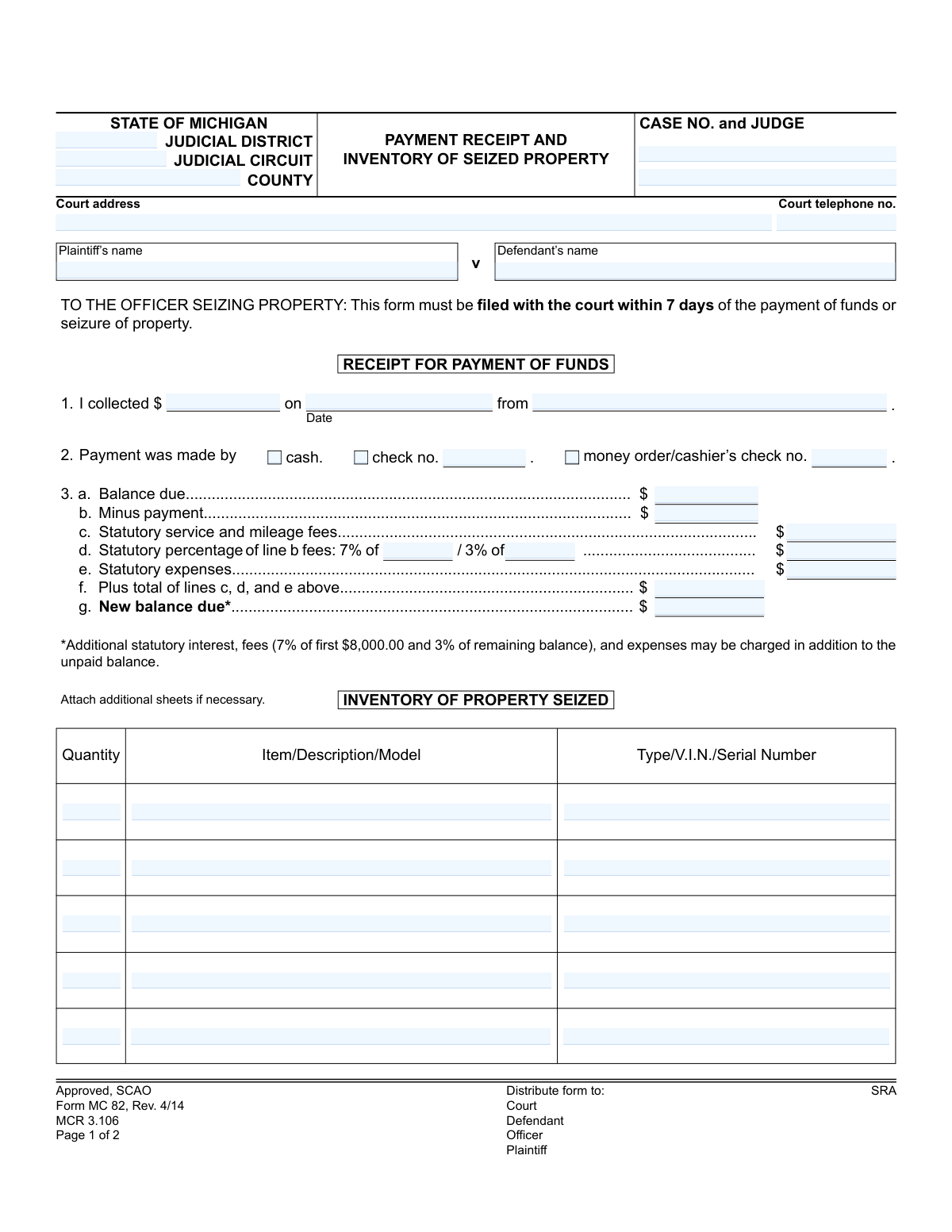
Yes! You can use AI to fill out Form MC 82, Payment Receipt and Inventory of Seized Property

Form MC 82 is a State of Michigan judicial form used by court officers or deputy sheriffs to document the collection of funds or the seizure of property to satisfy a court judgment. It serves as an official receipt and inventory for the court, plaintiff, and defendant, detailing the payment made or property taken. Today, this form can be filled out quickly and accurately using AI-powered services like Instafill.ai, which can also convert non-fillable PDF versions into interactive fillable forms.
MC 82 is part of the Michigan court forms category on Instafill.
Our AI automatically handles information lookup, data retrieval, formatting, and form filling.
It takes less than a minute to fill out MC 82 using our AI form filling.
Securely upload your data. Information is encrypted in transit and deleted immediately after the form is filled out.

Form specifications

Form name: Form MC 82, Payment Receipt and Inventory of Seized Property
Number of fields: 48
Number of pages: 1
Language: English
main-image

Instafill Demo: How to fill out PDF forms in seconds with AI

How to Fill Out MC 82 Online for Free in 2026

Are you looking to fill out a MC 82 form online quickly and accurately? Instafill.ai offers the #1 AI-powered PDF filling software of 2026, allowing you to complete your MC 82 form in just 37 seconds or less.
Follow these steps to fill out your MC 82 form online using Instafill.ai:
  1. 1 Navigate to Instafill.ai and upload or select Form MC 82, Payment Receipt and Inventory of Seized Property.
  2. 2 Use the AI assistant to automatically populate case details such as the court address, case number, judge, plaintiff, and defendant names.
  3. 3 Complete the 'Receipt for Payment of Funds' section by entering the amount collected, date, and payment method, or the 'Inventory of Property Seized' section with details of the items taken.
  4. 4 If a payment was received, input the initial balance and payment amount, and let the AI calculate the new balance due, including statutory fees and expenses.
  5. 5 Carefully list all seized items in the inventory section, including quantity, description, and any identifying numbers like VINs or serial numbers.
  6. 6 Review all entered information for accuracy, then digitally sign and date the form to certify its contents.
  7. 7 Download the completed MC 82 and distribute copies to the court, defendant, and plaintiff as required by MCR 3.106.

Our AI-powered system ensures each field is filled out correctly, reducing errors and saving you time.

Why Choose Instafill.ai for Your Fillable MC 82 Form?

Speed

Complete your MC 82 in as little as 37 seconds.

Up-to-Date

Always use the latest 2026 MC 82 form version.

Cost-effective

No need to hire expensive lawyers.

Accuracy

Our AI performs 10 compliance checks to ensure your form is error-free.

Security

Your personal information is protected with bank-level encryption.

Frequently Asked Questions About Form MC 82

This form, titled 'Payment Receipt and Inventory of Seized Property,' is used by a court officer in Michigan to officially document either the collection of money or the seizure of property to satisfy a court judgment.

A court officer or deputy sheriff who collects a payment or seizes property is required to complete and file this form. It is not filled out by the plaintiff or defendant.

You received a copy as an official notification that a payment was collected or that your property has been seized to satisfy the judgment against you. The form details what was taken and calculates any remaining balance.

The officer must file this form with the court within 7 days of collecting the funds or seizing the property.

The fees are calculated based on the amount of the payment collected, typically at a rate of 7% on the first $8,000 and 3% on the remaining balance, as noted on the form.

The 'Receipt for Payment of Funds' section is used only when money is collected. The 'Inventory of Property Seized' section is used to list any physical items, like vehicles or equipment, that were taken.

The form states that property may be redeemed by paying the judgment in full, along with all statutory fees and expenses. If the property is not redeemed, it will be sold at a public sale.

According to the form's distribution list, copies are provided to the Court, the Defendant, the Plaintiff, and the Officer who performed the seizure.

The officer must list the quantity, a detailed description of the item, and any identifying numbers such as a model, Vehicle Identification Number (V.I.N.), or serial number.

You should immediately contact the court officer or deputy sheriff whose name and phone number are listed at the bottom of the form to report any potential discrepancies.

Yes, services like Instafill.ai use AI to help officers and legal staff accurately auto-fill form fields, which saves time and helps reduce data entry errors.

You can use a service like Instafill.ai to easily complete this form online. Simply upload the MC 82 PDF, and the platform will make it an interactive, fillable form for you to complete, sign, and manage.

Services like Instafill.ai can convert flat, non-fillable PDFs into interactive forms. You can upload the static PDF, and the tool will automatically detect the fields and allow you to type directly into them.

The 'New balance due' is the remaining amount owed on the judgment after the collected payment has been subtracted and all statutory service fees, mileage, and percentage fees have been added.

Compliance MC 82
Validation Checks by Instafill.ai

1
Case Number Consistency
This check ensures the 'CASE NO.' field on the first page matches the 'Case No.' field on the second page. This is critical for maintaining document integrity and ensuring all pages of the submission are correctly associated with the same legal case. A mismatch would lead to filing errors and potential legal complications.
2
Jurisdiction and Case Info Completeness
Validates that the primary case identifiers, including 'CASE NO.', 'JUDGE', 'COUNTY', and either 'JUDICIAL DISTRICT' or 'JUDICIAL CIRCUIT', are all populated. These fields are essential for correctly filing the document with the court and routing it to the appropriate judge. An incomplete submission would be rejected by the court clerk.
3
Exclusive Payment Method Selection
Verifies that exactly one payment method ('cash', 'check', or 'money order/cashier’s check') is selected. This prevents ambiguity or contradiction in how the funds were received. If more than one or zero methods are selected, the form is invalid as the payment type is unclear.
4
Conditional Check/Money Order Number
This validation ensures that if the payment method is 'check' or 'money order/cashier’s check', the corresponding number field ('check no.') is filled out. This number is crucial for tracking and auditing the payment. A failure to provide it would create a record-keeping gap and could complicate reconciliation.
5
Payment Amount Consistency
Ensures the amount entered in the 'collected $' field (line 1) is identical to the amount entered in the 'Minus payment' field (line 3b). These two fields represent the same value and must match for the subsequent balance calculation to be correct. A discrepancy indicates a data entry error that must be resolved.
6
Date Sequence and Validity
This check verifies that the 'collected date' and the signature 'Date' are both valid calendar dates and are not in the future. It also ensures the 'collected date' is on or before the signature 'Date'. This logical sequence is important for establishing a correct timeline of events for the legal record.
7
New Balance Calculation Verification
Performs an arithmetic check on the 'New balance due' (line 3g). The system calculates '(Balance due - Minus payment) + (Total of lines c, d, and e)' and compares it to the value entered in line 3g. This is a critical validation to ensure the final amount owed by the defendant is calculated correctly and avoids mathematical errors on a legal document.
8
Total Fees Calculation Verification
Validates the calculation on line 3f, 'Plus total of lines c, d, and e above'. The system sums the values from lines 3c, 3d, and 3e and ensures the result matches the value entered on line 3f. This check prevents simple addition errors when calculating the total fees and expenses to be added to the balance.
9
Statutory Percentage Fee Calculation
This is a complex business rule validation for line 3d. The system calculates the statutory fee based on the payment amount (line 3b), applying 7% to the first $8,000 and 3% to the remainder, and verifies this calculated amount matches the value entered on line 3d. This ensures the legally mandated fees are calculated and applied correctly.
10
Inventory Item Completeness
For each row in the 'INVENTORY OF PROPERTY SEIZED' section, this check ensures that if any field (e.g., 'Item/Description') is filled, the corresponding 'Quantity' field is also populated with a positive integer. This rule prevents incomplete or ambiguous entries for seized property. A partial entry would be flagged for completion.
11
Officer Certification Completeness
Verifies that the certifying officer has provided a 'Signature', a printed 'Name', and a 'Date' at the bottom of the form. These elements are required to attest to the accuracy of the information and make the document legally valid. A submission lacking any of these components is considered incomplete and uncertified.
12
Court and Officer Telephone Number Format
This check validates that the 'Court telephone no.' and the officer's 'Telephone no.' fields adhere to a standard phone number format (e.g., XXX-XXX-XXXX or (XXX) XXX-XXXX). Proper formatting ensures the data is clean and usable for any necessary follow-up communication. It prevents entry of invalid characters or incomplete numbers.
13
Conditional Real Property Attachment
Checks if the 'Real property seized' checkbox is marked. If it is, the system flags the submission to verify that a corresponding document or attachment with the property description has been included. This is a procedural check to ensure that the required legal documentation for seizing real estate is present.
14
Monetary Field Numeric Validation
Ensures that all fields intended to hold monetary values (e.g., 'collected amount', 'balance due', 'payment', 'statutory service and mileage fees') contain only valid, non-negative numeric characters. This prevents data corruption from text being entered into a number field and ensures all financial calculations can be performed correctly. An invalid entry would be rejected.

Common Mistakes in Completing MC 82

Miscalculating the New Balance Due

The form requires several manual calculations, including subtracting the payment and adding multiple statutory fees. Users often make arithmetic errors, leading to an incorrect 'New balance due'. This can cause disputes, require corrected filings, and delay case resolution. To avoid this, use a calculator and double-check all additions and subtractions before finalizing the form.

Incorrectly Calculating Statutory Percentage Fees

The form requires a tiered percentage fee (7% of the first $8,000 and 3% of the remainder), but the line item is brief. Officers may misinterpret this and apply a flat rate or calculate the percentage on the wrong amount (e.g., the total judgment instead of the payment collected). This results in an incorrect fee assessment, which can be legally challenged. The calculation must be carefully performed based on the payment amount collected.

Providing Vague or Incomplete Property Descriptions

In the inventory section, officers may use generic terms like 'laptop' or 'jewelry' without including brands, model numbers, or serial numbers. This ambiguity creates major problems if the defendant wishes to redeem the property or if disputes arise about what was actually seized. To prevent this, record every possible unique identifier for each item to create a clear and indisputable record.

Incorrect or Incomplete Case Identification

Mistakes in the 'CASE NO.', 'JUDGE', or court location fields are common. An incorrect case number can cause the document to be rejected by the clerk or filed in the wrong case, leading to significant administrative delays. Always cross-reference these details with the official court order or judgment to ensure accuracy. AI-powered tools like Instafill.ai can help prevent these errors by auto-populating case information correctly.

Omitting Payment Method Details

Officers sometimes collect a payment but forget to check the box for 'cash', 'check', or 'money order', or fail to write in the corresponding number. This lack of detail makes it difficult to trace the payment if an issue arises, such as a bounced check or a dispute over the payment source. To ensure a clear financial record, Section 2 must be completed in its entirety for every payment collected.

Using Illegible Handwriting

This form is often filled out by hand in the field, and illegible writing for names, amounts, or serial numbers is a frequent issue. Poor handwriting can lead to data entry errors by court staff, causing misdirected notices or incorrect financial records. To avoid this, print clearly in block letters. If the form is a non-fillable PDF, a tool like Instafill.ai can convert it into a fillable version, allowing for clear, typed entries.

Missing Signature or Date in Certification

The officer's signature and date are required to certify the form's accuracy, but this section is often overlooked. An unsigned or undated form is legally invalid and will be rejected by the court, potentially causing the officer to miss the 7-day filing deadline. Always perform a final review to ensure the certification section is fully completed before submission.

Failing to Attach Required Real Property Documentation

When seizing real estate, the form requires that a copy of the legal description be attached. Officers may check the 'Real property seized' box but forget to include the necessary attachment. This omission makes the seizure legally incomplete and can invalidate the action, as a proper description is essential for public notice and sale. Always ensure the full legal description is attached when this box is checked.

Inconsistent or Missing Case Number on Subsequent Pages

The case number is required on both page 1 and page 2. It is common for the filler to complete it on the first page but forget the second, especially if the pages are handled separately. If the pages become separated, the second page has no context, delaying the process. It is vital to fill in the case number on all pages of any multi-page legal document.

Reversing Plaintiff and Defendant Names

In a rush, it's easy to accidentally write the plaintiff's name in the defendant's field and vice versa. This seemingly small mistake causes significant confusion in the court record, potentially leading to notices being sent to the wrong party. Carefully verify the roles of each party from the original court order before filling out these fields.
Saved over 80 hours a year

“I was never sure if my IRS forms like W-9 were filled correctly. Now, I can complete the forms accurately without any external help.”

Kevin Martin Green

Your data stays secure with advanced protection from Instafill and our subprocessors

Robust compliance program

Transparent business model

You’re not the product. You always know where your data is and what it is processed for.

ISO 27001, HIPAA, and GDPR

Our subprocesses adhere to multiple compliance standards, including but not limited to ISO 27001, HIPAA, and GDPR.

Security & privacy by design

We consider security and privacy from the initial design phase of any new service or functionality. It’s not an afterthought, it’s built-in, including support for two-factor authentication (2FA) to further protect your account.

Fill out MC 82 with Instafill.ai

Worried about filling PDFs wrong? Instafill securely fills form-mc-82-payment-receipt-and-inventory-of-seized-property forms, ensuring each field is accurate.