Yes! You can use AI to fill out MC 283, Order for DNA Sample
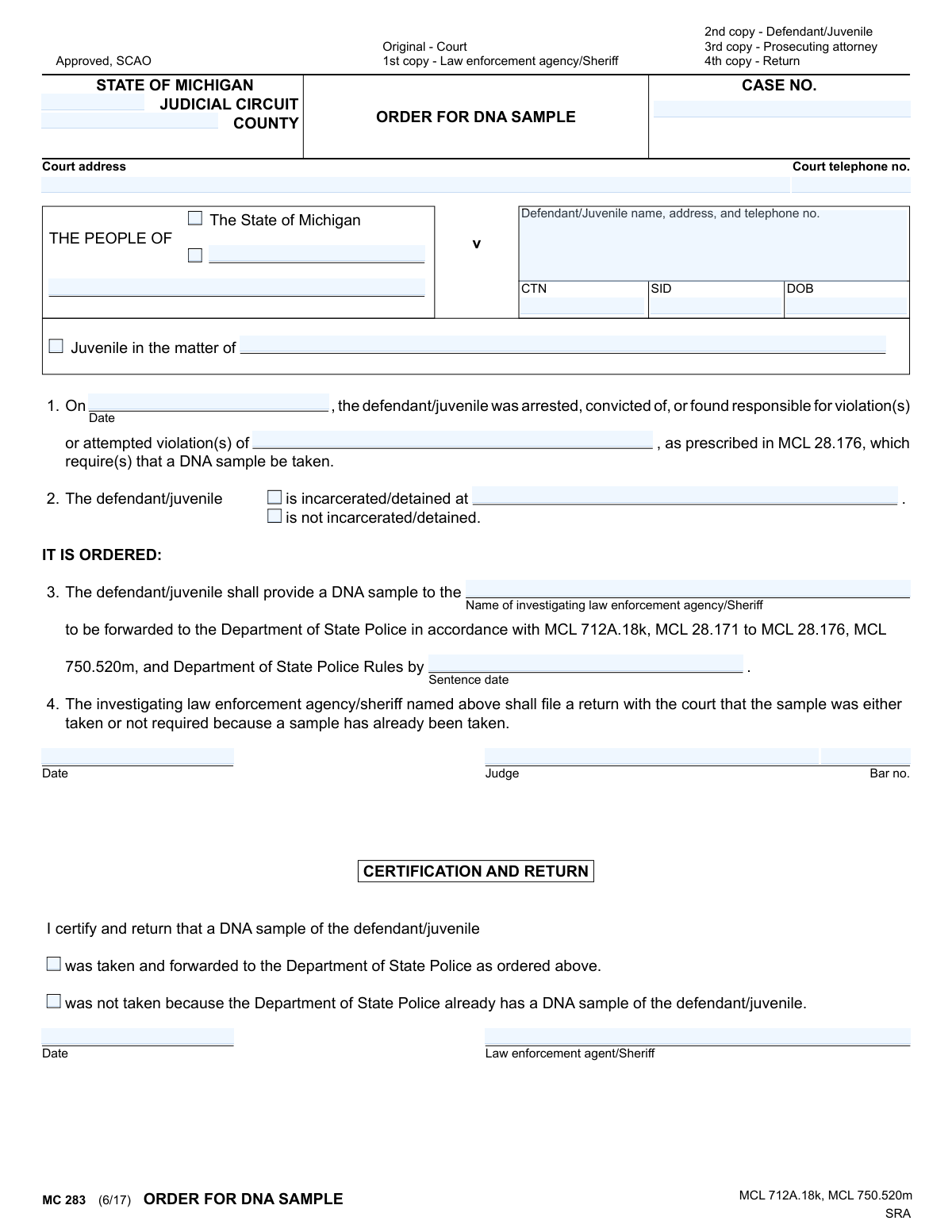
The MC 283, Order for DNA Sample, is a legal document issued by a Michigan court. It is used to order a defendant or juvenile who has been arrested, convicted, or found responsible for specific offenses to provide a DNA sample to a designated law enforcement agency. This ensures compliance with state laws requiring DNA collection for certain crimes, aiding in law enforcement databases. Today, this form can be filled out quickly and accurately using AI-powered services like Instafill.ai, which can also convert non-fillable PDF versions into interactive fillable forms.
MC 283 is part of the
Michigan court forms category on Instafill.
Our AI automatically handles information lookup, data retrieval, formatting, and form filling.
It takes less than a minute to fill out MC 283 using our AI form filling.
Securely upload your data. Information is encrypted in transit and deleted immediately after the form is filled out.
Form specifications
| Form name: | MC 283, Order for DNA Sample |
| Number of fields: | 29 |
| Number of pages: | 1 |
| Language: | English |
More forms in Michigan court forms
Instafill Demo: How to fill out PDF forms in seconds with AI
How to Fill Out MC 283 Online for Free in 2026
Are you looking to fill out a MC 283 form online quickly and accurately? Instafill.ai offers the #1 AI-powered PDF filling software of 2026, allowing you to complete your MC 283 form in just 37 seconds or less.
Follow these steps to fill out your MC 283 form online using Instafill.ai:
- 1 Navigate to Instafill.ai and upload or select the MC 283, Order for DNA Sample form.
- 2 Provide the court and case information, including the judicial circuit, county, case number, and court address.
- 3 Enter the full name, address, date of birth, and other identifying information for the defendant or juvenile.
- 4 Specify the date and details of the violation(s) that necessitate the DNA sample, as prescribed by Michigan law.
- 5 Indicate whether the individual is currently incarcerated or detained and provide the location if applicable.
- 6 Review the judge's order section, which will specify the law enforcement agency responsible for collection and the deadline.
- 7 Use the AI to review all entered information for accuracy and completeness before the judge signs and the form is distributed and filed.
Our AI-powered system ensures each field is filled out correctly, reducing errors and saving you time.
Why Choose Instafill.ai for Your Fillable MC 283 Form?
Speed
Complete your MC 283 in as little as 37 seconds.
Up-to-Date
Always use the latest 2026 MC 283 form version.
Cost-effective
No need to hire expensive lawyers.
Accuracy
Our AI performs 10 compliance checks to ensure your form is error-free.
Security
Your personal information is protected with bank-level encryption.
Frequently Asked Questions About Form MC 283
This form is a legal court order compelling a defendant or juvenile to provide a DNA sample. It is issued after an arrest, conviction, or finding of responsibility for certain offenses specified in Michigan law.
The individual identified as the 'Defendant/Juvenile' on the form must provide the DNA sample. A judge issues this order as a required part of a criminal or juvenile case proceeding.
CTN is the Complaint Tracking Number, SID is the State Identification Number, and DOB is the person's Date of Birth. These identifiers are used to ensure the correct individual is linked to the court case.
If the Michigan Department of State Police already has your DNA sample on file, a new one will not be taken. The law enforcement agency will verify this and indicate it on the 'Certification and Return' portion of the form.
The law enforcement agency or sheriff's department named in section 3 of the order is responsible for collecting the sample. It is then sent to the Michigan Department of State Police for processing and entry into the state's DNA database.
You must provide the sample by the deadline specified in the order, which is typically the 'Sentence date' listed in section 3. You will need to coordinate with the designated law enforcement agency to do so.
This information helps the law enforcement agency determine how to collect the sample. If the person is in a correctional facility, the sample will likely be taken there; otherwise, the individual must report to the agency.
Copies are distributed to the court, the law enforcement agency, the defendant/juvenile, and the prosecuting attorney. This ensures all relevant parties are officially notified of the court's order.
This section is completed by the law enforcement agent after the collection process. They certify whether the sample was successfully taken or was not needed, and then return this confirmation to the court.
Yes, services like Instafill.ai use AI to accurately auto-fill form fields, which saves time and helps prevent errors. This is particularly helpful for legal staff who frequently prepare these orders.
To fill this form online, upload the 'Order for DNA Sample' PDF to the Instafill.ai platform. The AI will make the fields interactive, allowing you to type in the information before printing the completed form for signatures.
You can use a service like Instafill.ai, which can convert flat, non-fillable PDFs into interactive forms. Simply upload your scanned document, and the platform will make it possible to fill out digitally.
The legal requirement for this DNA sample is established by Michigan Compiled Laws (MCL). Key statutes cited on the form include MCL 28.176, MCL 712A.18k, and MCL 750.520m.
Compliance MC 283
Validation Checks by Instafill.ai
1
Date of Birth Format and Plausibility
This validation ensures the 'DOB' field contains a valid, complete date in a recognized format (e.g., MM/DD/YYYY). It also checks that the date is in the past and represents a plausible age for a defendant/juvenile. This is critical for correctly identifying the individual and preventing data entry errors that could affect their legal record. If the date is invalid or in the future, the form submission should be rejected.
2
Mutually Exclusive Incarceration Status
This check verifies that only one of the two incarceration status options ('is incarcerated/detained' or 'is not incarcerated/detained') is selected. These options are mutually exclusive, and selecting both would create a logical contradiction in the order. This validation prevents ambiguity and ensures the form accurately reflects the defendant's current status. An error should be flagged if both or neither are selected.
3
Conditional Requirement for Incarceration Location
This validation rule ensures that if the 'is incarcerated/detained' option is selected, the corresponding 'is incarcerated/detained at' location field must be filled out. It is essential to know the location of an incarcerated individual to serve the order and collect the sample. Failure to provide this information when required would render the order difficult or impossible to execute, so the submission should be blocked until the location is provided.
4
Chronological Date Validation: Conviction vs. Order
This check confirms that the 'it is ordered date' is on or after the 'convicted date'. A judicial order for a DNA sample based on a conviction cannot logically be issued before the conviction itself has occurred. This validation maintains the logical and legal integrity of the document's timeline. A submission with an order date preceding the conviction date should be flagged as an error.
5
Required Field: Violation Justification
This validation ensures the 'violation(s) or attempted violation(s) of' field is not empty. This field provides the specific legal justification for requiring a DNA sample, as prescribed by MCL 28.176. Without this information, the order lacks a legal basis, making it invalid. The form should not be considered complete or submittable without this crucial detail.
6
Judge's Bar Number Format
This check validates that the 'Bar no.' field for the judge conforms to the official Michigan State Bar format, which is typically a 'P' followed by a sequence of digits (e.g., P12345). Using the correct format ensures the signing judge is uniquely and accurately identified, which is essential for the order's authenticity and legal standing. An incorrectly formatted number should trigger a warning or error.
7
Required Field: Investigating Agency
This validation verifies that the 'Name of investigating law enforcement agency/Sheriff' field is completed. This field designates the specific agency responsible for executing the order and collecting the DNA sample. Leaving this field blank creates ambiguity and could prevent the order from being carried out. The submission must be rejected if this mandatory information is missing.
8
Mutually Exclusive Certification Status
In the 'Certification and Return' section, this check ensures that only one of the two outcome options ('was taken' or 'was not taken') is selected. These statuses are mutually exclusive and report the final result of the order. Selecting both would create a contradiction, so the system should prevent this to ensure a clear and accurate record of the outcome.
9
Chronological Date Validation: Order vs. Certification
This validation confirms that the 'certification and return date' is on or after the 'it is ordered date'. The certification, which reports the action taken, cannot logically occur before the order authorizing the action was issued. This check maintains the chronological integrity of the legal process documented on the form. An error should be raised if the certification date is earlier than the order date.
10
Case Number Presence
This check ensures that the 'CASE NO.' field is not empty. The case number is the primary identifier linking this order to a specific court case within the judicial system. Without it, the document cannot be correctly filed or associated with the defendant's record. A missing case number is a critical error that must prevent the form from being processed.
11
Completeness of Defendant/Juvenile Identification
This validation ensures the 'Defendant/Juvenile name, address, and telephone no.' field is populated. This information is fundamental to identifying the subject of the order. An order without clear identification of the individual is unenforceable and invalid. The system should reject any submission where this critical identifying information is missing.
12
Chronological Date Validation: Conviction vs. Sentence
This check verifies that the 'Sentence date' is on or after the 'convicted date'. A sentence is imposed as a result of a conviction, so it cannot logically precede it. This validation ensures the sequence of legal events is recorded correctly, preventing nonsensical timelines that could invalidate the record. The form should flag an error if the sentence date is before the conviction date.
Common Mistakes in Completing MC 283
Users often transpose digits in the 'Case No.' or enter the wrong 'Judicial Circuit' number when filling out the form from case files. This error can lead to the order being rejected by the court clerk, misfiled, or associated with the wrong case, causing significant administrative delays. To prevent this, double-check the case number against official court documents before submission.
In the 'violation(s) of' field, filers often write the common name of a crime (e.g., 'Assault') instead of the required Michigan Compiled Laws (MCL) statutory code (e.g., 'MCL 750.81'). This makes the order legally imprecise and can render it invalid, as the authority to collect DNA is tied to specific statutory offenses. Always look up and enter the exact MCL code corresponding to the conviction to ensure the order is enforceable.
A frequent error is checking the 'is incarcerated/detained' box without specifying the name of the correctional facility in the subsequent field. This leaves law enforcement guessing where the defendant is located, delaying the sample collection. To ensure the order is executed promptly, it is critical to provide the full, correct name of the jail or prison where the individual is being held.
The field for 'Defendant/Juvenile name, address, and telephone no.' is frequently submitted with incomplete or old information, such as a missing phone number or a previous address. This mistake can severely hinder the ability of law enforcement to locate the individual for sample collection, leading to non-compliance and potential warrants. Ensure all contact details are current and complete.
This form includes multiple date fields, such as the conviction date, sentence date, and order date, which are easily confused. Users frequently mix these up, for instance, putting the conviction date in the 'Sentence date' field, which creates incorrect deadlines and procedural errors. Carefully read each field label to ensure the correct date is entered in the corresponding location.
The 'DOB' (Date of Birth), 'CTN' (Complaint Tracking Number), and 'SID' (State Identification Number) fields are often filled with formatting errors or left blank. These identifiers are crucial for linking the DNA sample to the correct person in state databases, and errors can lead to a sample being unmatchable. AI-powered tools like Instafill.ai can automatically validate these fields for correct format and length, significantly reducing such errors.
When specifying the 'investigating law enforcement agency/Sheriff', filers may enter a generic term like 'Police Department'. This is insufficient, as the order needs to be directed to a specific entity (e.g., 'Washtenaw County Sheriff's Office'). This mistake causes the order to be misrouted, delaying collection. An intelligent form-filler could use the case's county information to suggest a list of valid agencies, ensuring accuracy.
The 'Certification and Return' section at the bottom of the form is exclusively for the law enforcement agent who collects the DNA sample. A significant error occurs when the person preparing the order fills this section out beforehand. This invalidates the certification process, requiring the form to be voided and a new order issued.
The preparer of the form may accidentally misspell the judge's name or enter an incorrect 'Bar no.'. While a minor typo, it can raise questions about the order's authenticity and authority, leading to rejection by the receiving agency or requiring clarification from the court. Instafill.ai can help prevent this by pulling from a database of judges and their associated bar numbers for the specified court.
This form is often available only as a non-fillable PDF, forcing users to print and complete it by hand. This frequently results in illegible handwriting, which can cause data entry errors when the information is later digitized by court or law enforcement staff. To avoid this, use a tool like Instafill.ai, which can convert any flat PDF into a smart, fillable form, allowing for clean, typed entries and preventing transcription mistakes.
Saved over 80 hours a year
“I was never sure if my IRS forms like W-9 were filled correctly. Now, I can complete the forms accurately without any external help.”
Kevin Martin Green
Your data stays secure with advanced protection from Instafill and our subprocessors

Robust compliance program
Transparent business model
You’re not the product. You always know where your data is and what it is processed for.
ISO 27001, HIPAA, and GDPR
Our subprocesses adhere to multiple compliance standards, including but not limited to ISO 27001, HIPAA, and GDPR.
Security & privacy by design
We consider security and privacy from the initial design phase of any new service or functionality. It’s not an afterthought, it’s built-in, including support for two-factor authentication (2FA) to further protect your account.
Fill out MC 283 with Instafill.ai
Worried about filling PDFs wrong? Instafill securely fills mc-283-order-for-dna-sample forms, ensuring each field is accurate.