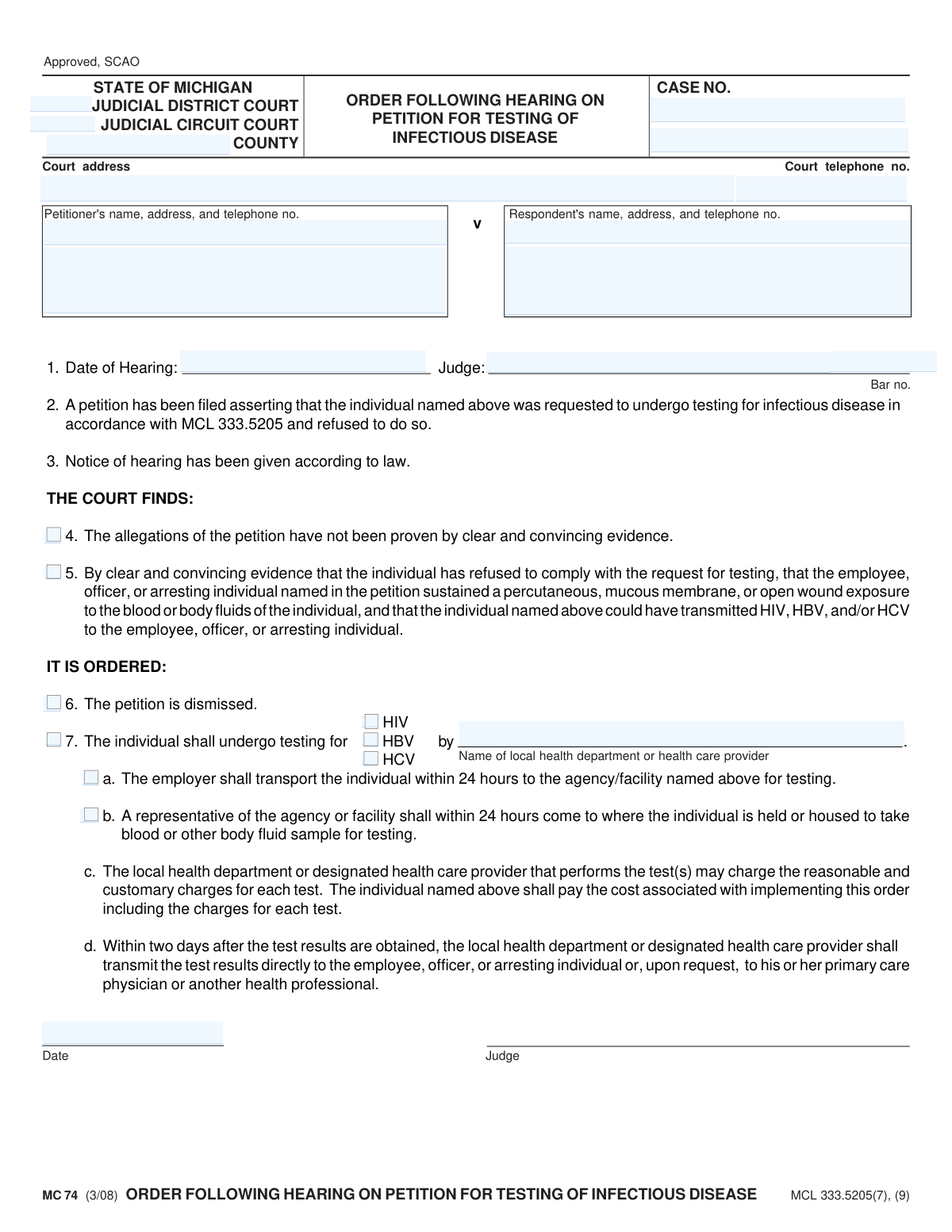
Yes! You can use AI to fill out MC 74, Order Following Hearing on Petition for Testing of Infectious Disease

Form MC 74 is a legal document used by Michigan courts to issue an order after a hearing on a petition to compel an individual to be tested for an infectious disease, such as HIV, HBV, or HCV. This typically occurs when an officer or employee has been exposed to an individual's bodily fluids and the individual has refused voluntary testing. The form documents the court's findings and, if granted, orders the testing, specifying the details and responsibilities. Today, this form can be filled out quickly and accurately using AI-powered services like Instafill.ai, which can also convert non-fillable PDF versions into interactive fillable forms.
MC 74 is part of the Michigan court forms category on Instafill.
Our AI automatically handles information lookup, data retrieval, formatting, and form filling.
It takes less than a minute to fill out MC 74 using our AI form filling.
Securely upload your data. Information is encrypted in transit and deleted immediately after the form is filled out.

Form specifications

Form name: MC 74, Order Following Hearing on Petition for Testing of Infectious Disease
Number of fields: 25
Number of pages: 1
Language: English
main-image

Instafill Demo: How to fill out PDF forms in seconds with AI

How to Fill Out MC 74 Online for Free in 2026

Are you looking to fill out a MC 74 form online quickly and accurately? Instafill.ai offers the #1 AI-powered PDF filling software of 2026, allowing you to complete your MC 74 form in just 37 seconds or less.
Follow these steps to fill out your MC 74 form online using Instafill.ai:
  1. 1 Navigate to Instafill.ai and upload or select the MC 74 form.
  2. 2 Enter the court information, including the judicial district/circuit, county, and case number.
  3. 3 Provide the full names, addresses, and telephone numbers for both the petitioner and the respondent.
  4. 4 Input the hearing details, such as the date of the hearing and the presiding judge's name and bar number.
  5. 5 Indicate the court's findings by checking the appropriate box to show whether the petition's allegations were proven or not.
  6. 6 Specify the court's order by checking if the petition is dismissed or if testing is ordered, selecting the specific diseases (HIV, HBV, HCV) and the deadline.
  7. 7 Review all entered information for accuracy before finalizing and downloading the completed document for filing with the court.

Our AI-powered system ensures each field is filled out correctly, reducing errors and saving you time.

Why Choose Instafill.ai for Your Fillable MC 74 Form?

Speed

Complete your MC 74 in as little as 37 seconds.

Up-to-Date

Always use the latest 2026 MC 74 form version.

Cost-effective

No need to hire expensive lawyers.

Accuracy

Our AI performs 10 compliance checks to ensure your form is error-free.

Security

Your personal information is protected with bank-level encryption.

Frequently Asked Questions About Form MC 74

This form is a court order issued by a judge after a hearing. It documents the court's decision on whether to compel an individual to undergo testing for infectious diseases like HIV, HBV, or HCV.

The petitioner (who requested the testing) and the respondent (the individual asked to be tested) both receive this order. It outlines the legal outcome of the hearing regarding the testing petition.

A hearing was held because a petition was filed after an individual refused a request to be tested for an infectious disease following an incident involving potential exposure to their blood or body fluids.

If the petition is dismissed, it means the court did not find clear and convincing evidence to support the request. The individual will not be legally required to undergo testing based on this petition.

If the court orders testing, you must comply. The order specifies the type of test (HIV, HBV, HCV), the facility, and the timeline for sample collection, which is typically within 24 hours.

According to the order, the individual being tested is responsible for paying the costs associated with implementing the order, including the reasonable and customary charges for each test.

The test results are sent directly to the employee, officer, or arresting individual who was exposed. Upon request, the results can also be sent to their primary care physician or another health professional.

The local health department or designated provider must transmit the test results within two days after they are obtained.

This legal term refers to an incident where another person's blood or body fluids came into contact with broken skin, such as from a cut or needle stick, or with mucous membranes like the eyes or mouth.

This order is the official result of your petition. If testing was ordered, the relevant agencies will carry it out; if it was dismissed, the case is closed unless you choose to appeal the decision.

No, this is a court order completed and signed by a judge, not a form you fill out. However, AI-powered services like Instafill.ai can be used to help accurately fill out the initial petition that leads to the hearing.

If the petition form you need to file is a non-fillable PDF, you can use a service like Instafill.ai. It can convert flat PDFs into interactive, fillable forms that you can complete and save online.

This is a legal standard of proof requiring that the evidence presented is highly and substantially more probable to be true than not. The judge must be clearly convinced that the petition's claims are true before ordering the testing.

Compliance MC 74
Validation Checks by Instafill.ai

1
Mutually Exclusive Findings
Validates that only one of the two main findings (item 4 or item 5) is selected. The court can either find that the allegations were not proven (item 4) or that they were proven by clear and convincing evidence (item 5), but not both. An error should be raised if both or neither are checked, as this represents a fundamental logical contradiction in the court's decision.
2
Logical Consistency of Dismissal
Ensures that if the finding is 'allegations have not been proven' (item 4), the corresponding order is 'The petition is dismissed' (item 6). An order for testing when the petition's allegations were not proven is legally inconsistent. This check prevents the generation of a contradictory and invalid court order.
3
Logical Consistency of Testing Order
Ensures that if the finding is 'proven by clear and convincing evidence' (item 5), the order is for the individual to 'undergo testing' (item 7). Dismissing the petition after finding the allegations were proven would be illogical. This validation enforces the correct legal outcome based on the court's findings.
4
Contradictory Order Prevention
Validates that the order does not both dismiss the petition (item 6) and order testing (item 7). These two outcomes are mutually exclusive. This check prevents the creation of an ambiguous and unenforceable order by ensuring a single, clear directive is issued.
5
Required Test Specification
If testing is ordered (item 7 is checked), this validation ensures that at least one of the specific infectious diseases (HIV, HBV, or HCV) is also selected. An order for testing is incomplete and invalid without specifying what tests must be performed. This check guarantees the order is actionable by the designated health provider.
6
Valid Testing Compliance Date
Checks that the date by which testing must be completed is a valid date that occurs in the future, after the date the order is signed. An expired or past deadline is unenforceable. This ensures the respondent is given a reasonable and legally sound timeframe to comply with the court's order.
7
Order Date Chronology
Validates that the Order Date is on or after the Hearing Date. A judge cannot issue an order resulting from a hearing that has not yet taken place. This check maintains the logical and chronological integrity of the legal process documented on the form.
8
Case Number Format
Ensures the Case Number ('caseno') adheres to the standard format for Michigan courts (e.g., YY-######-XX). Proper formatting is critical for accurate filing, retrieval, and referencing of the document within the court system. An invalid format can lead to administrative delays or lost records.
9
Judge's Bar Number Format
Validates that the Judge's Bar Number ('barno') follows the official Michigan State Bar format, which typically starts with a 'P' followed by a sequence of digits. This serves as a verification of the signing judge's credentials and is a key piece of identifying information on a legal order. Failure to match the format may indicate a data entry error.
10
Required Testing Provider
If testing is ordered (item 7 is checked), this validation confirms that the 'Name of local health department or health care provider' field is filled. The order is unenforceable if it's not clear where the individual must go for testing. This check ensures all necessary parties are identified to carry out the order.
11
Sample Collection Method Selection
Verifies that if testing is ordered (item 7), one of the two methods for sample collection (item 7a or 7b) is selected. This clarifies the logistical responsibility for either transporting the individual or having a professional visit them. An order without this specification is incomplete and could lead to disputes over compliance.
12
Court Jurisdiction Identification
Ensures that either the 'JUDICIAL DISTRICT COURT' number or the 'JUDICIAL CIRCUIT COURT' number is provided, but not both. This correctly identifies the specific court with jurisdiction over the case. Ambiguity in jurisdiction could call the validity of the entire order into question.
13
Party Identification Completeness
Checks that the names for both the Petitioner ('pname') and the Respondent ('rname') are provided. These fields are fundamental to the legal document, as they identify the primary parties involved in the hearing. An order missing the name of a party is legally deficient.

Common Mistakes in Completing MC 74

Contradictory Findings and Orders

This critical error occurs when checking mutually exclusive boxes, such as finding the allegations were not proven (Box 4) but then ordering testing (Box 7). This often happens due to haste or misunderstanding the form's logic. An order with such contradictions is legally invalid and unenforceable, requiring a corrected order to be issued and causing significant delays. To avoid this, carefully review the findings and ensure the corresponding order is the only one selected.

Incomplete or Incorrect Case Number

Users often enter the Case Number with typos, missing digits, or in the wrong format. Since the case number is the primary identifier linking this order to the court's records, any error can cause the document to be misfiled or rejected entirely. This delays the execution of the order and creates administrative rework. Using a tool like Instafill.ai can help by saving and auto-filling recurring information like case numbers, reducing the risk of manual entry errors.

Omitting Specific Test Types

When ordering testing under section 7, the filer may forget to check the specific boxes for HIV, HBV, or HCV. This happens when focusing on the main order and overlooking the details. An order that simply says "undergo testing" without specifying the diseases is too vague for a healthcare provider to act upon, making the order ineffective until it is amended.

Failing to Designate a Testing Provider

An order for testing is incomplete if the "Name of local health department or health care provider" field is left blank. This oversight means there is no designated entity to perform the test, bringing the entire process to a halt. The parties involved are left without a clear next step, delaying compliance with the court's decision and rendering the order ineffective.

Ambiguous Sample Collection Method

After ordering a test in section 7, the filer must specify how the sample will be collected by checking either box 7a (transport) or 7b (on-site collection). Forgetting to select one of these options creates confusion and potential disputes over who is responsible for arranging the test. This ambiguity can delay the testing process significantly until a clarification is issued by the court.

Incorrect Court Jurisdiction Selection

Filers may neglect to check the correct box for "JUDICIAL DISTRICT COURT" or "JUDICIAL CIRCUIT COURT" at the top of the form, or they may check both. This mistake can lead to the order being filed in the wrong court system, causing jurisdictional issues and rejection of the document. It's a simple but crucial detail for proper legal processing and can be easily missed when filling out forms manually.

Inaccurate Party Information

Transcribing the petitioner's or respondent's name, address, or phone number with errors is a common mistake, often due to misreading the original petition or simple data entry typos. Incorrect information can lead to failed service of the order and may even provide grounds for challenging its validity. Since many court forms are flat PDFs, a tool like Instafill.ai can convert them into fillable versions and then use saved profiles to populate party information accurately, preventing transcription errors.

Inconsistent Hearing and Order Dates

Entering an order date that is earlier than the hearing date is a frequent logical error that can happen when pre-filling parts of the form or through simple oversight. An illogical date sequence can invalidate the document, as an order cannot be issued before the hearing it is based on has occurred. This requires the form to be corrected and re-signed, causing delays.

Missing Judge's Bar Number

The judge's bar number is often overlooked and left blank, especially by staff who are less familiar with a specific judge's information. Court clerks may reject forms missing this required identifier, as it is essential for verifying the judge's credentials and for official record-keeping. AI-powered tools like Instafill.ai can store and automatically populate such repetitive data for different judges, ensuring completeness and preventing rejections.
Saved over 80 hours a year

“I was never sure if my IRS forms like W-9 were filled correctly. Now, I can complete the forms accurately without any external help.”

Kevin Martin Green

Your data stays secure with advanced protection from Instafill and our subprocessors

Robust compliance program

Transparent business model

You’re not the product. You always know where your data is and what it is processed for.

ISO 27001, HIPAA, and GDPR

Our subprocesses adhere to multiple compliance standards, including but not limited to ISO 27001, HIPAA, and GDPR.

Security & privacy by design

We consider security and privacy from the initial design phase of any new service or functionality. It’s not an afterthought, it’s built-in, including support for two-factor authentication (2FA) to further protect your account.

Fill out MC 74 with Instafill.ai

Worried about filling PDFs wrong? Instafill securely fills mc-74-order-following-hearing-on-petition-for-testing-of-infectious-disease forms, ensuring each field is accurate.