Yes! You can use AI to fill out Order on Motion to Set Aside Forfeiture and Discharge of Bond

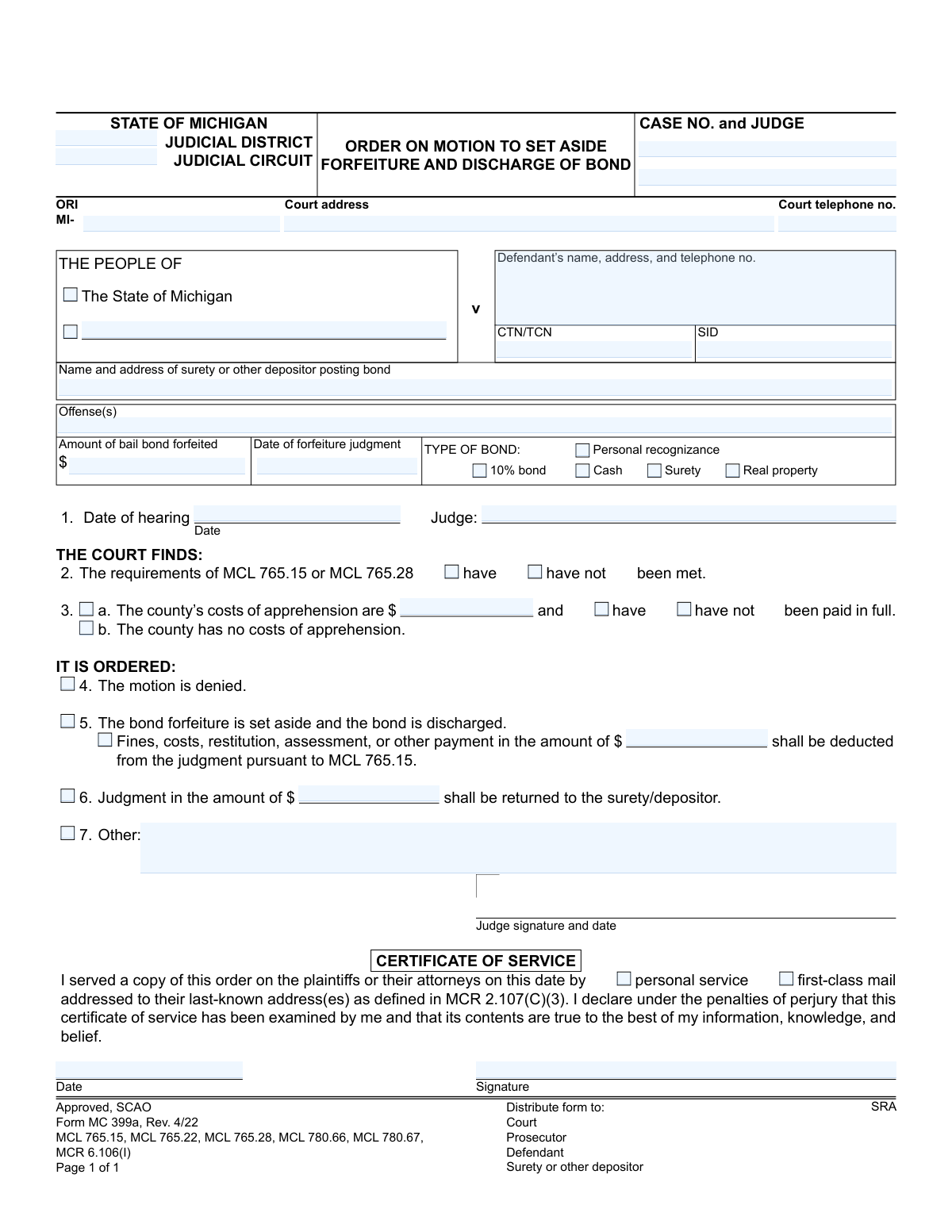
The Order on Motion to Set Aside Forfeiture and Discharge of Bond, Form MC 399a, is a legal document issued by a Michigan court following a hearing. It formalizes the judge's decision on whether to cancel a previously ordered bail bond forfeiture and release the associated bond. This order is crucial for defendants and sureties seeking to recover forfeited funds after resolving the circumstances that led to the forfeiture. Today, this form can be filled out quickly and accurately using AI-powered services like Instafill.ai, which can also convert non-fillable PDF versions into interactive fillable forms.
MC 399a is part of the Michigan court forms category on Instafill.
Our AI automatically handles information lookup, data retrieval, formatting, and form filling.
It takes less than a minute to fill out MC 399a using our AI form filling.
Securely upload your data. Information is encrypted in transit and deleted immediately after the form is filled out.

Form specifications

Form name: Order on Motion to Set Aside Forfeiture and Discharge of Bond
Number of fields: 43
Number of pages: 1
Language: English
main-image

Instafill Demo: How to fill out PDF forms in seconds with AI

How to Fill Out MC 399a Online for Free in 2026

Are you looking to fill out a MC 399A form online quickly and accurately? Instafill.ai offers the #1 AI-powered PDF filling software of 2026, allowing you to complete your MC 399A form in just 37 seconds or less.
Follow these steps to fill out your MC 399A form online using Instafill.ai:
  1. 1 Navigate to Instafill.ai and upload your MC 399a form or select it from their template library.
  2. 2 Provide the essential case information, including the judicial district/circuit, case number, judge, and court address.
  3. 3 Enter the details of the defendant, the surety or depositor, and the specific offenses related to the case.
  4. 4 Input the financial details, such as the amount of the bail bond forfeited and the date of the forfeiture judgment.
  5. 5 Indicate the court's findings from the hearing, specifying whether legal requirements were met and noting any costs of apprehension.
  6. 6 Clearly state the court's final order: whether the motion is denied, the forfeiture is set aside, and any amounts to be deducted or returned.
  7. 7 Review the AI-populated document for accuracy, make any final adjustments, and then download the completed form for the judge's signature and official filing.

Our AI-powered system ensures each field is filled out correctly, reducing errors and saving you time.

Why Choose Instafill.ai for Your Fillable MC 399a Form?

Speed

Complete your MC 399a in as little as 37 seconds.

Up-to-Date

Always use the latest 2026 MC 399a form version.

Cost-effective

No need to hire expensive lawyers.

Accuracy

Our AI performs 10 compliance checks to ensure your form is error-free.

Security

Your personal information is protected with bank-level encryption.

Frequently Asked Questions About Form MC 399a

This form, MC 399a, is a court order signed by a judge. It documents the court's final decision on a request to cancel a bail bond forfeiture and return the bond money.

A judge or authorized court personnel completes and signs this form. It is not filled out by the defendant or the person who posted the bond; it is the official record of the judge's ruling.

This is a legal term for when a judge cancels the court's claim on bail money that was lost (forfeited) because a defendant missed a court date. Setting aside the forfeiture is the first step to getting the bond money returned.

You must first file a 'Motion to Set Aside Forfeiture' with the court that handled the case. This MC 399a form is the order the judge will issue after a hearing is held on your motion.

Not necessarily. The order allows the judge to deduct any outstanding fines, court costs, restitution, or the county's costs for apprehending the defendant before the remaining amount is returned to you.

These are the expenses the county incurred to find and arrest the defendant after they failed to appear in court. The judge can order these costs to be paid from the forfeited bond money.

If the motion is denied, the bond forfeiture stands. This means the court will keep the money that was posted for the bail bond.

According to the form, copies are distributed to the court, the prosecutor, the defendant, and the surety or other depositor who posted the bond.

Processing times for refunds vary by court. Once the order is signed, you should contact the court clerk's office to inquire about their specific procedure and timeline for issuing the payment.

A surety is typically a professional bail bond company that guarantees the defendant's appearance. A depositor is any other individual, such as a friend or family member, who posted cash or property for the bond.

While this specific form is a court order, AI services like Instafill.ai can be very helpful for filling out the 'Motion to Set Aside Forfeiture' form that you must file to initiate this process, saving you time and ensuring accuracy.

Simply upload the motion form to the Instafill.ai platform. The AI will automatically detect the form fields, allowing you to type your information directly into them, then download the completed document.

Services like Instafill.ai can solve this problem. Upload your flat, non-fillable PDF, and the tool will convert it into an interactive, fillable form that you can complete easily on your computer.

Compliance MC 399a
Validation Checks by Instafill.ai

1
Exclusive Bond Type Selection
This validation ensures that only one 'TYPE OF BOND' is selected from the available options (Personal recognizance, 10% bond, Cash, Surety, Real property). These options are mutually exclusive, and selecting more than one would create ambiguity in the legal record of the bond. If this check fails, the user should be prompted to select only a single bond type before submission.
2
Mutually Exclusive Order Selection
Validates that either item '4. The motion is denied' or '5. The bond forfeiture is set aside' is selected, but not both. These two outcomes are mutually exclusive and represent the core decision of the order. Failure to select exactly one option would make the order legally nonsensical and unenforceable.
3
Financial Calculation Consistency
This check verifies the mathematical accuracy of the financial amounts when a bond forfeiture is set aside. It ensures that the 'Amount of bail bond forfeited' minus the 'Fines, costs, restitution...' amount equals the 'Judgment in the amount of $' to be returned. This is critical for financial accountability and ensures the correct amount is returned to the surety or depositor.
4
Logical Date Sequence
This validation confirms that the 'Date of hearing' is on or after the 'Date of forfeiture judgment'. A hearing to set aside a forfeiture cannot logically occur before the forfeiture itself has been judged. This check prevents data entry errors that would create a chronologically impossible legal record.
5
Mutually Exclusive Apprehension Cost Status
Ensures that the form does not simultaneously state that there are costs of apprehension (section 3a) and that there are no costs of apprehension (section 3b). These two sections are mutually exclusive and describe opposite scenarios. If this validation fails, the form is contradictory and cannot be processed correctly.
6
Conditional Requirement for Financial Fields
If '5. The bond forfeiture is set aside' is selected, this validation ensures that the financial fields ('Fines, costs, restitution...' and 'Judgment amount') are filled, even if with a zero. This is important to explicitly state the full financial disposition of the original bond amount. An empty field would create ambiguity about whether funds were deducted or if the information was simply omitted.
7
Case Number Presence and Format
Verifies that the 'CASE NO.' field is not empty and potentially matches a predefined format for the specified judicial district or circuit. The case number is the primary identifier for the legal proceeding and is essential for filing, retrieval, and linking documents. A missing or malformed case number would prevent the order from being correctly associated with its case file.
8
Valid Currency Format
Checks that all monetary fields, such as 'Amount of bail bond forfeited' and 'costs of apprehension', contain valid, non-negative numeric values. This prevents the entry of text or invalid characters into fields intended for financial data. Maintaining a proper currency format is crucial for accurate calculations and financial record-keeping.
9
Exclusive Finding on MCL Requirements
This check ensures that for finding #2, either 'have' or 'have not' is selected, but not both. This finding regarding the requirements of MCL 765.15 or MCL 765.28 is a critical legal determination. The form must clearly state whether the requirements were met to be a valid order.
10
Conditional 'Other' Field Completion
Validates that if the checkbox for '7. Other:' is selected, the corresponding text field is not empty. This prevents a user from indicating an 'other' condition exists without providing the necessary explanation. An empty 'other' field would render that part of the order meaningless and incomplete.
11
Exclusive Service Method Selection
This validation ensures that in the 'CERTIFICATE OF SERVICE' section, either 'personal service' or 'first-class mail' is selected, but not both. The method of service is a key legal requirement for ensuring all parties have been properly notified. The record must be clear and unambiguous about how service was performed.
12
Defendant Information Completeness
Verifies that the 'Defendant’s name, address, and telephone no.' field is not empty. This information is fundamental for identifying the subject of the order and for any future communication or legal action. A form lacking this core identifying information is incomplete and cannot be properly processed or filed.

Common Mistakes in Completing MC 399a

Incorrect or Incomplete Case Identifiers

People often misenter the 'Case No.', 'Judge', or criminal justice identifiers like 'CTN/TCN/SID'. This happens due to typographical errors when copying from other documents or not knowing where to find the information. An incorrect case number can cause the order to be rejected or filed in the wrong case, leading to significant delays in processing the bond discharge and refund.

Using Defendant's Name Instead of Surety/Depositor

The form asks for the 'surety or other depositor posting bond,' but filers often list the defendant's name, even if a family member or bail bond company paid. This mistake can cause the refund to be delayed or sent to the wrong person entirely. It is critical to list the legal name and current address of the exact person or entity that posted the money to ensure they receive the refund.

Miscalculating the Final Refund Amount

The form requires calculating the final judgment to be returned by subtracting fines, costs, and other payments from the original forfeited amount. People often make simple arithmetic errors or forget to include all deductions specified by the court. This leads to the form being rejected for correction, delaying the refund process and requiring a new proposed order to be submitted.

Incomplete or Missing Certificate of Service

The Certificate of Service at the bottom is a legal declaration that a copy of the order was sent to the prosecutor, but it is frequently overlooked. Filers, especially those representing themselves, often forget to date, sign, or check the method of service. An incomplete certificate can invalidate the order because proper notice is a legal requirement, forcing the filer to resubmit the form and re-serve the other party.

Making Contradictory Selections in the Order Section

When preparing a proposed order for the judge, a filer might mistakenly check both box 4 ('The motion is denied') and box 5 ('The bond forfeiture is set aside'). These are mutually exclusive outcomes that create a legally nonsensical document that the judge cannot sign. This error leads to immediate rejection and requires the filer to correct and resubmit the form.

Leaving Critical Financial Fields Blank

Fields like 'Amount of bail bond forfeited,' 'county’s costs of apprehension,' and the amounts for deductions are frequently left blank. This often happens when the filer doesn't have the exact figures readily available and submits the form anyway. Submitting the form with blank financial fields makes it impossible for the judge to sign, as these are the core details of the order, resulting in an automatic rejection.

Omitting the Type of Bond

The form provides checkboxes for the type of bond posted (e.g., '10% bond,' 'Cash,' 'Surety'). Filers sometimes forget to mark the appropriate box, leaving the court with incomplete information. This ambiguity can cause the clerk to reject the form or delay processing while they manually verify the bond type from the case file, slowing down the entire process.

Illegible Handwriting on a Printed Form

This form is often available as a non-fillable PDF, forcing users to print and fill it out by hand. Poor or illegible handwriting, especially for critical numbers and names, can lead to data entry errors by the court clerk or cause the form to be rejected. To avoid this, it's best to type the information; AI-powered tools like Instafill.ai can convert non-fillable PDFs into fillable versions, ensuring all entries are clear and legible.

Incorrect Date of Forfeiture Judgment

The 'Date of forfeiture judgment' must be the exact date from the official court record, but filers may guess or use the date of the offense or arrest instead. An incorrect date can cause confusion and lead to rejection, as it is a key piece of information for identifying the specific judgment being set aside. Always refer to the original forfeiture judgment document to get the correct date.

Failure to Check a 'have/have not' Box

The form contains several 'have/have not' checkboxes, such as in section 2 regarding legal requirements and section 3 regarding apprehension costs. Filers sometimes leave both options unchecked, creating ambiguity in the proposed findings for the judge. This forces the court to return the document for clarification, delaying the ruling on the motion.
Saved over 80 hours a year

“I was never sure if my IRS forms like W-9 were filled correctly. Now, I can complete the forms accurately without any external help.”

Kevin Martin Green

Your data stays secure with advanced protection from Instafill and our subprocessors

Robust compliance program

Transparent business model

You’re not the product. You always know where your data is and what it is processed for.

ISO 27001, HIPAA, and GDPR

Our subprocesses adhere to multiple compliance standards, including but not limited to ISO 27001, HIPAA, and GDPR.

Security & privacy by design

We consider security and privacy from the initial design phase of any new service or functionality. It’s not an afterthought, it’s built-in, including support for two-factor authentication (2FA) to further protect your account.

Fill out MC 399a with Instafill.ai

Worried about filling PDFs wrong? Instafill securely fills order-on-motion-to-set-aside-forfeiture-and-discharge-of-bond forms, ensuring each field is accurate.