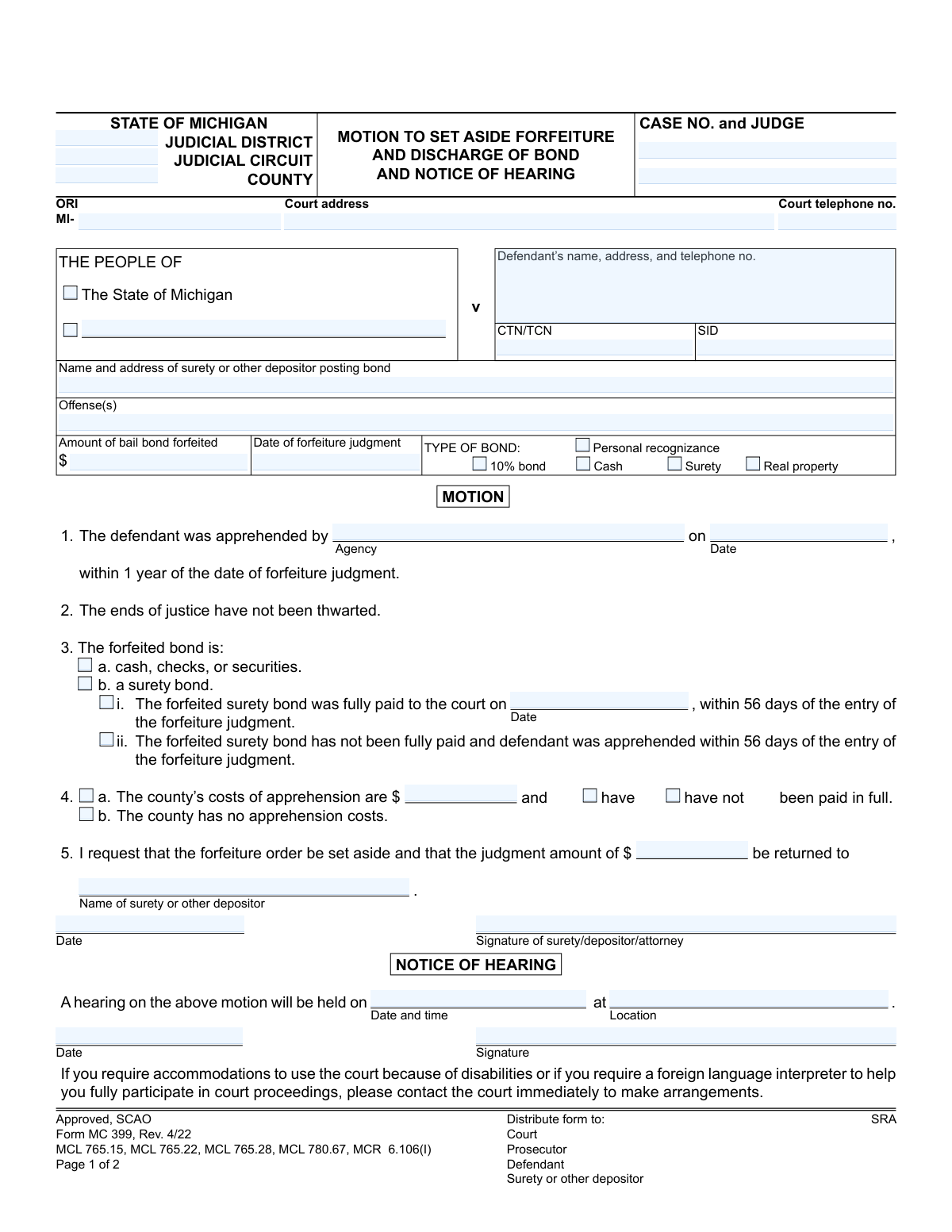
Yes! You can use AI to fill out State of Michigan Form MC 399, Motion to Set Aside Forfeiture and Discharge of Bond and Notice of Hearing

Form MC 399 is a legal document filed in a Michigan court to ask a judge to set aside a previous order that forfeited a bail bond. It is typically used when a defendant who failed to appear in court has since been apprehended, arguing that the purpose of the bond has been fulfilled. Today, this form can be filled out quickly and accurately using AI-powered services like Instafill.ai, which can also convert non-fillable PDF versions into interactive fillable forms.
MC 399 is part of the Michigan court forms category on Instafill.
Our AI automatically handles information lookup, data retrieval, formatting, and form filling.
It takes less than a minute to fill out MC 399 using our AI form filling.
Securely upload your data. Information is encrypted in transit and deleted immediately after the form is filled out.

Form specifications

Form name: State of Michigan Form MC 399, Motion to Set Aside Forfeiture and Discharge of Bond and Notice of Hearing
Number of fields: 46
Number of pages: 1
Language: English
main-image

Instafill Demo: How to fill out PDF forms in seconds with AI

How to Fill Out MC 399 Online for Free in 2026

Are you looking to fill out a MC 399 form online quickly and accurately? Instafill.ai offers the #1 AI-powered PDF filling software of 2026, allowing you to complete your MC 399 form in just 37 seconds or less.
Follow these steps to fill out your MC 399 form online using Instafill.ai:
  1. 1 Navigate to Instafill.ai and upload or select the Michigan Form MC 399.
  2. 2 Provide the court and case information, including the case number, judicial district/circuit, and judge's name.
  3. 3 Enter the full names and addresses for the defendant and the surety or depositor who posted the bond.
  4. 4 Specify the details of the bond, including its type (cash, surety, etc.), the forfeited amount, and the date of the forfeiture judgment.
  5. 5 Complete the motion section by providing details of the defendant's apprehension and any associated costs.
  6. 6 Review all the information populated by the AI for accuracy, then e-sign and date the motion section.
  7. 7 Download the completed form to file with the court and serve copies to the prosecutor and other relevant parties as required.

Our AI-powered system ensures each field is filled out correctly, reducing errors and saving you time.

Why Choose Instafill.ai for Your Fillable MC 399 Form?

Speed

Complete your MC 399 in as little as 37 seconds.

Up-to-Date

Always use the latest 2026 MC 399 form version.

Cost-effective

No need to hire expensive lawyers.

Accuracy

Our AI performs 10 compliance checks to ensure your form is error-free.

Security

Your personal information is protected with bank-level encryption.

Frequently Asked Questions About Form MC 399

This form is used to ask a Michigan court to cancel a bail bond forfeiture and return the bond money. It is typically filed by the person or company who posted the bond after the defendant, who previously missed a court date, has been apprehended.

The surety or depositor who originally posted the bail bond should file this form. This could be a professional bail bond agent, or a family member or friend who put up the cash or property for the defendant's bail.

The primary requirement is that the defendant must have been apprehended within one year of the date the forfeiture judgment was entered. You must provide the date of apprehension and the name of the apprehending agency on the form.

Apprehension costs are expenses the county incurred to find and arrest the defendant. You should contact the county prosecutor's office or the arresting law enforcement agency to determine the amount and whether it has been paid.

You must file the original motion with the court clerk for the judicial district or circuit handling the case. You are also required to mail a copy to all parties listed on the form, including the prosecutor and the defendant.

Before filing the form, you must contact the court clerk's office to get a date, time, and location for the hearing. You will then fill in this information on the form before distributing it to all parties.

You will need the court case number, judge's name, the original bond amount, the date of the forfeiture judgment, and the details of the defendant's apprehension. Having this information ready will make filling out the form much faster.

The Certificate of Mailing is your sworn statement confirming that you have sent a copy of the motion and hearing notice to all required parties. This is a crucial step to ensure everyone is properly notified and for the court to proceed with your motion.

This is a legal statement asserting that returning the bond money is fair because the defendant has been brought back into the justice system. It suggests that permanently keeping the money is not necessary for justice to be served.

Yes, services like Instafill.ai use AI to help you accurately auto-fill form fields, which can save time and reduce errors. This is especially helpful for entering case information and personal details.

Simply upload the MC 399 PDF to the Instafill.ai platform. The service's AI will make the form fillable online, allowing you to type your information directly into the fields, save your progress, and download the completed document.

If you have a non-fillable or 'flat' PDF, you can use a service like Instafill.ai. It can convert the non-fillable PDF into an interactive, fillable form online, so you can easily type in your information.

The form provides options for different scenarios. If the bond wasn't paid but the defendant was apprehended within 56 days, you can still file the motion by checking box 3.b.ii.

Compliance MC 399
Validation Checks by Instafill.ai

1
Case Number Presence and Format
This check ensures the 'CASE NO.' field is not empty and conforms to the expected format for the specified judicial circuit/district. The case number is a critical identifier for filing the motion with the correct court record. If the case number is missing or invalid, the system will reject the submission to prevent it from being lost or misfiled.
2
Date of Forfeiture Judgment Validity
Validates that the 'Date of forfeiture judgment' is a valid, correctly formatted date that occurs on or before the current date. This date serves as the primary reference for several time-sensitive conditions in the motion, such as the one-year apprehension window. An invalid or future date would make subsequent logical checks impossible and render the motion legally unsound.
3
Apprehension Date Logical Consistency
This check verifies that the 'apprehended date' is a valid date that falls after the 'Date of forfeiture judgment' but within one year of it, as stipulated in section 1 of the motion. This is a core legal requirement for setting aside a forfeiture. If the date is outside this window, the motion is not legally viable and the user should be alerted that they do not meet the criteria.
4
Exclusive Bond Type Selection
Ensures that exactly one bond type (Personal recognizance, 10% bond, Cash, Surety, Real property) is selected. The type of bond determines which legal rules and subsequent sections of the form apply. Failure to select a single, valid option creates ambiguity and prevents the system from correctly processing the motion's logic.
5
Surety Bond Conditional Logic
If the 'Surety' bond type is selected, this validation ensures that one of the sub-options ('3.b.i' or '3.b.ii') is also checked. This is necessary to clarify the payment status of the surety bond, which is a material fact for the court's decision. The form cannot be processed without this clarification as it directly impacts the potential for fund discharge.
6
Surety Bond Paid Date Requirement
If option '3.b.i' (surety bond was fully paid) is selected, this check requires the 'surety bond paid date' field to be populated with a valid date. Furthermore, it validates that this date is within 56 days of the 'Date of forfeiture judgment'. This confirms compliance with a specific statutory deadline, and failure to provide a valid, timely date may invalidate this claim.
7
Monetary Field Format Validation
Verifies that the 'Amount of bail bond forfeited', 'apprehension cost', and 'judgment amount' fields contain valid, non-negative numerical currency values. This prevents data entry errors and ensures the financial details of the motion are accurate and machine-readable. Incorrectly formatted monetary values would lead to calculation errors and processing rejection.
8
Judgment Amount vs. Forfeited Amount Consistency
This check ensures that the 'judgment amount' requested for return in section 5 does not exceed the 'Amount of bail bond forfeited'. It is logically impossible to return more money than was originally forfeited. This validation prevents typographical errors that could lead to legal or financial complications, ensuring the requested amount is plausible.
9
Apprehension Cost Status Declaration
Ensures that either checkbox '4.a' (county has costs) or '4.b' (county has no costs) is selected. If '4.a' is selected, it further validates that the 'apprehension cost' field is filled and that one of the 'have' or 'have not' paid options is chosen. This provides a complete and unambiguous statement regarding apprehension costs, which the court needs to consider.
10
Hearing Date Must Be in the Future
Validates that the 'Date and time' for the hearing is a valid date and time that occurs in the future. Scheduling a hearing for a past date is a nonsensical action that would invalidate the notice to all parties. This check is critical for ensuring the hearing is properly scheduled and all parties can be legally notified.
11
Defendant Information Completeness
This check ensures the 'Defendant’s name, address, and telephone no.' field is not empty. This information is essential for identifying the primary party in the case and for the court and other parties to provide proper legal notice. A submission without defendant information is incomplete and cannot be officially processed.
12
Surety/Depositor Information Completeness
Verifies that the 'Name and address of surety or other depositor' field is populated. This party is the one filing the motion and to whom any discharged funds would be returned. Missing this information makes it impossible for the court to identify the movant or process any potential refund, making the motion unenforceable.
13
Motion Signature Requirement
Ensures the 'Signature of surety/depositor/attorney' field is completed (e.g., not null, or contains a valid digital signature). An unsigned motion is legally invalid and has no effect. This check prevents the submission of incomplete forms that would be immediately rejected by the court clerk.
14
Certificate of Mailing Date Logic
Validates that the 'Certificate of Mailing' date is a valid date that is on or after the 'Motion date' and on or before the current submission date. This confirms that the certification of service to other parties was made after the motion was prepared. An illogical date would call the validity of the service into question, potentially delaying the hearing.

Common Mistakes in Completing MC 399

Incorrect or Incomplete Case Identifiers

Filers often enter the wrong 'CASE NO.', 'JUDGE' name, or 'COUNTY', especially if they are involved in multiple legal matters. This happens due to simple transcription errors or confusion between different court documents. An incorrect case identifier can lead to the motion being rejected, misfiled, or significantly delayed, as it won't be matched with the correct court record. To avoid this, carefully double-check all case information against the original forfeiture judgment or other official court notices.

Inconsistent Forfeiture Amounts

A frequent error is entering one figure for the 'Amount of bail bond forfeited' near the top of the form and a different figure in the request line (Section 5) for the 'judgment amount' to be returned. This discrepancy creates confusion and can cause the court to question the validity of the motion, potentially leading to its denial. Always ensure the monetary amounts listed in both sections are identical and match the official court order. AI-powered tools like Instafill.ai can help prevent this by cross-referencing fields for consistency.

Logical Errors in Bond Information (Section 3)

This section's conditional logic is a common point of failure. People may check the wrong box for the type of bond, or worse, fill out sub-sections that don't apply, such as detailing surety bond payment dates (3.b.i) for a cash bond (3.a). This invalidates the motion's legal basis. It is crucial to correctly identify the bond type and only complete the corresponding sub-section (a or b) that accurately reflects the situation.

Forgetting to Sign or Date the Motion

Omitting the signature or date on the 'Signature of surety/depositor/attorney' line is a critical and surprisingly common mistake. An unsigned motion is legally invalid and will be immediately rejected by the court clerk, forcing the filer to start the process over. This simple oversight can cause missed deadlines and significant delays. Always perform a final review to ensure all signature and date fields are completed before filing.

Failure to Complete the Certificate of Mailing

Filers often focus on the first page and forget to complete and sign the 'Certificate of Mailing' on page two. This certificate is a sworn statement that all relevant parties have been notified of the motion, and without it, the court cannot proceed with the hearing. This oversight will halt the entire process until a properly completed and served motion is filed. Remember to mail copies to all parties and then sign and date the certificate as proof of service.

Missing or Vague Apprehension Details

In Section 1, filers must specify the 'Agency' that apprehended the defendant and the 'Date' it occurred. This information is the primary justification for the motion, but it is often left blank or filled with vague terms like 'the police'. This lack of specific information weakens the motion and may lead to a request for more evidence or outright denial. Before filing, obtain the official apprehension details from the relevant law enforcement agency or court records.

Ambiguous Status of Apprehension Costs (Section 4)

When filling out Section 4.a regarding the county's apprehension costs, filers sometimes state the dollar amount but neglect to circle or check either 'have' or 'have not' been paid. This ambiguity leaves the court uncertain about whether a required condition for the motion has been met. This can delay the hearing as the court seeks clarification. Ensure you clearly indicate both the cost amount (or lack thereof) and the payment status.

Incomplete Contact Information for Parties

The fields for the 'Defendant’s name, address, and telephone no.' and the 'Name and address of surety' are often filled out incompletely, missing a zip code, apartment number, or phone number. This prevents the court and other parties from sending legally required notices, which can cause hearings to be postponed or motions to be dismissed for improper service. Using a tool like Instafill.ai can help ensure addresses are complete and properly formatted, and since the form is a non-fillable PDF, Instafill.ai can convert it into an interactive, fillable version.

Misunderstanding Technical Identifiers (CTN/TCN/SID)

Many filers are unfamiliar with identifiers like 'CTN/TCN' (Case Tracking Number/Transmittal Control Number) or 'SID' (State Identification Number) and either leave them blank or enter incorrect information. These numbers are crucial for the court and law enforcement to accurately track the case and the defendant's record across different systems. Leaving them blank can slow down processing, as clerks must manually search for the information. These numbers can typically be found on previous court orders or criminal history reports.

Incorrectly Filling the 'Notice of Hearing' Section

A common mistake is for the filer to unilaterally write a date, time, and location in the 'Notice of Hearing' section. This section is almost always completed by the court clerk after the motion is filed and a hearing is officially scheduled. Pre-filling this information can cause confusion, conflict with the court's actual calendar, and may require the form to be re-issued. This section should be left blank unless you have been explicitly instructed by the court to fill it.
Saved over 80 hours a year

“I was never sure if my IRS forms like W-9 were filled correctly. Now, I can complete the forms accurately without any external help.”

Kevin Martin Green

Your data stays secure with advanced protection from Instafill and our subprocessors

Robust compliance program

Transparent business model

You’re not the product. You always know where your data is and what it is processed for.

ISO 27001, HIPAA, and GDPR

Our subprocesses adhere to multiple compliance standards, including but not limited to ISO 27001, HIPAA, and GDPR.

Security & privacy by design

We consider security and privacy from the initial design phase of any new service or functionality. It’s not an afterthought, it’s built-in, including support for two-factor authentication (2FA) to further protect your account.

Fill out MC 399 with Instafill.ai

Worried about filling PDFs wrong? Instafill securely fills state-of-michigan-form-mc-399-motion-to-set-aside-forfeiture-and-discharge-of-bond-and-notice-of-hearing forms, ensuring each field is accurate.