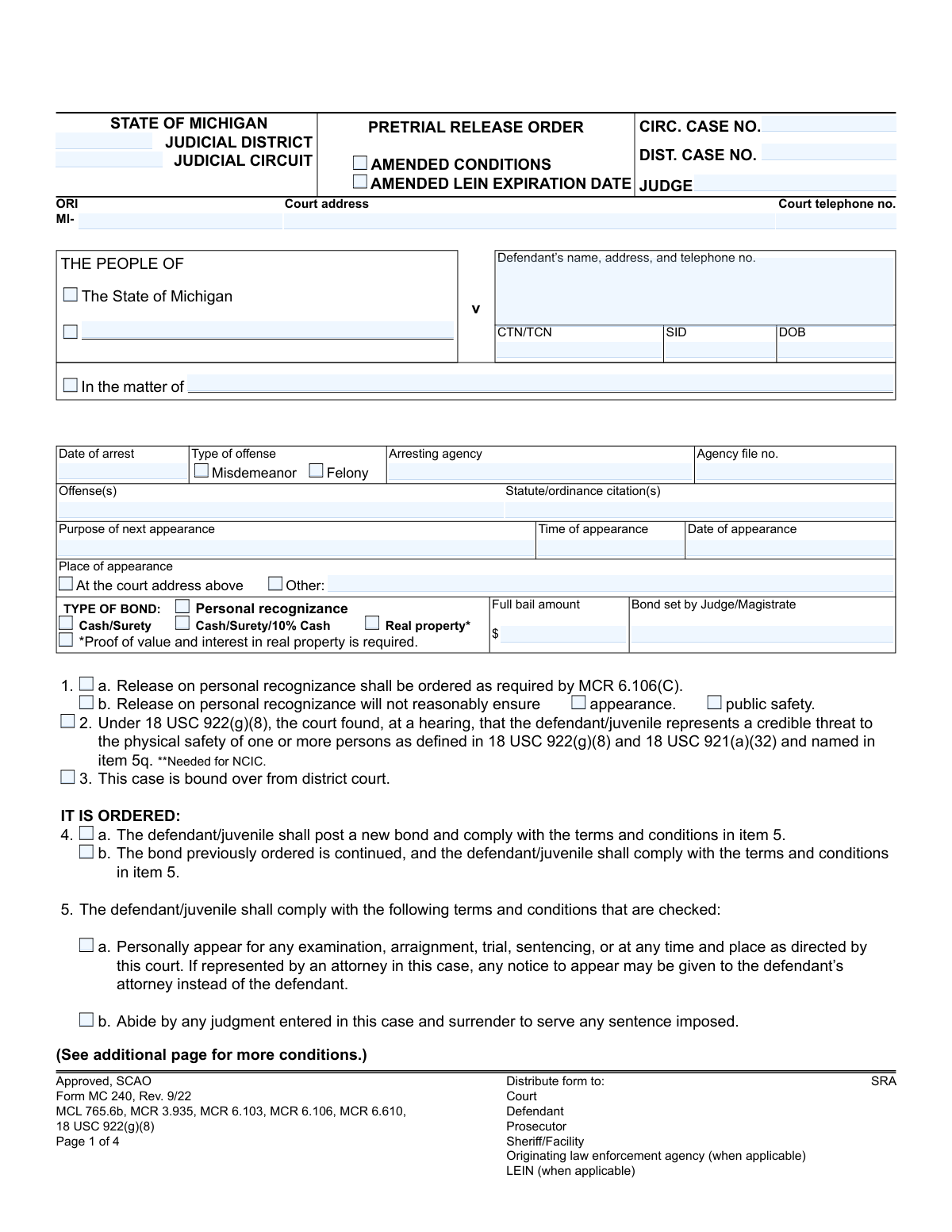
Yes! You can use AI to fill out State of Michigan Pretrial Release Order (Form MC 240)

Form MC 240, the Pretrial Release Order, is a crucial legal document used in the Michigan judicial system to outline the specific conditions for a defendant's release from custody pending trial. It details the bond amount and type, and lists mandatory rules such as court appearances, travel restrictions, and prohibitions on certain behaviors. Today, this form can be filled out quickly and accurately using AI-powered services like Instafill.ai, which can also convert non-fillable PDF versions into interactive fillable forms.
MC 240 is part of the Michigan court forms category on Instafill.
Our AI automatically handles information lookup, data retrieval, formatting, and form filling.
It takes less than a minute to fill out MC 240 using our AI form filling.
Securely upload your data. Information is encrypted in transit and deleted immediately after the form is filled out.

Form specifications

Form name: State of Michigan Pretrial Release Order (Form MC 240)
Number of fields: 108
Number of pages: 1
Language: English
main-image

Instafill Demo: How to fill out PDF forms in seconds with AI

How to Fill Out MC 240 Online for Free in 2026

Are you looking to fill out a MC 240 form online quickly and accurately? Instafill.ai offers the #1 AI-powered PDF filling software of 2026, allowing you to complete your MC 240 form in just 37 seconds or less.
Follow these steps to fill out your MC 240 form online using Instafill.ai:
  1. 1 Navigate to Instafill.ai and upload your Pretrial Release Order (Form MC 240) or select it from the template library.
  2. 2 Allow the AI to process the document, accurately identifying all fields for case information, defendant details, and bond type.
  3. 3 Enter the required case information, including the judicial district/circuit, case number, defendant's name, and offense details.
  4. 4 Carefully check the boxes corresponding to the specific terms and conditions of release as ordered by the judge, such as travel restrictions, substance abuse testing, and no-contact provisions.
  5. 5 Fill in the bond type, amount, and any specific details required for LEIN entry, such as the defendant's physical description.
  6. 6 Review all entered information for accuracy before the judge and defendant add their digital signatures and dates to finalize the order and acknowledgment.
  7. 7 Securely download, print, or share the completed MC 240 form with all required parties, including the court, prosecutor, defendant, and sheriff's department.

Our AI-powered system ensures each field is filled out correctly, reducing errors and saving you time.

Why Choose Instafill.ai for Your Fillable MC 240 Form?

Speed

Complete your MC 240 in as little as 37 seconds.

Up-to-Date

Always use the latest 2026 MC 240 form version.

Cost-effective

No need to hire expensive lawyers.

Accuracy

Our AI performs 10 compliance checks to ensure your form is error-free.

Security

Your personal information is protected with bank-level encryption.

Frequently Asked Questions About Form MC 240

This is a court order that specifies the terms and conditions a defendant must follow to be released from custody before their trial. It outlines the type of bond and the specific rules they must obey.

A judge or magistrate fills out the order, checking the boxes for the conditions of release. The defendant must then sign the acknowledgment section on page 4 to confirm they understand and agree to the terms.

A Personal Recognizance bond allows release based on a promise to appear in court, with no money required. A Cash/Surety bond requires a financial deposit, which can be forfeited if the defendant fails to appear.

If the defendant complies with all conditions, the bond money is used to pay any fines, costs, or restitution. Any remaining balance is returned to the person who deposited it.

This is a strict order prohibiting any direct or indirect communication or contact with the person(s) named. This includes calls, texts, social media, or using a third party to make contact, and it applies even while in custody.

As stated in condition 5e, you are required to immediately notify the court in writing of any change to your address or telephone number.

Violating the terms can lead to your arrest without a warrant, the revocation of your release, and the forfeiture of the full bond amount. You may also face new charges or be held in jail.

LEIN is the Law Enforcement Information Network. Your information is entered when the release order includes conditions to protect specific people, making the order and its restrictions visible to all law enforcement agencies.

As noted on the form, you must provide proof of the value of the real property and your interest in it. The court will require documentation to verify ownership and equity.

Yes, services like Instafill.ai use AI to read and organize form data. This can help you keep a clear digital record of your case details, conditions, and important court dates.

You can use a service like Instafill.ai to upload your copy of the Pretrial Release Order. The platform allows you to easily view, annotate, and securely store the document for your personal records.

Instafill.ai can convert flat, non-fillable PDFs into interactive forms. Simply upload your document, and the platform will automatically identify and create fillable fields for your convenience.

This section is where the defendant must sign to legally confirm they have read, understood, and agree to all the terms and conditions of their release. A signature is required before release from custody.

No, the form states that for a 10% cash bond, the court will return only 90% of the amount you deposited if the defendant complies with all conditions. The remaining 10% is retained by the court.

Compliance MC 240
Validation Checks by Instafill.ai

1
Case Number Presence
This validation checks that either the 'DIST. CASE NO.' or 'CIRC. CASE NO.' field is populated. A case number is the primary identifier for a legal proceeding and is essential for tracking, filing, and associating the order with the correct court case. If neither case number is provided, the form submission should be rejected as it cannot be correctly processed or filed by the court system.
2
Mutually Exclusive Offense Type
This check ensures that only one of the 'Misdemeanor' or 'Felony' checkboxes is selected for the primary offense type. These categories are mutually exclusive for a given charge, and selecting both would create an ambiguous and legally invalid record. An error should be displayed prompting the user to select only one, ensuring the legal classification of the offense is clear.
3
Mutually Exclusive Bond Type
This validation confirms that only one primary bond type ('Personal recognizance', 'Cash/Surety', 'Real property') is selected. A defendant is released on one type of bond, not multiple simultaneously, so selecting more than one is a logical contradiction. The system should prevent the user from checking multiple options to ensure the terms of release are unambiguous.
4
Conditional Curfew Time
This check verifies that if the 'Comply with the following curfew' checkbox (item 5m) is selected, the corresponding time field (`curfewtime`) is filled in. A curfew condition is unenforceable without a specified time. If the box is checked but the time is left blank, the submission should be flagged with an error, requiring the user to provide the specific curfew hours.
5
Conditional No Contact Name
This validation ensures that if the 'Do not have... any direct or indirect contact with the following person(s)' checkbox (item 5s) is selected, the associated name field (`nocontactname`) is populated. A no-contact order is meaningless and unenforceable without identifying the protected individual(s). The system must reject the submission if this condition is checked without a name, preventing the creation of a legally deficient order.
6
Conditional Premises Location
This check confirms that when the 'Do not enter the following specified premises or areas' checkbox (item 5t) is selected, the address or location field (`donotenterloc`) is completed. This condition is intended to protect individuals or locations, which is impossible without a specific address or clearly defined area. Failure to provide the location while the condition is checked should result in a validation error.
7
LEIN Data Completeness
This validation is triggered if the order is marked for entry into the Law Enforcement Information Network (LEIN). It confirms that the 'Race', 'Sex', and 'Date of birth' fields are all populated, as noted on the form. This information is mandatory for creating a valid LEIN entry to identify the individual correctly. If the LEIN box is checked but any of this data is missing, the form should be rejected until the required fields are completed.
8
LEIN Expiration Date Logic
This check verifies that the 'expires on' date for the LEIN entry (`expdate`) is a date in the future. A LEIN entry for a protective order must have a future expiration date to be active and effective. An expired or past date would render the entry invalid upon creation, so the system must enforce a future date for this field.
9
Appearance Date Logic
This validation ensures that the 'Date of appearance' (`appdate`) for the defendant's next court hearing is a date in the future relative to the form's submission date. Scheduling a court appearance for a past date is a logical impossibility and indicates a data entry error. The system should display an error and require the user to enter a valid, future date.
10
Arrest Date Logic
This check confirms that the 'Date of arrest' (`adate`) is a date in the past or the current date, but not in the future. An arrest cannot happen on a future date, so such an entry would be a clear data error. This validation prevents illogical data from entering the system and ensures the timeline of events is accurate.
11
Defendant DOB Validity
This check ensures the defendant's 'DOB' is a valid date that occurred in the past and results in a reasonable age (e.g., not in the future, not more than 120 years ago). This is crucial for identity verification, LEIN entry, and determining if the individual should be processed as a juvenile or adult. An invalid or illogical DOB should trigger an error to prompt correction.
12
Third-Party Depositor Completeness
This validation is triggered if bond is indicated as being deposited by a 'Third Party' or 'Surety/Agent'. It checks that all required fields for the depositor, including name, address, telephone number, and signature, are filled out. This information is critical for legal accountability and for returning the bond money to the correct person after the case concludes. The form should be considered incomplete if this section is initiated but not fully populated.
13
Substance Restriction Specificity
This check ensures that if the parent checkbox 'Do not use' (item 5g) is selected, at least one of the sub-options ('alcohol', 'marijuana', 'illegal controlled substances') is also checked. A general restriction without specificity is ambiguous and difficult to enforce. This validation forces clarity in the court's order, ensuring the defendant understands the exact substances they are prohibited from using.
14
ORI Format Validation
This check validates that the Originating Agency Identifier (ORI) field follows the expected format, which appears to be 'MI-' followed by a series of characters. The ORI is a unique identifier for a law enforcement agency, and maintaining a consistent format is crucial for database integrity and proper routing of information. An entry that does not match the 'MI-...' pattern should be flagged as a potential error.

Common Mistakes in Completing MC 240

Incomplete or Incorrect Case Numbers

People often confuse the District Court (`dcaseno`) and Circuit Court (`ccaseno`) case numbers or leave them blank if they are unsure. This mistake can cause significant administrative delays as court staff must manually locate the correct file. An incorrect number could lead to the order being misfiled or not processed in a timely manner, potentially delaying release. To avoid this, carefully copy the case numbers from previous court documents.

Using an Informal Name Instead of a Full Legal Name

Defendants sometimes enter a nickname or an abbreviated version of their name in the 'Defendant’s name' field. This creates identification discrepancies within the court system and with law enforcement databases like LEIN, which require a full legal name for accurate record-matching. Such errors can cause delays in processing or legal complications down the line. Always use your full, official name as it appears on government-issued identification.

Providing Inaccurate Physical Descriptors for LEIN

The form requires specific physical descriptors like height, weight, race, and sex for entry into the Law Enforcement Information Network (LEIN). People often guess these details or leave them blank, but the form explicitly notes they are mandatory. Inaccurate or missing data can prevent the order from being entered into the system, hindering law enforcement's ability to identify the individual and enforce the release conditions. It is crucial to provide accurate, up-to-date information.

Forgetting to Sign or Date the Acknowledgment

A very common and critical error is forgetting to sign or date the 'Acknowledgment of Pretrial Release Conditions' on page 4. This signature legally confirms that the defendant understands and agrees to the terms of their release. Without a valid signature and date, the acknowledgment is invalid, which could nullify the release order and result in the defendant being held in custody until the form is properly completed.

Transposing Numbers in Critical Identifier Fields

Simple data entry errors, such as transposing digits, are frequent in fields for Date of Birth (`dob`), Driver's License Number (`dln`), or case numbers. A single wrong digit can link the order to the wrong person's record or cause a failure when searching databases. This can lead to significant delays, misidentification, and serious legal problems. AI-powered form filling tools like Instafill.ai can help prevent these errors by automatically validating data formats for accuracy.

Neglecting to Report Address or Phone Number Changes

Condition 5e explicitly requires the defendant to notify the court in writing of any change of address or telephone number. Many individuals forget this ongoing obligation, causing them to miss crucial court notices sent to their old address. This is a primary reason for 'failure to appear' charges, which can result in a bench warrant being issued for the defendant's arrest and the forfeiture of their bond.

Incorrectly Filling Out the Third-Party Surety Section

When a friend or family member posts a bond, they may get confused by the 'Bond deposited by Third Party' section. Common mistakes include the surety signing in the defendant's signature block or failing to provide their complete name and address. This creates ambiguity regarding who is financially liable for the bond and to whom any refund should be issued, potentially leading to financial loss or disputes.

Vague or Misspelled Information for No-Contact Orders

When filling out conditions that restrict contact with specific people (`nocontactname`) or entry to certain locations (`donotenterloc`), it is crucial that the information is precise and correctly spelled. Vague descriptions like 'the victim's house' or misspelled names can make the no-contact provision legally ambiguous and unenforceable. This fails to protect the intended individuals and can expose the defendant to violation accusations due to unclear boundaries.

Checking a Condition Box but Omitting the Required Details

The form includes several conditions that require specific details if checked, such as providing a time for a curfew (`curfewtime`) or listing the specifics under 'Other' (`otherlist`). A frequent mistake is to check the box but forget to write in the corresponding information. This renders the condition incomplete and unenforceable by the court or law enforcement, defeating the purpose of its inclusion in the release order.

Misunderstanding the Bond Forfeiture Agreement

Both the defendant and any third-party surety must sign to acknowledge they understand the financial consequences of non-compliance. People often sign this section without fully reading, not realizing that the entire bond amount can be forfeited if the defendant fails to appear. They may also miss the detail that for a 10% cash bond, a portion is non-refundable even with full compliance. This misunderstanding can lead to significant and unexpected financial loss. Since this form is often a non-fillable PDF, a tool like Instafill.ai can convert it into an interactive version, making it easier to read and complete these critical sections.
Saved over 80 hours a year

“I was never sure if my IRS forms like W-9 were filled correctly. Now, I can complete the forms accurately without any external help.”

Kevin Martin Green

Your data stays secure with advanced protection from Instafill and our subprocessors

Robust compliance program

Transparent business model

You’re not the product. You always know where your data is and what it is processed for.

ISO 27001, HIPAA, and GDPR

Our subprocesses adhere to multiple compliance standards, including but not limited to ISO 27001, HIPAA, and GDPR.

Security & privacy by design

We consider security and privacy from the initial design phase of any new service or functionality. It’s not an afterthought, it’s built-in, including support for two-factor authentication (2FA) to further protect your account.

Fill out MC 240 with Instafill.ai

Worried about filling PDFs wrong? Instafill securely fills state-of-michigan-pretrial-release-order-form-mc-240 forms, ensuring each field is accurate.